


Introduction to Collecting Themes
Playing cards can be broadly categorised into standard and non-standard designs, with collectors appreciating their variety.


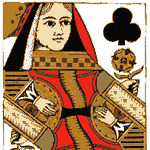
Above: Contemporary Standard Cards: Q♥ from Waddingtons #1 (left) and USPC Bicycle (right)
In the broadest sense, there are two kinds of cards, standard cards and everything else ‘non-standard’. Standard cards are simply the very familiar designs that have been used for over 600 years for all sorts of games. We will take two journeys – across the globe and back in time…


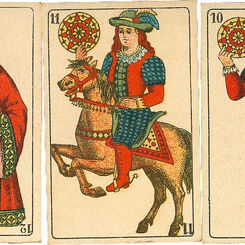
Above: Q♥ by Grimaud France. Note the naming ‘Judith’. Cavalier of Coins (right), Fournier, Spain.
Early cards were very expensive – card itself and printing were both very new – so almost all early users played for money. Anything unusual is a distraction and a possible source of mistakes. As a result, cards for use in competitive games and gambling have a small range of accepted designs. These are Standard. The modern pattern familiar to us is called English, International or Anglo-American Standard.
Across the world, and we find that different areas have different standard designs. English cards evolved from French, so the French pack is very similar except that the court cards have different figures and the indices are ‘R D V’ (Roi, Dame, Valet). Note also that French Standard court figures have names.

Above: Indian Gangifa: Mir of Surkh (gold coins)1850-75
The cards of Spain and hence South America have Clubs, Coins, Cups and Swords as suits, 12 cards in each suit and a Cavalier instead of a Queen (the card 11 above). Italian Cards vary by region, some with French suits some Spanish, and usually 40 cards in all. German suits are Acorns (above), Bells, Hearts and Leaves. Indian cards – called Ganjifa- are round, beautifully hand painted and come in sets of different sizes, 96 and 120 being common! Japan, China and Iran also have traditional designs.

Above: Illustrated ‘Cries of London’ from c. 1754.
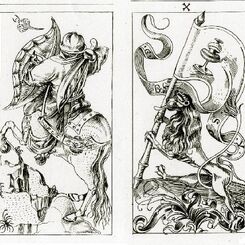
Our second journey is back through time. Early cards are very different. They have square corners and the court cards show full length figures. These were hand-made using wooden blocks to print the outlines and paintbrush and stencils to fill in the colors. Examples are shown below, these are the original English Standard pattern.
Non-standard cards have re-designed faces and may or may not be intended for playing with. The most common types are those where the court cards depict real people or where all the cards are re-drawn by a graphic artist. Illustrated cards were very popular around 1700, where the 52 faces are used as a story board, the full set depicting historic events or capturing other information. Examples include accounts of the Spanish Armada, the Cries of London and the Counties of England and Wales.


Above: Transformation of Goodall cards 19th century, this example is the Fournier Museum facsimile.
Another favorite for collectors are ‘transformation cards’, in which the pips on the numbered cards have been incorporated in a picture in which they look natural (although of course that is rarely possible!). The easy way to ‘get’ the idea is to see some:
So far we have only been concerned with the fronts of the cards. Backs were in fact plain for many centuries – literally unprinted or sometimes a single colour - and gradually became patterned from about 1800.
With improvements in printing, colourful designs became the norm from the 1840s and now they are the main interest for many collectors. The basic artistic back is generally intended to showcase the artist or simply to make the cards more attractive to play with.


Above: Drinks advertising: a collecting theme in itself.
It was not long before card backs were used for promotional purposes too. Collectors nowadays follow categories like films, drinks, cigarettes and airlines.


Above: Travel Souvenirs (…the warmer the better!)
Other special backs are Souvenir and Commemorative. Souvenir cards feature a specific place or event, whereas commemorative cards relate to a date or anniversary. The cards below show some travel souvenirs. Royal births, deaths, cornonations and marriages are another collectible theme.
The Worshipful Company of Makers of Playing-Cards has produced a set of cards every year since 1882 and their backs, all in this commemorative category, recent examples being the Queen’s 60th year as monarch (2013), the centenary of the Christmas truce (2014) and the 800th Lord Mayor’s Parade (2015). This is another very collectible series.
Those wishing to get into more depth can find many resources online, for example here on the ‘World of Playing-cards’ and among books, there are excellent introductions by Sylvia Mann, Rod Starling and others.
References
- Bostock, Paul; Clear the Decks, 52 Plus Joker, Vol. 32, No. 1 (June 2018)

By Paul Bostock
United Kingdom • Member since May 07, 2024
Paul has been a collector of playing cards since his early teenage years, the mid 1970s. In the last 20 years or so he has specialised in standard English cards and their story. His collection, including many other English Standards, are featured on his website plainbacks.com. Paul is currently editor of Clear the Decks, the Journal of 52 Plus Joker, the American club for playing card collectors, and is a member of the IPCS Council, an EPCS member and a Past Master of the Worshipful Company of Makers of Playing cards, a City of London livery company.

Activity for Introduction to Collecting Themes
Sign in to comment or save this article.

Related Articles
COOPEXIM
A colourful Polish pack produced in 1965 for the Cooperative Company for Foreign Trade in Warsaw.
Playing Card Books - References
A guide to reference books for playing-card collectors, focusing on museum catalogues, collection su...
Advice and General Knowledge for Newer Collectors
A little general knowledge goes a long way for newer collectors, helping you choose a focus and unde...
Piatnik’s 200th Anniversary
A special philatelic souvenir for Piatnik’s 200th anniversary, combining playing cards an...
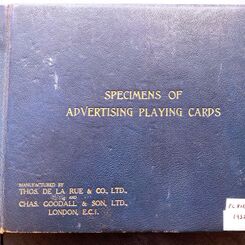
De La Rue 1932-1933 Sample Book of Advertising cards
Complete contents of a sample book of advertising cards by De La Rue
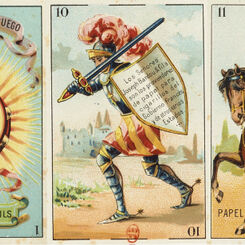
Joseph Bardou & Fils cigarette papers
Delightful pack advertising Joseph Bardou & Fils cigarette papers for the Philippines.
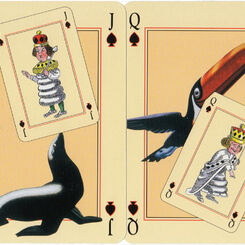
My Goodness my Guinness
Gilroy Special Edition Playing Cards to commemorate the centenary of the birth of John Gilroy, 1989....
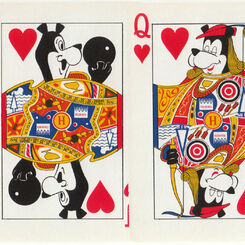
Hamm’s Beer
Hamm’s Beer promotion deck with bear cartoons by Frank M. Antoncich 1968.
Piwiarnia Pub in Warsaw
Advertising Deck for the Piwiarnia Pub in Warsaw.
Progressive Whist Cards - page 3
There were various Sports and Sporting Whist themes... and tobacco advertising on score cards.
Grolsch Brewery
A somewhat unusual deck specially designed for Grolsch Breweries evoking self-expression and indepen...
Shipping
A survey of modern Shipping advertising playing cards
Suicide King
The King of Hearts, holding a sword behind his head, is sometimes nicknamed the “Suicide King”. He c...
Fabrica de Cigarrillos Roldan y Cia, Lima, Peru
The design of the figures is very agile with excellent colour harmony and execution.
11: Some Cards from Sylvia Mann’s Collection
A fascinating collection that was the basis of a lot of research that we still benefit rom today.
Mamluk Playing Cards
Nã'ib, the game of lieutenants... these cards are amongst the earliest Arabic playing cards ext...
Cigarrillos Compadre, Peru, early 1900s
Spanish-suited playing cards for Cigarrillos Compadre, Peru, early 1900s
South German Engraver
A pack of 52 cards with banner 10s, female 'Sotas', horsemen and kings, the pack was engraved in the...
The History of Playing Cards
Playing cards appear in European records in the late 14th century, but their earlier history lies fu...
Standard and Non-standard Playing Cards
Standard playing cards are based upon traditional designs and are used for card games.
Most Popular
Our top articles from the past 60 days