


Early English Playing Cards
Early examples of traditional, standard English playing cards of which the best known are those of Hewson of the seventeenth century, and Blanchard from the eighteenth century.
 HE EARLIEST ENGLISH playing cards are very scarce… few specimens have survived and little is known about the manufacturers.
This page exhibits several early examples of traditional, standard English playing cards of which the best known are those of Hewson of the seventeenth century, and Blanchard from the eighteenth century.
HE EARLIEST ENGLISH playing cards are very scarce… few specimens have survived and little is known about the manufacturers.
This page exhibits several early examples of traditional, standard English playing cards of which the best known are those of Hewson of the seventeenth century, and Blanchard from the eighteenth century.
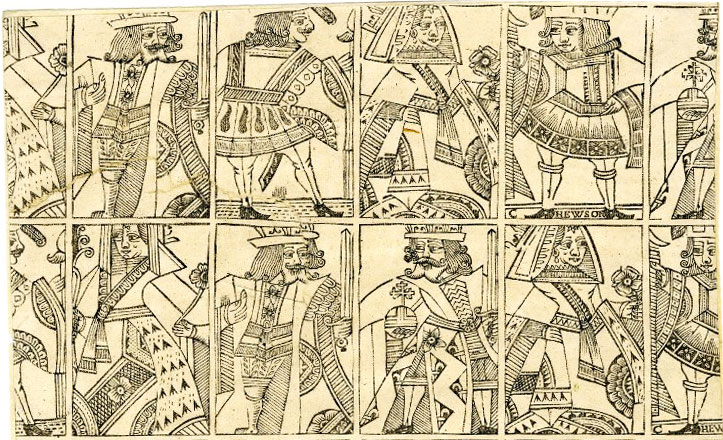
Above: early English Playing Cards, fragment of an uncut, uncoloured sheet c.1650. The name "HEWSON" is inscribed on the Jack of clubs. These designs are not as stylised or corrupted as later examples, and many details and features are still recognisable (click to see enlargement).
An Exciting Find
Whilst renovating a house in Ross-on-Wye, and having removed the floorboards in the attic, workmen discovered 33 rather old playing cards: 9 court cards and 24 pip cards in varying states of wear and deterioration.
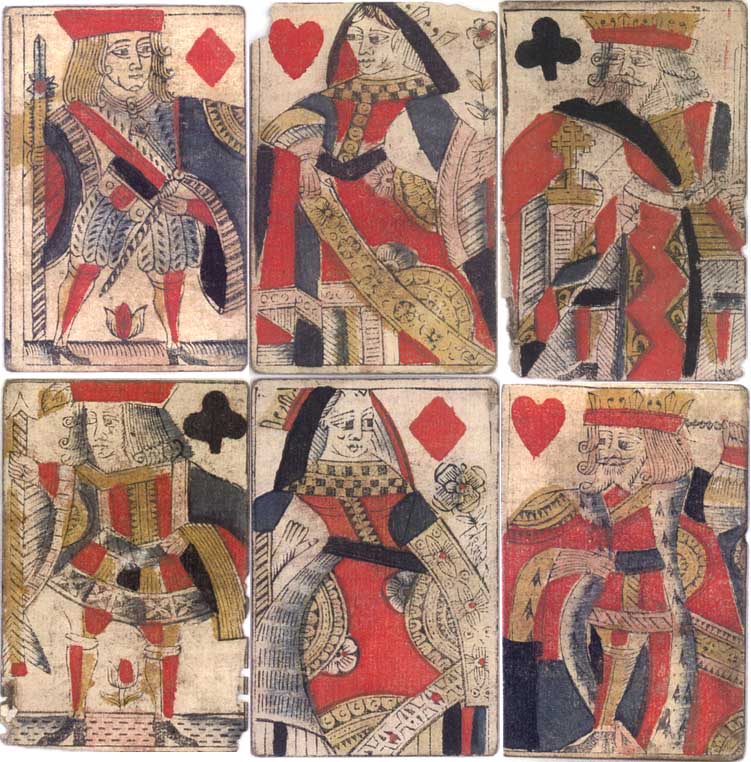
Above: Early English Playing Cards c.1725, found under floorboards. There is no maker's name on any card.
It is unusual to find so many cards under floorboards, and suggests that the cards may have been hidden there. One recalls edicts and laws forbidding card playing to servants and apprentices except during the Christmas holidays. The maker is unidentified, and there is no Ace of Spades or tax stamp, however there are clues which assist in dating the cards:
King of clubs: early style with Cross of Lorraine on an imperial orb
King of hearts: early style wielding an axe
King of diamonds: armed with a battle axe
Queen of hearts: a very long, thin stalk to the flower

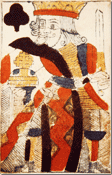
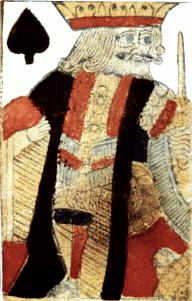
English Playing Cards printed from wood blocks and coloured using stencils, (left) by Blanchard c.1769 and (right) by Joseph Hunt c.1805.
During the 18th century the design of standard English playing cards tended to become set and stereotyped, so that these designs differed less noticeably from maker to maker. Wood blocks were supplied to card makers by a different trade and so a block-maker might have supplied various manufacturers with the same style of court designs. The designs tended to become more distorted, sometimes slightly grotesque, as the features and attributes were corrupted.

Between 1820 and 1840 designs began to be revised, and printing methods evolved, so that, once again, designs between manufacturers became more and more distinctive and competition stimulated innovation. However, it needs to be borne in mind that even as late as the 1870s packs of playing cards were assembled by hand, and that left-overs might have been used to complete another pack. Thus it is sometimes difficult to distinguish these mixed packs from more recent mixes of incomplete packs.
Finally, although De La Rue pioneered letterpress for the production of playing cards in the 1830s, a number of other manufacturers, such as Hunt/Bancks and Reynolds, continued wood-block and stencil use right up until the 1870s. The cutting work and the application of wood blocks had by this time become more refined.


By Donald Welsh
United Kingdom • Member since February 01, 1996

Activity for Early English Playing Cards
Sign in to comment or save this article.

Related Articles
Playing Cards: A Secret History
Playing Cards: A Secret History
71: Woodblock and stencil: the hearts
A presentation of the main characteristics of the wood-block courts of the heart suit.
70: Woodblock and stencil : the spade courts
This is a presentation in a more straight forward fashion of the work done by Paul Bostock and me in...
Illustrated Playing Cards, c.1740
Illustrated playing cards featuring comical engravings and rhymes about saints, c.1740.
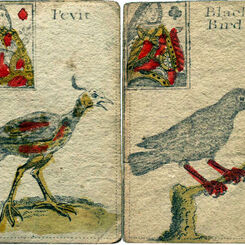
Forrest Cards, c.1750s
Hand-coloured Forrest Cards produced for “Young Gentlemen & Ladys who are Lovers of Ingenuity”, c.17...
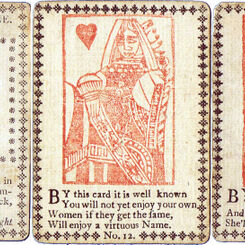
Fortune Telling playing cards
English Fortune Telling cards probably published c.1770.
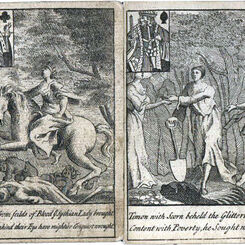
Delightful Cards, c.1723
Delightful Cards, containing variety of entertainment for young Ladies and Gentlemen c.1723.
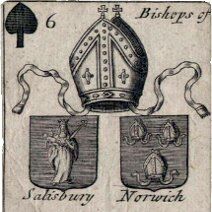
Arms of English Peers
The Arms of English Peers playing cards were first published in 1686. Heraldry, or a knowledge of th...
Cribbage Board Collection part 2
A collection of antique and vintage Cribbage Boards by Tony Hall, part 2
Hewson
Antique English woodblock playing cards by a card maker named C. Hewson, mid-17th century.
Suicide King
The King of Hearts, holding a sword behind his head, is sometimes nicknamed the “Suicide King”. He c...
Pope Joan Trays
Some traditional Pope Joan boards comprise a circular tray, others are square, divided into sections...
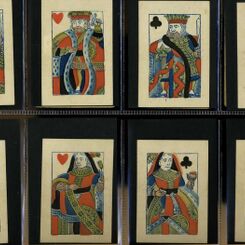
19: 19th Century Breaks with Tradition - Unusual versions of the Standard English Pattern
The centuries-long tradition of English court cards was subject to misinterpretation and in some cas...
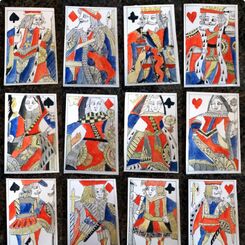
David James Binns
Hand-made “Tudor Playing Cards” by David James Binns, age 12.
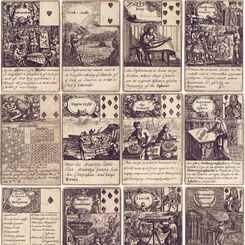
Mathematical Instruments
Mathematical Instruments playing cards forming an instrument maker's trade catalogue, Thomas Tuttell...
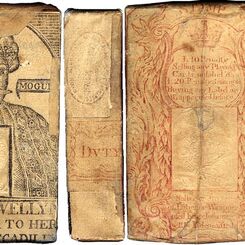
John Llewellyn, playing card manufacturer, London, 1778-1785
John Llewellyn, playing card manufacturer, London, 1778-1785
Cries of London
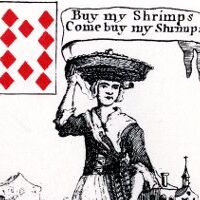
The cards were printed from copper plates, with the red suit symbols being applied later by stencil....
Hewson Replica Pack
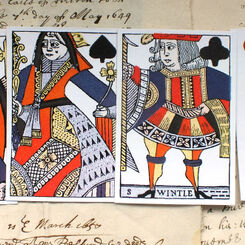
Hand-made replica 17th century English playing cards, based on museum originals.
History of Court Cards
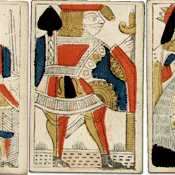
The court cards in English packs of playing cards derive from models produced by Pierre Marechal in ...
History of English Playing Cards & Games
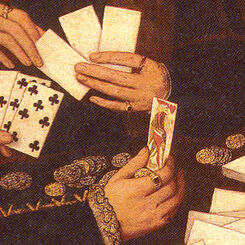
The History of English Playing Cards dates probably from the mid 15th century
Most Popular
Our top articles from the past 60 days


