


Prisoners of War
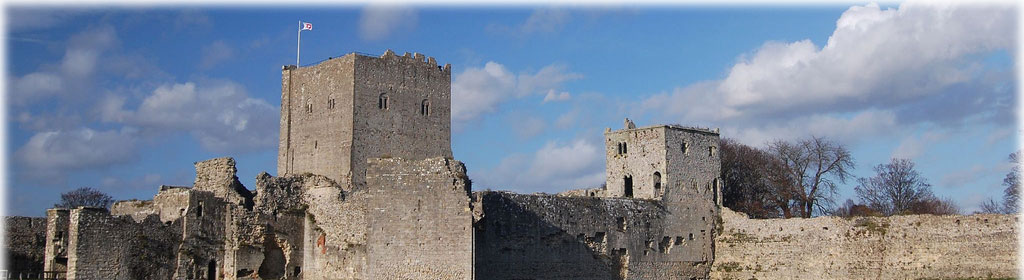
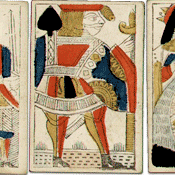
Hand-made playing cards by French prisoners of war in Porchester Castle, Hampshire, c.1796.
Hand-made playing cards by French prisoners of war in Porchester Castle, Hampshire, c.1796.
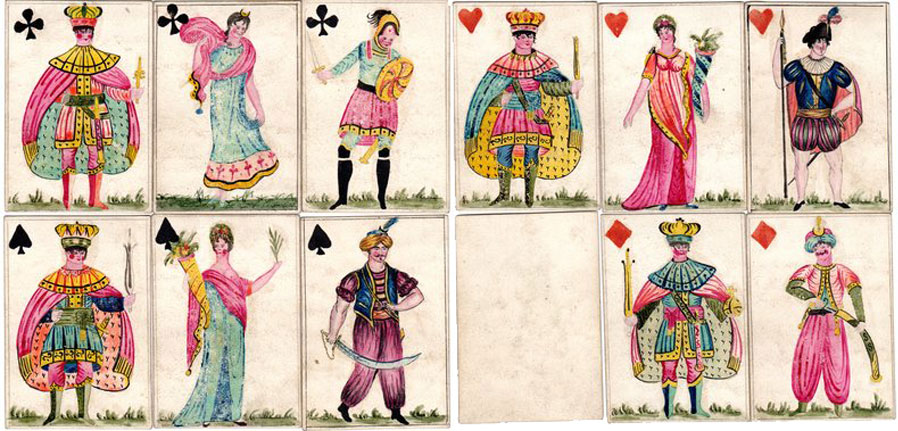
Above: the court cards stand on grassy ground in animated poses against white background, and the backs are plain. All images and notes courtesy Nick Thomas.
This deck of cards was hand made by French prisoners of war in Porchester Castle, Hampshire, UK. Prisoners were held in the castle over three periods: 1644 to 1652, 1756 to 1760 and 1793 to 1817. I believe these cards are from the early part of the latter period, circa 1796, as the forged ace of spades is the Hall ace for the years 1789 to 1801.
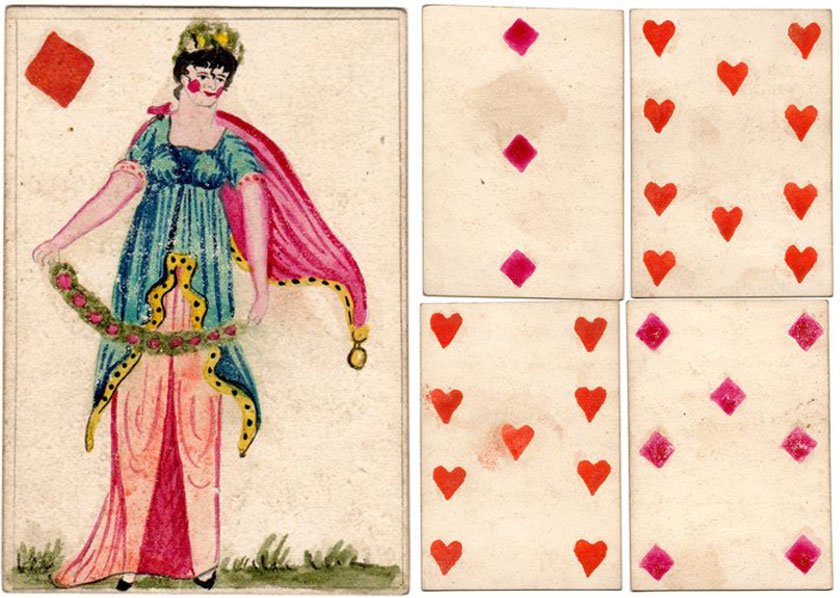
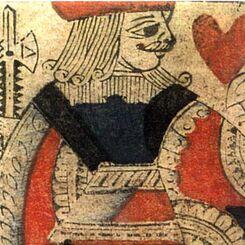
Above: the Queen of Diamonds and 4 numeral cards, all hand-painted and without any indices.
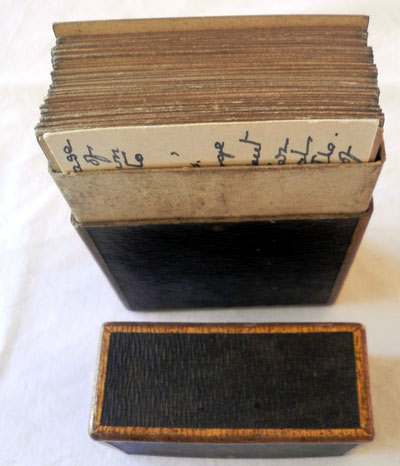
52 cards complete, with original hand-made box in lovely condition, hand-drawn and painted, really well done for a hand-made pack. I can’t discover if the court figures are based on any particular people but it was suggested that the Queens might be Goddesses: Diana as Q of clubs and Flora as Q of diamonds?
The forged ace is just fantastic, if only for its faults. It matches genuine aces for the years 1789 to 1801 The deck is given added provenance by the little business card with a hand-written inscription that came with the box when I found it. Dated 1947 it refers back to the writer’s named great-great grandfather who was actually a keeper at the gaol at the time. I do know of one other deck similar to this, the style suggesting it was perhaps painted by the same hand, but there is no box and I have heard some cards are missing, regardless I believe this deck to be unique.
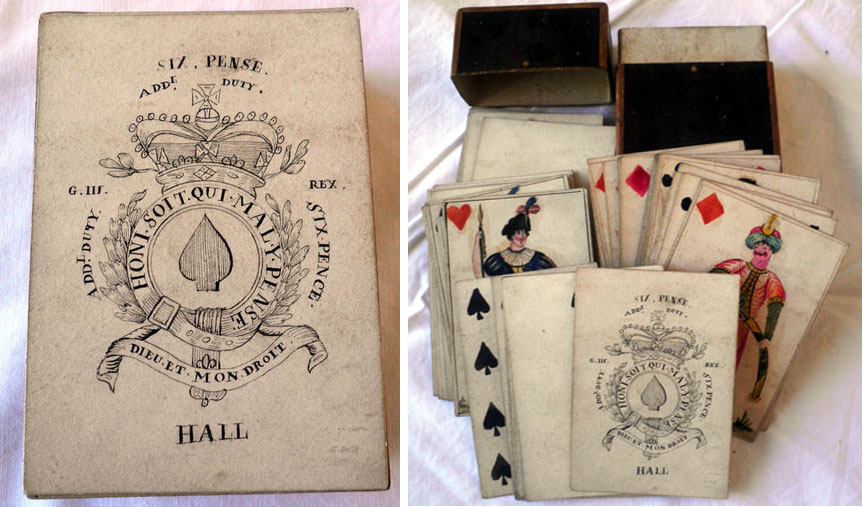
Above: The forged ace of spades includes the mis-spelling “Pense” instead of “Pence”. Cards and notes courtesy Nick Arden Thomas.

By Simon Wintle
Spain • Member since February 01, 1996
I am the founder of The World of Playing Cards (est. 1996), a website dedicated to the history, artistry and cultural significance of playing cards and tarot. Over the years I have researched various areas of the subject, acquired and traded collections and contributed as a committee member of the IPCS and graphics editor of The Playing-Card journal. Having lived in Chile, England, Wales, and now Spain, these experiences have shaped my work and passion for playing cards. Amongst my achievements is producing a limited-edition replica of a 17th-century English pack using woodblocks and stencils—a labour of love. Today, the World of Playing Cards is a global collaborative project, with my son Adam serving as the technical driving force behind its development. His innovative efforts have helped shape the site into the thriving hub it is today. You are warmly invited to become a contributor and share your enthusiasm.

Activity for Prisoners of War
Sign in to comment or save this article.

Related Articles
Paris pattern for WWII troops
Wartime edition of standard designs with fewer colours, a special back design and an overprint.
Hand made WW2 Prisoner of War Playing Cards
made by German soldiers held captive by US troops
Playing Cards: A Secret History
Playing Cards: A Secret History
Bone Playing Cards
My late mother found these miniature cards in a skip around 50 years ago.
70: Woodblock and stencil : the spade courts
This is a presentation in a more straight forward fashion of the work done by Paul Bostock and me in...
64: The descendants of the French regional patterns: 2
A continuation oF the development of the off-spring of the Paris patterns and a few examples of how ...
Hand-Painted Transformation, c.1800-20
An early 19th century set of hand-painted transformation playing cards depicting contemporary scenes...
Cribbage Board Collection part 2
A collection of antique and vintage Cribbage Boards by Tony Hall, part 2
Flemish Hunting Deck
Set of medieval playing cards with King, Queen, Knave and numeral cards from one to ten in each of f...
Suicide King
The King of Hearts, holding a sword behind his head, is sometimes nicknamed the “Suicide King”. He c...
19: 19th Century Breaks with Tradition - Unusual versions of the Standard English Pattern
The centuries-long tradition of English court cards was subject to misinterpretation and in some cas...
Lyon Pattern type iii
This pattern was used in various parts of eastern France but was ultimately replaced by the official...

De La Rue Continental
During the latter part of the nineteenth century De La Rue produced two special packs of cards for t...
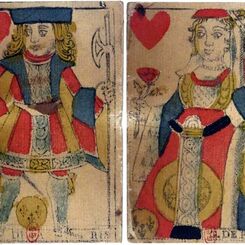
Paris Pattern
The Paris pattern was established as such around the middle of the seventeenth century (based, perha...
Early Anglo-French Cards
Cards produced in Rouen during the sixteenth century. It was cards like these which were imported to...
16th Century French Playing Cards based on Illustrations by Gurney Benham
This pack of cards by Rose & Pentagram is said to be based off Pierre Marechal, Rouen pack from the ...
The History of Playing Cards
Playing cards appear in European records in the late 14th century, but their earlier history lies fu...
History of Court Cards
The court cards in English packs of playing cards derive from models produced by Pierre Marechal in ...
History of English Playing Cards & Games
The History of English Playing Cards dates probably from the mid 15th century
Early English Playing Cards
Early examples of traditional, standard English playing cards of which the best known are those of H...
Most Popular
Our top articles from the past 60 days


Maria Nick
21 February 2026, 10:48SavedSaved this article to Maria Nick's Collection