


Finnish Chromolithographic Playing Cards
A fantasy interpretation of the French pattern in Renaissance and medieval costume.
Rather than displaying a distinctive Finnish national style, these cards adopt the standard double-ended French pattern of the period, reimagined in romantic Renaissance and medieval costume. They feature richly coloured chromolithographic printing, with decorative costume details, which was characteristic of Weilin & Göös of Helsinki. The Jacks carry halberds but wear soft caps rather than military dress. The Queens have elaborately decorated, fur-trimmed mantles and bodices, and the Kings hold orbs and scepters, wearing huge beards and storybook crowns. The result is a refined but essentially international design intended for the Finnish domestic market.
The stamp on the ace which reads "KRONO KORT STÄMPEL" was used in Finland around 1890, but the text is Swedish ("krono" = crown, "stämpel" = stamp/duty mark). The wrapper is bilingual in Finnish and Swedish and carries the WG monogram identifying the printer as Weilin & Göös of Helsinki. Although Finland had been part of the Russian Empire since 1809, Swedish remained an official language of administration, and revenue stamps continued to use Swedish terminology. The Swedish wording therefore reflects Finland's bilingual administrative heritage rather than Swedish manufacture.


Fantasy double-ended cards printed by Weilin & Göös, Helsinki, late 19th/early 20th-century. Bibliothèque nationale de France.
Although Weilin & Göös was primarily Finland's leading commercial printer rather than a specialist playing-card manufacturer, its packs display the firm's high standard of chromolithographic printing. The courts are a romanticised fantasy adaptation of the French pattern, rendered in colourful pseudo-Renaissance costume.
Bibliothèque nationale de France : Jeu de cartes finlandais au portrait de fantaisie à deux têtes ►
Peter Endebrock's Playing-card Pages : Tax Stamps from Finland ►
Note from Kari Elkelä :


Slides from presentation at IPCS Convention in Malmö, 3rd October 2026, by kind permission of Kari Elkelä.
The Pelikorttikonttori stamp was not compulsory. It was used only by cartel members = all Finnish playing card factories. Turun Kivipaino did not use it on all of their decks. Others did.

By Simon Wintle
Spain • Member since February 01, 1996
I am the founder of The World of Playing Cards (est. 1996), a website dedicated to the history, artistry and cultural significance of playing cards and tarot. Over the years I have researched various areas of the subject, acquired and traded collections and contributed as a committee member of the IPCS and graphics editor of The Playing-Card journal. Having lived in Chile, England, Wales, and now Spain, these experiences have shaped my work and passion for playing cards. Amongst my achievements is producing a limited-edition replica of a 17th-century English pack using woodblocks and stencils—a labour of love. Today, the World of Playing Cards is a global collaborative project, with my son Adam serving as the technical driving force behind its development. His innovative efforts have helped shape the site into the thriving hub it is today. You are warmly invited to become a contributor and share your enthusiasm.

Activity for Finnish Chromolithographic Playing Cards
Sign in to comment or save this article.

Related Articles
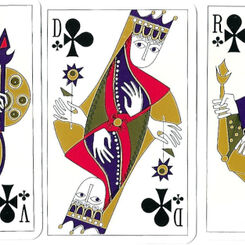
Troubadour
Charming deck evoking the art of the Middle Ages.
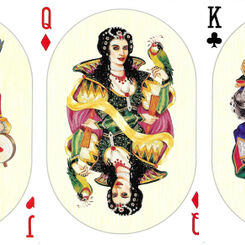
Crown Hill playing cards
Crown Hill playing cards with illustrations by Corrine Guiney, USA,
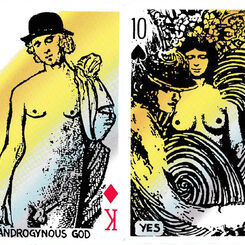
Ulysses a Vau-de-Ville
the James Joyce cards with drawings by Rosita Fanto.
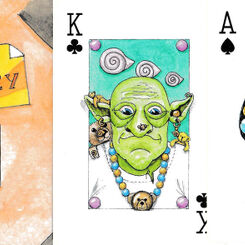
The Journey
‘The Journey’ limited edition playing cards produced by Peter Wood, UK, 2008.
Flora playing cards
Flora playing cards made by the Angel Playing Card Co., Kyoto, 1982.
Dungeons & Dragons “Curse of Strahd” Tarokka Deck
Enhance your Dungeons & Dragons game with the Tarokka Deck, a tarot-inspired set of cards that bring...
Dungeons and Dragons Tarot
This 78-card officially licensed Dungeons & Dragons (D&D) tarot deck offers a visually appealing var...
Baron Louis Atthalin’s Transformation Playing Cards, 1817
Baron Louis Atthalin (1784-1856) designed these cards whilst on a sea crossing from Palermo to Marse...
Bertschinger y Codina
Fantasy Spanish-suited playing cards by Bertschinger y Codina (Barcelona), c.1850.
Vicente Gombau y Labad
Elegant fantasy designs by Vicente Gombau y Labad (Madrid), 1861.
Spyscape
Spyscape espionage, surveillance and cryptography themed playing cards, 2018.
Minifusor Tipo Español
Naipes "Minifusor" tipo Español published by Difusora S.A., c.1980.
Little Demons
“Little Demons” playing cards illustrated by Wayne Anderson, c.1970
Cartes Comiques du Colonel Atthalin
“Jeu de cartes comiques” transformation cards designed by Louis Atthalin (1784-1856) and published i...
Starościanka
“Starościanka” playing cards manufactured by KZWP-Trefl (Poland).
Hermits
Playing cards depicting imagined residents of St. Petersburg with illustrations by Alexei Bobrinsky....

Chromolithography
Colour lithography was invented in 1798 by a Bavarian actor and playwright named Alois Senefelder (1...
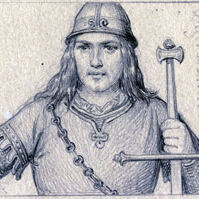
Fantasy historical Kings and Queens
Fantasy historical Danish Kings and Queens by L. P. Holmblad c.1850.

Jurassic Park
Jurassic Park card game made in Argentina, 2004.

The Enchanted Journey
The Enchanted Journey
Current Trends
Articles and Explore tags gaining attention


Kari Elkelä
09 October 2026, 20:29"Kronokortstämpel" in Swedish was issued in 1846. It was changed bilingual c. 1910. Independent Finland's stamp without crown "Pelikorttileima Spelkortstämpel" was issued 1920. It remained unchanged until the end of taxing in 1983.
Kari Elkelä
09 October 2026, 20:39This deck is published 1894-1904, because it is without Pelikorttikonttori (Playing Card Office) stamp.
Simon Wintle
10 October 2026, 20:17Thanks once again for your help. Could you point us to a source documenting the introduction of the Pelikorttikonttori stamp and its replacement around 1904? In particular, was the stamp compulsory on all playing cards sold in Finland, including imported packs, or were there exceptions?
Kari Elkelä
13 October 2026, 19:34I just add 2 slides from my presentation in IPCS Convention in Malmö 3rd October 2026.
Kari Elkelä
13 October 2026, 19:37Pelikorttikonttori stamp was not compulsory. It was used only by cartel members = all Finnish playing card factories. Turun Kivipaino did not use it in all of their decks. Others used.
Simon Wintle
15 October 2026, 22:16Thank you Kari for these very helpful slides; we have added them to the Finnish pages.