


EPOC playing cards
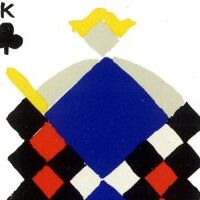
Modern designs by Brazilian artist Maria Leonor Décourt inspired by standard English pattern courts.
Although it is mentioned inside the sleeve that the artist, Maria Leonor Décourt, conceived and designed these cards “as a modification of the Standard English pattern”, one may have a hard job spotting any similarities. Only a few recognisable elements have been retained, such as the pikes and the swords and the occasional orb on the court cards. On the Aces and numeral cards, which are ‘cracked’ down the middle’, the pips have been superimposed on an enlarged suit-sign. As all the cards have a black background, the indices on the black suits are printed in white. It should also be mentioned that the cards are 100% plastic.
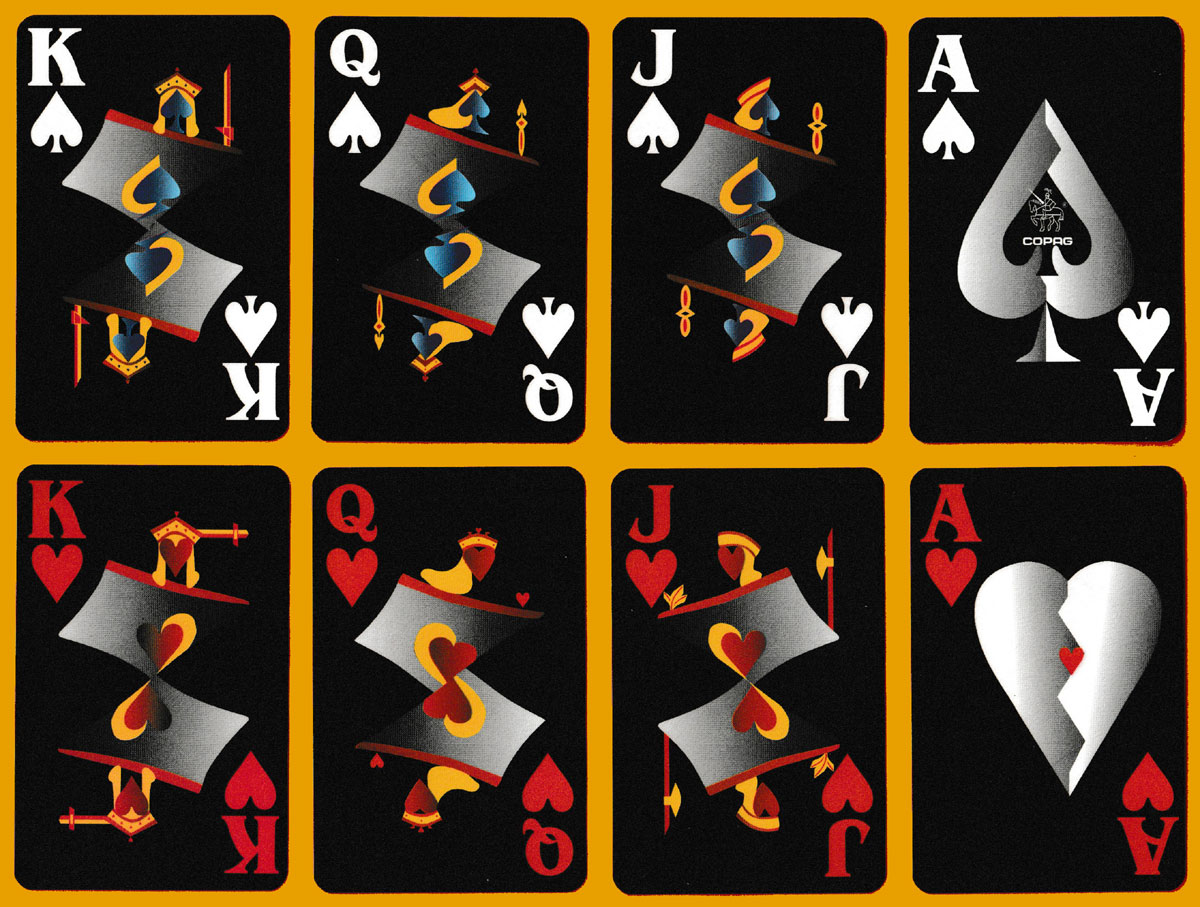
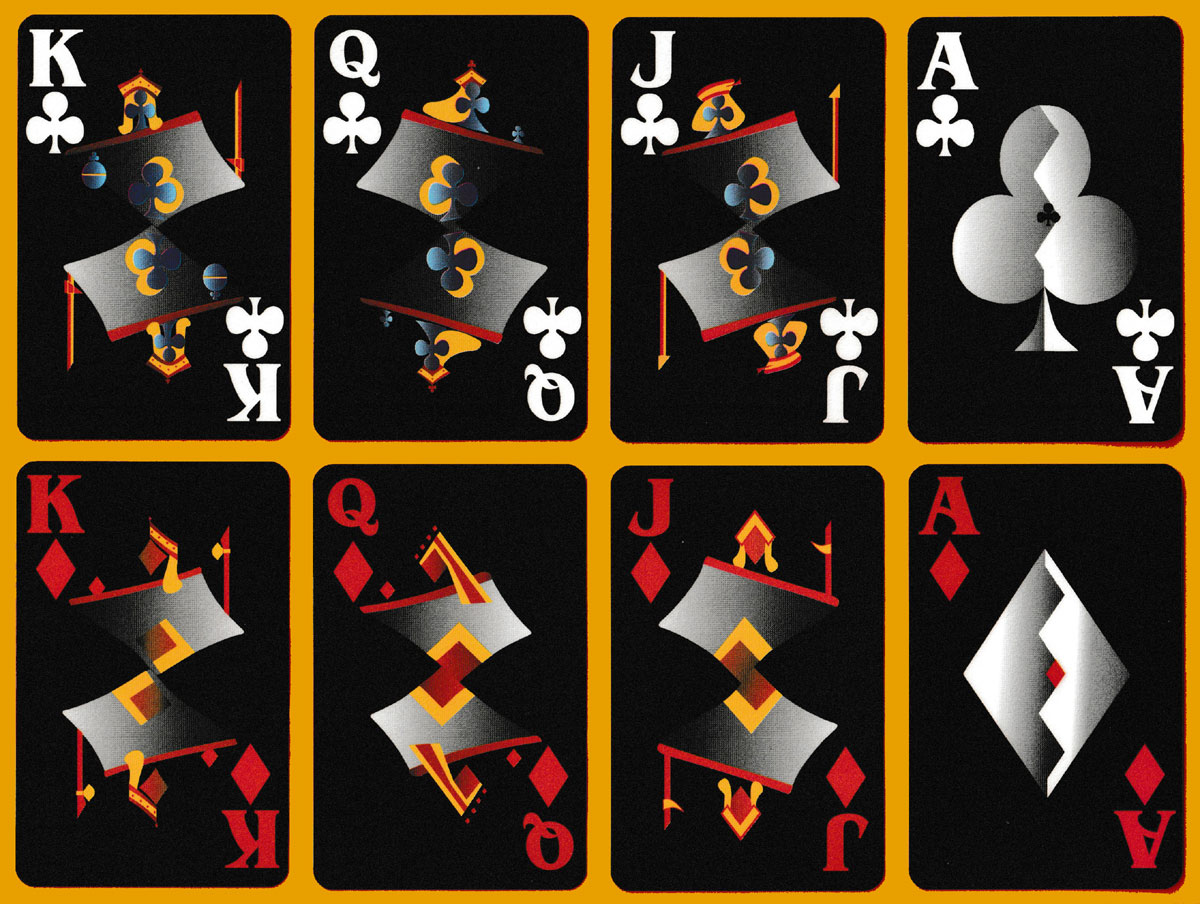
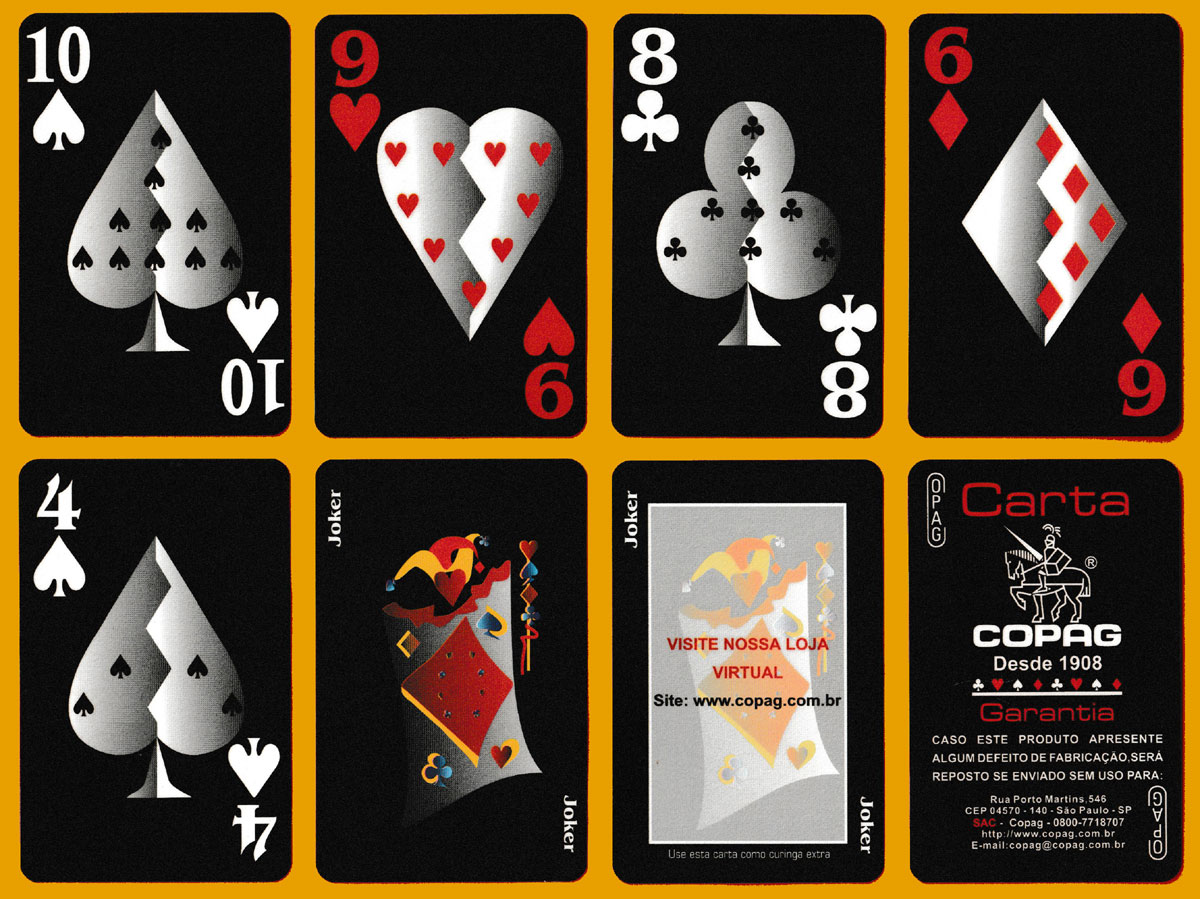
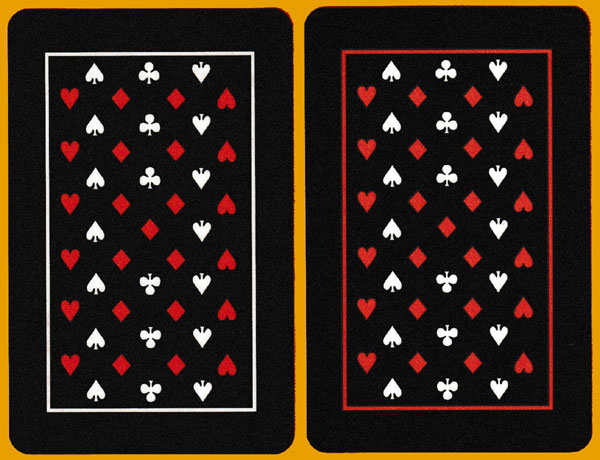
Above: EPOC playing cards conceived and designed by Maria Leonor Décourt. Made by COPAG, Manaus, Brazil, c2005. 2 x 52 cards + 2 Jokers + 1 extra card in black plastic box with drop lid + outer cardboard sleeve. Size: 57 x 89 mm.
The name EPOC is derived from the four initial letters of the French suit-signs, as spelt in Portuguese: E from espadas (spades), P from paus (clubs), O from ouros (diamonds) and C from copas (hearts).
• See the sleeve►

By Roddy Somerville
France • Member since May 31, 2022
Roddy started collecting stamps on his 8th birthday. In 1977 he joined the newly formed playing-card department at Stanley Gibbons in London before setting up his own business in Edinburgh four years later. His collecting interests include playing cards, postcards, stamps (especially playing cards on stamps) and sugar wrappers. He is a Past President of the Scottish Philatelic Society, a former Chairman of the IPCS, a Past Master of the Worshipful Company of Makers of Playing Cards and Curator of the WCMPC’s collection of playing cards. He lives near Toulouse in France.

Activity for EPOC playing cards
Sign in to comment or save this article.

Related Articles
Studydrive Student Cards
Minimalist playing cards from the “Ace your studies” Studydrive learning campaign.
Ampelmann Poker
Berlin’s little traffic light man, Ampelmännchen, dressed up ready for card play.
Tactics Design
Late modernist Japanese playing cards designed by Masayoshi Nakajo for Tactics Design.
Carte di Natale
Designed by Pier Canosa as a Christmas pack for the Cortina Art Gallery in Milan.
escART, ec-ART, SKAT
Fully illustrated pack printed from etchings by Johannes Vennekamp.
Jeu Boléro
Sweeping, semi-abstract designs by J.L. Jolin in red and black only.
Knoll International
Geometric designs by the French artist Jean Garçon for Knoll International, the furniture company.
Marcello Morandini
Modern designs by Italian artist Marcello Morandini using the simplest of forms and colours.
Baraja Nefertiti
Mexican fortune-telling pack with black and white designs by Thania Nicolopulus.
The Bristol Pack
The Bristol Pack, an exhibition of playing cards designed by Bristol artists, 2005.
Benedicte Morand-Bail
Benedicte Morand-Bail’s striking and colourful abstract poker deck with French named courts
Virginie Houdet
Virginie Houdet “Cartes à Jouer” limited edition, 2017.
40: More on Design Copies and Fakes
The issue of design copies needs further consideration and when does a copy become a fake?
Egbert Moehsnang
The suit signs and indices are clear and easily recognisable, and each suit has a different predomin...
Copag Baralho Espanhol
Copag Baralho Espanhol / Naipes Español.
Brazil
Playing card production in Brazil was officially sanctioned by royal decree in 1770.
Simultané
Simple geometric forms with an inner life and poetry emanating from the richness of colour, the musi...
Most Popular
Our top articles from the past 60 days


