


Master of the Playing Cards
Animal suited playing cards engraved by the Master of the Playing Cards, Germany, c.1455
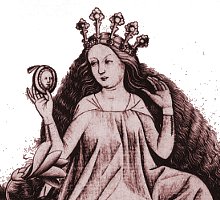
A unique set of animal suited playing cards, copper-engraved and uncoloured, by the “Master of the Playing Cards”, Germany, c.1450. The engravings are distinct and skillfully produced. The animal suit symbols, depicting characteristic mannerisms and behaviour, are laid out formally in a clear arrangement. Many of the images are printed from individual plates which are repeated on several cards in the same suit.
At first sight it appears that playing cards such as these may have served as generic models or design motifs to be used by students, craftsmen or artists. Maybe this is why the details and outlines are clearly legible and not overlapping. Furthermore, such figures of flowers, wild animals and birds recur almost identically incorporated into the border decorations and miniature illustrations of manuscripts or printed books, carvings or sculptures from the same period.
Striking examples can be seen in The Hours of Catherine of Cleves, the Giant Bible of Mainz and the Gutenberg Bible where many correspondences with the playing cards can be found.
The Hours of Catherine of Cleves
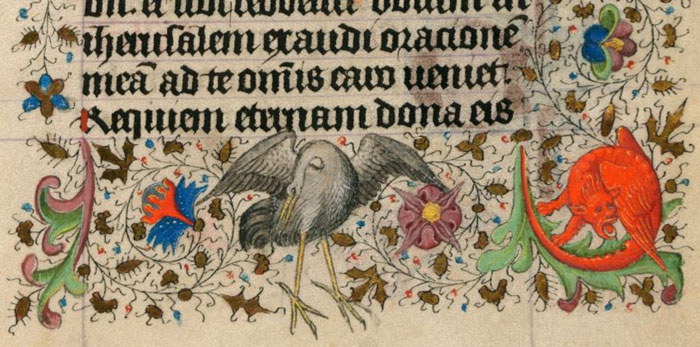
Left: border detail showing a heron from St. Michael Weighing Souls, illuminated by the Master of Catherine of Cleves, Utrecht, The Netherlands, c.1440. Morgan Library & Museum MSS M.945, f. 108v–M.917, p. 29. Original image here►
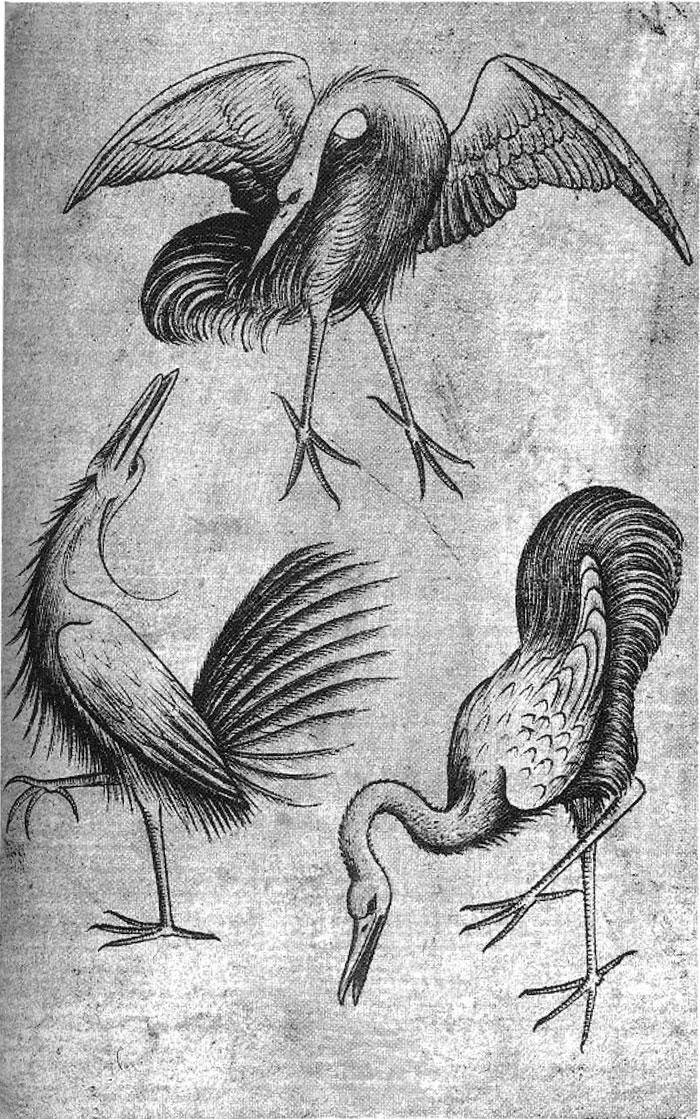
Both the manuscript border details can be identified in the three of herons card engraved by the Master of the Playing Cards.
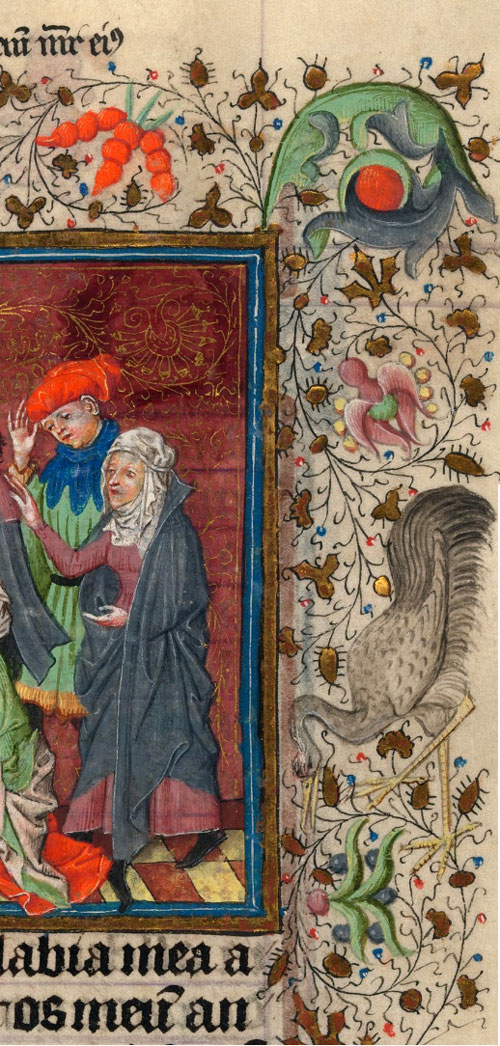
below: border detail showing a heron from Pentecost: Judgment of Solomon, illuminated by the Master of Catherine of Cleves, Utrecht, The Netherlands, c.1440. Morgan Library & Museum MS M.917, pp. 52–53. Original image here►
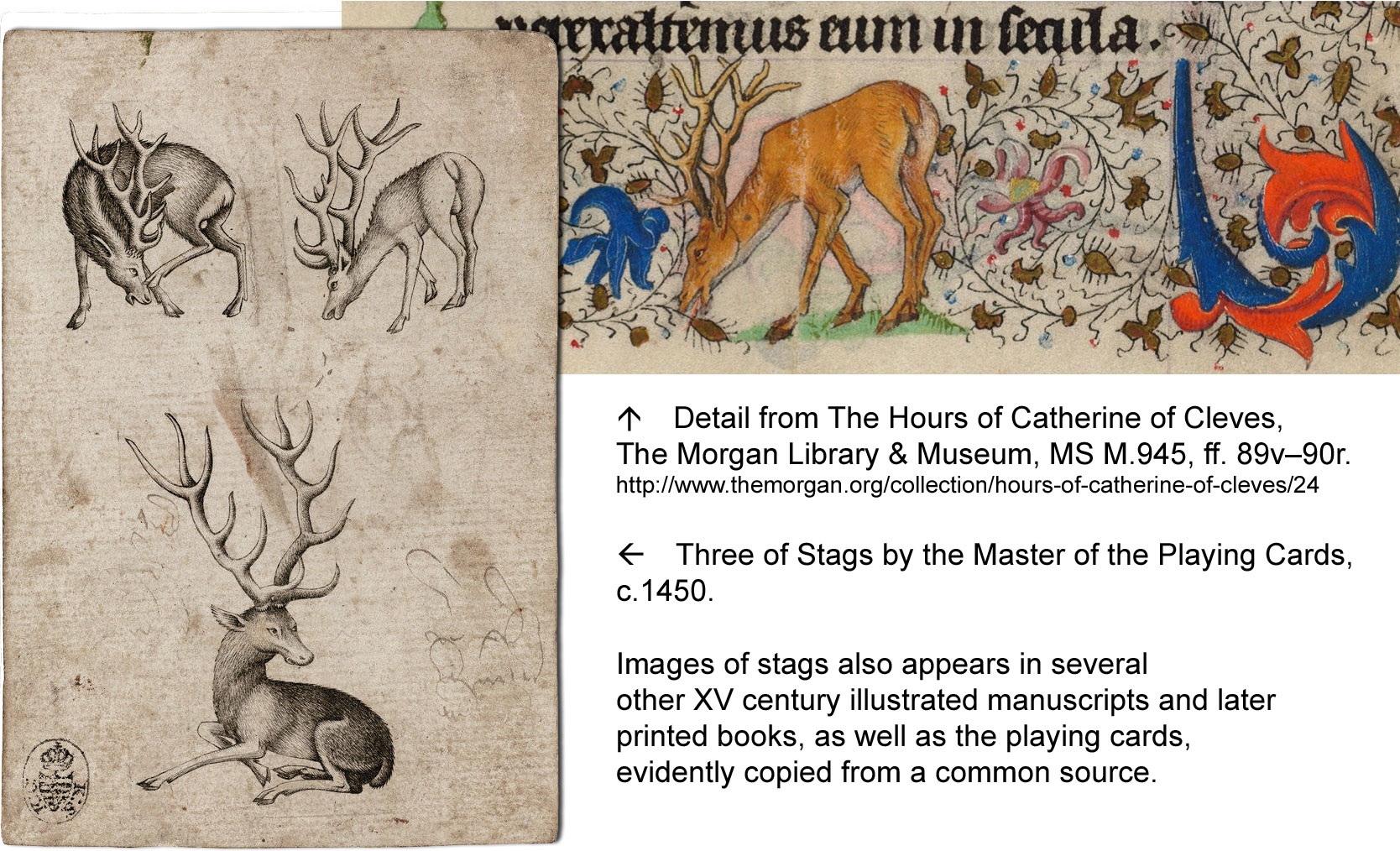
Above: border detail showing a grazing deer which also appears in the playing cards. The Morgan Library & Museum, MS M.945, f.90r. (Click to zoom). Original image here►
The engraved playing cards
The engravings in the playing cards are very close in artistic conception and stylistic execution to the miniatures found in the manuscripts. However, in the manuscripts they are integrated into a composition but in the cards they are isolated. It also turns out that some of the manuscript illustrations may be earlier than the date of the cards, in which case other model books may have been used as a common source. The court cards are wearing the costumes worn at court.
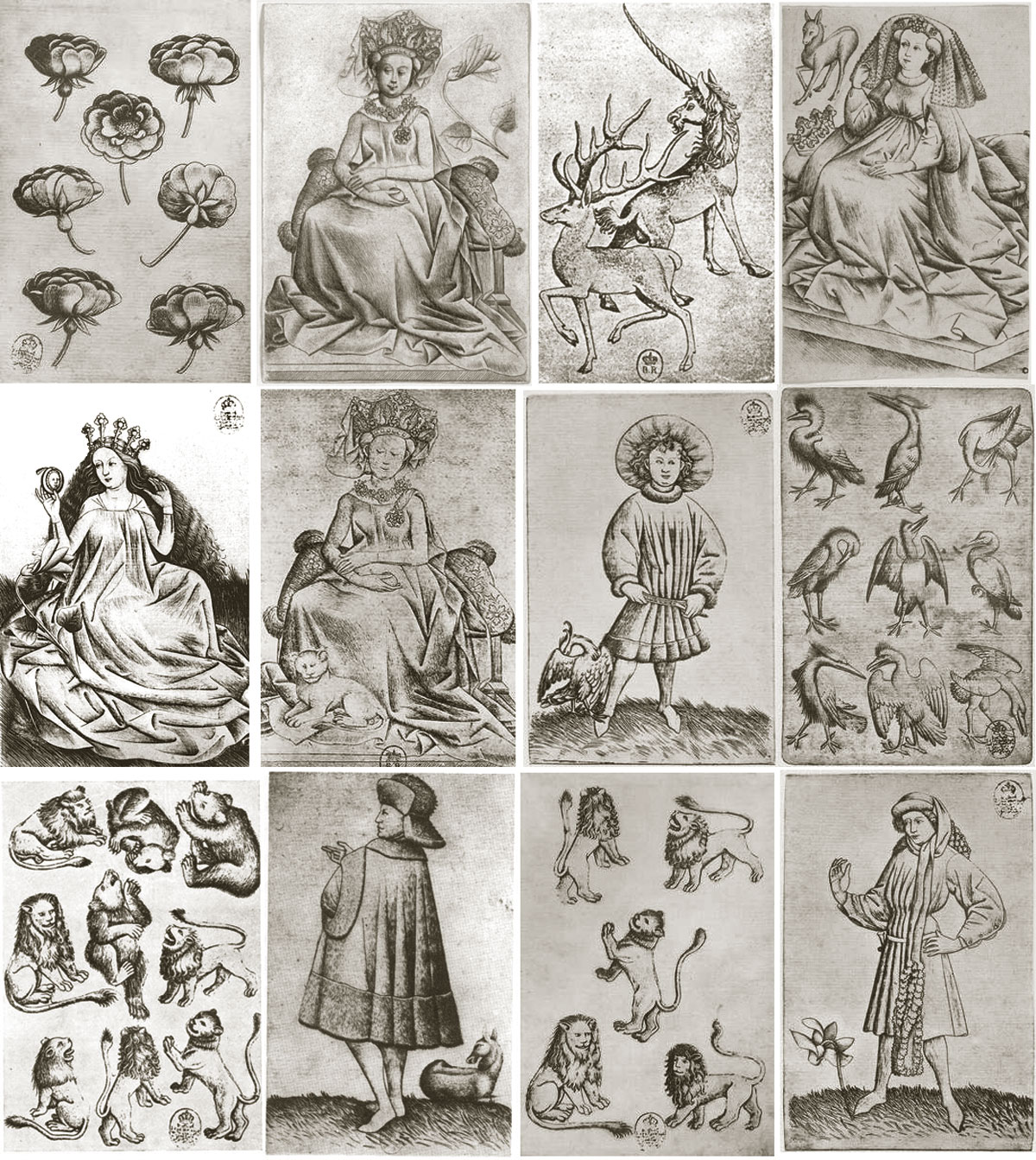
Above: roses, cyclamens, wild animals, deer and birds appear as suit symbols in these playing cards printed from intaglio plates by the Meister der Spielkarten (Master of the Playing Cards). The cards are not obviously produced as a coherent pack, in sheets of eight or twelve cards, but are produced as individual prints. Many of the prints are made up from several small plates assembled together.
The Giant Bible of Mainz and Gutenberg Bible
Lions and other animals, even small roses illuminated in the margins of the Giant Bible of Mainz, 1450s, and the Gutenberg Bible c.1455, suggest a common source to the cards engraved by the Master of the Playing Cards. In fact many more correspondences of similar images appearing in different manuscripts as well as in the playing cards have been found. The possibility exists that the Master of the Playing Cards and Johannes Gutenberg were working in closely related fields at that time and may have known each other (Lehmann-Haupt, 1966). Mainz was a vibrant centre of arts and crafts where ecclesiastical manuscripts of the highest quality were being written and illuminated. . Maybe the engravings were early attempts to find a mechanical means of reproducing decorative images and patterns in printed books, inspired by existing model books.
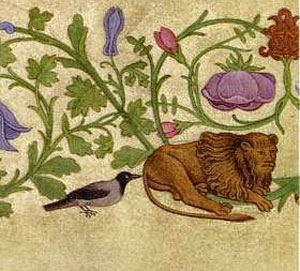
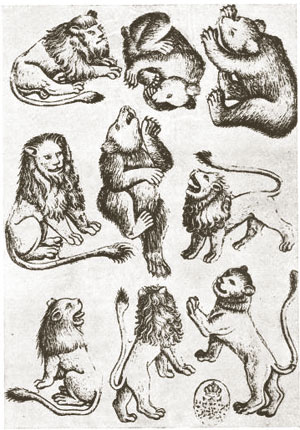
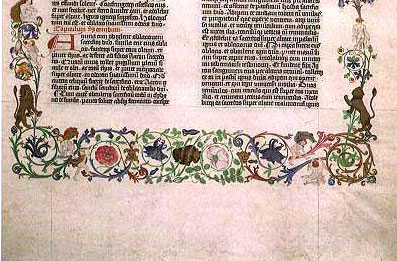
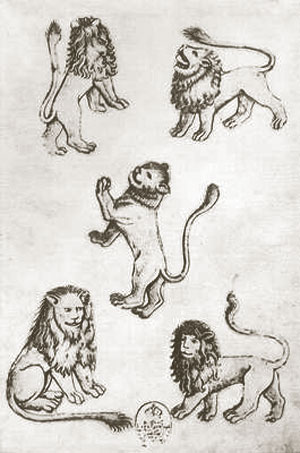
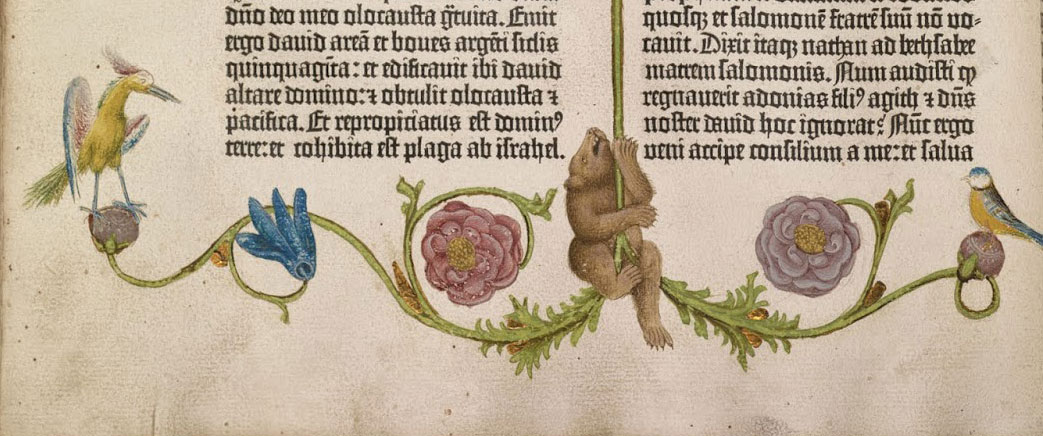
Above: a climbing bear, amongst cyclamens and roses, from hand-painted decorations in a copy of the Gutenberg Bible [William H. Scheide collection, f.160v, 1455] also appears on the nine of wild animals card engraved by the Master of the Playing Cards. The Scheide copy of the Gutenberg Bible contains a large number of miniatures which correspond with the playing cards. Further correspondences have been identified in other copies of the Gutenberg Bible and also in later Mainz printed Bibles.
Although many cards are now lost, there appear to have been several sets of cards attributed to “The Master of the Playing Cards” for the cards vary in shape and size. In one series the suits are bears, lions, stags, birds, flowers and leaves, and there are remnants of other series with frogs, dogs, rabbits, leopards, dragons and other mythical monsters (Hargrave, 1966). The number cards seem to run from one to nine in each suit, with three or four court cards in each suit: King, Queen, an Upper and/or Lower Knave. One possible explanation for the diversity of suit signs is that cards were made to order according to the desire of the buyer, but more likely they were from the standard repertoire of stock images, found in model books and used in various other artefacts, including books, sculpture or devotional prints. The engraver may have been working on a new method of printing such images inside books now, or soon to be, printed with moveable type by Johannes Gutenberg in Mainz, and had them printed into packs of playing cards for amusement.
It is ironical that the little copper plates, intended for marginal embellishment in a Bible or ecclesiastical volume, became a pack of playing cards – the Devil’s Picture Book.
REFERENCES
Hargrave, Catherine Perry: A History of Playing Cards and a Bibliography of Cards and Gaming, Dover Publications, New York, 1966
Husband, Timothy B: The World in Play, Luxury Cards 1430-1540, Metropolitan Museum of Art, New York, 2015
Lehmann-Haupt, Hellmut: Gutenberg and the Master of the Playing Cards, Yale University Press, New Haven and London, 1966
Plummer, John: The Hours of Catherine of Cleves, George Braziller, Inc., New York, [undated] c. 1970
Wikipedia: Master of the Playing Cards►
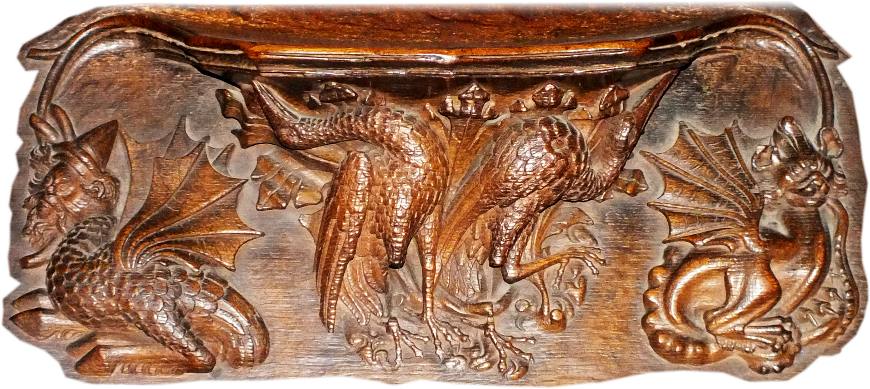
Below: church decorations, for so long the picture books of medieval education, show numerous examples of the way in which decorative artists borrowed designs from model books which also appear in alabaster panels, brasses, sculpture or illuminated books. The illustration below shows a carved misericord from the choir stalls in Chester cathedral, late XIV century.
See also: The Ambras Hunting Pack • The Stuttgart Pack • Master of the Banderoles • Master PW Circular Playing Cards • Early German Engraved Cards • The South German Engraver • The History of Playing-cards

By Simon Wintle
Spain • Member since February 01, 1996
I am the founder of The World of Playing Cards (est. 1996), a website dedicated to the history, artistry and cultural significance of playing cards and tarot. Over the years I have researched various areas of the subject, acquired and traded collections and contributed as a committee member of the IPCS and graphics editor of The Playing-Card journal. Having lived in Chile, England, Wales, and now Spain, these experiences have shaped my work and passion for playing cards. Amongst my achievements is producing a limited-edition replica of a 17th-century English pack using woodblocks and stencils—a labour of love. Today, the World of Playing Cards is a global collaborative project, with my son Adam serving as the technical driving force behind its development. His innovative efforts have helped shape the site into the thriving hub it is today. You are warmly invited to become a contributor and share your enthusiasm.

Activity for Master of the Playing Cards
Sign in to comment or save this article.

Related Articles
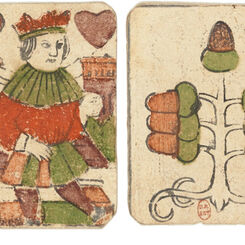
Early German playing cards
Some early examples of popular German playing cards from the XV and XVI centuries.
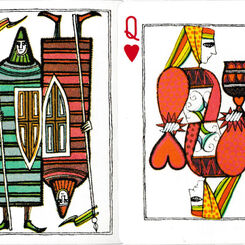
Nintendo deck with Medieval theme
Courts in medieval costume holding both French and Italian/Spanish suit-signs.
History of Playing Cards explained in 5 Minutes
Video by Art of Impossible. In this video you will get a short overview of the most important histor...
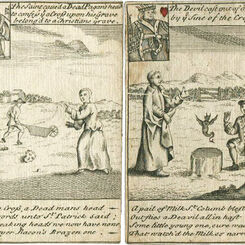
Illustrated Playing Cards, c.1740
Illustrated playing cards featuring comical engravings and rhymes about saints, c.1740.
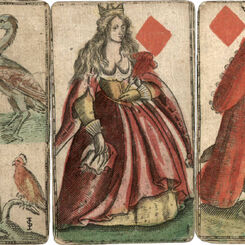
XVII Century Engraved Animal Cards
Anonymous French-suited German engraved cards c1610 to 1650.
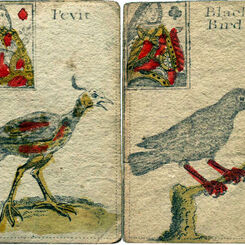
Forrest Cards, c.1750s
Hand-coloured Forrest Cards produced for “Young Gentlemen & Ladys who are Lovers of Ingenuity”, c.17...
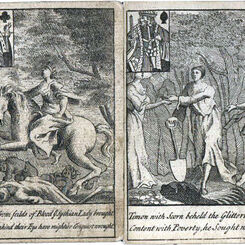
Delightful Cards, c.1723
Delightful Cards, containing variety of entertainment for young Ladies and Gentlemen c.1723.
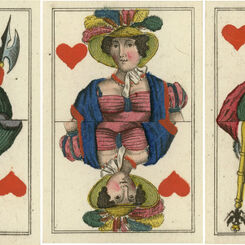
Unknown Maker
Early German deck by unknown maker, c.1825
Joseph Losch
French-suited pack with full-length courts by Joseph Losch, c.1800.
Stuttgart pack, c.1430
The luxury, hand-painted Stuttgart Cards (Stuttgarter Kartenspiel) dated c.1430, with suits of ducks...
Hans Sebald Beham
Playing cards designed by Hans Sebald Beham (1500–1550).
Das Kupferstichspiel des I.M.F. von 1617
Playing cards had been made as precious objects for wealthy clients since the late 14th century. The...
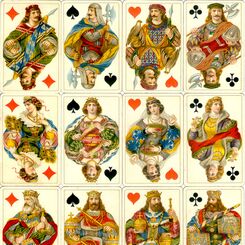
Mittelalter No.150
These designs imitating late medieval costumes were published by B. Dondorf in Germany in various ed...
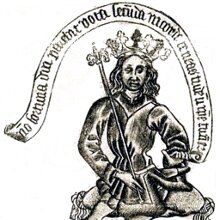
Master of the Banderoles
Playing Cards by the Master of the Banderoles, one of the earliest professional printmakers.
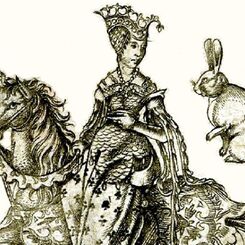
Master PW Circular Cards
Master PW Circular Playing Cards: roses, columbines, carnations, parrots and hares... everyday objec...
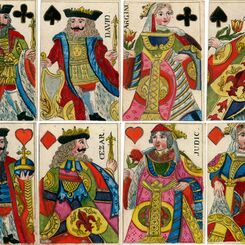
Johann Jobst Forster
Deck made by Johann Jobst Forster, Nürnberg, first half of 18th century in the Paris pattern.
Johann Matheus Backofen
French-suited deck manufactured by Johann Matheus Backofen, Nürnberg c.1800.
The Princely Hunting pack, c.1440
The Princely Hunting Pack, c.1440/45, is attributed to Konrad Witz and his workshop in Basle.
South German Engraver
A pack of 52 cards with banner 10s, female 'Sotas', horsemen and kings, the pack was engraved in the...
The History of Playing Cards
Playing cards appear in European records in the late 14th century, but their earlier history lies fu...
Most Popular
Our top articles from the past 60 days


Alannyë Daeris
19 November 2025, 09:47SavedSaved this article to Decks Históricos
Paola Benzoni
12 July 2026, 13:49SavedSaved this article to Mazzi