


Virgil Solis
Remarkable pack of 52 animal-suited playing-cards designed and etched by Virgil Solis.
Virgil Solis (1514-1562) was a prolific German printmaker, draughtsman and book illustrator who lived and worked in Nuremberg. He was a master of his craft and ran a successful workshop, employing several journeymen and later his sons. Solis produced a vast number of prints, estimated to be over 2,000, covering a wide range of subjects including religious themes, mythology, history, portraits and decorative motifs. His work was popular and widely distributed, influencing artisans and craftsmen across Europe.
He produced this remarkable pack of 52 ornamental playing-cards in c.1544-50, showcasing his skill and meticulous attention to detail. Intricate designs and motifs such as leaves and flowers support the suit symbols. The four aces contain the cipher VS. The suit symbols characteristic of German cards in those days have been reassigned on the aces as monkeys for acorns (aicheln), peacocks for leaves (Graven), parrots for hearts (Rot) and lions for bells (Schelen). The pip cards in each suit run from 1 to 10 with their values in Roman numerals at the top; the court cards are a foot soldier, mounted Queen and mounted King (no uber and ober). Thus in several aspects the pack does not conform to a typical German pattern, which suggests that maybe the pack was “not intended for the commonality” (Willshire p.217). The monkeys, peacocks, parrots and lions reflect Solis’s interest in natural history and exotic creatures, which were popular subjects in Renaissance art, instead of employing the more rustic acorns, bells, hearts and leaves.¹


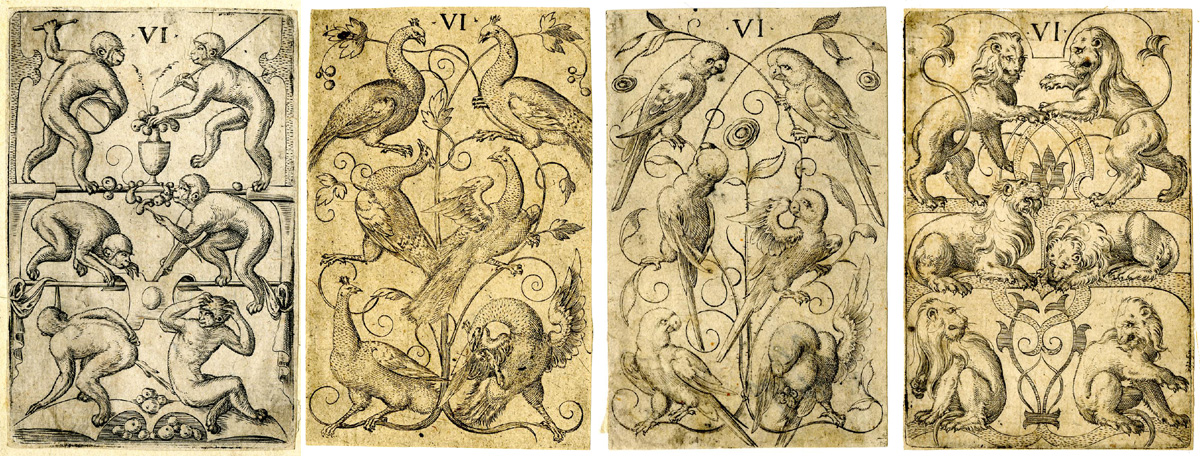

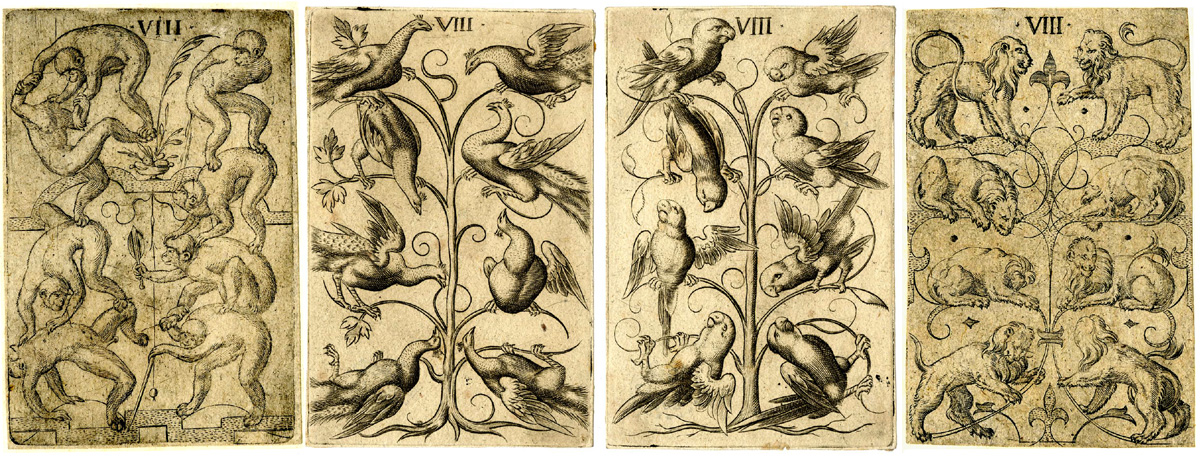


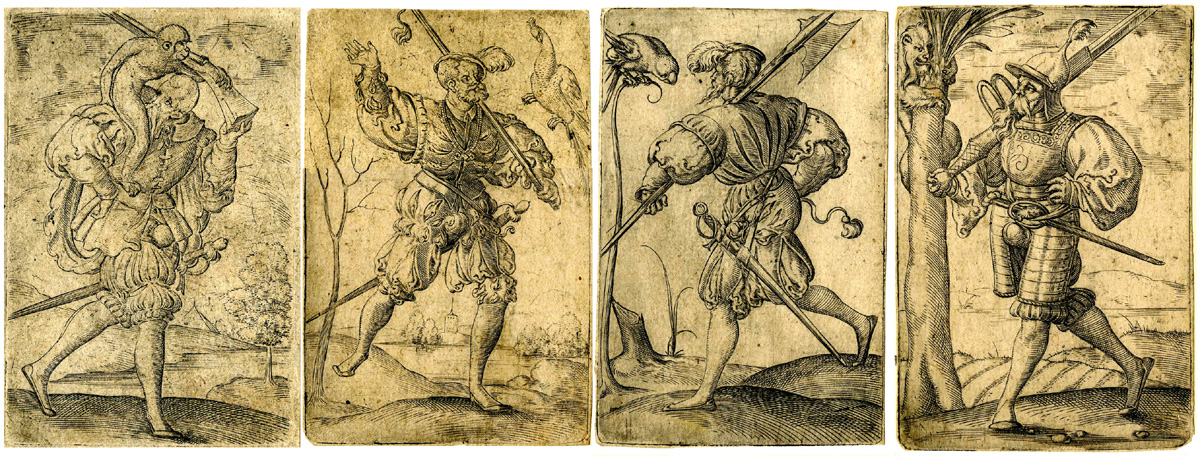


Above: set of 52 playing-cards designed and etched by Virgil Solis, Nuremberg, c.1545-50. No coloured examples are known. Sizes vary around 92x62 mm. © The Trustees of the British Museum
Below: Two men and a woman playing cards, engraving by Virgil Solis • Metropolitan Museum Object Number: 2012.136.759►

Note 1. On the question of suit symbols, examples are known of packs with roses, acorns, birds, bells, leaves, pomegranates, parrots, carnations, beans, lions, bears, dogs, shields, crowns, swords, batons, eagles or hearts as suit symbols. It has been suggested (Dummett 1980, p.14ff) that this sort of anarchy in early German cards was because every cardmaker was free to choose their own until about 1460, when suits began to be standardised. We already noted that Solis alluded to the four standard German suit symbols on the aces in his pack, so in this case he must have been extending his artistic licence.
Further References
British Museum: keyword 1854,1113.206►
These cards are composed of originals by Solis plus a number of contemporary copies “after Virgil Solis”.
O’Donoghue, Freeman M: Catalogue of the collection of playing cards bequeathed by Lady Charlotte Schreiber (German 111), Trustees of the British Museum, London, 1901 [digital version here]
Willshire, W. H.: A Descriptive Catalogue of Playing and Other Cards in the British Museum (German 156), Trustees of the British Museum, 1876, reprint 1975, p.217-8.
Cards from this pack and close variants can also be found under Willshire German 157 and 158.
Tor Gjerde Historical playing cards: Virgil Solis c.1544►
Tor Gjerde discusses the structural similarity with French decks and the directional and symbolic differences in the court cards. Tor also kindly clarified the orthographic variations of the suit names as seen on the four aces, which I had mis-assigned: The one (ace) of monkeys bears the legend AICHELN, an archaic spelling of “eicheln” meaning acorns • Lions has SCHELEN, a misspelling of “schellen”, bells • Parrots has ROT, red, which is a not too uncommon alternative name to “herzen”, hearts • Peacocks has GRVEN – there is a bar above the V which in this case is not an abbreviation mark, but signifies that the letter V still is used for both “u” and “v” which only later were split into separate letters. Especially in capitals as here, “ue” (here written VE) represents the umlauted “ü”, so that the legend is to be read “grün”, green, which is an alternate term for “laub”, leaves, typically used alongside “rot” for “herzen”.
V&A Museum: Portrait of Virgil Solis►

By Simon Wintle
Spain • Member since February 01, 1996
I am the founder of The World of Playing Cards (est. 1996), a website dedicated to the history, artistry and cultural significance of playing cards and tarot. Over the years I have researched various areas of the subject, acquired and traded collections and contributed as a committee member of the IPCS and graphics editor of The Playing-Card journal. Having lived in Chile, England, Wales, and now Spain, these experiences have shaped my work and passion for playing cards. Amongst my achievements is producing a limited-edition replica of a 17th-century English pack using woodblocks and stencils—a labour of love. Today, the World of Playing Cards is a global collaborative project, with my son Adam serving as the technical driving force behind its development. His innovative efforts have helped shape the site into the thriving hub it is today. You are warmly invited to become a contributor and share your enthusiasm.

Activity for Virgil Solis
Sign in to comment or save this article.

Related Articles
Chambord
A Renaissance-style pack with ornate court cards and gilded corners.
Advice and General Knowledge for Newer Collectors
A little general knowledge goes a long way for newer collectors, helping you choose a focus and unde...
Infirrera
Italo-Portuguese-suited cards by Andrea Infirrera with the arms of Malta, 1693.
Tulsa City-County Library System Annual Report
Tulsa City-County Library System Annual Report playing cards, USA, 1983.
New Orleans Suits
New Orleans Suits playing cards designed by Eddie Tebbe, USA, 1999.
The Fat Pack
A vastly expanded pack with 8 suits for playing traditional or new games, devised by Roger Howard Bu...
Le Burling
1960s pack from Annecy with non-standard suits all connected with the office.
Calliope: a Renaissance band
Facsimile of cards attributed to Hans Schäufelein (c. 1480-1540) produced by ‘Calliope’, a New York ...
Nintendo deck with Medieval theme
Courts in medieval costume holding both French and Italian/Spanish suit-signs.
Il Quinto Seme
An Italian pack with a fifth suit of “amici” (“friends”).
Pentacards
A five-suited set of playing cards published by Fleet and Case Games Ltd., Rainham, Kent, UK, c.1980...
Master of the Playing Cards
Animal suited playing cards engraved by the Master of the Playing Cards, Germany, c.1455
Stuttgart pack, c.1430
The luxury, hand-painted Stuttgart Cards (Stuttgarter Kartenspiel) dated c.1430, with suits of ducks...
Who Knows?
Who Knows? game of questions and answers produced by Adolf Sala Games, Berlin, c.1900.
16: European Standard Playing Cards
A brief survey of the different types of standard cards to be found in Continental Europe.
Master PW Circular Cards
Master PW Circular Playing Cards: roses, columbines, carnations, parrots and hares... everyday objec...
The Visconti-Sforza Tarot, c.1460
This pack of tarot cards appears to have have been made in the Bembo workshop in Cremona for Bianca ...
The Princely Hunting pack, c.1440
The Princely Hunting Pack, c.1440/45, is attributed to Konrad Witz and his workshop in Basle.
The Book of Trades by Jost Amman, 1588
The Book of Trades by the prolific German Renaissance artist Jost Amman (1539-91). Suits are books, ...
The History of Playing Cards
Playing cards appear in European records in the late 14th century, but their earlier history lies fu...
Most Popular
Our top articles from the past 60 days


