


Toledo, 1584
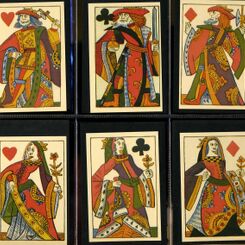
Archaic Spanish-suited deck with 48 cards made in Toledo in 1584.
Spanish-suited deck with 48 cards made in Toledo in 1584, found in an old book-binding and now preserved in the Biblioteca Nacional de España [here]. They may have been rejects from a card-maker’s workshop.
This is an archaic, late medieval type, which pre-dates the Spanish National pattern, and has several typical features. Three baton numeral cards have naked children incorported in the design, often seen in medieval cards. The king of coins wields a battle axe over his shoulder. He suirvives in later cards from Provence and also as the King of Hearts in English packs ('Suicide King'). There are several inscriptions, for example the 5 of swords has the inscription “EN TO 1584”; the 2 of swords has the inscription “15 EN TO 84”. Others can be found. The ace of coins has the legend “EN TO LEDO” and a coat of arms with double-headed eagle with the initials F.F. on either side. After 1575 the administration of playing cards in Castile was divided into three districts, with Toledo being one of them. It was thereafter obligatory to indicate the origin or destination of the cards on the decks, as can be seen in this example. The 2 of coins is dated 1584 and displays the coats-of-arms of Castilla y León (above) and Aragón (below). The two of cups bears a rampant lion; the fours of cups and coins show tri-symmetric motifs which are probably the maker’s guild identity devices.
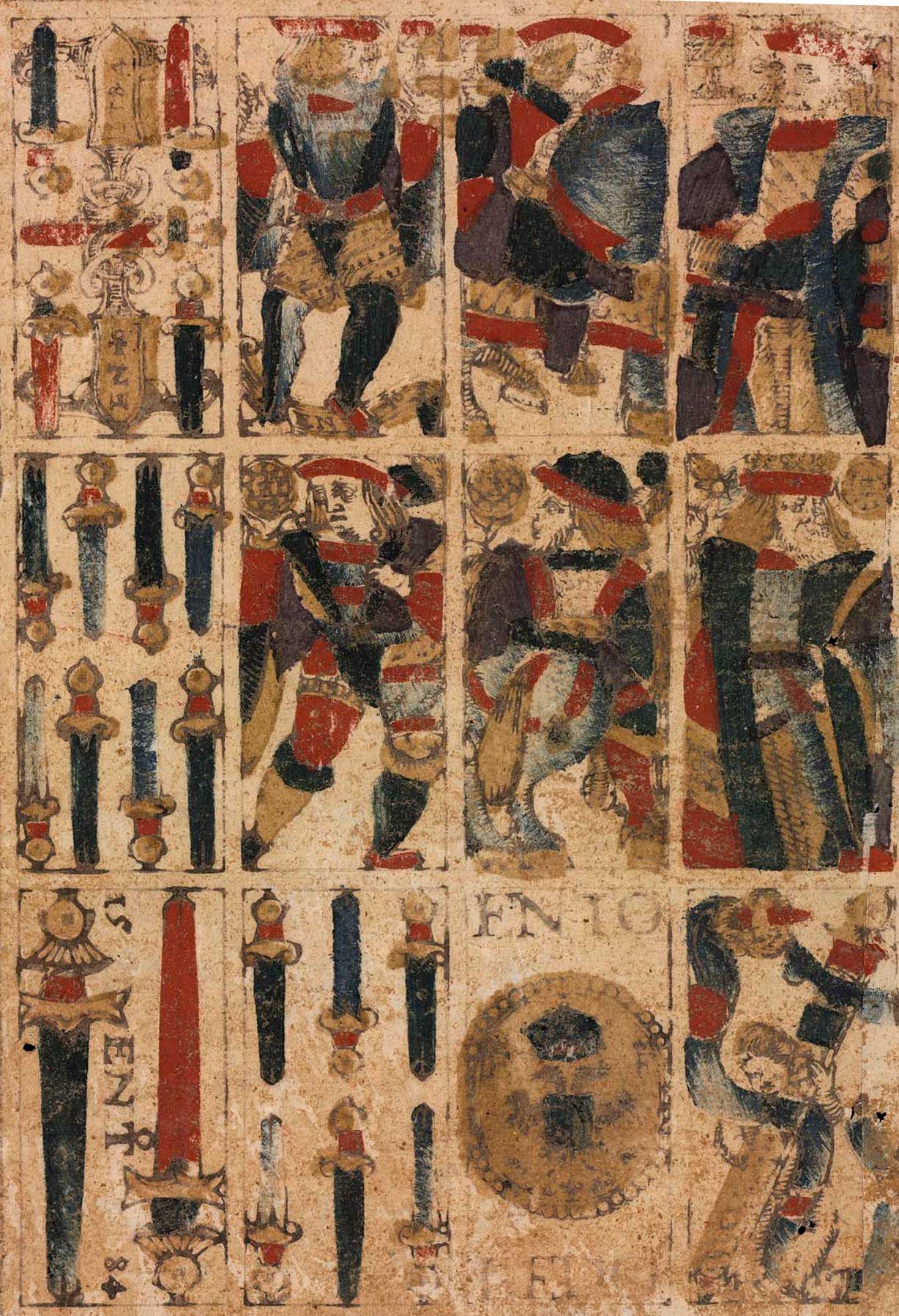
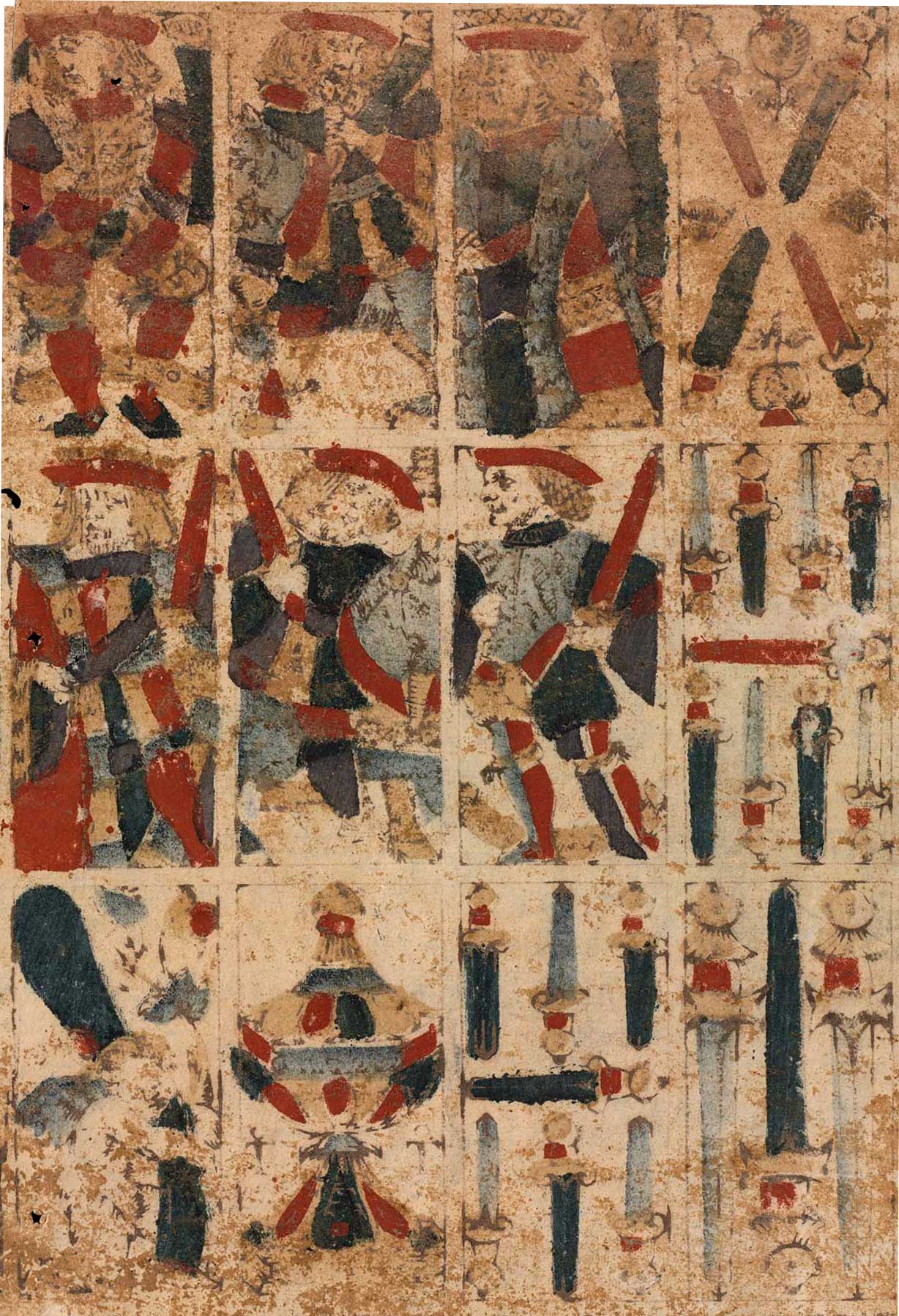
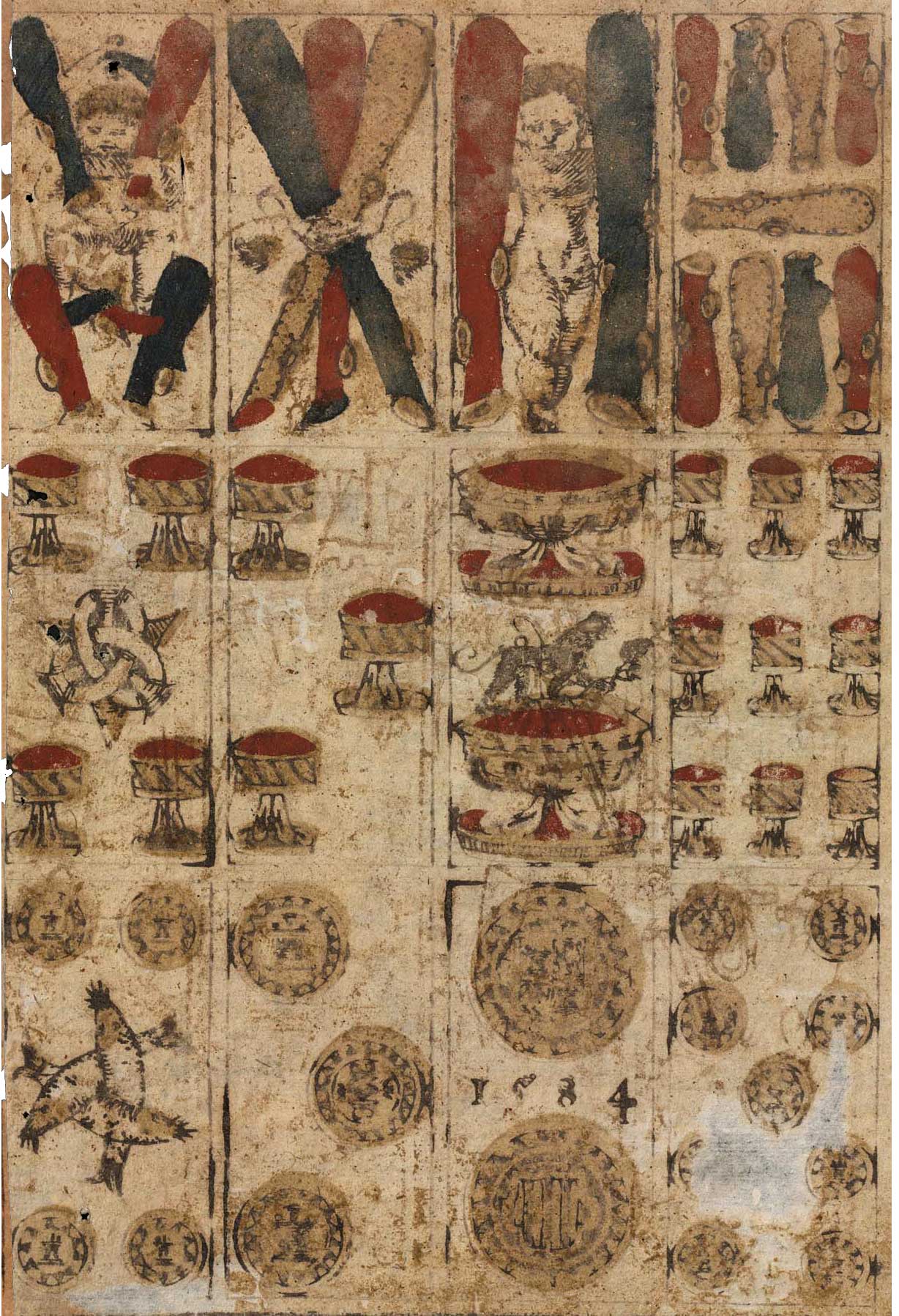
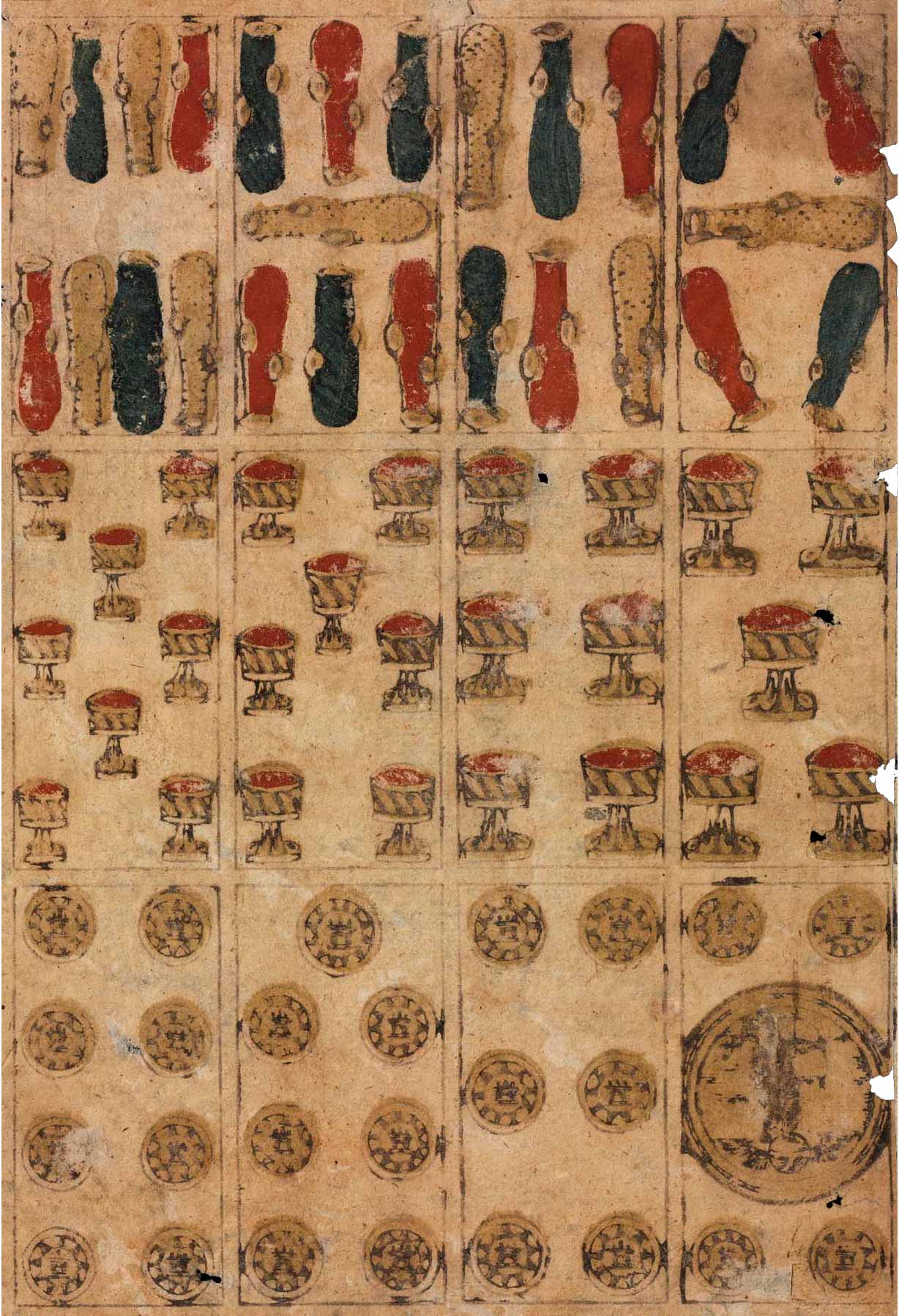
Above: Spanish-suited deck made in Toledo in 1584. 48 cards, printed from woodblocks, coloured with stencils. Unfortunately the specimen is not a fine example, and has been defaced in one or two places. Biblioteca Digital Hispánica / BIBLIOTECA NACIONAL DE ESPAÑA.
References
Biblioteca Digital Hispánica : Colección de cuarenta y ocho naipes►
Colección de cuarenta y ocho naipes pertenecientes a una baraja española con los cuatro palos: oros, copas, espadas y bastos // Lugar y fecha de impresión tomados del cinco de espadas: "En To[ledo] 1584" // Naipes sin cortar distribuídos en 4 hojas, 300 x 211 mm, coloreados a la trepa e impresos en xilografía // H. 1: En el dos de copas aparece un león rampante; en los oros una torre en el centro y en concreto en el dos de oros, la fecha 1584 separa el superior con el escudo de Castilla y León y el inferior con el de Aragón. H. 2: En el dos de espadas consta: "15 en TO 84"; en el as de Oros, escudo con águila bicéfala y "En Toledo". Localización: R/41421. Los naipes han perdido algo de entintado y sufrido mínimos desgarros y abrasiones pero en general legibles y sin retoques. Antiguamente formaban un bloque dentro de una encuadernación nobiliaria. Incluye 3 hojas duplicadas muy deterioradas
Pérez González, Alberto : Diego del Campo ¿El primer hombre en “hacer naipes” en España?

By Simon Wintle
Spain • Member since February 01, 1996
I am the founder of The World of Playing Cards (est. 1996), a website dedicated to the history, artistry and cultural significance of playing cards and tarot. Over the years I have researched various areas of the subject, acquired and traded collections and contributed as a committee member of the IPCS and graphics editor of The Playing-Card journal. Having lived in Chile, England, Wales, and now Spain, these experiences have shaped my work and passion for playing cards. Amongst my achievements is producing a limited-edition replica of a 17th-century English pack using woodblocks and stencils—a labour of love. Today, the World of Playing Cards is a global collaborative project, with my son Adam serving as the technical driving force behind its development. His innovative efforts have helped shape the site into the thriving hub it is today. You are warmly invited to become a contributor and share your enthusiasm.

Activity for Toledo, 1584
Sign in to comment or save this article.

Related Articles
The archaic “Classic Madrid” Pattern
Centralisation, standardisation and consolidation of the Spanish card tradition.
La baraja de Almagro
De la chimenea al monumento nacional: la baraja de Almagro y el renacer del corral de comedias.
Ganjifa - Playing Cards from India
Indian playing cards, known as Ganjifa, feature intricate designs with twelve suits and are traditio...
Sevilla 1647 reproduction
Facsimile of Spanish-suited pack produced in Sevilla, Spain, 1647.
73: Fakes, forgeries and Tax Evasion
When there are official taxes to pay, people will find a way to avoid paying them - often illegally....
Baraja Carlos IV by Félix Solesio, 1800
Baraja Carlos IV, Félix Solesio en la Real Fábrica de Macharaviaya, 1800.
70: Woodblock and stencil : the spade courts
This is a presentation in a more straight forward fashion of the work done by Paul Bostock and me in...
64: The descendants of the French regional patterns: 2
A continuation oF the development of the off-spring of the Paris patterns and a few examples of how ...
Trentine Pattern
Trentine Pattern
Pedro Varangot, 1786
Archaic Navarra pattern produced for the Pamplona General Hospital Monopoly by Pedro Varangot in 178...
Navarra Pattern, 1682
Navarra pattern produced for the Pamplona General Hospital Monopoly in 1682.
Navarra Pattern
Navarra Pattern produced for the Pamplona General Hospital Monopoly.
Navarra Pattern, 1793
Navarra pattern by an unknown cardmaker with initials I. I., 1793.
Anonymous Spanish Suited pack, c.1760
Anonymous archaic Spanish suited pack, c.1760.
XV Century Catalan playing cards
XV Century Catalan Playing Cards, featuring four female Sotas, four Aces and four cards from the sui...
19: 19th Century Breaks with Tradition - Unusual versions of the Standard English Pattern
The centuries-long tradition of English court cards was subject to misinterpretation and in some cas...
1: Playing Cards and their History: An Introduction and some links to other sites
What was considered the first mention of playing cards in England is in 1463 when Edward I banned th...
Navarra, XVII Century
Facsimile of 17th century Spanish-suited playing cards produced by Erregeak, Sormen S.A., Vitoria-Ga...
Moorish playing cards
These two uncoloured, uncut sheets of early Moorish playing cards were formerly preserved in the Ins...
Baraja Morisca — Early XV century playing cards
Primitive Latin suited pack, dated by paper analysis as early XV century, which makes this one of th...
Most Popular
Our top articles from the past 60 days


