


Samuel Hart, 1846-1871
Samuel Hart was a prolific manufacturer of playing cards who commenced business sometime around 1845 in Philadelphia. He had previously worked for L.I. Cohen.

Samuel Hart was a prolific manufacturer of playing cards who commenced business sometime around 1846 in Philadelphia. He had previously worked for L.I. Cohen. Hart purchased the Thomas Crehore playing card plates and some of their machinery after Crehore closed down in 1846. He is considered as an early innovator in the business. They also made the "Thomas Crehor" decks (no 'e') which had similar aces of spades and the typical Hart one-way courts and possibly were attempting to continue the Crehore name. Hart also appears to have traded as Charles Bartlet. From 1849 Hart also had offices in New York City.
In 1871 Samuel Hart & Co became part of the New York Consolidated Card Co. During their 22 year life as an independent playing card manufacturer they were extremely active and produced a large variety of decks, including many different aces of spades and "Imperial Bower" jokers. The name "Squeezers" had been used from around 1870 to denote the indices in the corners of the cards, but after 1873 all indexed cards made by NYCC were called Squeezers. more...


Above: single-ended deck manufactured by Samuel Hart & Co in c.1860. The ace of spades gives the address as New-York.
Corner Indices
A patent was issued on February 9, 1864 to Cyrus W. Saladee of Paducah, Kentucky, under patent number 41,587. It is believed to be the first American deck with corner indices. This idea revolutionized American card manufacture by enabling card players to fan the cards to view only a small portion of each card, sufficient to see the indices. This was soon followed by Andrew Dougherty’s patent for “Triplicates” and other novel systems of index types which were adopted by several competing manufacturers until, over time, they became the new norm.

Above: Saladee's patent deck with small corner indices published by Samuel Hart, Philadelphia, 1864. The Ace of Spades mentions Saladee’s name. Hart also issued a “Bazique” set incorporating two Saladee Bazique Registers►

Above: double-ended deck manufactured by Samuel Hart & Co in c.1865. The ace of spades gives two addresses: 416 South 13th St., Philadelphia and 546 Broadway, New York.
Probably the most popular and long-lived of all Hart issues were the George & Martha Washington Aces of Spades, all published under the Samuel Hart & Co. name. At least five different versions are known, from between 1868 until after 1900.

Above: cards by Samuel Hart & Co., West 14th Street, N. Y., c.1872, with newly designed double-ended courts without indices, somewhat similar in style to those of Chas Goodall of London. The "Imperial Bower" was probably the first U.S. Joker which first appeared during the 1860s for the game of Euchre.

Above: Samuel Hart & Co., N.Y., c.1870, probably produced by New York Consolidated Card Co.

By Simon Wintle
Spain • Member since February 01, 1996
I am the founder of The World of Playing Cards (est. 1996), a website dedicated to the history, artistry and cultural significance of playing cards and tarot. Over the years I have researched various areas of the subject, acquired and traded collections and contributed as a committee member of the IPCS and graphics editor of The Playing-Card journal. Having lived in Chile, England, Wales, and now Spain, these experiences have shaped my work and passion for playing cards. Amongst my achievements is producing a limited-edition replica of a 17th-century English pack using woodblocks and stencils—a labour of love. Today, the World of Playing Cards is a global collaborative project, with my son Adam serving as the technical driving force behind its development. His innovative efforts have helped shape the site into the thriving hub it is today. You are warmly invited to become a contributor and share your enthusiasm.

Activity for Samuel Hart, 1846-1871
Sign in to comment or save this article.

Related Articles
Cartomancy, Oracle and Divination Cards
Playing cards are used for fortune-telling - turning another card illumines the moment and a new per...
Corner Indices
Corner Indices were a major innovation in playing card production.
Squared Faro #366
Squared Faro #366 by Russell & Morgan Co. first issued in 1887.
Zum
Zum card game published by Milton Bradley Co., c.1905.
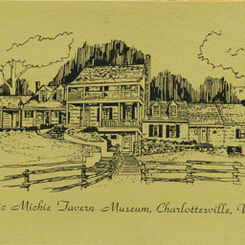
Michie Tavern Museum
Historic Michie Tavern Museum playing cards by Brown & Bigelow.
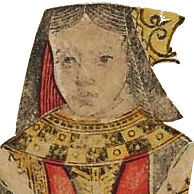
Globe Card Company
“Globe Playing Cards” patented on Oct. 6, 1874 by I. N. Richardson.
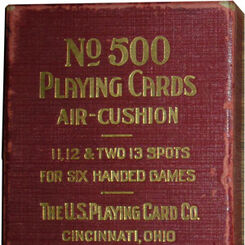
No.500 Playing Cards
No.500 Playing Cards published by U.S.P.C.C., c.1910
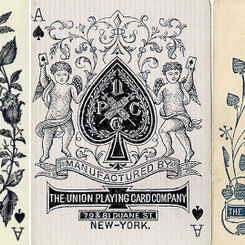
Union Playing Card Co.
Not much is known about this early manufacturer who is reckoned to have traded between c.1860s-1890s...
Bicycle No.808
The famous Bicycle playing cards were first introduced by Russell & Morgan Printing Co in 1885. More...
The United States Playing Card Company
Over the years the pressures of competition and other market forces have led to many smaller manufac...
Lawrence & Cohen
Lawrence & Cohen were successors to Lawrence, Cohen & Co.
Royal Playing Cards, 1890s
Royal Playing Cards, 1890s
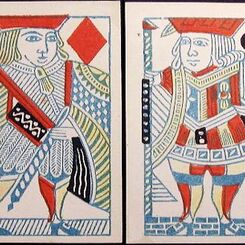
Lewis I. Cohen
Lewis I. Cohen made his first deck of cards in 1832. In 1835 Mr Cohen invented a new machine to prin...
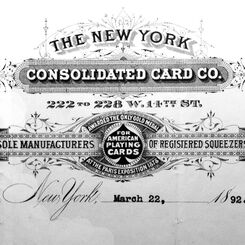
New York Consolidated Card Company
The New York Consolidated Card Company was formed in 1871 by the merging of Lawrence & Cohen, Samuel...
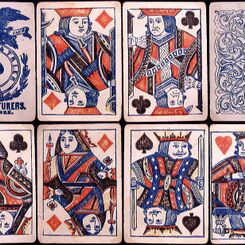
Strauss & Trier, c.1860
Strauss & Trier, New York, c.1860.
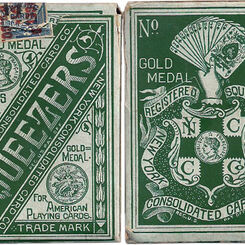
Squeezers No.35
By 1877 the New York Consolidated Card Co's "Squeezers" were a great success on account of the indic...
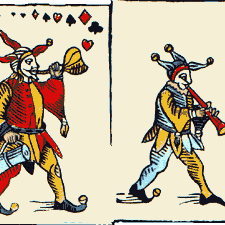
The Joker Card
The 'Joker' is believed to have been invented by American Euchre players who, when modifying the rul...

Bonnie Blue’s Rummy Cards
Bonnie Blue’s Rummy Cards.

4 Seasons Playing Cards
Colours of the Four Seasons - Playing Card Art Deck
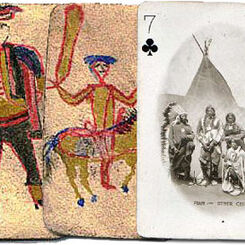
U. S. A.
The manufacture of playing cards in America only began during the second half of the 18th century, a...
Most Popular
Our top articles from the past 60 days


cheryl z
17 June 2026, 17:34SavedSaved this article to cheryl z's Collection