


De Luxe No.142
A wide size version of De Luxe No.142 had been published in c.1920, with a similar Ace of Spades and Joker, but which was never very popular.
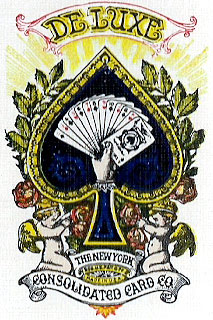

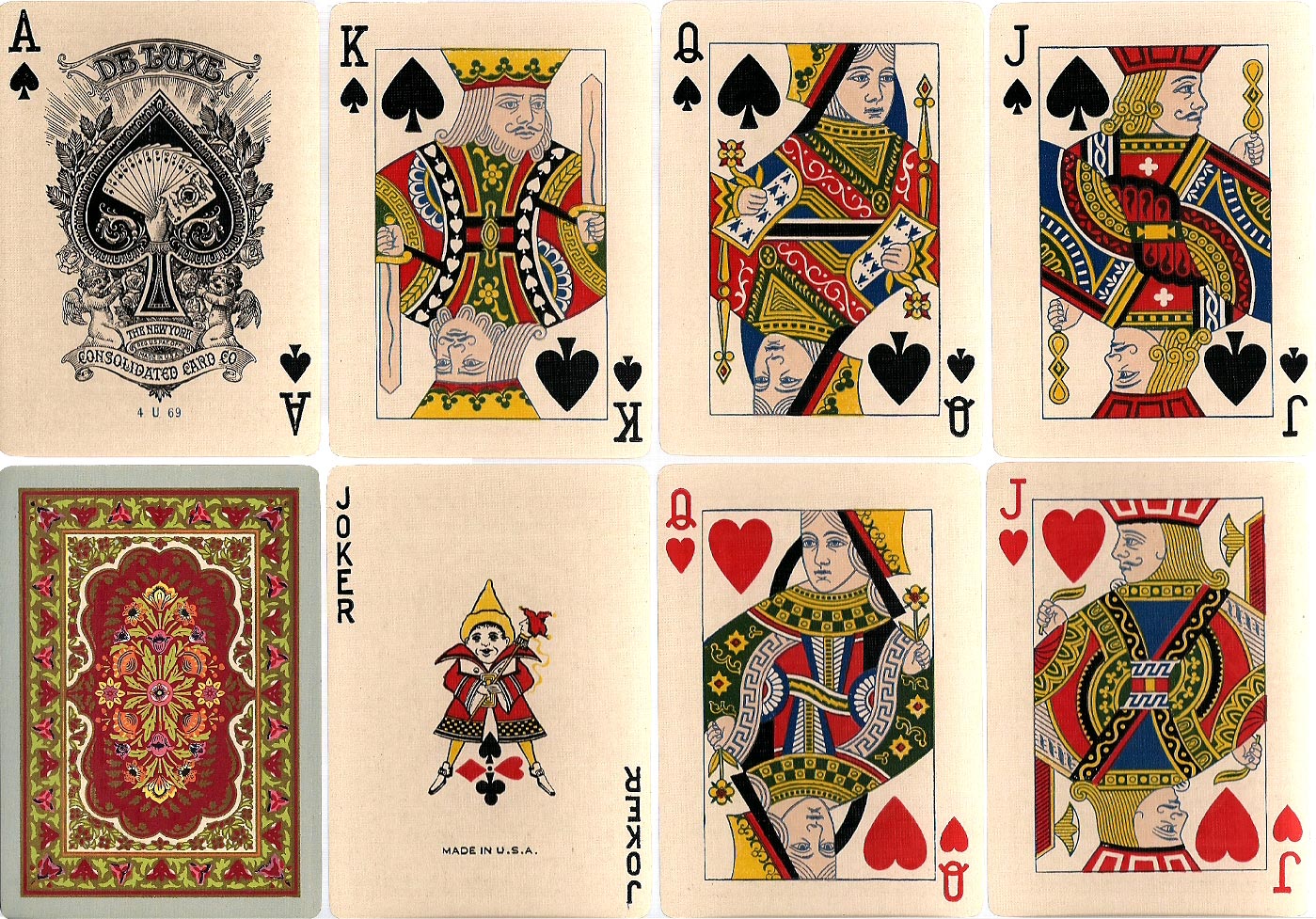
The De Luxe No.142 brand of playing cards was introduced around 1921 by the New York Consolidated Card Company. This Bridge size deck came with a multi-coloured Ace of Spades featuring a fan of cards inside a Spade suit sign, and two cherubs at the base, and a coloured Joker, inside a luxury box with a vivid ornamental back design. It proved to be NYCCC's most popular deck in this size. Both the wide and narrow versions of the De Luxe deck are gold edged.
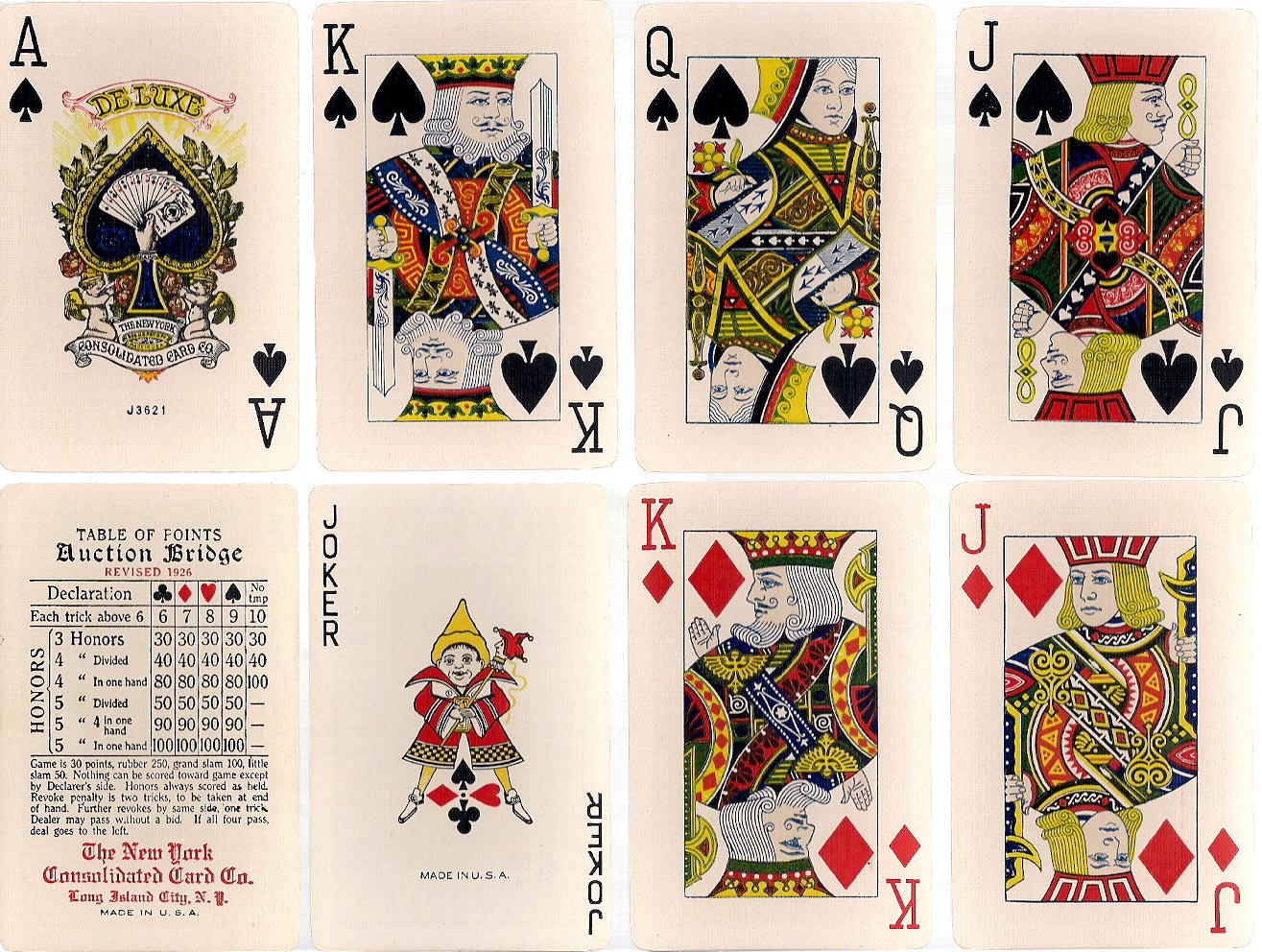
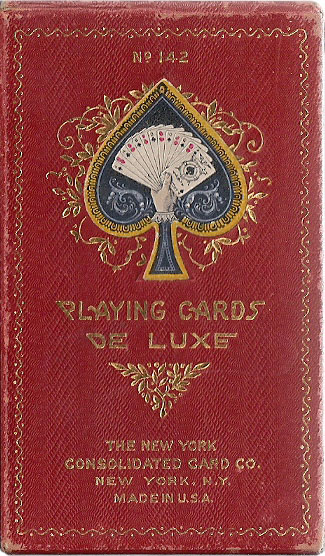
Above: De Luxe Bridge size cards, c.1926, with a colourful Ace of Spades. Note: the reference to the number 142 only appears on the box, not on either the Ace of Spades or the Joker. Images courtesy Rod Starling.
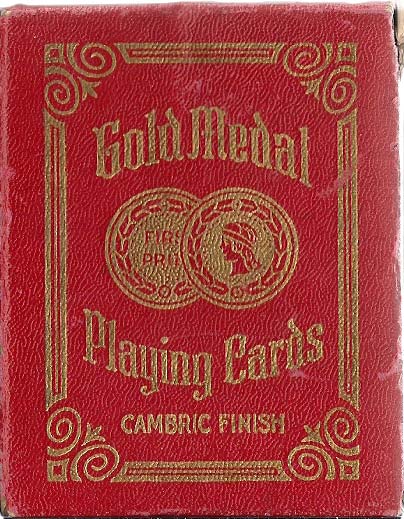
Right: the front of the box (click to zoom) →
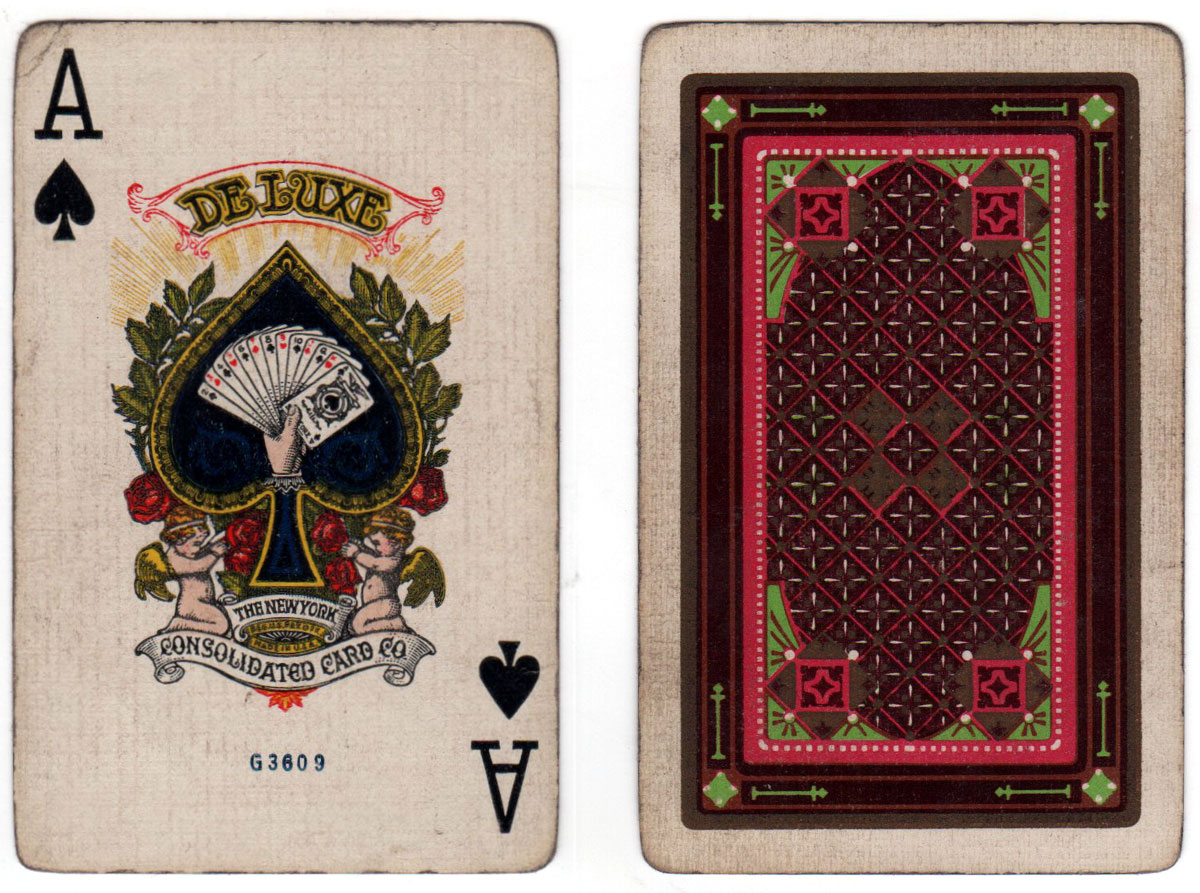
The De Luxe No.142 brand was quite popular with the result that many specimens of the decks have survived. It is not known exactly when the brand was discontinued but the latest date of issue would probably be 1930 when NYCC merged with the Andrew Dougherty Playing Card Company and produced cards under the name of Consolidated-Dougherty Playing Card Company until 1962.
The back design is just one of many that were used for the brand, some of which were pictorial and some Arabesque.
“De Luxe No.142” Wide Size
Slighty earlier a wide size version of De Luxe No.142 had been published, in c.1920, with a similar Ace of Spades and Joker, but which was never very popular. The narrow version shown above was issued shortly afterwards.
Above: De Luxe cards, wide size, c.1925. The Ace of Spades is not coloured. This is an extremely rare deck. Images and extra notes courtesy Rod Starling.
Right: this box was used for various brands. A special De Luxe box was probably never made for the wide version (click to zoom) →
The “Cambric Finish” mentioned on the box was a sort of fabric texture applied to the cards which improved their handling qualities. It has also been seen on NYCCC's “Bee” brand. The box containing the wide deck is intriguing. It looks “generic” and was probably used for several different brands. One gets the impression that from the outset, NYCCC did not intend to go very far with the wide version. Hence, they never made up its own particular box.
REFERENCES
Dawson, Tom & Judy: The Hochman Encyclopedia of American Playing Cards, U.S. Games Systems Inc., 2000
Cards from the collection of Rod Starling.

By Rod Starling (1936-2023)
United States • Member since January 09, 2013
Rod Starling was one of the founding members of the 52 Plus Joker card collectors club. He authored many articles for the club's quarterly newsletter, Clear the Decks. His collection encompasses both foreign and American decks. Rod also authored a book titled The Art and Pleasures of Playing Cards.

Activity for De Luxe No.142
Sign in to comment or save this article.

Related Articles
Paper Empires by Jason McKinstry
A review of Jason McKinstry’s Paper Empires, Volume I, an illustrated study of early American...
Mediaeval Playing Cards
Finely executed late 19th century pack from the USA featuring courts in medieval costume.
The Bird by Kings Wild Project
Originally titled Oriole Playing Cards, based on a deck produced by The New York Consolidated Card C...
A Case Study
Case Study: using detective work to identify and date a pack discovered in charity shop.
43: The United States Playing Card Co.
The United States Playing Card Co. (USPCC) represents an amalgamation of all the major American card...
34: Design Copies
Some copies of the designs of Goodall and the New York Consolidated Card Co.
Lighthouse No.922
“Lighthouse No.922” playing cards were introduced in c.1920.
Triton No.42
There have been at least three different versions of the Triton deck, with different Jokers, differe...
7: Brands and Packs
The introduction of brands commenced during the late 19th century as a development of the old qualit...
Lawrence & Cohen
Lawrence & Cohen were successors to Lawrence, Cohen & Co.
Royal Playing Cards, 1890s
Royal Playing Cards, 1890s
Lewis I. Cohen
Lewis I. Cohen made his first deck of cards in 1832. In 1835 Mr Cohen invented a new machine to prin...
New York Consolidated Card Company
The New York Consolidated Card Company was formed in 1871 by the merging of Lawrence & Cohen, Samuel...
Samuel Hart, 1846-1871
Samuel Hart was a prolific manufacturer of playing cards who commenced business sometime around 1845...
Squeezers No.35
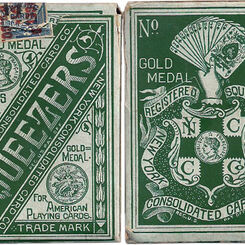
By 1877 the New York Consolidated Card Co's "Squeezers" were a great success on account of the indic...
Bertrand Domec, 1904-1970 page 2
Bertrand Domec page 2 (c.1905-1926).
Most Popular
Our top articles from the past 60 days


