


Handmade playing cards
Non-standard designs on Nepalese handmade paper for Pilgrims Book House, Kathmandu, Nepal, c.2000.

Non-standard designs on Nepalese handmade paper for Pilgrims Book House, Kathmandu, Nepal, c.2000. Traditional Nepalese figures (Bodhisattvas and auspicious symbols*) appear on the court cards and decorated Aces. The same three court card designs are used in each suit. Printed in black or red only.
There are at least two, slightly different versions of this pack. Type 1 is on thicker paper in a deeper box. The decoration on the red-suit Aces is barely visible. The backs are plain orange-red. Type 2 is on thinner paper in a slimmer box with different script. Darker red used for the red suits. The decoration on the red-suit Aces is more visible. The backs are brown. There are also differences in the telephone numbers and websites given on the backs of the tuck boxes. It is not clear whether one pack predates the other.
Type 1
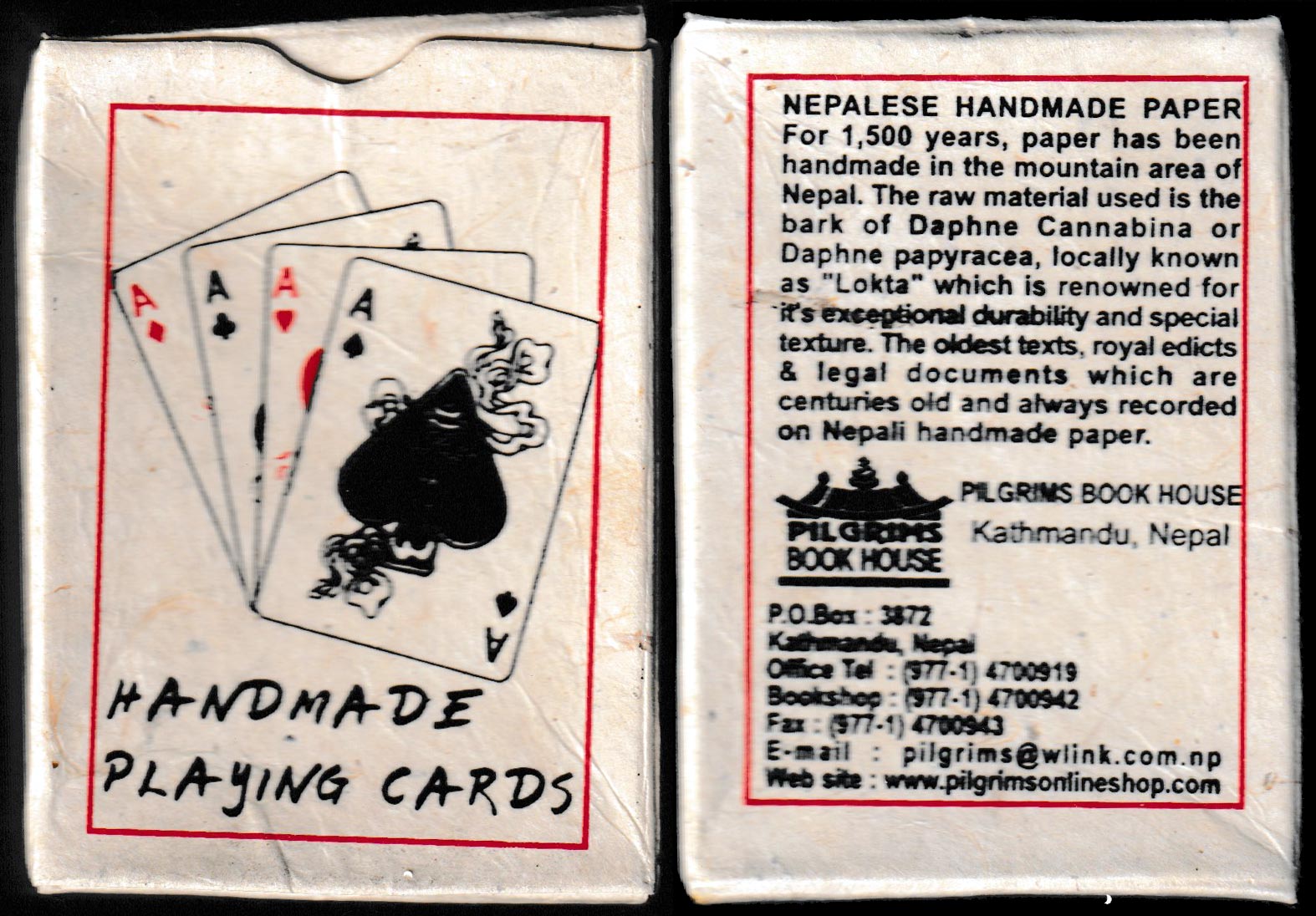
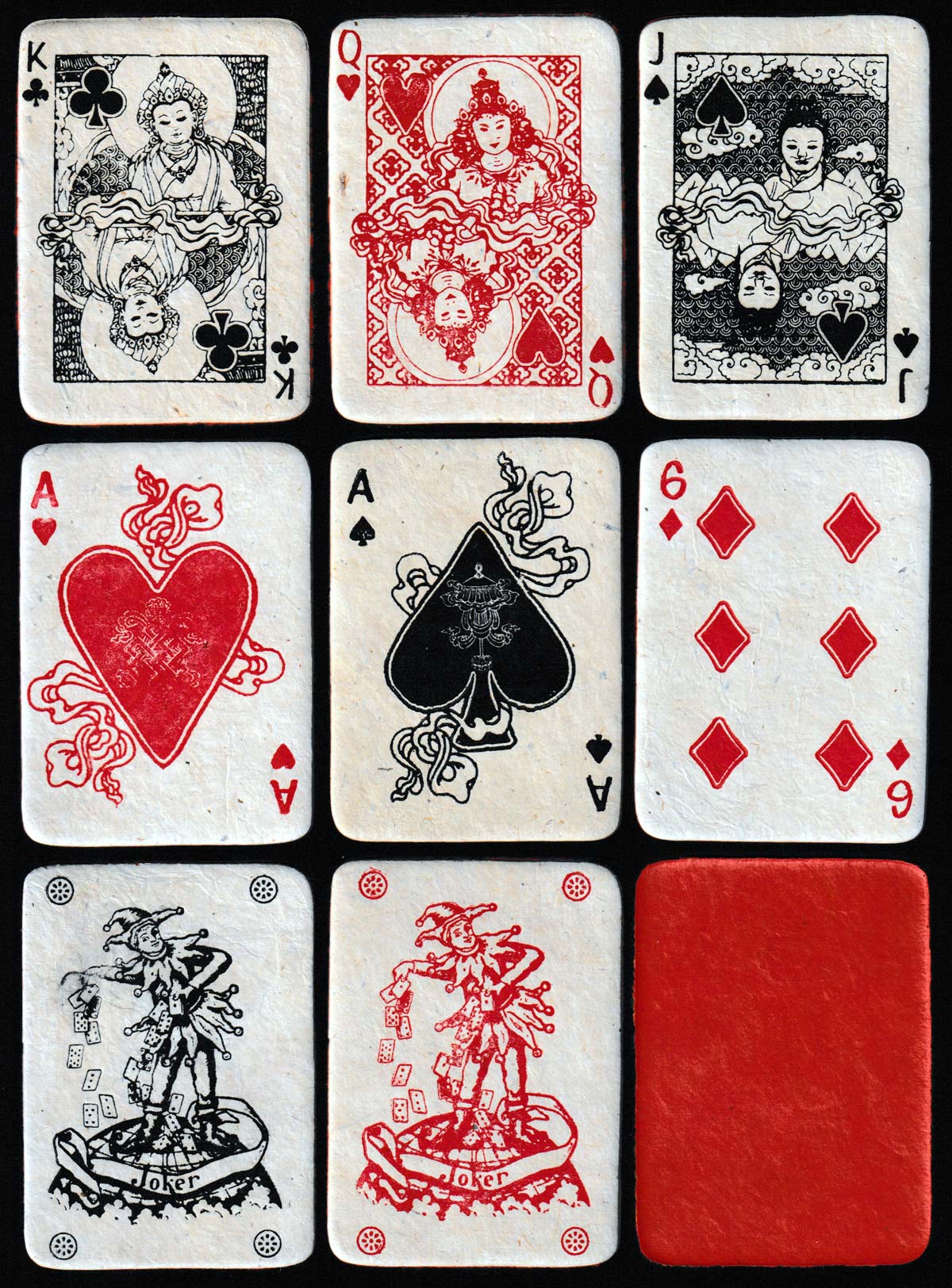
Above: size 60 x 84 mm. 52 cards + 2 Jokers in a handmade box. The Joker design is a copy of one by Carta Mundi. The ace of hearts contains an Endless Knot motif within the central heart, overlapping without a beginning or an end, symbolising the Buddha’s endless wisdom and compassion. The ace of spades contains a Parasol decorated with precious jewels which represents the Buddha’s unfathomable wisdom and compassion.
Type 2
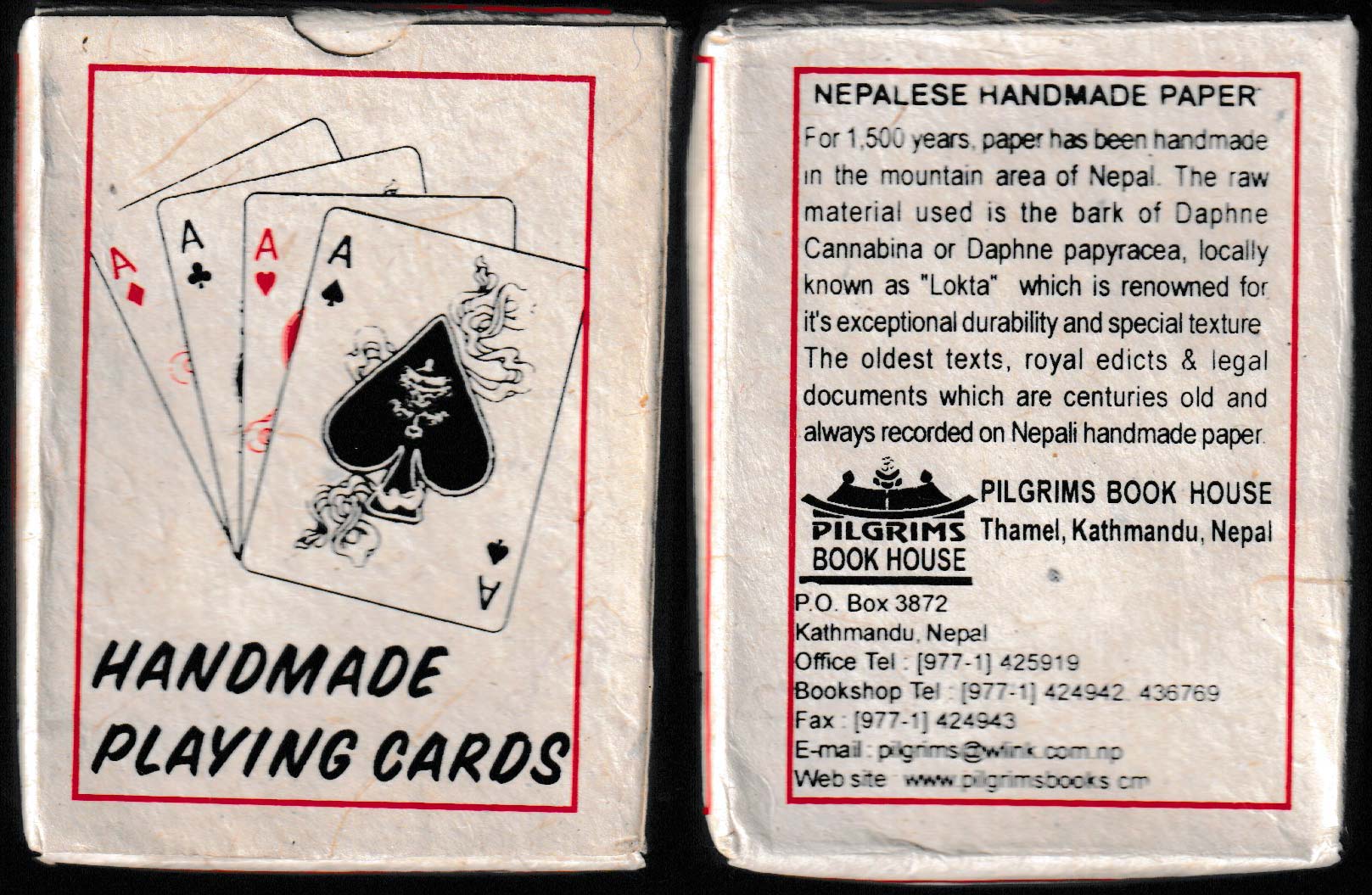
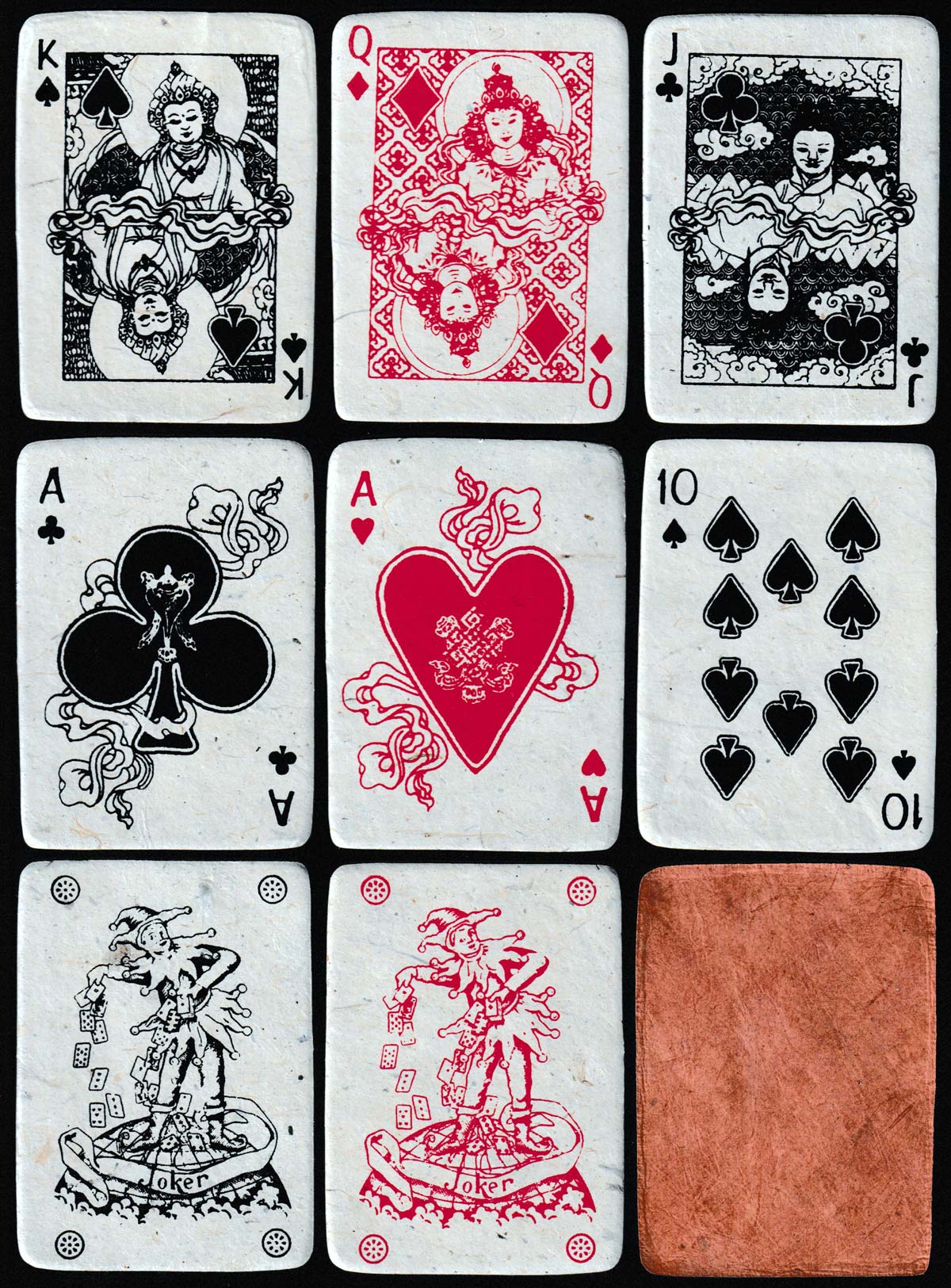
Above: Nepalese Handmade playing cards, 52 cards + 2 Jokers in handmade box. The backs are brown. The ace of clubs contains a Conch motif, one of the eight Auspicious Symbols, representing the proclamation of the truth of Dharma fearlessly, which is profound, melodic and far-reaching. The ace of hearts contains the Endless Knot described above.
Pilgrims Book House used to be the most famous (and best stocked) bookshop in Kathmandu. However, a disastrous fire in 2013 wiped out almost its entire stock. It is likely that these packs predate the fire as they are no longer being offered on the company’s website.
* Further References
Samten de Wet has kindly provided extra information regarding the iconography and symbolism of these cards. “...it certainly is a blend of the ordinary playing cards, garnished with Buddhist motives. In the ACES are the AUSPICIOUS SYMBOLS - on which there is a wealth of material available online. The King and Queen &c are most likely stock images of Bodhisattvas, Buddhas – sourced from a Buddhist Nepalese Pantheon – with the Western Joker thrown in for good luck”.
Further comment from Dr Ben Joffe: “These are lovely! Agree with Samten that one would have to see the entire deck to get a better idea. The black Jack's face also looks a little like typical representations of Guru Rinpoche a.k.a. Padmasambhava, the 'second Buddha' tantric saint who tamed the autochthonous deities of Tibet, if only because of his thin curly moustache but it's a bit hard to say.”

By Roddy Somerville
France • Member since May 31, 2022
Roddy started collecting stamps on his 8th birthday. In 1977 he joined the newly formed playing-card department at Stanley Gibbons in London before setting up his own business in Edinburgh four years later. His collecting interests include playing cards, postcards, stamps (especially playing cards on stamps) and sugar wrappers. He is a Past President of the Scottish Philatelic Society, a former Chairman of the IPCS, a Past Master of the Worshipful Company of Makers of Playing Cards and Curator of the WCMPC’s collection of playing cards. He lives near Toulouse in France.

Activity for Handmade playing cards
Sign in to comment or save this article.

Related Articles
Ubo cards
Traditional Ubo cards from the Philippines made from tree bark.
Race Card
‘Race Card’ playing cards published by the Concept Card Co., New Orleans, Louisiana, USA.
The Times of Kamehameha The Great
Figures from Hawaiian history and scenes of everyday life designed by Joseph Feher.
Traditional Nomadic Life of Mongolia
Playing cards depicting paintings of Traditional Nomadic Life of Mongolia.
Habesha playing cards
Habesha playing cards published by “Ethiopian Reflection”
Happy Playing Cards
Cheerful, colourful designs on handmade paper from Nepal.
Tonalamatl
Baraja Tonalamatl Mexican Aztec playing cards based on the prehispanic Codex Borgia manuscript.
Characters of “The Water Margin”
Characters from the Chinese novel “The Water Margin” - 水滸撲克.
Banana Leaf Cards
English Standard pack hand drawn & coloured on banana leaf, c.1820.
Ainu culture
A terrific deck of cards made by Nintendo c.1979 with original designs on every card showing the Ain...
Iceland Mythological Playing Cards
Iceland Mythological Playing Cards designed by Sigurlinna Pétursson, 1958
Pelaco
‘Pelaco’ playing cards with Aboriginal characters by Sands & McDougall, Australia, c.1930.
Reed Paper Products
Reed Paper Products of Waterloo manufactured playing cards until the late 1970s.
Kenya Tribes Playing Cards
“Kenya Tribus” playing cards published by Sapra, Mount Kenya Sundries Ltd, Nairobi, 1991
Mongol Playing Cards
Mongol Playing Cards with courts in traditional costume.
Maori
Maori themed playing cards from New Zealand depicting Maori Kings, Queens and Chiefs
Lithuanian
Lithuanian Playing Cards, reprinted by Piatnik, 1995, 2004.
Mongolian Playing Cards
Mongolian Playing Cards.
Naipes Condor
"Naipes Condor" Chilean playing cards, with Chilean symbolism on the suit signs.
Thomas Creswick
Thomas Creswick was a paper-maker and wholesale stationer. Playing cards were produced from c.1820 o...
Most Popular
Our top articles from the past 60 days


Peter Burnett
19 November 2025, 09:47SavedSaved this article to Peter's Collection
Ethan Gibson
12 April 2026, 20:04SavedSaved this article to Ethans Collection