


Early nineteenth-century Transformation cards
Vernacular hand-painted Transformation cards, probably early 19th century.
These early nineteenth-century Transformation cards appear to have been individually designed using pen, ink and watercolours onto standard printed cards of the day. As such, they are likely unique, unless the artist produced multiple versions; even then, each would inevitably have differed in detail. It is possible that the maker owned, or had seen, commercially produced cards and enjoyed creating reinterpretations. At least one composition supports this idea: the six of clubs depicting marching soldiers corresponds closely to a well-known and frequently copied transformation motif.
The cards are probably around two centuries old and reportedly surfaced in the drawer of a desk in Rhode Island. The printed pips are single-ended rather than double-headed, a feature that strongly suggests a date before about 1850, when double-ended courts and pips became standard. The missing court cards would, by extension, also have been single-ended. The card backs are plain and unprinted, consistent with early nineteenth-century production.
In their informality and variation, the cards remind us that transformation imagery was not confined to professional engravers, but also flourished as a personal, imaginative pastime which give us glimpses of contemporary life. Zoom the two of spades


Above: 20 hand painted early 19th-century Transformation cards by an unknown artist, c.1800–1830. Images from the collection of Ronald Wells.
Thanks to Barney Townshend for advice about this deck.

By Simon Wintle
Spain • Member since February 01, 1996
I am the founder of The World of Playing Cards (est. 1996), a website dedicated to the history, artistry and cultural significance of playing cards and tarot. Over the years I have researched various areas of the subject, acquired and traded collections and contributed as a committee member of the IPCS and graphics editor of The Playing-Card journal. Having lived in Chile, England, Wales, and now Spain, these experiences have shaped my work and passion for playing cards. Amongst my achievements is producing a limited-edition replica of a 17th-century English pack using woodblocks and stencils—a labour of love. Today, the World of Playing Cards is a global collaborative project, with my son Adam serving as the technical driving force behind its development. His innovative efforts have helped shape the site into the thriving hub it is today. You are warmly invited to become a contributor and share your enthusiasm.

Activity for Early nineteenth-century Transformation cards
Sign in to comment or save this article.

Related Articles
Royal Mischief Transformation
Royal Mischief Transformation reworks Patrick Valenza’s Royal Mischief characters and imagery...
5th Kingdom playing cards
5th Kingdom Luxury playing cards designed by Maria Fedoseeva, USA, 2020.
Murphy Varnish pack
Reproduction of the 1883 Murphy Varnish transformation pack, USA, 2019
Around the world in 54 cards
“Around the world in 54 cards” hand-coloured transformation pack produced by Peter Wood, United King...
EclecDeck
EclecDeck transformation playing cards created by Dave Ufford, 2013.
La-Tee-Da transformation playing cards
Facsimile edition of ‘La-Tee-Da’ transformation playing cards, originally made in 1865 by Dean & Son...
The Deck
The Deck semi-transformation playing cards, USA, 1983.
Hand made WW2 Prisoner of War Playing Cards
made by German soldiers held captive by US troops
Curator
The Curator Deck with designs by Emmanuel José with suit symbols cleverly transformed into artistic ...
Palladin
Palladin Parlour & Playing Cards by Laura Sutherland, published by Palladin Paperworks, Santa Cruz C...
Thackeray Transformation Cards
Transformation playing cards by William Makepeace Thackeray, 1876.
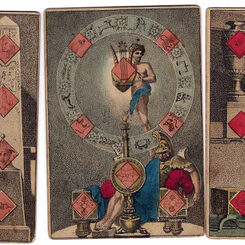
Hand-Painted Transformation, c.1800-20
An early 19th century set of hand-painted transformation playing cards depicting contemporary scenes...
Bartlett Ackermann Transformation
Pictorial playing cards published by C. Bartlett, New York, 1833.
Ye Witches’ No.62 Fortune Cards
Ye Witches Fortune Telling Cards published by the United States Playing Card Co., 1896. 52 cards + J...
Hustling Joe
Hustling Joe himself appears on the Ace of Spades dressed in red.
Inky-Dinky Playing Cards
A series of four decks designed by John Littleboy.
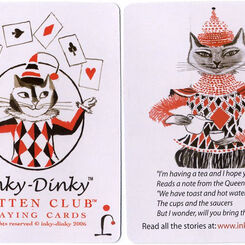
Kitten Club
From Empresses to King Cats and One-Eyed Jacks, every game is a pageant of unforgettable cats, each ...
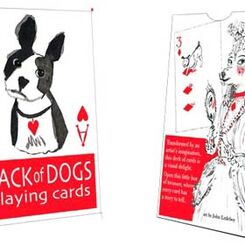
Pack of Dogs
Pack of Dogs playing cards designed by John Littleboy. Every card tells a story...
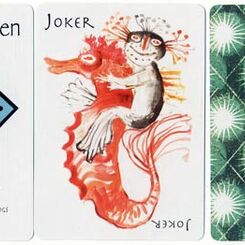
Mermaid Queen
Mermaid Queen playing cards, from a series of four decks designed by John Littleboy, 2008
Renaissance Playing Cards
Renaissance Playing Cards by Maxim Hurwicz, showing 54 different drawings spanning the years 1066 to...
Most Popular
Our top articles from the past 60 days


