


Portuguese pattern
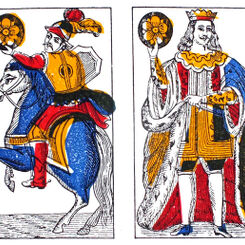
19th century Portuguese pattern, re-printed from original woodblocks.

The Portuguese pattern
This “later” version of the old Portuguese pattern can be traced back to the 16th century when it was carried abroad by Spanish and Portuguese explorers. It was produced more recently by the Real Fabrica de Lisboa from c.1769 onwards and the pattern was manufactured elsewhere until the mid-19th century. It still has the ‘Dragon Aces’ which are now more like serpents, and the Maid of Clubs is about to hit a dog. The Maid of Coins holds what used to be a shield. The pattern was also made in Brazil, but a larger number of Belgian copies were produced in Turnhout until the early part of the 20th century, when the pattern died out.

Above: 19th century Portuguese pattern, cards re-printed from original woodblocks, published by Vito Arienti, Edizioni del Solleone, 1978. Similar to Spanish cards the courts are Sota (female page, no crown), Knight and King. There are no Queens! The Aces are dragons.

By Simon Wintle
Spain • Member since February 01, 1996
I am the founder of The World of Playing Cards (est. 1996), a website dedicated to the history, artistry and cultural significance of playing cards and tarot. Over the years I have researched various areas of the subject, acquired and traded collections and contributed as a committee member of the IPCS and graphics editor of The Playing-Card journal. Having lived in Chile, England, Wales, and now Spain, these experiences have shaped my work and passion for playing cards. Amongst my achievements is producing a limited-edition replica of a 17th-century English pack using woodblocks and stencils—a labour of love. Today, the World of Playing Cards is a global collaborative project, with my son Adam serving as the technical driving force behind its development. His innovative efforts have helped shape the site into the thriving hub it is today. You are warmly invited to become a contributor and share your enthusiasm.

Activity for Portuguese pattern
Sign in to comment or save this article.

Related Articles
Carte Romantiche Italiane
Scenes of life and the theatre in Milan towards the second half of the 19th century.
Lo Stampatore
‘Lo Stampatore’ linocut images created by Sergio Favret, published as a deck of cards by Editions So...
Schwarze Katze (or Gioco del Gatto Nero)
Reproduction of a 40-card transformation pack with designs by “WS”, adapted for the game of Black Ca...
Le Nuove Minchiate di Firenze
Costante Costantini's second Minchiate deck, “Le Nuove Minchiate di Firenze”, was published by Solle...
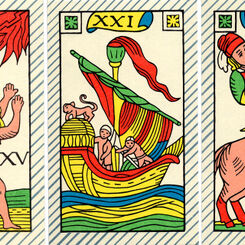
Minchiate Fiorentine
Minchiate Fiorentine created by Costante Costantini, published by Edizioni del Solleone.
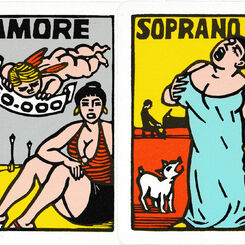
Il Mercante in Fiera del Solleone
Traditional Italian card game with bold designs by Costante Costantini.
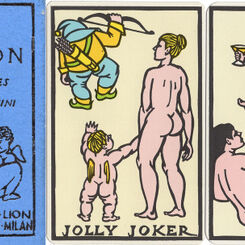
Venus et Cupidon
“Venus et Cupidon” from Costante Costantini in his distinctive woodcut style.
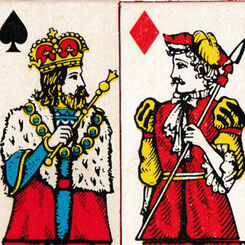
Italia playing cards
Small, narrow cards designed by Osvaldo Menegazzi, bearing a strong resemblance to a Swedish pattern...
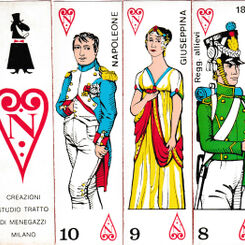
Napoleone playing cards
Long, narrow cards designed by Osvaldo Menegazzi, featuring Napoleon, Josephine and various soldiers...
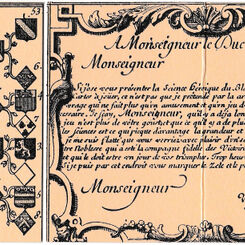
Carte Méthodique
Reproduction of a French pack by François Silvestre intended to teach heraldry, produced in Paris in...
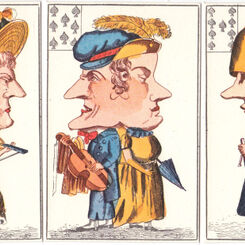
Jeu Grotesque
Jeu Grotesque was first published in France c.1800.
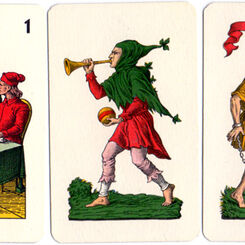
Tarocco Siciliano
The highly individual Sicilian Tarot has the Italo-Portuguese suit system with straight, interlockin...
Mitelli ‘Gioco di Passatempo’
Il Gioco di Passatempo contains 40 figurative playing cards depicting moral virtues and vices, dated...
Minchiate Fiorentine, 17th C.
17th century Minchiate cards reprinted from the original woodblocks.
Corona Ferrea
Trumps depict historical scenes primarily of the political period known as the Holy Roman Empire fro...

Tarocco Neoclassico
Gumppenberg published several new decks by artists or engravers of the day. The designs are clear an...
Piedmont Pattern
The Piedmont pattern is a very close relative to the French 'Paris' pattern. The courts are not name...

Portuguese Type Cards made in Belgium
Portuguese Type Playing Cards made in Belgium, c.1878.
Portuguese Type Playing Cards c.1860
10 cards from a pack of later Portuguese ‘Dragon’ type cards from c.1860, with the Maid of batons ab...
Neapolitan Pattern
Cartine da Gioco Vesuvio miniature Neapolitan pattern.
Most Popular
Our top articles from the past 60 days


