


Tarocco Siciliano
The highly individual Sicilian Tarot has the Italo-Portuguese suit system with straight, interlocking swords and batons, and maids instead of jacks
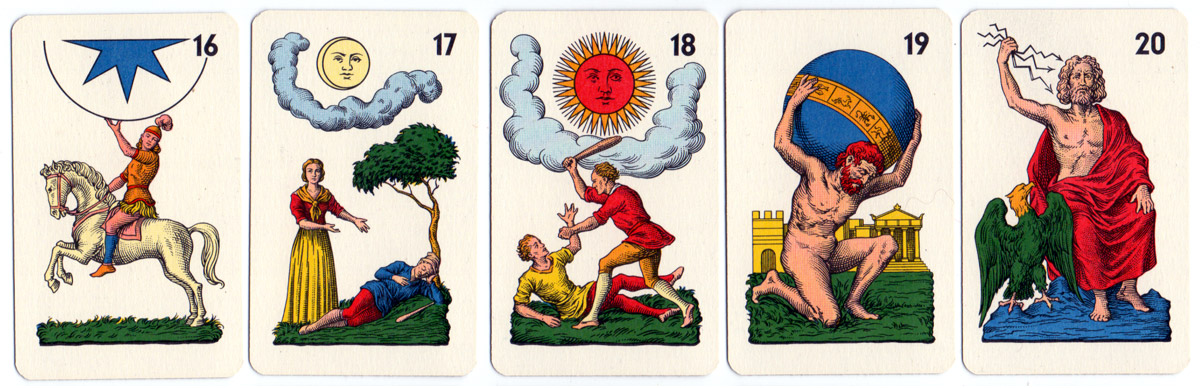
The highly individual “Sicilian Tarot” has the Italo-Portuguese suit system (found also in Minchiate and some early Spanish packs) with straight, interlocking swords and batons, maids instead of jacks in all suits, and suppresses the four aces and lower numeral cards. Several of the 22 trumps have new classicised images replacing the older ones which were seen as offensive (and some are derived from Minchiate). Trump 1 (i Picotti) shows some lads playing. The banner held by trump 4 sometimes reads “La Constanza” which identifies it as one of the ethical virtues. Trump 11, the Hanged Man, shows a man lynched from a tree. Trump 14 shows a ship, trumps 16, 17 & 18 are not the customary scenes. Trump 19 shows Atlas holding the celestial globe and trump 20 shows Jupiter. In early packs the trumps carried roman numerals but from the 19th century arabic numerals are found.
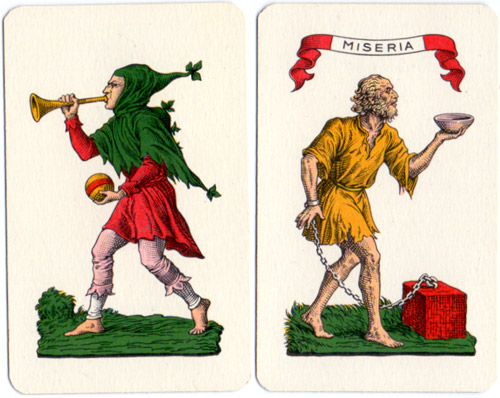
Above: the Fool is the highest ranking trump and serves to excuse the player from following suit. Miseria is the lowest trump, with no point-value, and ranking below trump 1.
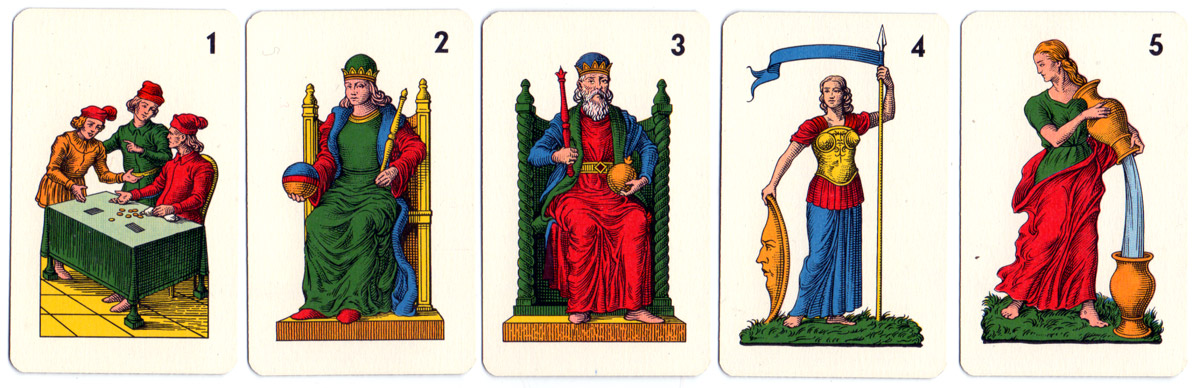
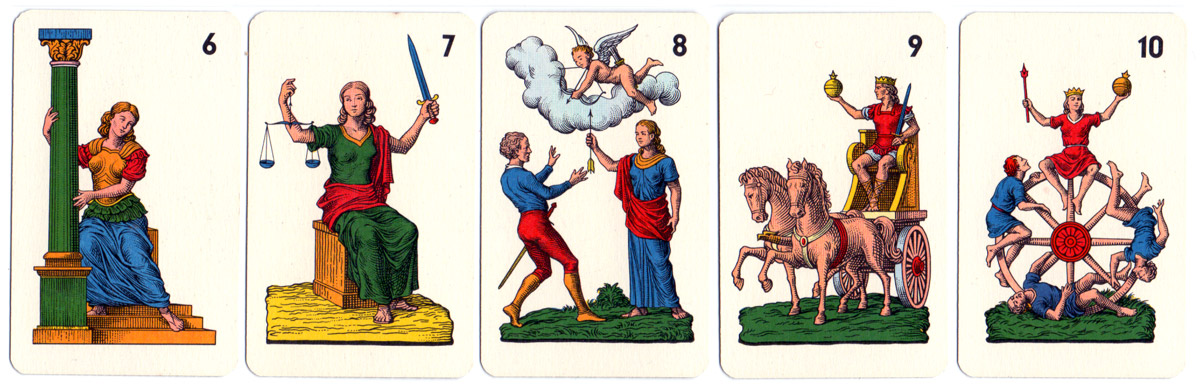
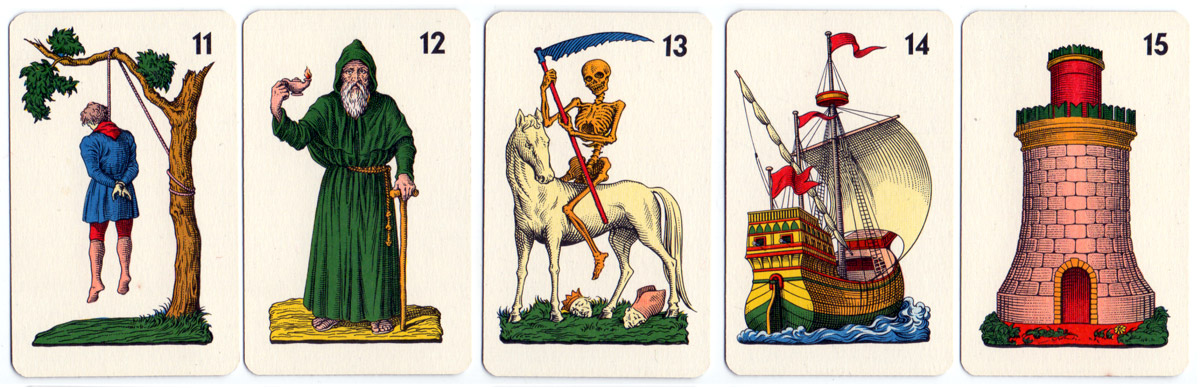
The Court Cards
The cards are of a relatively small size compared to other tarocchi sets. The suits are of the Portuguese type, and the court cards are based on the Archaic South Italian or Portuguese pattern with Maids (Donne) as the lowest court figures of all suits, and intersecting batons and swords on the numeral cards. No aces are used in the game.
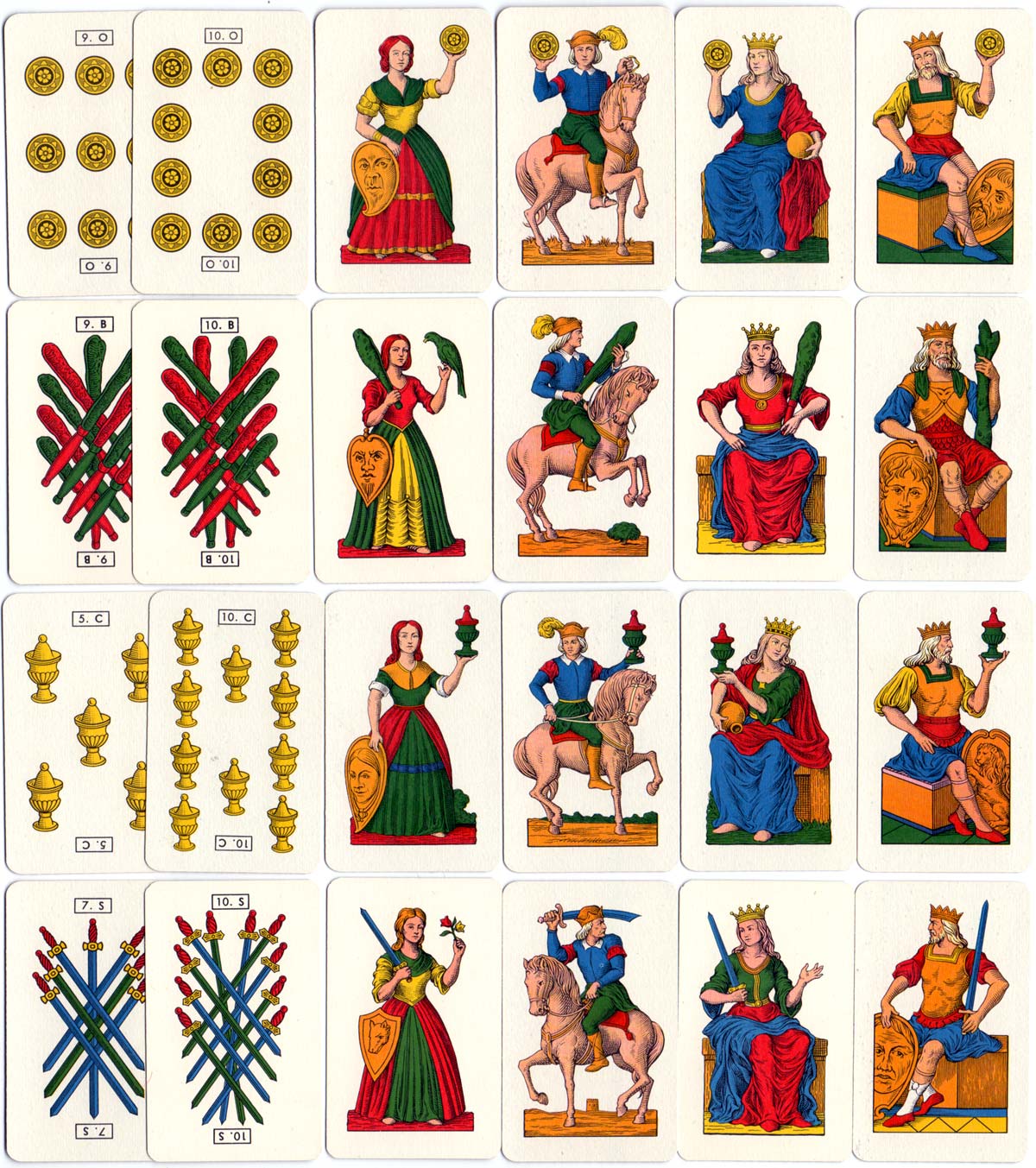
Above: Tarocco Siciliano No.94 manufactured by Modiano S.p.A., Trieste, c.1960, 64 cards in box. An ace of coins is included for the purpose of carrying the tax stamp.
Further References
Salvatore Bonaccorsi, Nicola De Giorgio, Emilia Maggio: The origins of the “Portuguese” suit system for playing cards and tarots in Sicily►

By Simon Wintle
Spain • Member since February 01, 1996
I am the founder of The World of Playing Cards (est. 1996), a website dedicated to the history, artistry and cultural significance of playing cards and tarot. Over the years I have researched various areas of the subject, acquired and traded collections and contributed as a committee member of the IPCS and graphics editor of The Playing-Card journal. Having lived in Chile, England, Wales, and now Spain, these experiences have shaped my work and passion for playing cards. Amongst my achievements is producing a limited-edition replica of a 17th-century English pack using woodblocks and stencils—a labour of love. Today, the World of Playing Cards is a global collaborative project, with my son Adam serving as the technical driving force behind its development. His innovative efforts have helped shape the site into the thriving hub it is today. You are warmly invited to become a contributor and share your enthusiasm.

Activity for Tarocco Siciliano
Sign in to comment or save this article.

Related Articles
Modiano Napoletane Cards
From Trieste with Pride – a 150th Anniversary Edition of the Neapolitan Pattern.
Czech National Patterns by S.D. Modiano
Modiano produced cards with the Prague and Trappola patterns in the early 20th century.
Austrian Tarock by S.D. Modiano
Modiano’s Austrian Tarock with country scenes has been in production for over 100 years.
Alan Tarot Deck
Reprint of a Tarock pack originally designed by Argio Orell for the Austrian Lloyd shipping company....
Tarocco Indovino
Sergio Ruffolo’s “Tarocco Indovino” is an expanded version of his “Lo Zodiaco” cartomancy deck.

Tarocco Piemontese by Giovanni Rossi
18th c. Piedmont Tarocchi by Giovanni Rossi, Turin.
Venetian Tarot
Scenes from the history of Venice on a set of the major arcana.
Il Quinto Seme
An Italian pack with a fifth suit of “amici” (“friends”).
Triestine Pattern
The Triestine pattern is derived from the Venetian (Trevisane) pattern but with its own characterist...
Primiera Bolognese
Primiera Bolognese by Modiano, c.1975
Bergamasche Pattern
Bergamasche Pattern by Modiano, 1970s.
V. F. Solesio Tarot
V. F. Solesio Tarot, Genoa, mid-late 19th century.
Il Destino Svelato Dal Tarocco
The Cagliostro Tarot was first published in 1912 as “Il Destino Svelato Dal Tarocco”.
Club Bridge
Modiano’s ‘Club Bridge’ is a new edition of a stylish deck originally published in c.1895.
Tarocco Piemontese | Piedmontese tarot
The double ended version of the Piedmontese Tarot evolved during the second half of the nineteenth c...
XV Century Italian Playing Cards
Cards from a pack of an early form of north Italian playing cards, with the swords back-to-back and ...
Tarocco Milanesi by Lamperti (Milan) c.1850
Tarocco Milanesi by Lamperti (Milan) c.1850
Tarocco Bolognese
Tarocco Bolognese
Neapolitan Pattern
Cartine da Gioco Vesuvio miniature Neapolitan pattern.
Hand-Painted Tarocchi Cards
Hand-painted Tarocchi cards sometimes known as ‘Charles VI tarot’, North Italy, 1475-1500.
Most Popular
Our top articles from the past 60 days


Jason Somers
10 June 2026, 06:38SavedSaved this article to Jason Somers's Collection