


Juan Roura Catalan
Catalan type by Juan Roura, La Hispano-Americana, Barcelona (1872 - 1962).
La Hispano-Americana, Barcelona
Standard Catalan type Spanish-suited playing cards with designs which evolved during the nineteenth century. The legend “Naipes Finos de Una Hoja” printed on the four of cups refers to the fact that the cards were printed on a single sheet of opaque card (‘una hoja’ = one sheet) rather than on two or three-ply pasteboard. In earlier times cards were printed on laminated card to ensure they would not be transparent, but improvements in paper making technology produced better quality cardboard. Juan Roura worked in Barcelona at Calle Nápoles no. 113 until acquired by Heraclio Fournier in 1962.
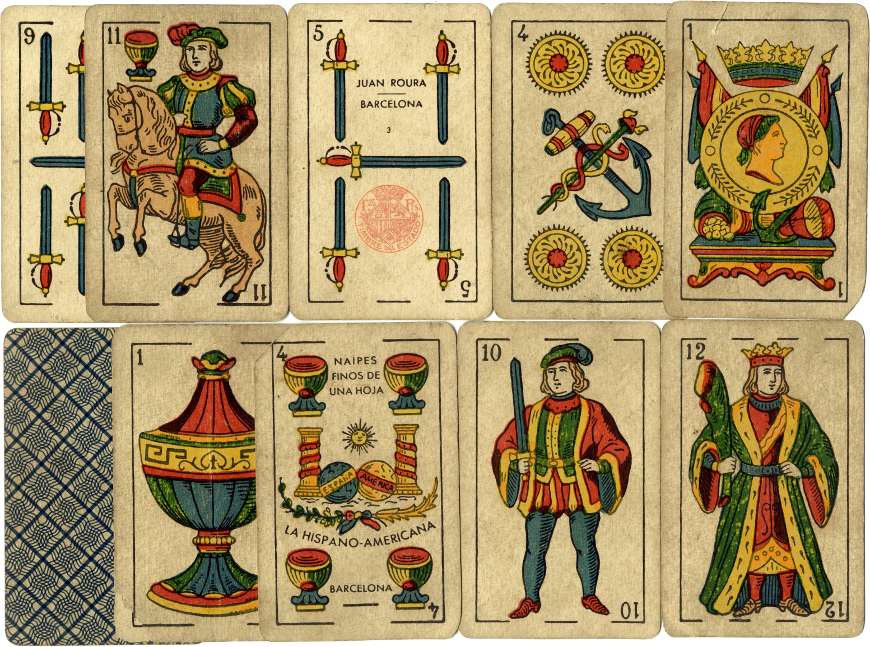
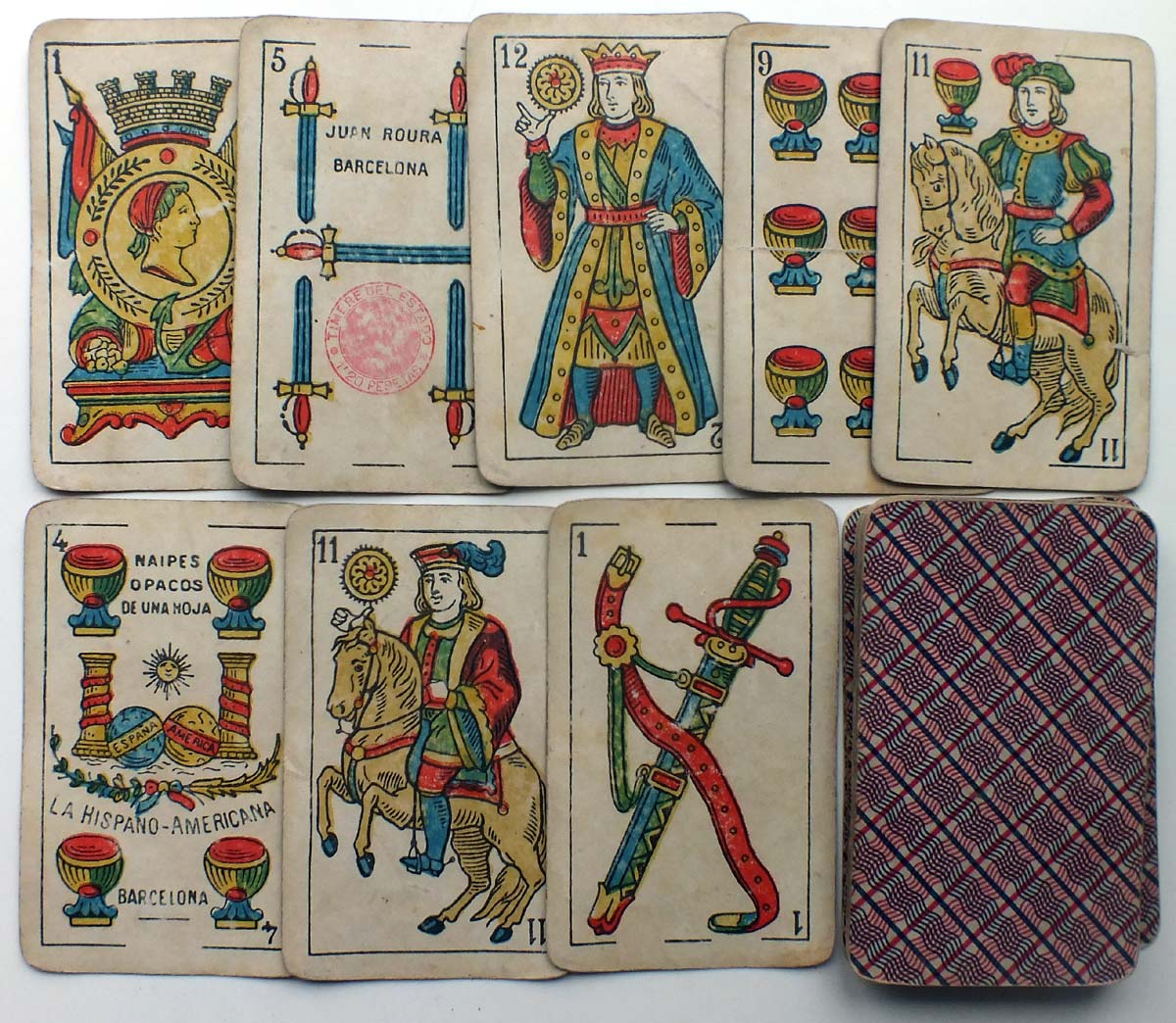
Above: cards from two examples of Catalan type "Naipes Finos de Una Hoja La Hispano-Americana", manufactured in Barcelona by Juan Roura, c.1930s. This design was used, with slight modifications, over several decades. The four of coins depicts an anchor and a caduceus, whilst the ace of coins also depicts an anchor along with a cornucopia and other emblems suggestive of maritime trade and national prosperity. The red 1.25 Pesetas tax stamp on the five of swords in both examples were used during the period c.1931-36. Roura also exported cards to South America.
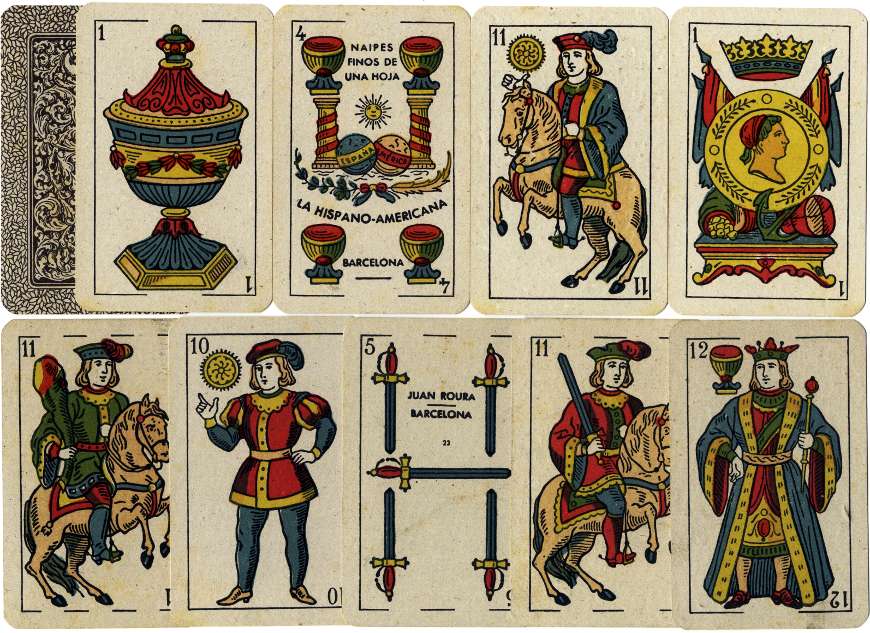
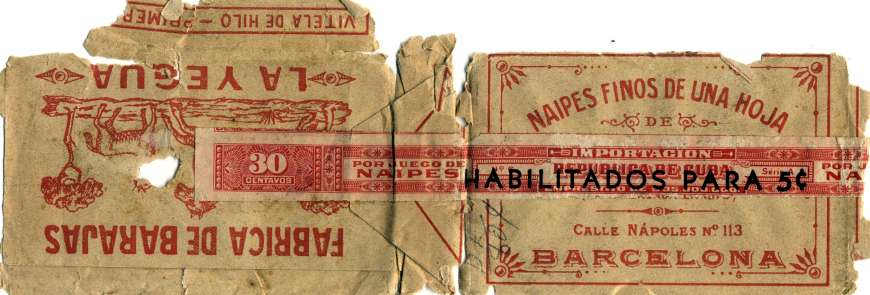
Above: cards and wrapper from another example of Catalan type "Naipes Finos de Una Hoja La Hispano-Americana", manufactured in Barcelona by Juan Roura and exported to Cuba in c.1950. There are some slight differences in the design of some cards, for example the Ace of Cups. Some of the court cards have different colouring. For more information about tax bands on Cuban playing cards click here.
See also: Roura Homepage Spain Homepage S. Giraldez, Barcelona Fournier No.55

By Simon Wintle
Spain • Member since February 01, 1996
I am the founder of The World of Playing Cards (est. 1996), a website dedicated to the history, artistry and cultural significance of playing cards and tarot. Over the years I have researched various areas of the subject, acquired and traded collections and contributed as a committee member of the IPCS and graphics editor of The Playing-Card journal. Having lived in Chile, England, Wales, and now Spain, these experiences have shaped my work and passion for playing cards. Amongst my achievements is producing a limited-edition replica of a 17th-century English pack using woodblocks and stencils—a labour of love. Today, the World of Playing Cards is a global collaborative project, with my son Adam serving as the technical driving force behind its development. His innovative efforts have helped shape the site into the thriving hub it is today. You are warmly invited to become a contributor and share your enthusiasm.

Activity for Juan Roura Catalan
Sign in to comment or save this article.

Related Articles
Navarra Pattern, 1682
Navarra pattern produced for the Pamplona General Hospital Monopoly in 1682.
Navarra Pattern
Navarra Pattern produced for the Pamplona General Hospital Monopoly.
Navarra Pattern, 1793
Navarra pattern by an unknown cardmaker with initials I. I., 1793.

Cádiz Pattern playing cards
A popular Spanish playing card pattern widely exported to Spanish-influenced markets.
Pedro Rotxotxo
Standard Spanish National pattern by Pedro Rotxotxo, Barcelona, late 18th century.
Xilografías de Mallorca
Spanish National pattern re-printed from original woodblocks which are preserved in the monastery at...
Navarra, XVII Century
Facsimile of 17th century Spanish-suited playing cards produced by Erregeak, Sormen S.A., Vitoria-Ga...

Maciá Pattern
The Maciá Pattern which was originally produced by a Barcelona cardmaker in the 1830s and subsequent...

S. Giráldez, Barcelona
Standard Spanish Catalan pattern playing cards by S. Giráldez, Barcelona, c.1905.

Hija de B Fournier
Having started out as Fournier Hermanos, Burgos in 1860, the company remained in the Fournier family...

Sanmartí, 1840
Sanmartí, 1840.
Heraclio Fournier S.A.
Founded in 1868, today it is part of Cartamundi.

Spanish Playing Cards ~ La Baraja Española
Spain has played a pivotal role in the history of playing cards in Europe and Latin America.
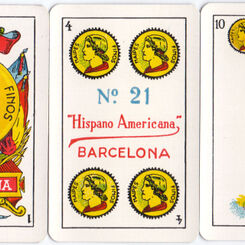
Naipes Finos No.21
Naipes Finos No.21 "Hispano Americana", in the Castilian style, by Juan Roura, Barcelona, c.1940.

Moliner - Burgos
Cards from a Nº 4 pack manufactured by Antonio Moliner, Burgos.
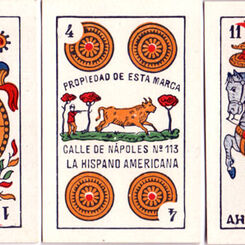
Juan Roura, Cadiz pattern
Cádiz type playing cards made by Juan Roura for export to Spanish-speaking countries.
Juan Roura, Barcelona (1872 - 1962)
Juan Roura produced a range of popular designs including Catalán, Castilian and Cádiz patterns for d...
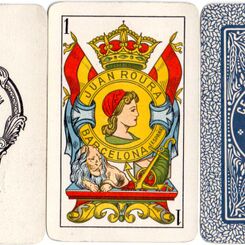
Juan Roura No.32 Catalan pattern
Juan Roura No.32, with advertisement for Cervezas Damm, c.1932.

Baraja Boxeo
Baraja de Boxeo, c.1930.

Baraja Artistas del Cine Mudo
Baraja Artistas del Cine Mudo, c.1926.
Most Popular
Our top articles from the past 60 days


