


S. Giráldez, Barcelona
Standard Spanish Catalan pattern playing cards by S. Giráldez, Barcelona, c.1905.
S. Giráldez, Barcelona, c.1905
This pattern developed in North Eastern Spain, mainly Barcelona, during the nineteenth century. The shape of the cup symbols, like egg cups, is distinctive and a move away from the earlier baroque traditions in Spanish playing cards. The figures also have more natural proportions with youthful faces and bland expressions, to the extent that in many cases they are devoid of any personality. The characteristic Ace of Coins shows a central female bust in profile, within a wreathed and crowned circular frame. This is mounted on a low platform carrying symbols of commerce and prosperity - barrels, cornucopias, anchors, etc., with flags draped at the sides. The Modern Spanish Catalan Pattern has become well-established in South America as well as in Spain.
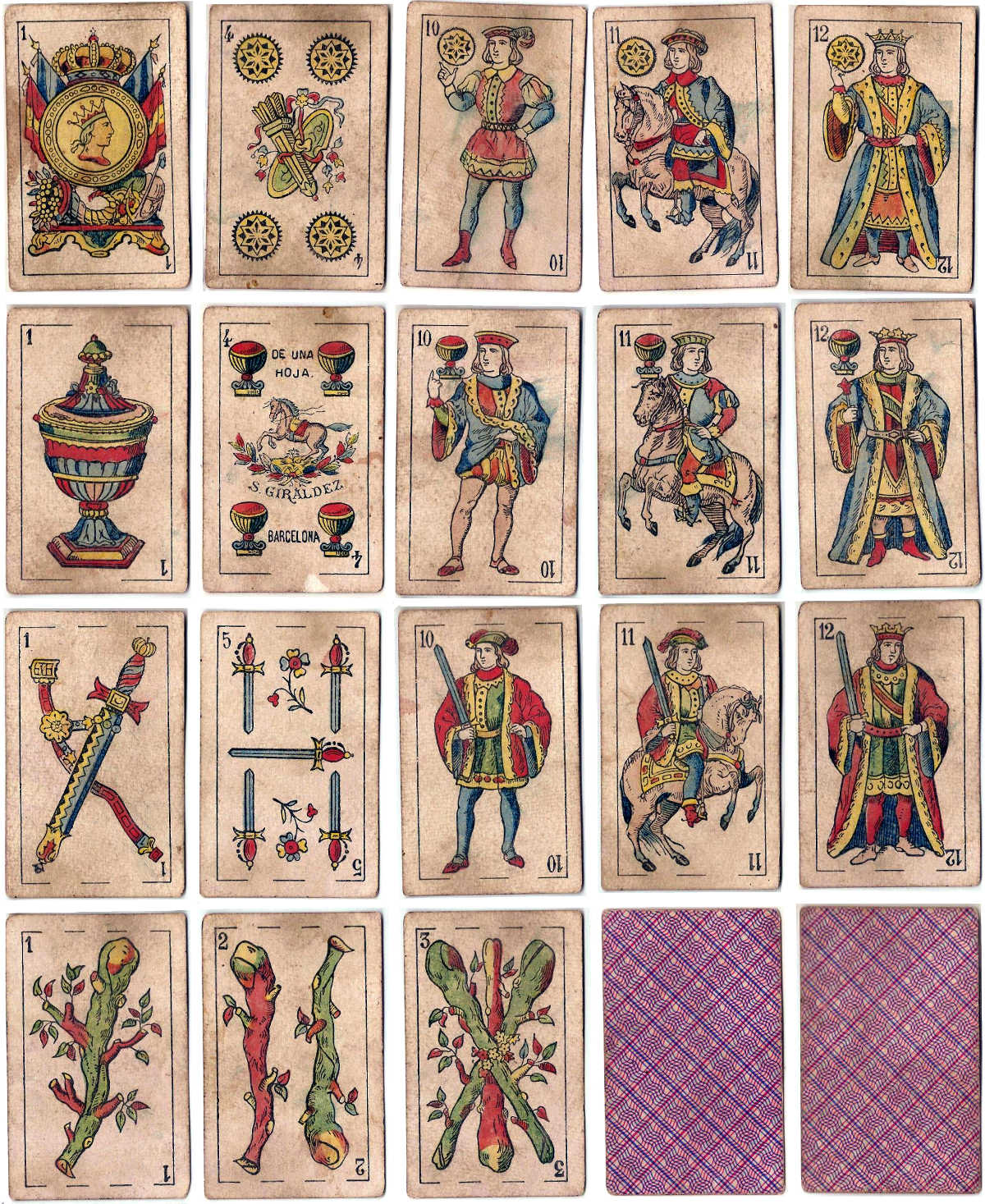
Above: standard Catalan pattern Spanish-suited playing cards by S. Giráldez, Barcelona, c.1905. 40 cards, hand-coloured. The ace of coins shows a cornucopia and an anchor, symbolical of maritime trade and abundance, with flags draped either side of a medallion. In this design the kings are clean-shaven.

By Simon Wintle
Spain • Member since February 01, 1996
I am the founder of The World of Playing Cards (est. 1996), a website dedicated to the history, artistry and cultural significance of playing cards and tarot. Over the years I have researched various areas of the subject, acquired and traded collections and contributed as a committee member of the IPCS and graphics editor of The Playing-Card journal. Having lived in Chile, England, Wales, and now Spain, these experiences have shaped my work and passion for playing cards. Amongst my achievements is producing a limited-edition replica of a 17th-century English pack using woodblocks and stencils—a labour of love. Today, the World of Playing Cards is a global collaborative project, with my son Adam serving as the technical driving force behind its development. His innovative efforts have helped shape the site into the thriving hub it is today. You are warmly invited to become a contributor and share your enthusiasm.

Activity for S. Giráldez, Barcelona
Sign in to comment or save this article.

Related Articles
Most Popular
Our top articles from the past 60 days


