


Tax on Spanish Playing Cards
Taxation on Spanish playing cards, the monopolies and smuggling.
By the 16th century, the Spanish crown recognized the profitability of card games and imposed heavy taxes and regulations, making card production a state-controlled monopoly, or estanco, in many regions. A state-controlled monopoly was first established in 1543. It was divided into several regions including Aragon, Toledo, Castile, Seville as well as Mexico and ‘New Spain’. Leases for these respective monopolies were awarded on a competitive basis to the highest bidder and subject to strict controls. Lease holders also enjoyed the protection of laws governing the playing card monopolies, which included the outlawing of contraband playing cards and protection against Moors, Turks, Pirates, Corsairs and enemies of the Catholic Faith. Manufacturers were required to sell their packs of playing cards at prices controlled by law.
Seeking to prevent the outflow of Spanish currency, the King issued a royal decree on March 11, 1552, banning the entry of "all types of playing cards," among other items. However, the decree proved ineffective due to strong public opposition, leading to widespread smuggling. In response, noting that despite the earlier prohibition, playing cards and other goods continued to enter Spain illegally, tariffs were imposed in another decree dated July 28, 1565, setting the duty at "half a real of silver (17 maravedís) per deck." Remarkably, this tax was even higher than the actual cost of the deck itself, thereby creating a powerful incentive for more smuggling. The cost of playing cards having been artificially inflated by the tax, it became highly profitable to bypass these fees, importing French and Italian playing cards secretly.
In 1575 the playing card administration in Castile was divided into three districts (Madrid, Sevilla, Toledo) and as a controlling measure it was declared obligatory to indicate the origin or destination of cards, such as “EN SEVILLA” or “PARA TOLEDO”. This law applied to all Spain except Catalonia, Valencia and Balearic Isles. These regulations drove up the cost of legal decks. The high prices and restricted supply created a black market, as players sought cheaper alternatives. Card makers, particularly from regions outside Spain or those evading the estanco, began smuggling decks to meet this demand. While direct accounts of specific smuggling operations are scarce, evidence suggests that producers in France and Italy, operating through ports or overland routes, contributed to a thriving black market. Most of these unregulated decks omitted the manufacturer's name and included fake claims like "con licencia del rey".
The smuggling wasn’t just about economics; it was a defiance of control. The Spanish church and state had been attempting to ban or restrict card games due to their association with gambling and idleness, since the late XIV century. These restrictions pushed the trade underground. The “flooding” of the Spanish market with smuggled decks was a natural response to overregulation and high demand.
Catalonia had a local tax in the 17th century, at least since 1613. The assignment of the lease on May 8, 1628, also involved cards imported from France, but more from Castile. Card makers registered samples of their production. For export, cards and packaging had to be marked.
Until the 19th century, there were various forms of monopoly on making and selling cards. The last one was the Real Fábrica de Naipes, the Royal Card Factory of Madrid (18th century - beginning of the 19th century). Its marking "RL FB DE MD" can be read on some packs. Imitations, e.g., made in Turnhout, had the spelling "RL EA DE MD".
Sevilla, XVII Century
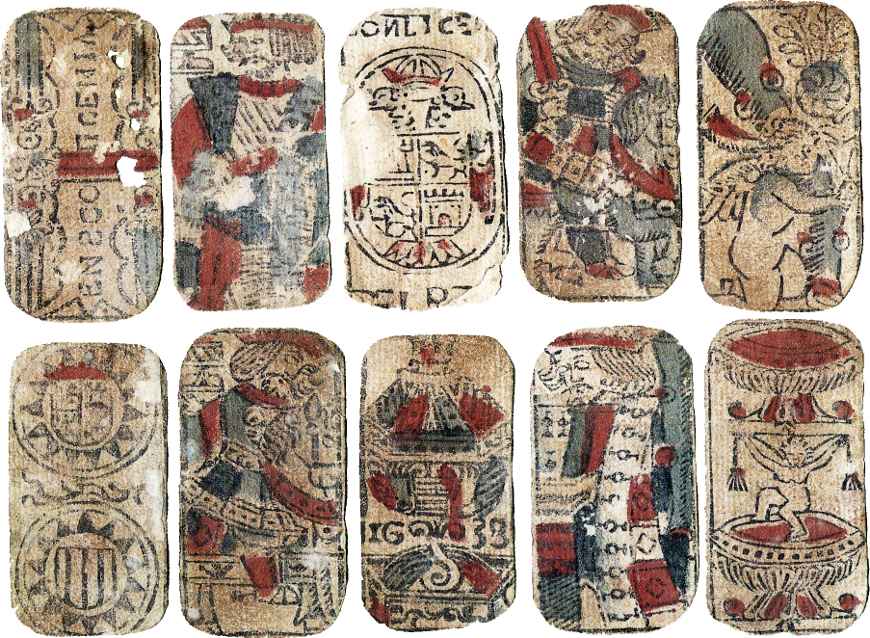
Above: Spanish playing cards, woodcut & stencil, Seville, dated 1638 on the Ace of Cups. The Ace of Batons and the Two of Cups have small naked figures adorning the suit symbols. The Ace of Coins has a two-headed imperial eagle. Inscriptions on the cards read: "En S (en Sevilla) Con Licencia del Rey." These cards were discovered inside a wall during the demolishing of the former Granada prison, and were probably handled by gambling card players running a racket inside jail. Image of cards in the Fournier Museum, Alava, taken from: Agudo Ruiz: Los Naipes en España, Diputación Foral de Álava, 2000.
Revenues from the Seville playing card monopoly, which also included Granada and the Canary Isles, reached twelve million maravedis when it was acquired by Francisco de Zayas for a ten year tenure. Cards made in Seville during this period have official signatures on certain cards as proof of taxes paid to the treasury.

Above: Spanish playing cards, woodcut & stencil, made in Seville, dated 1647 on the Two of Coins. Official signatures on certain cards were proof that taxes had been paid to the treasury. Image of cards in the Fournier Museum taken from: Agudo Ruiz: Los Naipes en España, Diputación Foral de Álava, 2000.
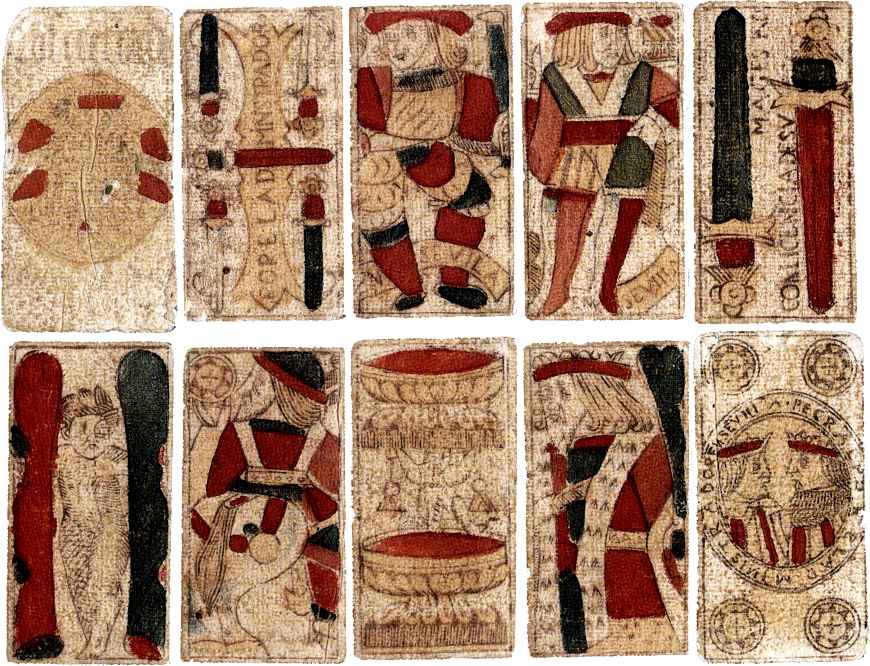
Above: Spanish playing cards, woodcut & stencil, made in Seville, late XVII centiry. Several cards bear legends relating to the royal licence for the administration of the sale of playing cards. Two Sotas also have banderoles with the text 'En Sevilla'. Image of cards in the Fournier Museum taken from: Agudo Ruiz: Los Naipes en España, Diputación Foral de Álava, 2000.
Seville was a favoured location by gamblers read more →

References
Agudo Ruiz, Juan de Dios: Los Naipes en España, Diputación Foral de Álava, 2000
Pérez González, Alberto: Diego del Campo ¿El primer hombre en “hacer naipes” en España? in La Sota Nº53, Oct 2024, Asescoin, Madrid

By Simon Wintle
Spain • Member since February 01, 1996
I am the founder of The World of Playing Cards (est. 1996), a website dedicated to the history, artistry and cultural significance of playing cards and tarot. Over the years I have researched various areas of the subject, acquired and traded collections and contributed as a committee member of the IPCS and graphics editor of The Playing-Card journal. Having lived in Chile, England, Wales, and now Spain, these experiences have shaped my work and passion for playing cards. Amongst my achievements is producing a limited-edition replica of a 17th-century English pack using woodblocks and stencils—a labour of love. Today, the World of Playing Cards is a global collaborative project, with my son Adam serving as the technical driving force behind its development. His innovative efforts have helped shape the site into the thriving hub it is today. You are warmly invited to become a contributor and share your enthusiasm.

Activity for Tax on Spanish Playing Cards
Sign in to comment or save this article.

Related Articles
Los Maffei y la marca “El León”
Mariano Maffei (Mafei) Cano, 1818-1840.
Naipes en Chile
Noticias y crónicas de la época del virreinato.

Early Cadiz pattern by Marchan
Typical early Cadiz pattern by Marchan of Cadiz, 1817.
Pierre Varangot
Tracing the origins, legality and legacy of Pierre Varangot’s San Sebastián deck.
Archaic Spanish-suited pattern from Bayonne
Archaic Franco-Spanish pattern from Bayonne by a manufacturer with the initals M.V.
Archaic Spanish proof sheets
2 x uncoloured proof sheets of archaic Spanish-suited playing cards produced for “New Spain”, possib...
73: Fakes, forgeries and Tax Evasion
When there are official taxes to pay, people will find a way to avoid paying them - often illegally....
Russian Playing Card History - From the Beginnings to 1917
An in-depth review of the history of card-playing, gambling, legislation, manufacture and taxation o...
Russian Playing Card Monopoly
The Russian Playing Card Monopoly was established in March 1798 with all revenue going to support th...
72: The Ace of Spades
In standard English packs the Ace of Spades is associated with decorative designs. This is a histori...
Australian Excise Duty
Excise Duty was introduced on Australian playing cards in 1932
Greek Heroes
Playing Cards manufactured by Aspioti Elka A.E., 1960, with ancient greek-style courts.
Iranian Popular Art
Representing Iranian culture and history and intended for a Persian market, these playing cards were...
Tunisia
Playing Cards in Tunisia. Chkobba is one of the most popular card games in Tunisia, mainly played by...
Thai Playing Cards Manufacturing Factory
Thai Playing Cards Manufacturing Factory was established in 1938 as part of the government Excise De...
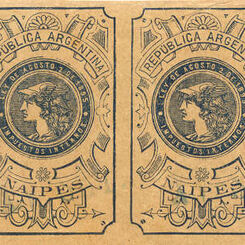
Impuestos Internos Sobre Naipes
Duty was first introduced on playing cards in Argentina in 1892, as part of the Internal Duties law,...
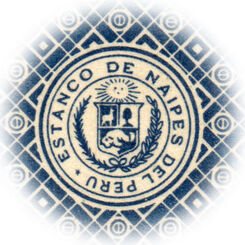
Estanco de Naipes del Perú
In October 1888 the Republic of Peru Congress passed Law no.26 establishing taxes on playing cards, ...
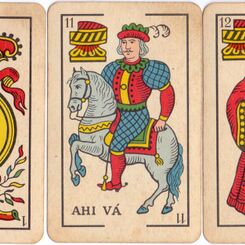
Cards for export to Peru by Heraclio Fournier
'El Caballo' brand (No.5P) playing-cards manufactured in Spain by Heraclio Fournier S.A. especially ...
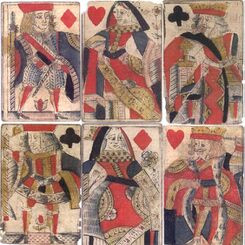
United Kingdom
Playing cards first arrived in England during the 15th century, but none have survived from such an ...
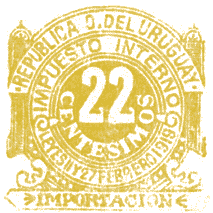
Uruguay playing card tax
In 1806 the Council of Concepción del Uruguay imposed an 8 Peso tax on card and billiard tables on a...
Most Popular
Our top articles from the past 60 days


