


Sevilla 1647 reproduction
Facsimile of Spanish-suited pack produced in Sevilla, Spain, 1647.
This interesting reproduction is of an antique Spanish pack from the Museo Fournier de Naipes de Álava. The Spanish coat of arms can be seen on the ace and 2 of coins and the four of cups. The initials 'AS' can be seen on the ace of cups (with 'SA' on the three of clubs), while the date 1647 can be found on several cards. The legend "Con Licencia del Rey" and En Sevilla referring to the royal monopoly can be noted on several other cards, and the signatures on many cards are proof of taxes paid. Several card designs include small children cavorting between the suit symbols, a feature often found in early Spanish-suited cards. These facsimile cards have a matt finish and a modern back design advertising the playing-card museum and the Archaeology Museum which are now in adjoining buildings. There is an extra card with text in Basque and Spanish. See the box and extra card


Above: facsimile edition of archaic Spanish-suited woodblock and stencil pack produced in Sevilla, dated 1647, published by Museo Fournier de Naipes de Álava, c.2009.

By Roddy Somerville
France • Member since May 31, 2022
Roddy started collecting stamps on his 8th birthday. In 1977 he joined the newly formed playing-card department at Stanley Gibbons in London before setting up his own business in Edinburgh four years later. His collecting interests include playing cards, postcards, stamps (especially playing cards on stamps) and sugar wrappers. He is a Past President of the Scottish Philatelic Society, a former Chairman of the IPCS, a Past Master of the Worshipful Company of Makers of Playing Cards and Curator of the WCMPC’s collection of playing cards. He lives near Toulouse in France.

Activity for Sevilla 1647 reproduction
Sign in to comment or save this article.

Related Articles
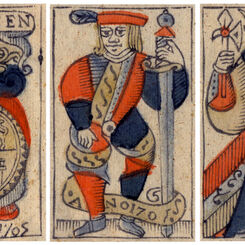
The archaic “Classic Madrid” Pattern
Centralisation, standardisation and consolidation of the Spanish card tradition.
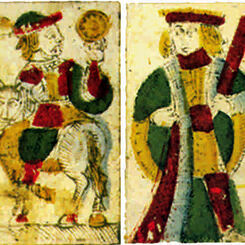
La baraja de Almagro
De la chimenea al monumento nacional: la baraja de Almagro y el renacer del corral de comedias.
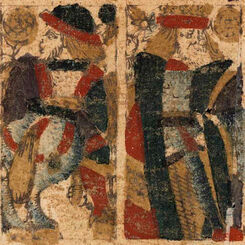
Toledo, 1584
Archaic Spanish-suited deck with 48 cards made in Toledo in 1584.
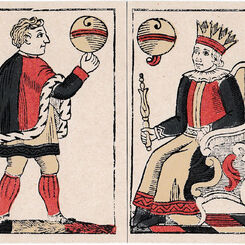
Johannes Müller c.1840
Facsimile edition of Swiss suited deck first published by Johannes Müller in c.1840.
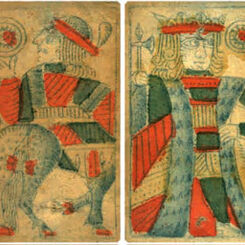
Pedro Varangot, 1786
Archaic Navarra pattern produced for the Pamplona General Hospital Monopoly by Pedro Varangot in 178...
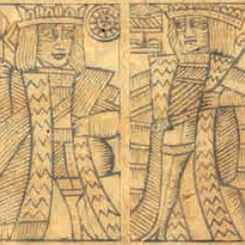
Navarra Pattern, 1682
Navarra pattern produced for the Pamplona General Hospital Monopoly in 1682.
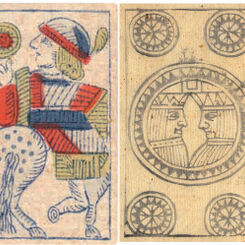
Navarra Pattern
Navarra Pattern produced for the Pamplona General Hospital Monopoly.
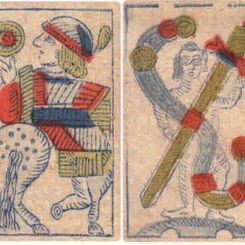
Navarra Pattern, 1793
Navarra pattern by an unknown cardmaker with initials I. I., 1793.
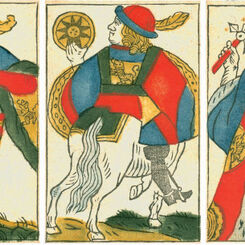
Anonymous Spanish Suited pack, c.1760
Anonymous archaic Spanish suited pack, c.1760.
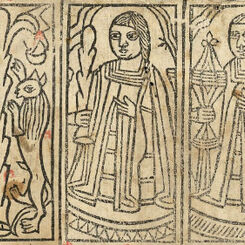
XV Century Catalan playing cards
XV Century Catalan Playing Cards, featuring four female Sotas, four Aces and four cards from the sui...
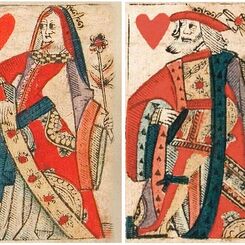
Pierre Marechal
Rouen became an important centre for card-making whose influence extended far afield. Cards from Rou...
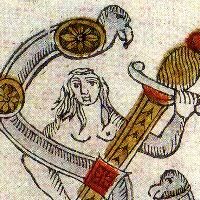
Joan Barbot
Joan Barbot, San Sebastian c.1765-1810.
Navarra, XVII Century
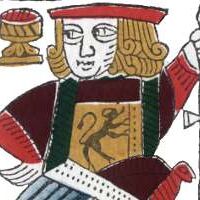
Facsimile of 17th century Spanish-suited playing cards produced by Erregeak, Sormen S.A., Vitoria-Ga...
Moorish playing cards
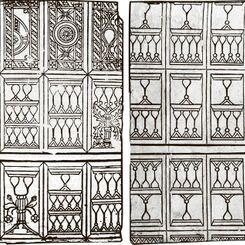
These two uncoloured, uncut sheets of early Moorish playing cards were formerly preserved in the Ins...
Gothic Spanish-suited cards
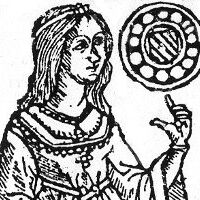
These cards may be a typical example of early 'standard' Spanish playing cards, maybe from before Co...
16th century cards discovered in Peru
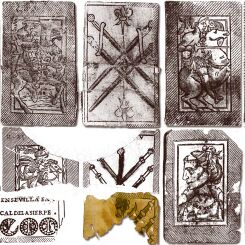
Fragments of playing cards and 2 dice were unearthed in a 16th century rubbish tip adjacent to a Spa...
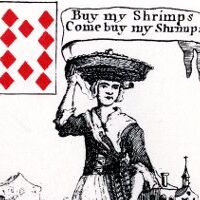
Cries of London
The cards were printed from copper plates, with the red suit symbols being applied later by stencil....
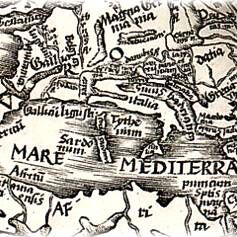
The History of Playing Cards
Playing cards appear in European records in the late 14th century, but their earlier history lies fu...
Hand-made Spanish Suited Playing Cards
Decks are made on two-ply pasteboard which reproduces the tactile quality of antique cards.
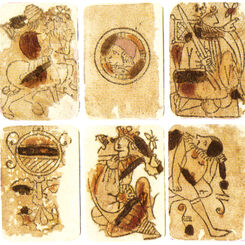
Baraja Morisca — Early XV century playing cards
Primitive Latin suited pack, dated by paper analysis as early XV century, which makes this one of th...
Most Popular
Our top articles from the past 60 days


