


Joan Barbot
Joan Barbot, San Sebastian c.1765-1810.
Joan Barbot, San Sebastian
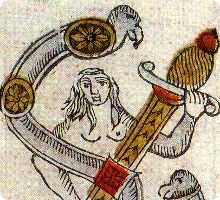
Joan Barbot originated from Poitiers (France) and settled in San Sebastian in his youth. He became a playing card manufacturer and his workshop was recorded in 1761 as one of four existing in the city. Barbot died in 1810 and his widow, Dña María Miloy (“la naipera”), continued running the business until it burnt down in 1813.
A similar pack is listed in the British Museum and described as follows: “The ace of coins has the arms of Spain displayed on an eagle with the name J. Barbot below. The maker's monogram appears on the 2 of swords and the ace of clubs. On the 2 of coins are the shields of Aragon and Castile. The large coin in the 5 of coins has the head of a king.” [Department of Prints & Drawings, Registration number: 1896,0501.857].
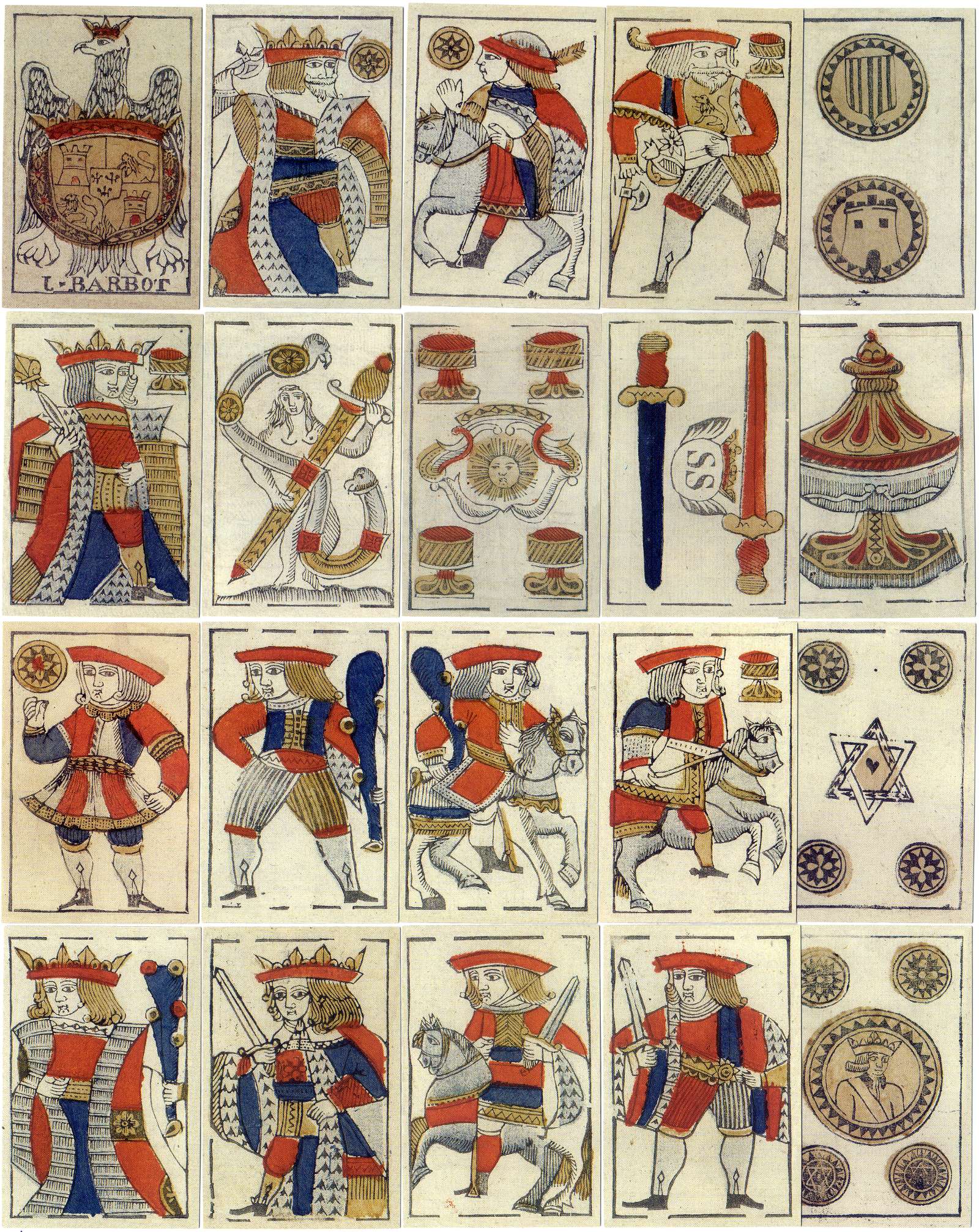
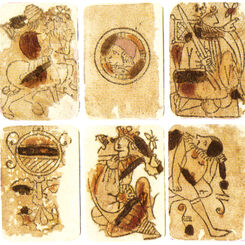
Above: cards from a facsimile edition published by Naipes Heraclio Fournier S.A. of an original pack held in the “Fournier” Playing Card Museum, Alava (Vitoria-Gasteiz), Spain, in 1997 on the occasion of the Asescoin AGM held in San Sebastian that same year. The publication was sponsored by Fundación Cruzcampo in celebration of the leisure and comaraderie which card playing has always been associated with.
Reference
Museo Fournier de Naipes de Álava : Baraja Jean Barbot►

By Simon Wintle
Spain • Member since February 01, 1996
I am the founder of The World of Playing Cards (est. 1996), a website dedicated to the history, artistry and cultural significance of playing cards and tarot. Over the years I have researched various areas of the subject, acquired and traded collections and contributed as a committee member of the IPCS and graphics editor of The Playing-Card journal. Having lived in Chile, England, Wales, and now Spain, these experiences have shaped my work and passion for playing cards. Amongst my achievements is producing a limited-edition replica of a 17th-century English pack using woodblocks and stencils—a labour of love. Today, the World of Playing Cards is a global collaborative project, with my son Adam serving as the technical driving force behind its development. His innovative efforts have helped shape the site into the thriving hub it is today. You are warmly invited to become a contributor and share your enthusiasm.

Activity for Joan Barbot
Sign in to comment or save this article.

Related Articles
The archaic “Classic Madrid” Pattern
Centralisation, standardisation and consolidation of the Spanish card tradition.
La baraja de Almagro
De la chimenea al monumento nacional: la baraja de Almagro y el renacer del corral de comedias.
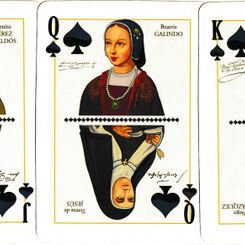
Baraja Cultura Española
ASESCOIN pack for 2022 designed by M.A. Corella featuring famous Spaniards and notable buildings.
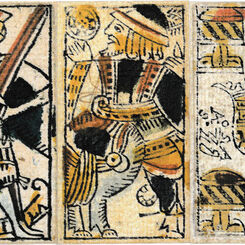
Sevilla 1647 reproduction
Facsimile of Spanish-suited pack produced in Sevilla, Spain, 1647.
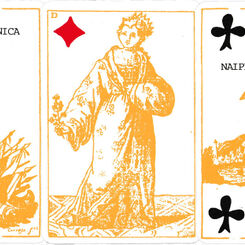
Baraja Napoleónica
Re-edition of a French-suited Spanish pack from the Napoleonic era, with designs by J. Carrafa.
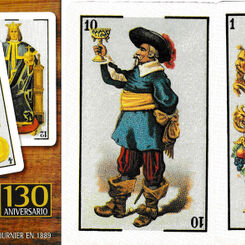
Naipes Heraclio Fournier 130th Anniversary
Baraja conmemorativa del 130 aniversario de naipes Heraclio Fournier (1868-1998) Spain, 1998.
Baraja El Quijote
Baraja El Quijote, facsimile of original deck designed by E. Pastor, reprinted by Naipes Heraclio Fo...
Baraja Historica de Madrid
“Baraja Historica de Madrid 1992” playing cards designed by Alberto Pérez and published by Asescoin ...
Toledo, 1584
Archaic Spanish-suited deck with 48 cards made in Toledo in 1584.
Baraja Carlos IV by Félix Solesio, 1800
Baraja Carlos IV, Félix Solesio en la Real Fábrica de Macharaviaya, 1800.
Johannes Müller c.1840
Facsimile edition of Swiss suited deck first published by Johannes Müller in c.1840.
Pedro Varangot, 1786
Archaic Navarra pattern produced for the Pamplona General Hospital Monopoly by Pedro Varangot in 178...
Navarra Pattern, 1682
Navarra pattern produced for the Pamplona General Hospital Monopoly in 1682.
Navarra Pattern
Navarra Pattern produced for the Pamplona General Hospital Monopoly.
Navarra Pattern, 1793
Navarra pattern by an unknown cardmaker with initials I. I., 1793.
Anonymous Spanish Suited pack, c.1760
Anonymous archaic Spanish suited pack, c.1760.
Goyesca
Baraja ‘Goyesca’ facsimile of original deck published in Madrid by Clemente de Roxas, 1814.
Navarra, XVII Century
Facsimile of 17th century Spanish-suited playing cards produced by Erregeak, Sormen S.A., Vitoria-Ga...
Hand-made Spanish Suited Playing Cards
Decks are made on two-ply pasteboard which reproduces the tactile quality of antique cards.
Baraja Morisca — Early XV century playing cards
Primitive Latin suited pack, dated by paper analysis as early XV century, which makes this one of th...
Most Popular
Our top articles from the past 60 days


