


Archaic Spanish-suited pattern from Bayonne
Archaic Franco-Spanish pattern from Bayonne by a manufacturer with the initals M.V.
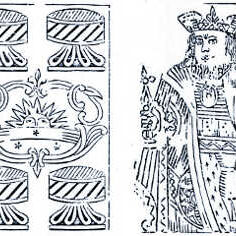
An archaic Franco-Spanish pattern from Bayonne by an anonymous manufacturer with the initals M.V., possibly a member of the Varangot or Volay dynasties. The pack is preserved in the British Museum, whose the curator notes: On the ace of coins are the arms of Spain with "Hispaniæ Rex Carolus Dei Gratia", referring to Charles II who died in 1700, and the letters "M V", the initials of the maker ... The letters "M V" appear also on the knave and 4 of cups and the knave of clubs. The 2 of swords is printed with "fechas en Baionne". The 4 of coins has a double triangle with an armorial shield, and the central suit-mark of the 5 has the two royal heads.
Owing to heavy tariffs imposed by the Spanish king, substantial quantities of packs like this “Franco-Spanish pattern” produced by French manufacturers from the southwest region were being exported, often irregularly and without a licence or “Con licencia del Rey”, into Spain. Often the eagle’s head on the ace of coins looks more like an owl and the maker’s name is not explicitly given, only the initials. These would have been cheaper to buy than legally produced Spanish packs as tax was being avoided.
The Ace and 5 of coins tended to imitate Double Excellent Gold Coins of the Catholic Monarchs
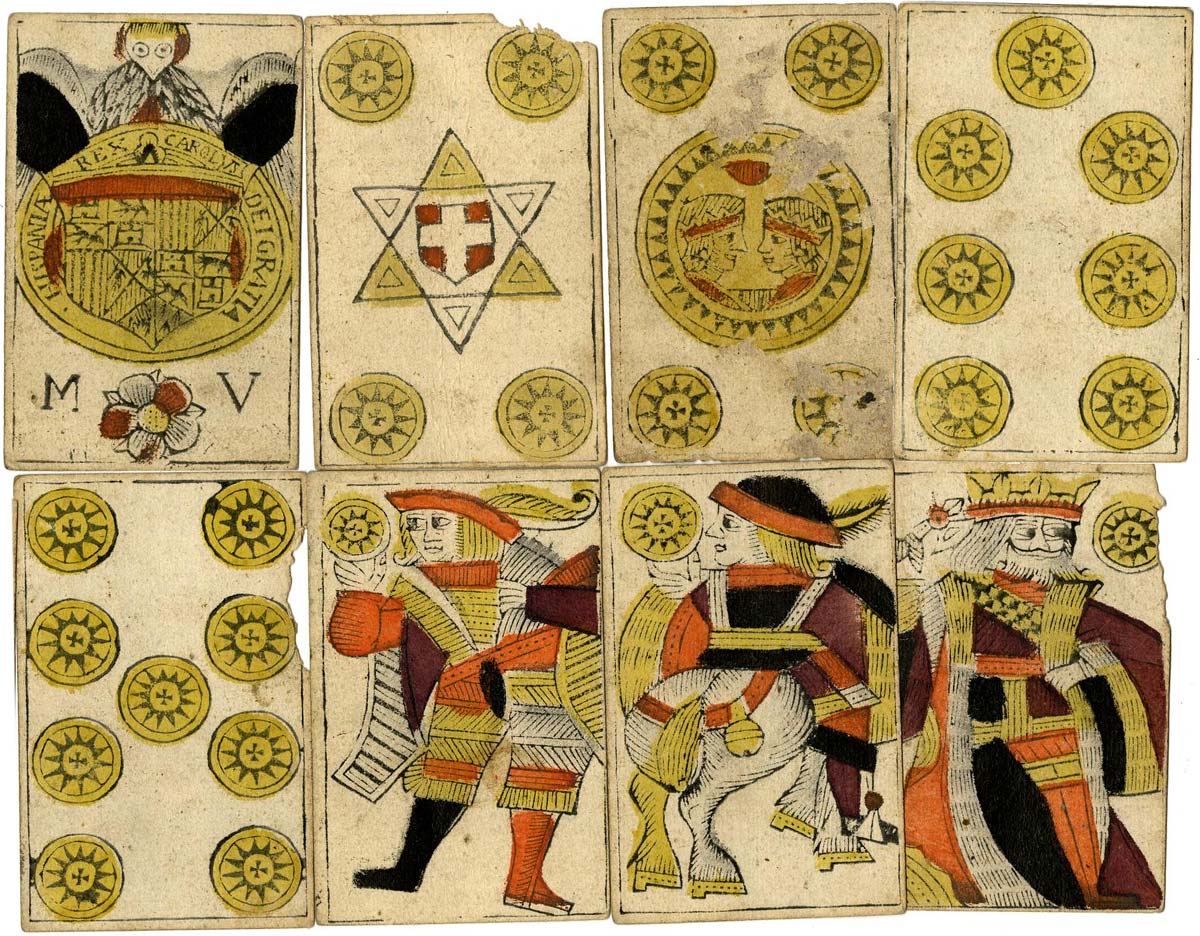
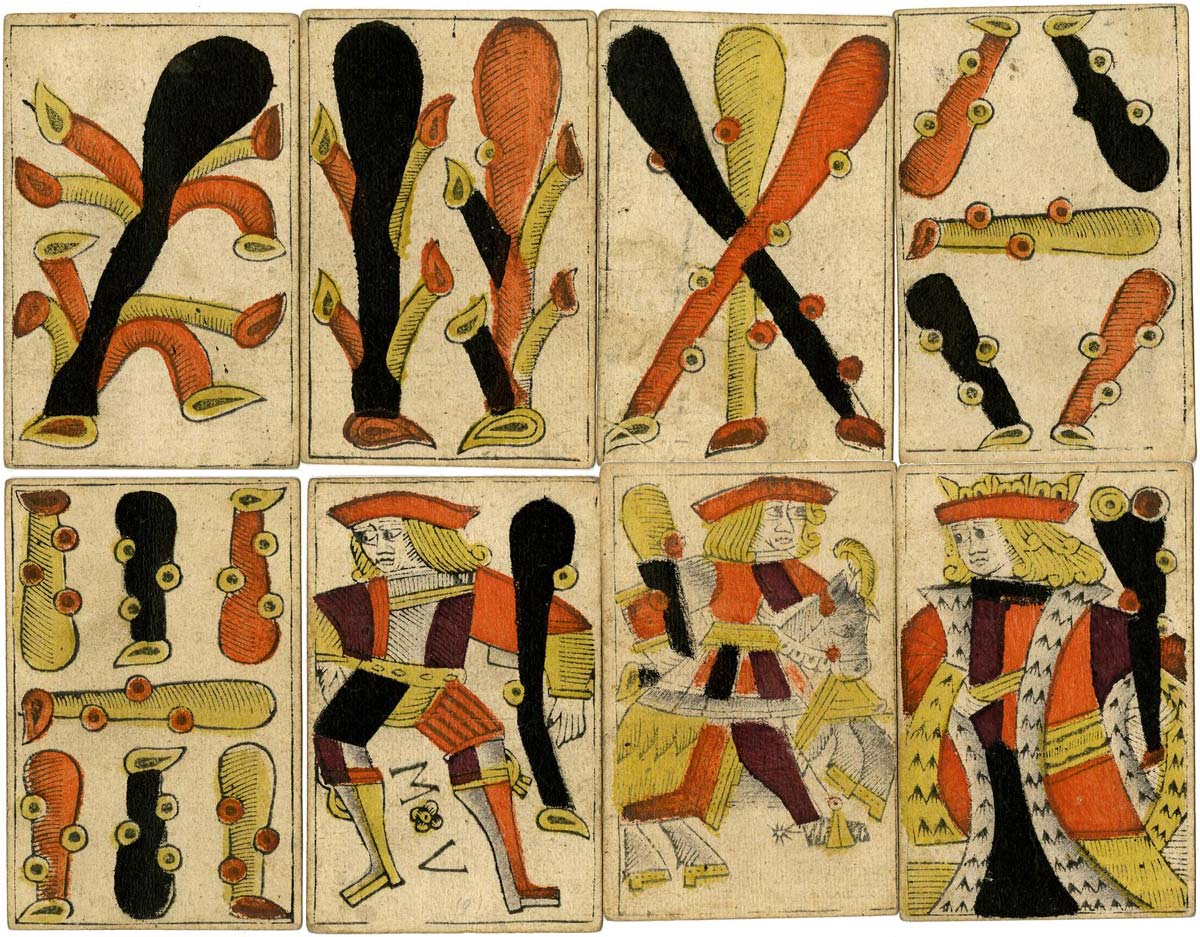
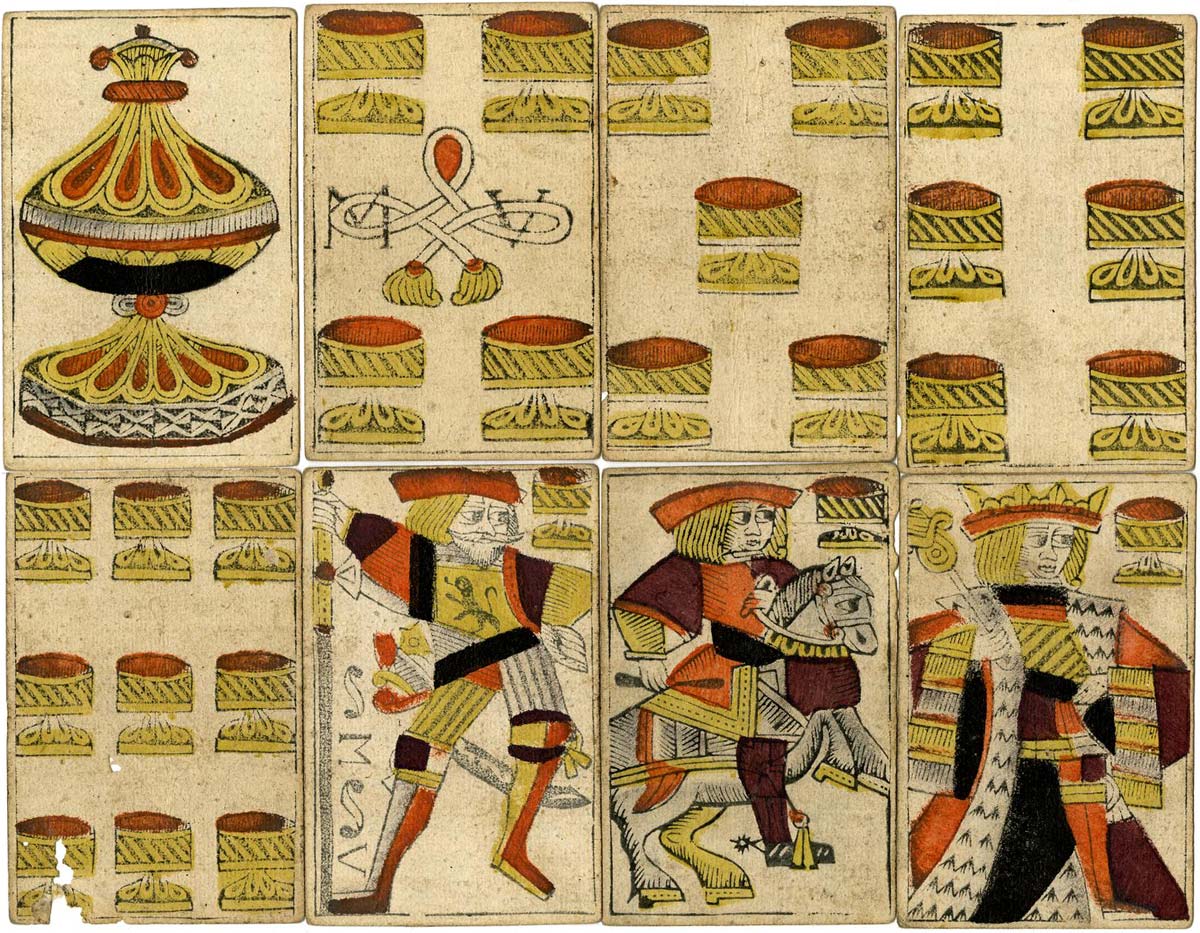
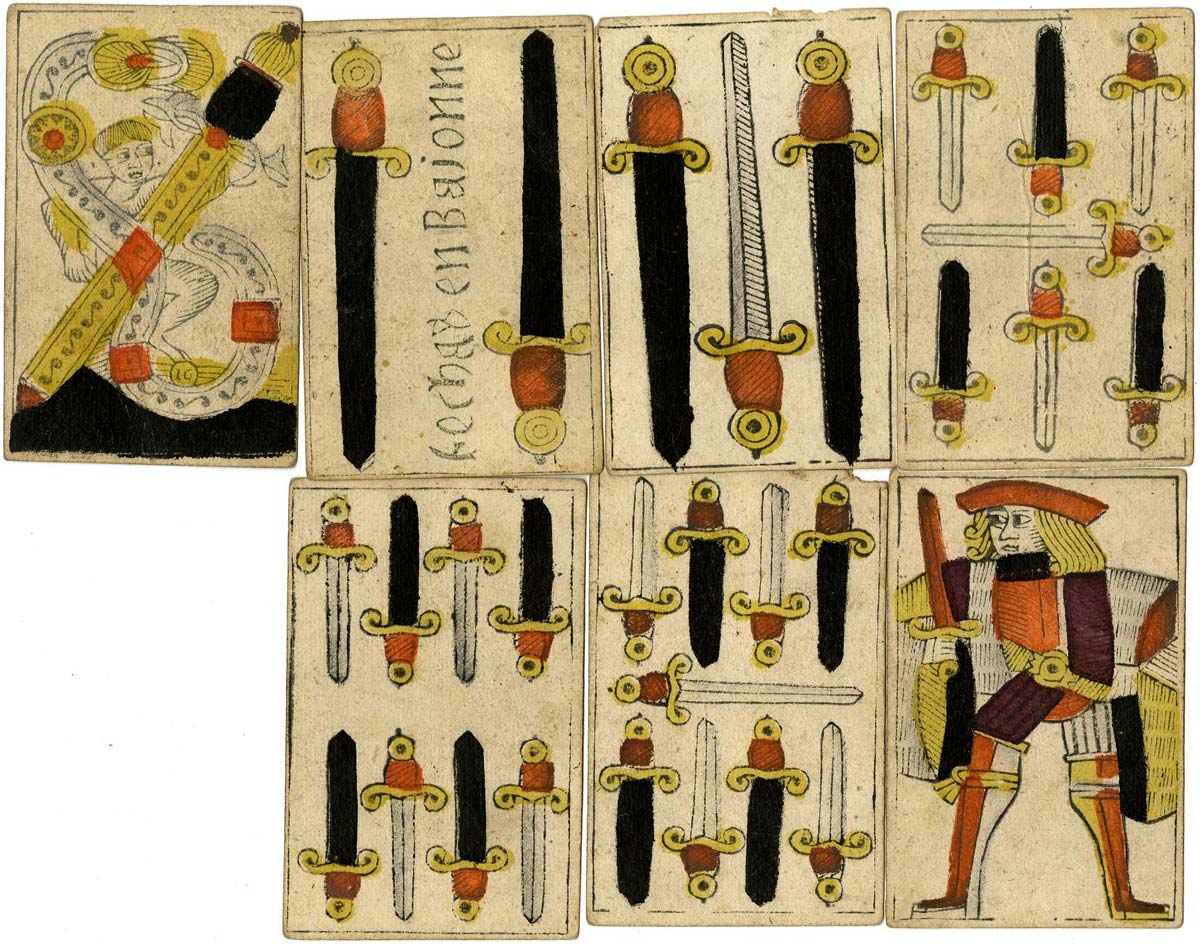
Above: an archaic Franco-Spanish pattern by an anonymous manufacturer from Bayonne (France) with the initals M.V., 18th C. Hand-coloured woodcut, backs plain. © The Trustees of the British Museum
The deck produced by M.V. and other anonymous makers, as well as many of the packs attributed to Jehan Volay (which may have been used as a pseudonym) are designed in the Spanish style, complete with Spanish heraldry like the arms of León and Castile. This suggests a deliberate design choice targeting Spain, where playing cards were popular despite heavy taxation and strict import restrictions imposed by the Spanish Crown. This strategy would have allowed French cardmakers to circumvent Spanish import restrictions and taxes, supplying a market with high demand for such goods.
References
British Museum : number 1896,0501.840►
O’Donoghue, Freeman M: Catalogue of the collection of playing cards bequeathed by Lady Charlotte Schreiber (Spain 16), Trustees of the British Museum, London, 1901 [digital version here]

By Simon Wintle
Spain • Member since February 01, 1996
I am the founder of The World of Playing Cards (est. 1996), a website dedicated to the history, artistry and cultural significance of playing cards and tarot. Over the years I have researched various areas of the subject, acquired and traded collections and contributed as a committee member of the IPCS and graphics editor of The Playing-Card journal. Having lived in Chile, England, Wales, and now Spain, these experiences have shaped my work and passion for playing cards. Amongst my achievements is producing a limited-edition replica of a 17th-century English pack using woodblocks and stencils—a labour of love. Today, the World of Playing Cards is a global collaborative project, with my son Adam serving as the technical driving force behind its development. His innovative efforts have helped shape the site into the thriving hub it is today. You are warmly invited to become a contributor and share your enthusiasm.

Activity for Archaic Spanish-suited pattern from Bayonne
Sign in to comment or save this article.

Related Articles
Premio para los ninõs
Antique fantasy Spanish-style children's card game making a map, published in France.
Pierre Varangot
Tracing the origins, legality and legacy of Pierre Varangot’s San Sebastián deck.
Archaic Franco-Spanish pattern
Archaic Franco-Spanish pattern by Guillaume & Jean Grossard (Bordeaux).
Archaic Spanish proof sheets
2 x uncoloured proof sheets of archaic Spanish-suited playing cards produced for “New Spain”, possib...
Jeu des 7 familles basques
A Happy Families-type game from the Basque country, with designs by Soledad Bravi and Agathe de Las...
Monuments de Paris
‘Monuments de Paris’ souvenir playing cards produced by Heraclio Fournier, c.1964.
Aluette by Dieudonné Jeune, Orléans, c.1850
Aluette game by Fabrique Dieudonné Jeune, Orléans, c.1850.
The New Game of Tarot (or Tarock)
Regional costumes and alpine flora on a French Tarot game pack marking 600 years of playing cards in...
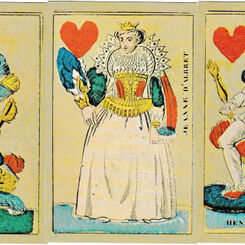
Histoire de France
“Histoire de France” facsimile of French historical deck of 1820.
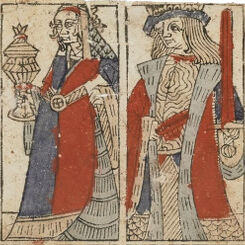
J. Deluy c.1490s
Archaic Spanish-suited cards produced by J. Deluy c.1490s.
El Gato con Botas
Puss in Boots card game manufactured by H. Fournier, 1981.
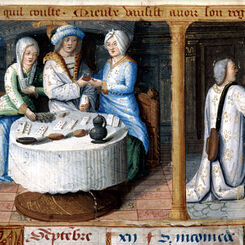
Gambling and Vice in the Middle Ages
Gambling and Vice in the Hours of Charles V: card-playing in the local tavern
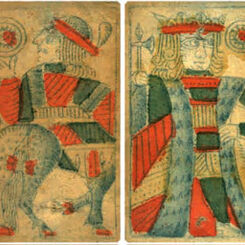
Pedro Varangot, 1786
Archaic Navarra pattern produced for the Pamplona General Hospital Monopoly by Pedro Varangot in 178...
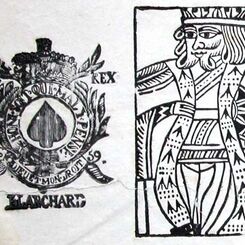
Fake Blanchard Ace of Spades
Fake Blanchard Ace of Spades with court cards based on Hall.
Thai Playing Cards Manufacturing Factory
Thai Playing Cards Manufacturing Factory was established in 1938 as part of the government Excise De...
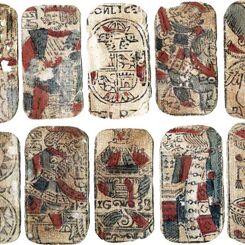
Tax on Spanish Playing Cards
Taxation on Spanish playing cards, the monopolies and smuggling.
Brazil
Playing card production in Brazil was officially sanctioned by royal decree in 1770.
United Kingdom
Playing cards first arrived in England during the 15th century, but none have survived from such an ...
Phelippe Ayet, 1574
49 assorted cards were found hidden in the lintel of a doorway, in an old building in Toledo, during...
Belgian Playing Cards
Belgian cardmakers have been actively designing and exporting playing cards since the 14th century. ...
Most Popular
Our top articles from the past 60 days


