


Fortune Telling playing cards
English Fortune Telling cards probably published c.1770.
We think that these early English fortune telling cards were published by S. Hooper, a Book and Print Publisher of various London addresses during the period 1766 to 1792, Strand, Ludgate Hill, Arundal Street, Dukes Court and Holborn. He is also known for publishing his ‘Conversation Cards’. See the Instructions►


The wording printed on each card conforms to that found in the work on the oldest cartomancy meanings in English: “Dr. Flamstead’s and Mr. Patridge’s New Fortune-Book containing their new-invented method of knowing one’s fortune by a pack of cards” published c.1729, for further discussion see Mary K. Greer's Blog - https://goo.gl/JzSWR2►

Above: cards from a pack of Fortune Telling cards, probably published in London, c.1770. The court cards are of the early style. Jacks have Fleur de Lys between their feet, black jacks feathers in their hats, king of clubs holds Cross of Lorraine, diamonds and hearts are red stencilled cards (including court cards) but excluding borders and legend. The Black Wheel of Fortune card has many pin holes in it - as it should - it is used to select the cards which then reveal your fortune. The lack of Aces is explained by the Instruction Card (Direction The First): "The conjurer being obliged to multiply the 12 signs of the Zodiac by the four seasons of the year could only employ 48 cards, was therefore commanded by the oracle of Delphos to exclude the 4 aces". However, the referenced source above does give rhyming couplets for the four aces.
REFERENCES and CREDITS
Images and notes kindly contributed by John Sings ►
Mary K. Greer: Oldest Cartomancy Meanings in English ►

By Simon Wintle
Spain • Member since February 01, 1996
I am the founder of The World of Playing Cards (est. 1996), a website dedicated to the history, artistry and cultural significance of playing cards and tarot. Over the years I have researched various areas of the subject, acquired and traded collections and contributed as a committee member of the IPCS and graphics editor of The Playing-Card journal. Having lived in Chile, England, Wales, and now Spain, these experiences have shaped my work and passion for playing cards. Amongst my achievements is producing a limited-edition replica of a 17th-century English pack using woodblocks and stencils—a labour of love. Today, the World of Playing Cards is a global collaborative project, with my son Adam serving as the technical driving force behind its development. His innovative efforts have helped shape the site into the thriving hub it is today. You are warmly invited to become a contributor and share your enthusiasm.

Activity for Fortune Telling playing cards
Sign in to comment or save this article.

Related Articles
Cartomancy, Oracle and Divination Cards
Playing cards are used for fortune-telling - turning another card illumines the moment and a new per...
Playing Cards: A Secret History
Playing Cards: A Secret History
Navarra Pattern, 1682
Navarra pattern produced for the Pamplona General Hospital Monopoly in 1682.
Illustrated Playing Cards, c.1740
Illustrated playing cards featuring comical engravings and rhymes about saints, c.1740.
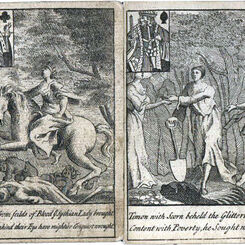
Delightful Cards, c.1723
Delightful Cards, containing variety of entertainment for young Ladies and Gentlemen c.1723.
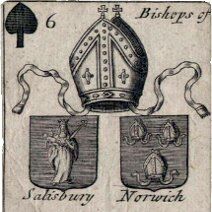
Arms of English Peers
The Arms of English Peers playing cards were first published in 1686. Heraldry, or a knowledge of th...
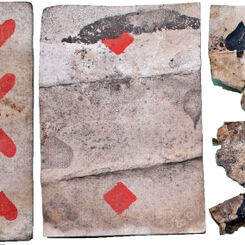
Archaeological find: old playing cards under the floorboards
The municipal archaeological service in Dordrecht (Netherlands) recently found some antique playing ...

De la Rue’s 125th anniversary
In around 1955 De la Rue introduced a new coloured joker and a series of aces of spades with a silho...
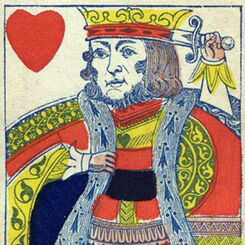
Suicide King
The King of Hearts, holding a sword behind his head, is sometimes nicknamed the “Suicide King”. He c...
Pope Joan Trays
Some traditional Pope Joan boards comprise a circular tray, others are square, divided into sections...
Mathematical Instruments
Mathematical Instruments playing cards forming an instrument maker's trade catalogue, Thomas Tuttell...

Brotherton, 1789-1840
Brotherton is recorded as operating at 13 Little Britain (London) from 1789-1840. In 1851 his factor...
John Llewellyn, playing card manufacturer, London, 1778-1785
John Llewellyn, playing card manufacturer, London, 1778-1785
Mamluk Playing Cards
Nã'ib, the game of lieutenants... these cards are amongst the earliest Arabic playing cards ext...
Waddington’s Classic and Wildlife Series, 1933
Waddington’s Classic and Wildlife Series, 1933.
Cries of London
The cards were printed from copper plates, with the red suit symbols being applied later by stencil....
Picture Show — Zodiac Fortune Telling Cards
Zodiac Celebrities fortune-telling cards presented with 'Picture Show' magazine, 1930. The cards wer...
The History of Playing Cards
Playing cards appear in European records in the late 14th century, but their earlier history lies fu...
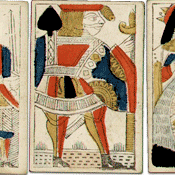
History of Court Cards
The court cards in English packs of playing cards derive from models produced by Pierre Marechal in ...
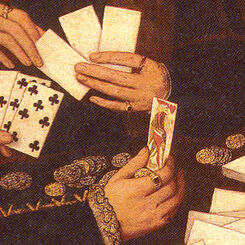
History of English Playing Cards & Games
The History of English Playing Cards dates probably from the mid 15th century
Most Popular
Our top articles from the past 60 days


Alannyë Daeris
19 November 2025, 09:47SavedSaved this article to Cartomancia Histórica
Zoyander Street
05 April 2026, 02:44SavedSaved this article to Narrative decks