


Playing Card Games Online
From Cribbage to Canasta: why old card games have found a new digital home.
I have spent my life playing card games of various kinds. I started to learn cribbage when I was seven¹. I learned bridge in my 20s and have played casual bridge on and off ever since. I think I learned comparatively late compared with many of my contemporaries. I can remember some of my friends at school played, and it was considered “cool” to do so. Since then, bridge and card games have fallen out of favour for many of us, and particularly for the young. There are so many more distractions and opportunities to fill leisure time than there used to be. I will confess that I too spent rather more time in my 60s playing the wonderful multiplayer online game World of Warcraft than I normally care to admit and that certainly left little time for cribbage or bridge.
If you look at the average age of ACBL² members in the USA, this is usually reported as between 70 and 72. The picture is not far different in the UK. A survey of county players in 2021 reported a median age of 69-70. One can conclude that card games are no longer the games of interest to people of all ages that they once were. And I suspect that only a tiny proportion of those who are 70 and over now play cards on a regular basis, if at all. There is so much more to do.
This may be a reasonable conclusion, but we should not extrapolate from this to assume that card games per se are no longer being played. Not so many people may be opening a new pack of cards, dealing to friends and enjoying a social occasion around a card table, but a surprising number of traditional card games are still available to play online if you explore the internet. By “online” I mean, of course, by whatever means of access you have to the internet – desktop, laptop, tablet or mobile phone. This offers not only the opportunity for you to play games that you know, but also to explore and play those games you have heard about but never been able to try. And all this is available in the comfort of your own home, with no-one judging you as you explore and try to understand the rules which for some card games can be a little arcane.
I can remember when computers started to be introduced into homes and workplaces in the 1970s. Few users at this time would not have spent at least some of their work or leisure time playing a traditional solitaire game. Today you have only to Google³ the card game of your choice and just about any game you can mention is available somewhere for you to play, either against the computer or online with real people. I have written elsewhere how the majority of county bridge tournaments in the UK are now played online⁴, and this facility is available to anyone. Just download the game of your choice and play against the computer, with friends or with complete strangers across the world. If you don’t wish to play but like to watch the game being played by good players, this too is available on sites such as Bridge Base Online.

The bidding has begun on a free option on Bridge Base Online. This will test your bidding and playing skills…and keep the score. Play against the computer, with a friend as a partner or with strangers.
Bridge is the game for which the online versions are the most sophisticated, as they are used regularly by national and international players in tournaments as well as by people like me. But the opportunities are not confined to bridge. I’ve just spent a few weeks tracking down some of the games which are currently available to play online and have been amazed and impressed by the opportunities out there. I do not pretend to have a complete list, but here is a start.
Apart from Bridge there is a wide variety of trick-taking games including Hearts, Spades, Euchre, Whist, Pinochle, Piquet, Skat, Oh Hell!, Bid Whist, Tarneeb, Kaiser, Court Piece, Klaverjassen, Sergeant Major, Troika, 500, Pitch and Rung.

Hearts.

Whist.
It is true to say that some of these games vary greatly in quality and sophistication, so you have to shop around. Even then there are frustrations. Trying to play a game that you know well can look and play very differently when playing with someone else’s rules. But that is almost inevitable; most card games have evolved over a long period of time and rules have been changed and adapted throughout their life. However, most traditional games are offered by several different providers, so it is worth trying several before settling on a version that you like, or which uses rules which most closely resemble those with which you are most familiar.
Most card game sites are free to play, but there are exceptions, so you need to be wary. Some offer a free demo version of the game but suggest that for serious play you should pay a fee to play the premium version which is allegedly better and more challenging. This is particularly true of gambling games. Some are financed by regular interruptions for advertisements, and a paid-for “ad free” option is offered to avoid this nuisance. I have played many of these games online and have found no need for either of these options.
There are a host of Rummy and Melding Games available including Gin Rummy, Oklahoma Gin, Rummy, Canasta, Hand & Foot, Rummy 500, Indian Rummy, Kalooki, Escobe and Cassino.

Gin Rummy.

Canasta.
You can also play Shedding or Climbing Games. A “Shedding” game is where the main goal is to be the first player to get rid of all their cards, whatever the process of play. A “Climbing” game, on the other hand, is focussed on how the cards must be played rather than the end goal. In a climbing game each new play must beat or climb above the previous card played, usually by rank but sometimes by a combination of cards. Most climbing games are also shedding games. Well-known examples include UNO, Crazy Eights, President, Big Two, Mau-Mau, Switch, Tien Len, Durak, Palace/Shithead, Spit and Thirteen. Some use traditional playing cards; others have cards specifically designed for the purpose.
You can play Matching and Family Games by yourself or with your kids with such games as Go Fish, Old Maid, War, Idiot, Cheat, Slapjack or Snap. (But why not use a proper pack!)
The basic Solitaire game is still available, but the range of Solitaire and Single-player Games has greatly increased. Klondike, FreeCell, Spider, Pyramid, Tri- Peaks, Yukon, Scorpion, Golf, Canfield, Clock, Crescent, Kings in the Corners, Seahaven Towers, and Addiction are just some of the variants. There are many more.

Classic solitaire.

Pyramid solitaire.
There are some wonderful sites allowing you to play my favourite game for two – Cribbage - against real people or pitching your wits against frustratingly competent AI opponents (which are usually better at calculating the odds). Clearly, as the AI revolution gains momentum its involvement in card pay games will also increase. It is with mixed feelings that I anticipate my AI opponent learning from my playing style and tactics and working out how best to defeat me unless I am equally adaptable,

Cribbage.
You can play for fun or win and lose real money playing various Poker or Gambling Games. Texas Hold’em is a big favourite, along with Omaha, Seven-Card stud, Five-Card Draw, Blackjack, Three-Card Poker, Teen Patti, Thirty-One and Arizona Discard to name but a few.


One must conclude that “old-fashioned” card games are not dead but, sadly, increasingly few of them are played with physical cards. But I will confess that the attractions of online play are great. You don’t have to assemble two, three, four or more people with common purpose to play, and you don’t have to feed them and supply endless drinks! But also, the computer organises the deals, manages the rules (and explains them, on request) and, possibly most important of all, keeps the score. You can play sitting in your pants or lying in bed. Being old, I regret the passing of the social occasion with friends gathered round the card table, because that offers so much more than just the game, but things move on…and so, I suppose, must we. I can also see the attraction and advantages. If I was still travelling to work on the bus or tube, I probably could not resist the temptation to play cribbage on my phone rather than struggle to concentrate on the contents of a book.
Perhaps at this point I should pause and reflect on the various pleasures one gets from playing card games. At best, in my view, it involves a social evening with chat, drinks, bonhomie and a challenging game of whatever bests suits the assembled company. Ideally the evening is balanced both with the distribution of cards and scores with no animosity about who won and how it was achieved. All concerned gain something and learn from the occasion. I contrast this with games played on line which is usually a lone pursuit. Even if it is played with family and friends based elsewhere on their own computers or tablets, it can involve plenty of interaction and banter (using a suitable audio link) but it is essentially soulless by comparison. Yet the advantages of the latter are clear, particular for younger generations who appear to spend much of their lives in disembodied conversations by phone with others, whether real of imaginary. But I wonder if they know what they are missing?
Apart from traditional games, the internet also offers a range of Modern Card Games which do not use the standard pack of 52 playing cards but cards designed specifically for each game. Some of these are games which can be played round a table with real cards but also offer an online version. They include Cards Against Humanity (discussed elsewhere on wopc⁵), Cards against GPT, Exploding Kittens, Love Letter, Skip-bo, Fluxx, Sushi Go, Bang!, Munchkin and Gloom to name but a few.
Some are exclusive to online play, using specifically designed packs, and have rather more sophisticated methods of play, more in common with multiplayer online fantasy games than traditional card play. These include, for example, Slay the Spire, Monster Train, Inscryption and Griftlands.
There are even sites (such as cardgames.io) which provide a forum where interested players can play any game they wish so long as they introduce and enforce the rules themselves. This requires technical abilities way beyond my competence.
But one of these “Modern” games stands out as using traditional 52 card packs and draws heavily on poker, but with a great many more additions and complications. Balatro⁶ was released first on the PC and in February 2026 on Nintendo Switch 2. If we thought that traditional card packs were out of favour we need to think again. By January 2025, Balatro had sold over 5 million copies and had won the Game of the Year at the 25th Game Developers Choice Awards! Sadly, it is difficult to see how the game could be played except on a computer or games console, but it is interesting to see the deep attachment to the traditional 52 card pack, and the hierarchy of poker-winning hands used as the basis of this particular design.


I was pleased to have discovered this modern game clearly derived from traditional game play but offering so much more. I wondered whether such a game would appeal to a new generation, so I asked my 16-year-old grandson whether he had heard of it. “Heard of it, Grandpa! I’ve been playing it for over a year. It’s great. Have you only just found it?” (Collapse of stout party!)
So, the traditional 52-card pack is certainly not dead – far from it – but it survives largely in a new medium. The advantages of online play are all too evident and attractive. But who knows, perhaps one day the ability to play cards round a table with a real pack may once again be considered “cool”.
Footnotes
- Learning to play Cribbage, wopc, 3 April 2026
- American Contract Bridge League
- Other search engines are available.
- Cheating at Whist and Bridge, wopc, 6 March 2026
- Question and Answer Games, wopc, 24 November 2024
- created by Local Thunk
Tony Hall, 15th April 2026

By Tony Hall
United Kingdom • Member since January 30, 2015
I started my interest in card games about 70 years ago, playing cribbage with my grandfather. Collecting card game materials started 50 years or so later, when time permitted. One cribbage board was a memory; two became the start of a collection currently exceeding 150!
Once interest in the social history of card games was sparked, I bought a wooden whist marker from the 1880s which was ingenious in design and unbelievably tactile. One lead to two and there was no stopping.
What happened thereafter is reflected in my articles and downloads on this site, for which I will be eternally grateful.

Activity for Playing Card Games Online
Sign in to comment or save this article.

Related Articles
COOPEXIM
A colourful Polish pack produced in 1965 for the Cooperative Company for Foreign Trade in Warsaw.
Learning to play Cribbage
I learned to pay cribbage when I was very young, aged around six or seven.
The Paraphernalia of Card Play
Innovation and novelties in the accessories on the card table.

Cheating at Whist and Bridge
The Blackleg in the Drawing-Room: Cheating and the Victorian Gentleman.
The Molassine Company and its link to Whist and Bridge
A savvy marketing strategy blending Victorian decorative design with Edwardian practicality.
Rap Rummy
Rap Rummy made by Parker Brothers in 1926, only 4 years after the discovery of King Tutankhamen’s to...
Iroha Karuta
Traditional Japanese matching game played mainly by children.
A New Look at the Evolution of Whist Markers and Gaming Counters
This article aims to illustrate the evolution of whist and gaming counters from the 18th century to ...
The Personalities and Books which shaped the game of Whist, 1860-1900
All the books described here are from Tony Hall's own collection, put together over years because of...
Hanky-Panky
Hanky-Panky poker card game, California, c.1975.
Final Fantasy VII
Final Fantasy VII is a role-playing video game.

International Football Whist
International Football Whist published by Pepys Games, 1947.
Progressive Whist Cards - page 2
Wireless Whist itself, in many forms...
Hoyle® Official Card Games Collection
The Hoyle® Official Card Games Collection 2015 includes plenty of favourites, and also includes the ...
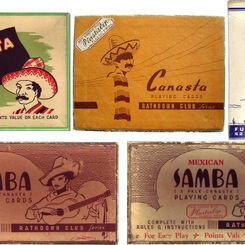
Canasta
Canasta is a card game of the Rummy family which originated in Uruguay probably about 1947.

Cribbage Board Collection part 4
A collection of antique and vintage Cribbage Boards by Tony Hall, part 4.
War of Omens
War of Omens is a card game combining deck-builder and collectable-card-game mechanics, featuring fa...

8-Bit Mafia and 8-Bit Werewolf
This pack created by Michael Scott has been inspired by retro 8-bit pixel games from the 80s and 90s...
Angry Birds UNO
Angry Birds UNO manufactured in China, 2003.

History and Evolution of Spades
History and Evolution of Spades
Most Popular
Our top articles from the past 60 days


