


The Paraphernalia of Card Play
Innovation and novelties in the accessories on the card table.
As readers of my various articles will have gathered, while I do not (intentionally) collect playing cards, I collect just about anything else connected with card play; card game boxes, cribbage boards, a wide variety of game markers, trump markers, whist drive cards – you name it and I will have a collection! This got me thinking. When card games have been played socially and in clubs, the card tables and other tables or “surfaces” nearby will have been cluttered with all manner of paraphernalia as well as the cards themselves, and that this will have changed dramatically in many respects over the years. All the examples below are from my own collections and form the basis of an ethnographic exposition of the subject.
In the 18th and early 19th centuries, the card table would have included, as well as the cards themselves (without corner indices, of course), at least one candleholder and candle, glasses for drinks, a snuff box or two and at least one ashtray for cigars and pipes, together possibly with the odd vesta case. The array of items on the card table would vary greatly depending on the game being played.

When playing poker, or one of the other popular gambling games, if not playing directly with cash, a variety of “chips” would be used depending on the status of the players and where the game was being played. Players would often provide their own counters so it was easy to demonstrate social status by their choice and design. These varied from the very basic to the highly ornate, even monogrammed.¹

Above: a wide variety of chips were used over the decades made from bone, metal and mother of pearl.

For cribbage, the range of boards used by two or four players was enormous.² Brass, ivory, wood and various combinations of all three were all common. In the early 19th century cribbage would be played to 61 points (once round the board) which became the standard from its invention in the early 1600s throughout the 19th century. Even as late as 1904 R. F. Foster describes the game only as being played to 61 points³. The “modern” game, played to 121 points, was very much an Edwardian invention but by the 1930s it had become standard.

Above: three cribbage boards played with in the early 19th century. Two Georgean boards in wood and brass and one in bone probably made by a French PoW in England during the war with Napoleon, 1803-1815.
Other options were available for the three-player game. Either a triangular board or one of the many ingenious designs incorporating a hinged optional extra line to a two-player board.

Above: a highly ornate carved board imported from India and an early example of a hinged extra line for a third player. In the right-hand image from 1822 note the cards on the floor and the overturned snuff box on the carpet!
For whist, easily the most popular game of this and later periods, various items were used to keep a record of the tricks played, won and lost. Given that players at this time would, during the evening, be playing by candlelight and with cards without corner indices, “mistakes” were fairly common. For this reason, a book of rules⁴ would have been handy to check the penalties required in the event of a revoke, or a card falling face up on the floor.
In the early years of whist through to the first decades of the 19th century, games were played to 10 points, and a “rubber” comprised the best of three games. All tricks won over the first six (“the book”) counted towards game. Various pieces of equipment were used to keep the score.
Inherited from the 18th century were sets such as these in ivory or mother of pearl.⁵

The counters were arranged in various configurations to record the game score in a form that all players could see. However, it is not difficult to imagine how, on a crowded table, markers such as these could be easily dislodged and the scores lost.
Not surprising, therefore, that the early 19th century saw a variety of different gadgets being designed which were less easily disrupted. These markers in various hard woods and different metals all recorded game scores up to the level of 10.

Above: typically, each partnership would have one of a pair; in this case (as on the left) one red, one white to avoid confusion.
Perhaps the earliest alternative to markers of this kind were sold by Thomas De La Rue who moved into the field of playing cards from the early 1820s and received a Royal Warrant in 1831. One of their earliest inventions was this unique form of whist marker made in thin card and almost certainly required the user to cut it out from a single sheet. The moveable jacket was moved up and down the strip to indicate points won and lost. It is very delicate and therefore not surprising that few genuine examples have survived. There is no information available on how popular they were, but I suspect that the more robust alternatives carried the day.

By the second half of the 19th century there were probably fewer snuff boxes but ash trays, glasses and much of the rest would remain until, of course, first gas lighting and then electricity provided the light by which to play and candle-sticks were no longer required.
But the biggest breakthrough in card play in these years was undoubtedly the introduction for the first time of corner indices to the playing cards themselves. Whilst, with the benefit of hindsight, this screamingly obvious redesign seems a long time coming, it must have transformed the ease and nature of card holding and play, whilst at the same time reducing many of the errors (dropping cards and revoking) which were a feature of play in earlier years.
Corner indices were invented in the USA in 1864 but did not emerge in British-made packs until the late 1880s after which they rapidly became standard.
Cribbage boards became increasingly elaborate and ornate using exotic hardwoods and metals, particularly brass. Many were made in Britain but there was also a substantial demand for boards made in India which were either imported or brought back by those serving in the Raj.

Above: just a few examples of cribbage boards. Those in box form contained the cards and pegs required for play.
Meanwhile, the paraphernalia used by whist players exploded in variety and ingenuity.
Most of the card producing companies had their versions of card markers which were initially designed for long whist (played to 10 points) but could equally be used for the increasingly popular short whist.

These designs were replaced with those which specifically acknowledged the popular shift to the shorter, 5-point, version of the game. Both the materials and the designs were improved.

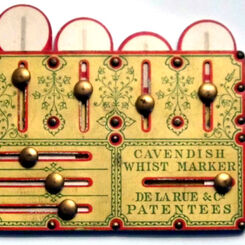
Then in June 1868 De La Rue introduced a newly designed card and brass whist marker endorrsed by the current whist guru “ Cavendish” (Henry Jones).

And later still, they produced a more expensive version made from various woods.

In response, Goodall registered the Camden Whist Marker in 1869.

This was a revolutionary new design with 5 pop-up markers to be used exclusively for short whist, and smaller pop-ups to indicate games played towards a three-game rubber. This design was subsequently copied by whist marker producers in Europe and all over the world. This second pair is a beautifully crafted set, using the Goodall design, from Shibayama in Japan.

The same design was used to produce markers for other games such as bezique, even pinocle.

In 1888, Goodall added the cheaper version – The Pall Mall – to its repertoire. The various designs show its evolution over the later years of the century.

By 1892 De La Rue fought back with their own version, based on the Goodall design, but sponsored by the later guru, Scottish-born American, R. F. Foster.

Meanwhile some players in Britain may have chosen to use the various celluloid designs developed in the USA from the 1880s. Both of these examples (of which there were many) have the advantage of being small and reminding players which suit is currently trumps.

By the end of the 19th Century the type of playing cards and the equipment in common use was almost unrecognisable from those used only 50 years earlier. And even more change was still to come.
I have not collected poker chips – a very specialist field in which the variety seems endless - but could not resist the attached set which I’m sure dates from the last decades of the 19th Century. The box contains two packs of cards and 18 stacks of chips in three colours. These standardised chips in various colours represent a significant change from the variety of chips used in earlier times.

Early 20th century tables would have been almost as cluttered with various items as in earlier times. Ash trays for cigarettes would be essential as at this time smoking was almost obligatory and was widely promoted as having health benefits!⁶ Pipes and cigars remained popular, but snuff boxes would be increasingly rare. Matches or table cigarette lighters would have replaced vesta cases.

As far as game play equipment is concerned, some players will have retained the equipment with which they were familiar, but for others the array of new designs were legion.
Goodall and De La Rue whist markers were still produced in large numbers but, around the turn of the 19th Century, De La Rue produced yet another innovation in the whist marker repertoire. The first advert for the “Klik” Whist Marker that I can find is from 1901.

The Klik marker, in ebony and brass, comprises a series of spring-loaded bars activated by pressing one of the buttons. The design includes the five “short whist” buttons and three game buttons used in earlier designs.
As various forms of bridge replaced whist, De La Rue attempted to use the same technology to score bridge games.

But it rapidly became clear that bridge scoring was a very different process requiring very different means of keeping account of the scores, above and below the line, and the patented bridge marker was not a success.
Very quickly all the card producing companies and stationers pitched in with their various versions of scoring tablets or pads, and these evolved as the game developed. My personal favourite is the ACME Bridge tablet from Goodall & Sons, shown below, together with two others, all displaying the auction bridge score chart.
I also love the universal “We” and “They” designations reflecting the language of the time which has managed to survive in modern pads.

As Auction evolved into Contract, pads did the same. Some manufacturers hedged their bets by including the scoring for both games, while eventually most settled exclusively on contract scoring, or just a blank reverse.

By 1933 most pads, including those included in the Wills cigarette card promotion scheme⁷, were smaller, produced in colours to match their container boxes, while De La Rue was selling double-sided blocks of 300, and find your own pencils!

One company produced this rather splendid set of four art deco-styled chrome cased pads, one for each player.

While others tried to be a little more inventive. Here are two examples; one in porcelain and a second in wood with a hinged metal frame allowing users to insert their own paper. Both could be reused.

The early 20th century was also the era of Trump markers, used for both whist and bridge, of which the variety (still available) is endless. Here are a few examples which will have cluttered Edwardian card tables. Why so late in the history of whist play it was thought to be necessary to remind people as the game progressed which suit was now trumps remains a mystery, yet there was sudden explosion of trump markers after the end of the 19th century.
For some, identifying the trump suit was the sole purpose; for others, the trump indicator also showed the scoring chart. These examples refer to Auction bridge and therefore date anywhere between about 1908 and the early 1930s.

Some were designed as card boxes with a trump-marker in the lid...

... whilst another served also as a crumb brush, presumably for those munching while playing.

One enterprising producer (sadly, unknown) combined the enthiusiasm for card play with the Edwardian addiction to smoking with a bakelite cigarette container which doubles as a trump indicator, and contains it own ashtray.

The first half of the 20th century saw the manufacture of a huge variety of cribbage boards. While the Victorians favoured brass, the Edwardians appear to have preferred varieties of wood and mostly designed boards which had at least two functions.
Folding boards were by far the most popular, although few identified who manufactured them. These were designed to hold at least one pack of cards and the four pegs required to play. The third pictured here provided for a three-player game.

Some boxes offered the opportunity to store more cards. The Goodall & Sons “Camden“ board is on the left.

By the 1920s and 30s a wide variety of companies saw the potential for advertising through gaming materials such as cribbage boards. As crib was one of the most popular pub games, drink and smoking companies saw the potential for new custom.

By the 1940s various plastics were the materials of choice.

At least one manufacturer, probably in India in this example, catered more directly for cribbage playing smokers by incorporating an ashtray into the board.

Attention was also paid to those who, for a variety of reasons, were likely to play in cramped conditions. This first traveller’s set dates from WW1;

And this from WW2.

The variety of manufactured boards from this time is seemingly endless, reflecting the populatirty of the game, and there was also a huge array of “shed-work” boards during this period of home-made and “make do and mend”.
As we have seen, the various items likely to have been placed on card tables in clubs and at home have varied hugely over the 150 years of this review. I have resisted the temptation in this article to highlight the further changes in card table paraphernalia from the 1950s onwards because I have dealt with this in some detail elsewhere. Sadly, the look of card tables from the second half of the 20th century until today was largely transformed by the efforts of game authorities to combat the tendency of some bridge players to cheat!⁸
However, there is one item which was common to most card tables from at least the 18th century onwards but is now very rare indeed. I refer, of course, to ash trays! Most modern players, if they smoke at all, would probably have to leave the building in order to meet this particular need!


References
- See also “A New Look at the Evolution of Whist Markers and Gaming Counters, wopc, July 2023
- Cribbage Board Collection, Parts 1 – 6, wopc, May 2015
- Handbook to the Card Games, Simpkin, Marshall, Hamilton, Kent & Co., c1904
- In these early years there were various tomes available, most of which drew heavily on the Code of Laws drawn up as early as 1760 by members of the White’s and Saunders’ Clubs in London.
- “A New Look at the Evolution of Whist Markers and gaming Counters, op.cit.
- Chesterfields were advertised as “Pure as the Water you drink”; R.J. Reynolds claimed that “More Doctors smoke Camels than any other cigarette”; British American Tobacco claimed that smoking was good for the nerves and digestion.
- The W.D. & H.O. Wills Playing Card Promotion of the Early 1930s, wopc, 2015, 2023
- Cheating at Whist and Bridge, wopc, March 2026
Tony Hall, 23 March 2023

By Tony Hall
United Kingdom • Member since January 30, 2015
I started my interest in card games about 70 years ago, playing cribbage with my grandfather. Collecting card game materials started 50 years or so later, when time permitted. One cribbage board was a memory; two became the start of a collection currently exceeding 150!
Once interest in the social history of card games was sparked, I bought a wooden whist marker from the 1880s which was ingenious in design and unbelievably tactile. One lead to two and there was no stopping.
What happened thereafter is reflected in my articles and downloads on this site, for which I will be eternally grateful.

Activity for The Paraphernalia of Card Play
Sign in to comment or save this article.

Related Articles
Goodall 1879-1880 Sample Book
Complete contents of a sample book by Goodall & Sons
Card Game Items and contemporary advertisements
It is often difficult to identify the origin, manufacturer and date of a card game boxed set and oth...
De La Rue Pocket Guides
The 19th Century saw the production, by all of the major companies, of pocket guides or “mini-books”...
A New Look at the Evolution of Whist Markers and Gaming Counters
This article aims to illustrate the evolution of whist and gaming counters from the 18th century to ...
Whist marker boxes
The Camden Whist marker was being advertised by Goodall and son in 1872 as a new product.
Kuhn Khan and Cooncan: an update
Kuhn Khan and Cooncan are pretty much exactly the same rummy-style game, but packaged and presented ...
The Evolution of Whist and Bridge Boxed Sets, 1870s – 1930s
Boxed sets of cards, markers, scorers and rule booklets have been around for many decades. Some of t...
Bezique Markers, 1860-1960
Bezique is a two-player melding and trick-taking game. Dr. Pole introduced Bezique to England in 186...
67: Adverts and related material after 1900
The final page of material relating to playing cards from British periodicals.
Pashas
“Pasha” is one of Charles Goodall’s brands which first appeared in c.1898 and was retained until aft...
Progressive Whist Cards - page 2
Wireless Whist itself, in many forms...
A Pair of Transformation Packs
Two similar but fascinatingly different hand-drawn transformation decks by the same artist, c.1875
Draughts League Medals
Arthur Charles Prince worked for De la Rue as a playing card cutter and later was promoted to superv...
Boudoir
“Boudoir” playing cards were introduced by Chas Goodall & Son in 1906 in a new, slimmer size.
Secondary Uses of Playing Cards
The unprinted backs of playing cards have led people to use them for secondary purposes such as memo...
Pneumatic Playing Cards
The surface of the cards was slightly grooved by being rolled on prepared plates, so that there were...
Games Leaflets
Thos De la Rue & Co. & Gibson's Games Leaflets.
Swastika designs
Swastika design playing cards by De La Rue, c.1925.

De La Rue
De La Rue introduced letter-press printing into playing card production and his patent was granted i...
History and Evolution of Spades
History and Evolution of Spades
Most Popular
Our top articles from the past 60 days


