


Miner’s Cards for Rutek Alliance
German-suited deck for the Czech company Rutek Alliance, 2012.
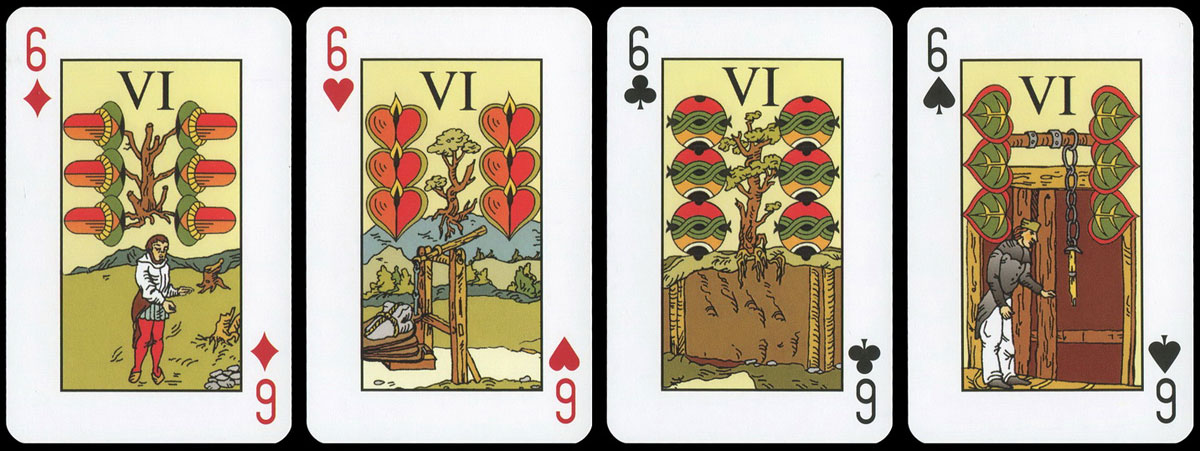
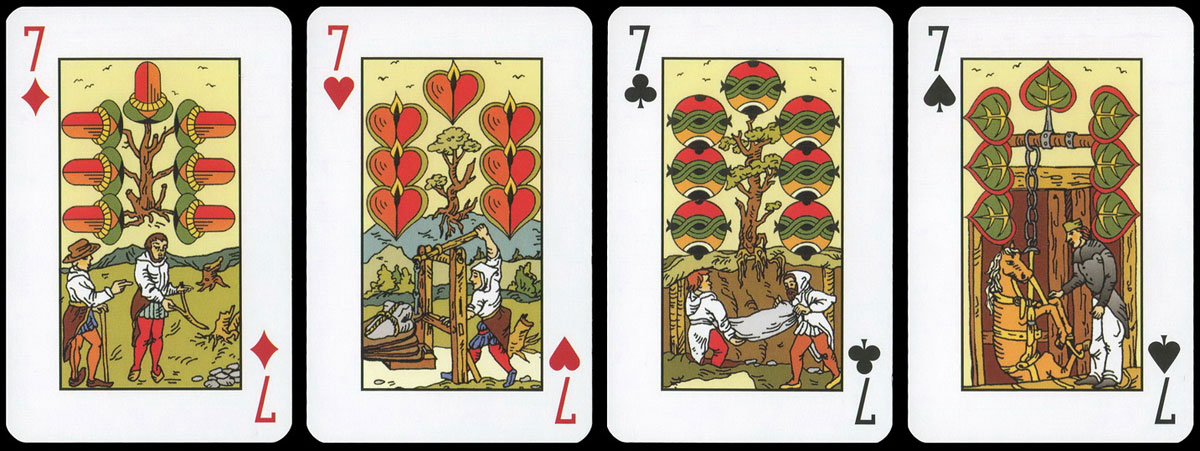
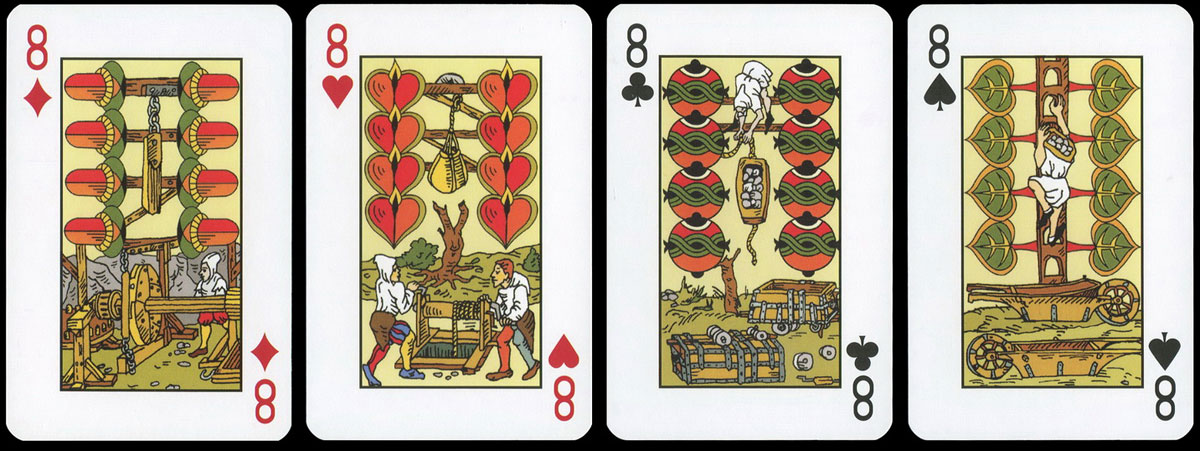
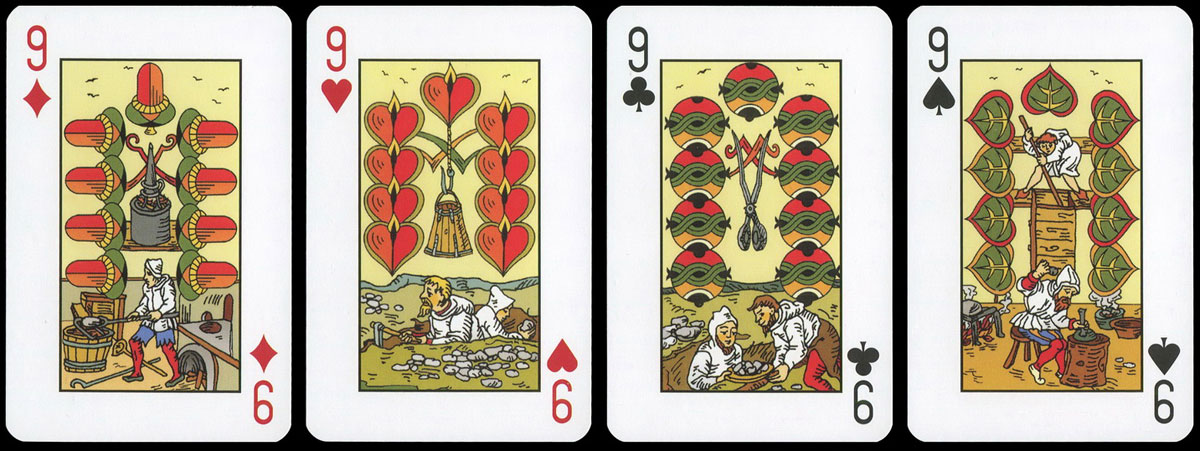
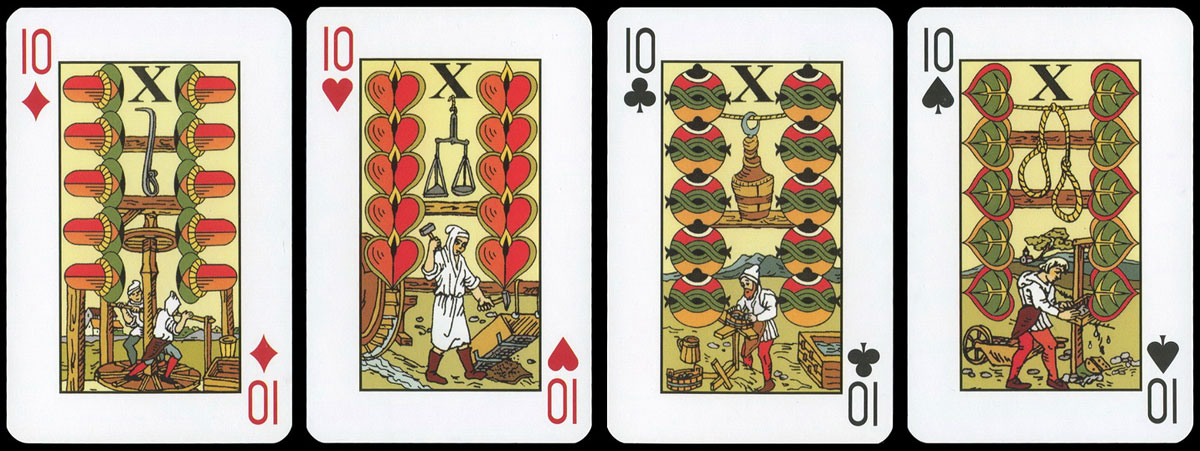
This German-suited deck was published by Nage Cards (GM Group) in St. Petersburg (2012) for the Czech company Rutek Alliance. The deck is dedicated to the mining industry. The four aces depict towns in the Czech Republic. The four jacks are medieval miners and the kings/queens are monarchs. The numeral cards 6 - 10 contain vignettes of mining scenes.
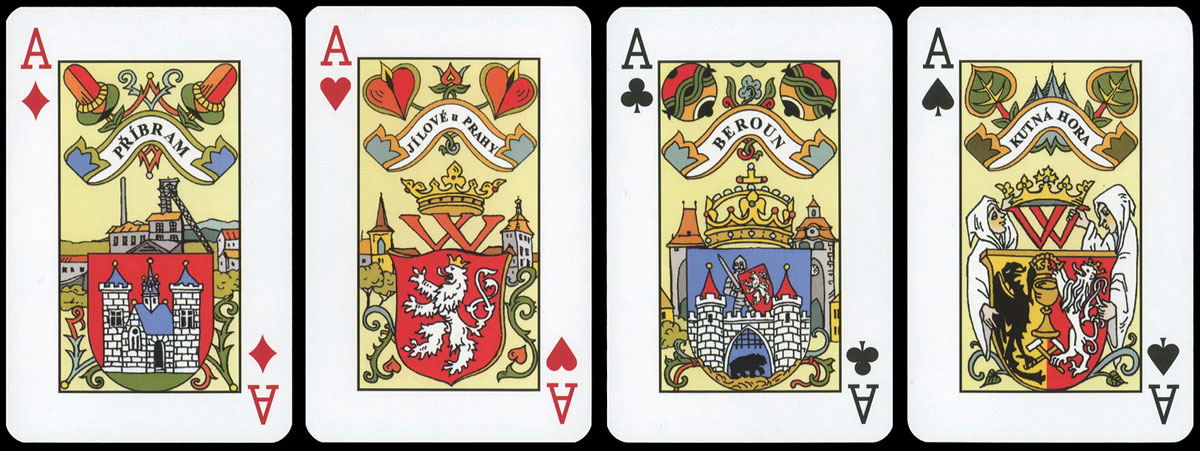
Above: the four aces represent towns in the Czech Republic: ♦ Příbram. Widely known pilgrimage site Svatá Hora ("Holy Mount") is located just above the city, while the Mining Museum Příbram, including the communist labour camp Vojna memorial is another tourism attraction. ♥ Jílové u Prahy. In this place there were large gold mines in the middle ages. ♣ Beroun. Beside several ironworks, Beroun became the site of textile manufacturing. ♠ Kutná Hora. The town began in 1142 with the settlement of the first Cistercian monastery in Bohemia, Sedlec Monastery, brought from the Imperial Cistercian Waldsassen Abbey. By 1260 German miners began to mine for silver in the mountain region, which they named Kuttenberg, and which was part of the monastery property. The name of the mountain is said to have derived from the monks' cowls (the Kutten) or from the word mining (kutání in old Czech). Under Abbot Heidenreich the territory greatly advanced due to the silver mines which gained importance during the economic boom of the 13th century.
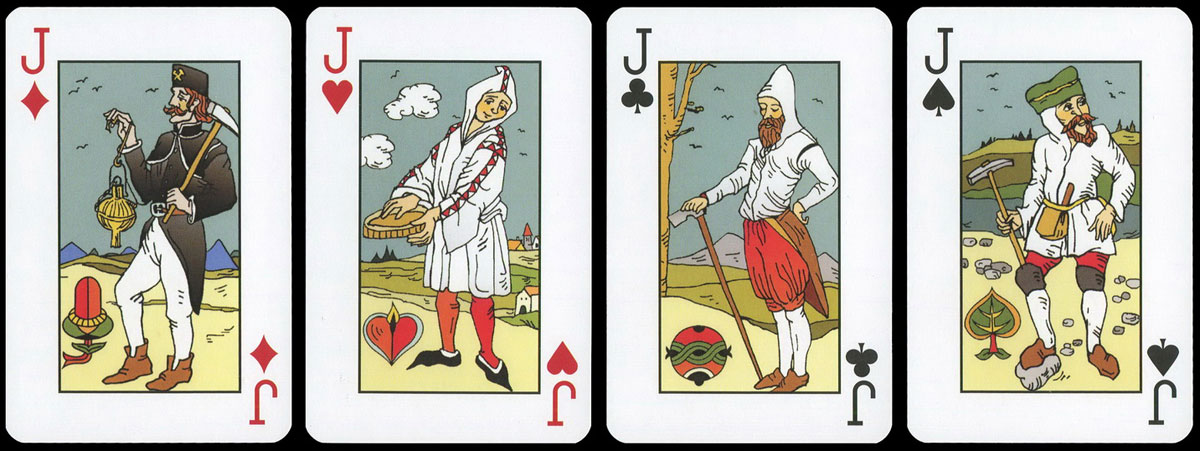
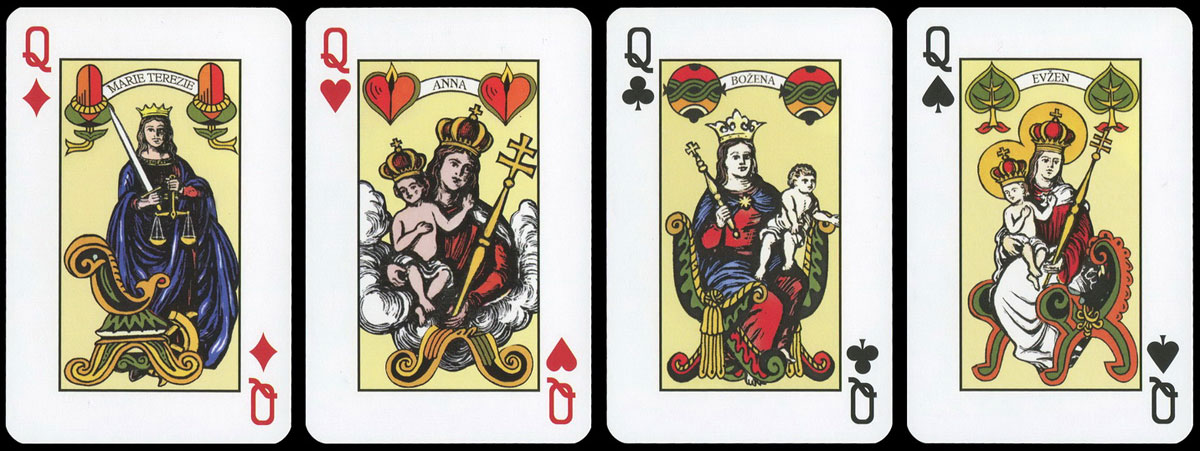
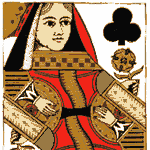
Below / Above: monarchs. ♦ Ludovit I / Marie Terezie ♥ Vaclav II / Anna ♣ Karel IV / Bozena ♠ Ferdinand I / Evzen,
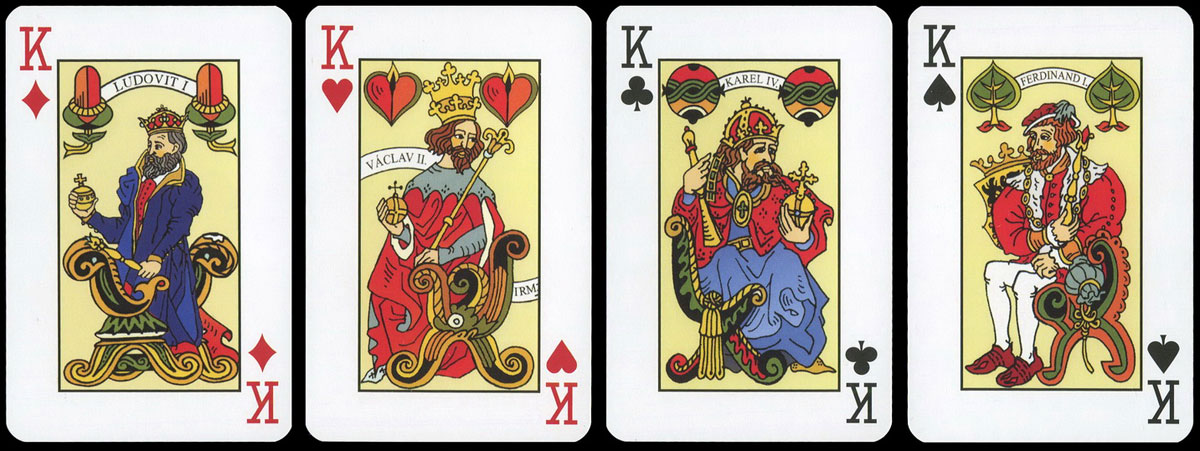
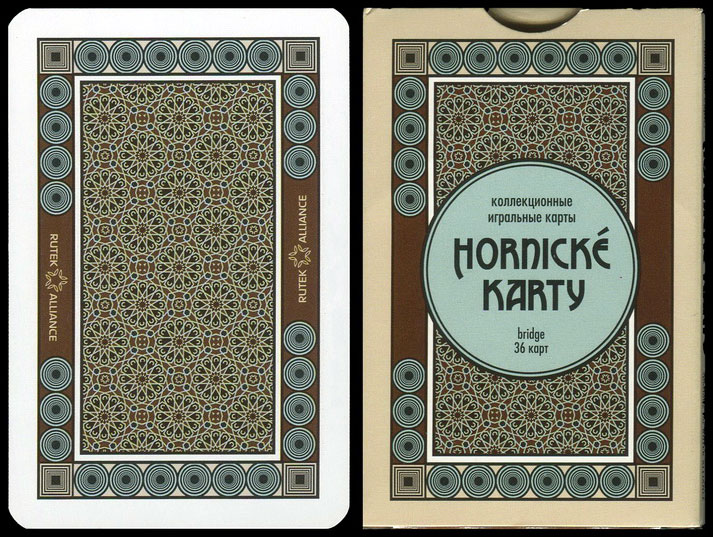
Above: mining-themed deck published by Nage Cards, St. Petersburg, for the Czech company Rutek Alliance, 2012. 36 cards in box.
Note from Marek Brejcha
A weird deck, where the elaborate reverse side contrasts in a special way with the design of the front side and the cover combines the description in Cyrillic with the Czech name in Latin.
From the preserved details, it is clear that the graphic design is based on the historical Animal skat deck. The similarity is especially obvious in the bell marks, but also in the remains of the thrones, which are found on the king cards (and, strangely enough, also on the queen cards.)
The relationship to the Czech Republic is also special. A common deck of cards in the Czech Republic contains 32 cards (without cards of value 6) and would very likely not be used for the game of bridge as the cover states.
Also, the names of the rulers sometimes do not correspond to Czech history. LUDOVIT I (probably Louis I of Hungary) never ruled the Czech Kingdom. And I am not aware of any connection between the name EVŽEN and the historical monarch.
The company Rutek is not registered in the Czech Republic today (as of February 2025), the registered office of the Rutek Group is listed in Moscow.
By Valentin Krasavin (Валентин Красавин)
Russian Federation • Member since January 05, 2014

Activity for Miner’s Cards for Rutek Alliance
Sign in to comment or save this article.

Related Articles
Mariáš - Black & Red Edition
A modern special edition of Prager pattern cards.
Intersigma
A Czech advertising deck for a company dealing with pump technology.
Egyptium
“Egyptium” is a hand-illustrated deck of fantasy playing cards with artwork by Russian artist Oleg S...
G&G Armament playing cards
G&G Armament Airsoft replica gun playing cards from Taiwan.
Eurocell® playing cards
Promotional playing cards produced by Eurocell® (UPVC window, door, conservatory and roofline system...
Trading Mart
‘Trading Mart’ playing cards published by RusJoker, St Petersburg, 2005.
Hotel Lena
Hotel Lena playing cards published by Bichik in Yakutsk in 2001.
The world’s smallest playing cards
Samye malen’kie v mire igral’nye karty / The world’s smallest playing cards
Pilsner Urquell
Pilsner Urquell publicity deck from Czech Republic featuring beer drinkers.
Eastern
“Eastern” playing cards dedicated to ethnic Buryat culture, 2015.

Schwarzkopf BC Bonacure
Schwarzkopf BC Bonacure playing cards promoting the ultimate hair perfection.
Titicaca ® Playing Cards
Each card in this novelty deck, subtitled “Funny Card”, carries information about a prestigious or p...
Hermits
Playing cards depicting imagined residents of St. Petersburg with illustrations by Alexei Bobrinsky....

Pekelna Horugva
“Pekelna Horugva” is the second deck designed by Ukrainian illustrator Vladislav Erko, manufactured ...
Speelkaarten-Fabriek Nederland “Fortuna”
Speelkaarten-Fabriek Nederland for Royal West Indian Mail Service, c.1926
Esveco Specialities B.V.
Alto Imaging Group playing cards manufactured by Esveco Specialities B.V., c.1990s
Sikar
Publicity playing cards for the Dutch credit company Sitters & van der Kar. The four Aces and Joke...
America Online Beach
America Online Beach playing cards, Spanish suit system, non-standard designs, 2006
RedElec
Publicity playing cards for RedElec Argentina, c.2008
Standard and Non-standard Playing Cards
Standard playing cards are based upon traditional designs and are used for card games.
Most Popular
Our top articles from the past 60 days


