


English Pattern by B.P. Grimaud
Standard English pattern published by B.P. Grimaud with engraving by F. Simon, c.1880.
This standard, double-ended English pattern published by B.P. Grimaud in c.1880 is from the collection of Bibliothèque nationale de France. The name of the engraver, F. Simon, can be found at the bottom of the rather elaborate ace of spades, the joker and the wrapper which also feature exhibition medals achieved between 1870-1880. Four small corner indices have been added to the 52 cards (but not the joker).
By the late 1870s several innovative types of corner indices came into common use on English and American cards, designed to help players hold their cards in a fan and only peek at the corners. Miniature indexes can also be seen on these French ones, where previously there had been none. Many of these new indexes were patented, e.g. Dexter, Eurekas, Indicators, Triplicates, etc. learn more →
We may notice that the ace of spades and the Gold Medal Joker have a passing resemblance to those issued in c.1880 by the New York Consolidated Card Co and subsequently used in their "Squeezers" decks. Manufacturers were evidently watching each other and in some instances agents were sent over to spy on competitors' technical innovations. These Grimaud court cards are clearly inspired by the unturned, double-ended designs of De la Rue from the 1870s, around the same time as rounded corners and two-way pips were being introduced on numeral cards. This French example has one-way pip cards and rounded corners.

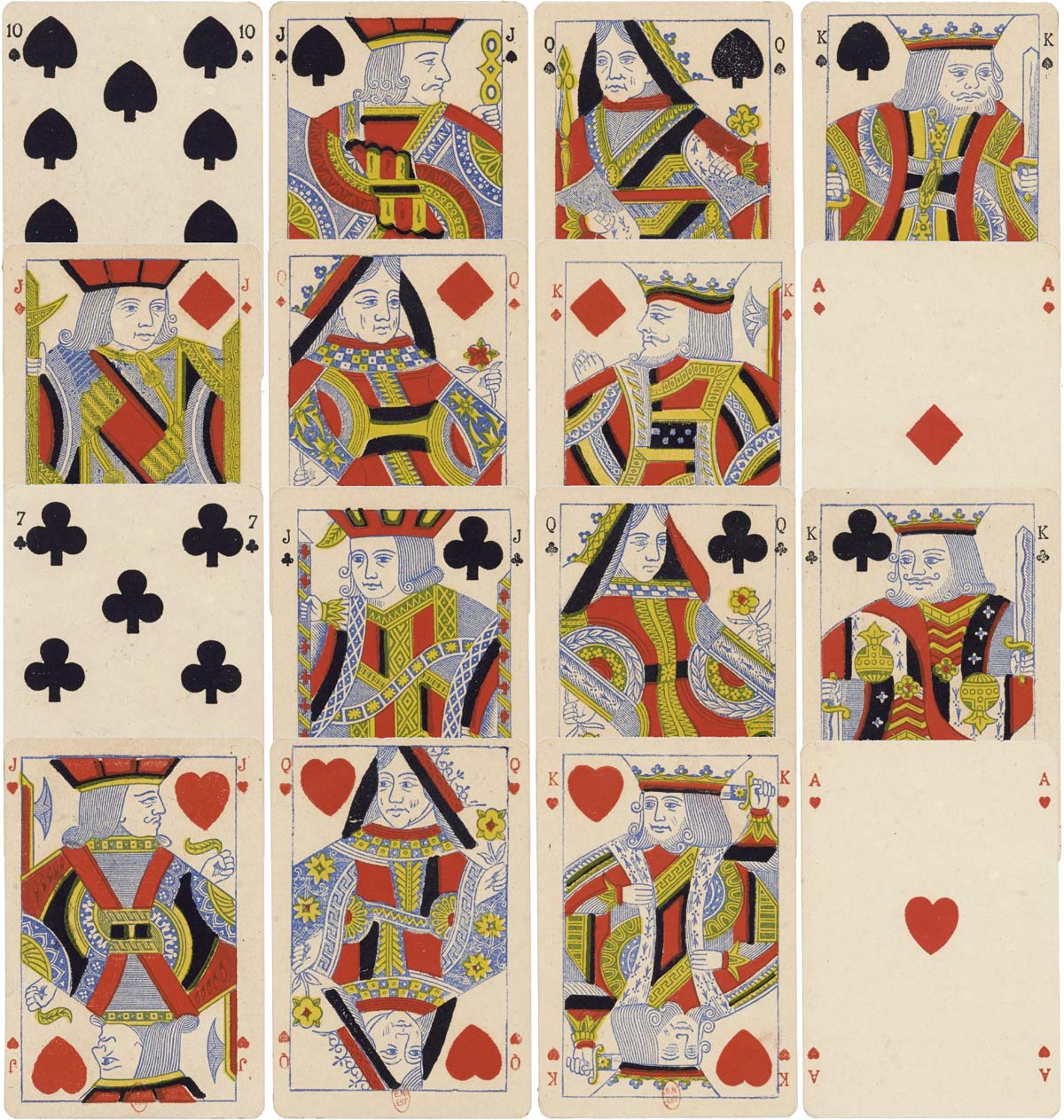
Above: standard English pattern by B.P. Grimaud, engraved by F. Simon, c.1880. 52 cards + the joker; courts outlined in blue. The back is pale lilac with a dainty bouguet of flowers in blue. Source gallica.bnf.fr / Bibliothèque nationale de France • Jeu de cartes au portrait anglais à deux têtes►
In the late 19th century, several innovations in playing card design emerged almost simultaneously across different countries, a result of increased globalization, improved communication, industrialization, market demands and the ease of adapting successful ideas across borders. These factors combined to create a global environment where innovations in one region could quickly influence and be adopted by manufacturers in other regions.
References
• Bibliothèque nationale de France: Jeu de cartes au portrait anglais à deux têtes►
• Bibliothèque nationale de France: Jeu de cartes au portrait anglais►
• Ken Lodge's Blog: De La Rue in detail►
• Ken Lodge's Blog: Functional Changes to Playing Cards►

By Simon Wintle
Spain • Member since February 01, 1996
I am the founder of The World of Playing Cards (est. 1996), a website dedicated to the history, artistry and cultural significance of playing cards and tarot. Over the years I have researched various areas of the subject, acquired and traded collections and contributed as a committee member of the IPCS and graphics editor of The Playing-Card journal. Having lived in Chile, England, Wales, and now Spain, these experiences have shaped my work and passion for playing cards. Amongst my achievements is producing a limited-edition replica of a 17th-century English pack using woodblocks and stencils—a labour of love. Today, the World of Playing Cards is a global collaborative project, with my son Adam serving as the technical driving force behind its development. His innovative efforts have helped shape the site into the thriving hub it is today. You are warmly invited to become a contributor and share your enthusiasm.

Activity for English Pattern by B.P. Grimaud
Sign in to comment or save this article.

Related Articles
Gibert Jeune (Molière)
Pack offered by the Parisian bookshop Gibert Jeune on the tricentenary of Molière’s death.
Catalan pattern by B.P Grimaud
Standard Spanish Catalan pattern deck made in Paris by B.P Grimaud.
Cartes politiques : Jeu d'actualité
Political playing cards published by Grimaud et Chartier, Paris, 1872.
SEMP playing cards
Modified Anglo-American courts advertising a French medical publishing company.
Compagnie Maritime des Chargeurs Réunis
French navigators and explorers on a promotional pack for the C.M.C.R shipping company.
B.P. Grimaud pack for Bolivia
Spanish-suited pack made in France for sale in Bolivia, c.1880.
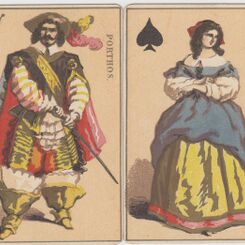
Les Mousquetaires Playing Cards
depicting characters from the novel by Alexandre Dumas
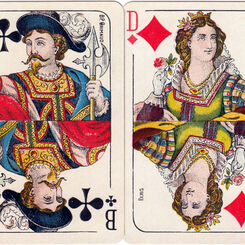
Grimaud copy of Wüst playing cards
A copy of Wüst house pattern 3
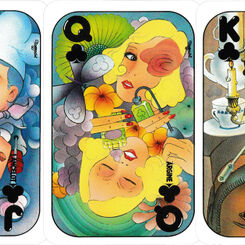
French External Trade Organization
Promoting the elegance and quality of a range of French products.
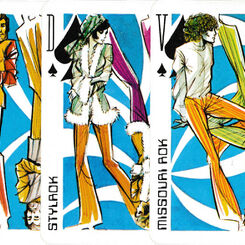
Rok playing cards
Distinctive designs by James Hodges for a clothing company.
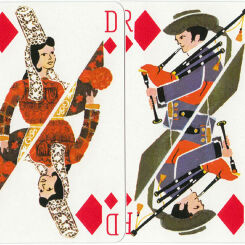
Bretagne
Bretagne (Brittany) playing cards, Grimaud, c.1970.
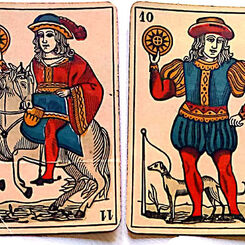
Parisian style Spanish deck by Grimaud
Parisian style Spanish deck by Grimaud for export to Uruguay.
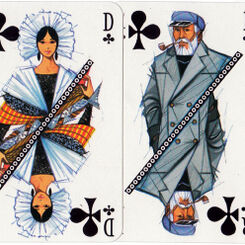
Boulogne-sur-Mer Chamber of Commerce
Boulogne-sur-Mer Chamber of Commerce & Industry playing cards illustrated by James Hodges, c.1974.

Versailles
Sumptuous ‘Versailles’ playing cards created by Matéjà and printed by B. P. Grimaud, c.1970
Jeu Louis XV
B.P. Grimaud of Paris issued this very ornate costume deck called “Jeu Louis XV No.1502” in c.1895. ...
S.S. France playing cards
A special non-standard pack of playing cards was designed by M. Marie for the maiden voyage of the t...
Livre du Destin
Livre du Destin / The Book of Fate, c.1900, entire deck (32 cards)
Livre du Destin
Livre du Destin or Book of Fate, printed by B.P.Grimaud, Paris, c.1900.
French Playing Cards
Some of the oldest cards still in existence come from France. During the 16th and 17th centuries Fra...
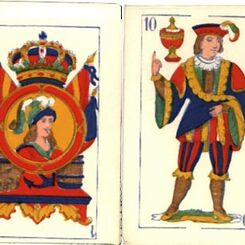
Grimaud Spanish pattern
Grimaud Spanish pattern, c.1880
Most Popular
Our top articles from the past 60 days


