


Card Games - Rules, Variants & Histories
| Image | Game | Total Articles | Introduction |
|---|---|---|---|
|
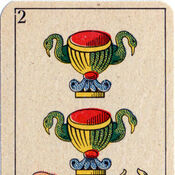
Aluette | 6 | The game of Aluette (or ‘La Vache’), dating back to the XVI century, is popular on the western coast of France, the Catalan region of Rousillon adjacent to Spain, also in Brittany and Bordeaux. It is played with a special pack based on the 48-card Spanish deck, which has evolved into a sort of hybrid deck with French stylistic influences. It is still used to this day. In its modern form the 2 of cups has a recumbent cow and other idiosyncratic symbols, such as storks on several cards, small arrows on the club cards, or a kissing couple on the five of coins. The cavaliers are female and there is usually a naked child on the ace of swords and another on a swing in the two of clubs. • See also: French Catalan pattern |
| Baccarat | 2 | ||
| Belote | 2 | ||
| Blackjack | 2 | ||
| Bridge | 41 | Les Gaietés du Bridge – The Joys of Bridge- Si je n’étais pas un homme bien élevé et si vous n’étiez pas mon hôte, je vous dirais, Monsieur, que vous jouez comme un cochon… ("If I weren't a well-mannered man, and you weren't my host, I'd tell you, sir, that you play like a pig"). La Baïonnette, Paris, 1918-10-24. https://gallica.bnf.fr/ark:/12148/bpt6k6583254s/f2.item  |
|
| Briscola | 1 | ||
| Bézique | 22 | ||
| Calabrasella | 1 | ||
| Canasta | 4 | ||
|
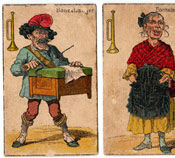
Card Games | 710 | The games we play mirror the world we live in, like popular art. There was a time when friends and family played indoor games by the fireside and enjoyed countless hours of pleasure and amusement. Children don’t play card games so much because they prefer computer games, the ultimate excitement. Antique and vintage card games offer documentary evidence, as well as nostalgic memories, of the social interaction, fashions and stereotypes of bygone days and are a study in social anthropology. |
| Check | 1 | ||
| Chkobba | 1 | ||
| Cribbage | 9 | ||
| Cuccu | 5 | ||
| Droggn | 1 | ||
| Gambling | 17 | ||
| Gaming | 15 | ||
| Gnav | 4 | ||
|
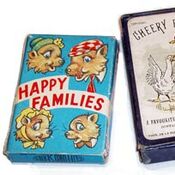
Happy Families | 115 | Happy Families is a set-collecting game where players ask for cards to complete “families” that share a theme, traditionally father–mother–son–daughter across trades or characters. Publishers have used it for teaching sets, promotions and souvenirs, from Victorian occupations to modern cultural themes. Formats vary from small children’s packs to boxed editions with rule cards; families are often labelled or colour-coded for easy sorting. Also known regionally as “families” or “jeu des familles”; see also Quartet. |
| Hindooy | 1 | ||
| Jass | 14 | ||
| Kabufuda | 1 | ||
| Khanhoo | 1 | ||
| Kille | 1 | ||
| Kuhn Khan | 2 | ||
| Kvitlech | 1 | ||
| Loo | 1 | ||
| Madiao | 3 | ||
| Mahjong | 6 | ||
| Mercante in Fiera | 2 | ||
| Minchiate | 6 | The Minchiate Fiorentine represents perhaps the most ambitious tarot variant ever made, expanding the sequence to 97 cards with the Zodiac, Elements, and Virtues. | |
| Misfitz | 29 | ||
| Mus | 1 | ||
| Old Maid | 23 | ||
| Ombre | 1 | ||
| Patience | 47 | Patience refers to single-player card games and the small packs made for them. Publishers issued miniature and medium sizes, often as double sets with rule booklets, gilt edges or cambric finishes in hinged, sliding-lid or travel cases. Themes include Goodall, De La Rue, Piatnik and Dondorf issues, teaching editions and later reprints, plus accessories such as Mary Whitmore Jones’s Chastleton board. See also: Miniature and Solitaire. | |
| Penchant | 1 | ||
| pinochle | 2 | ||
| Piquet | 11 | ||
| Poker | 16 | ||
| Preferance | 1 | ||
| Quartet | 87 | Quartet is a simple ask-and-answer game to collect themed sets, commonly four to a set (quartets) or, in French editions, six to a family. Makers publish wildlife, transport, costume, history and brand-promotion series, often with letters, icons or captions to identify each group. Packs typically run 32–60 cards and may include title or rule cards; some combine quartet play with standard packs. Also known as Happy Families in English-language markets; see also Happy Families. | |
| Quinto | 1 | ||
| Rummy | 2 | ||
| Schafkopf | 4 | ||
| Schnapsen | 1 | ||
| Skat | 37 | ||
| Snap | 107 | Snap is a simple picture-matching game that has been published for children and families since the late Victorian era. This theme gathers early parlour sets and one-penny imports, advertising issues from utilities and co-operatives, wartime caricatures, and licensed editions from studios, alongside modern reprints. Variants include Musical Snap, Zoological Snap, circular formats, and combined editions with Stop Thief or Snip-Snap, from makers such as De la Rue, Chad Valley, C.W. Faulkner, Spear’s, Pepys, Whitman and others. Articles focus on rules, artwork, print methods, and packaging to show how a shout-and-match mechanic travelled across decades, markets and price points. | |
|
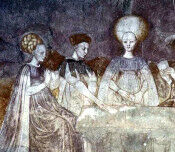
Tarocchi | 14 | The game of tarots is a trick-taking game played with a 78-card deck. Initially known as "triumphi", the word "tarocchi" or "tarots" was first noted in a 1505 document. It is mentioned as a pastime enjoyed by the higher classes or élite, as opposed to rowdy tavern players, in sources from the 1450s onwards, especially in the Ferrara area. See also tarot► |
| Tarocchini | 1 | ||
| Tarocchino | 2 | ||
| Tarocco | 9 | ||
|
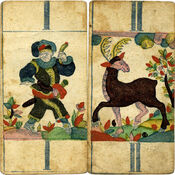
Tarock | 52 | Tarock and Tarok are traditional card games, distinct from tarot cards used in divination. Originating in the 15th century, these games involve strategic, trick-taking gameplay and have various regional versions across Europe. Unlike modern tarot decks for cartomancy, Tarock and Tarok decks are designed for gaming, featuring a special set of trumps with outdoor scenes and Roman numerals. Trump I often depicts a musician.
NOTE: there are several alternative spellings which derive from the original Italian ‘Tarocchi’ in its journey across different European language regions. In some countries it may be spelt Tarok, Taroky, Tarock or Tarokk but they are all the same thing. |
| The Club Series | 1 | ||
| Tsuris | 1 | ||
| Whist | 35 |  |