


Complete Index of 79 Playing-Card Suits
| Image | Suit | Total Articles | Introduction |
|---|---|---|---|
| Akahachi | 1 | ||
| Ansbach | 1 | ||
|
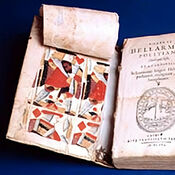
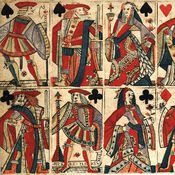
Archaic Patterns | 59 | Playing cards have a rich and fascinating history, with a wide variety of patterns and designs having been used throughout the centuries. A lot of these early patterns have fallen out of use and are now considered archaic or obsolete. Often only one example is known. These old, historic patterns are sometimes discovered as stiffener inside old book bindings when these are repaired, or under floorboards in old buildings during restoration. They are sometimes discovered in ancient rubbish tips. They are of great interest to collectors, historians, and enthusiasts alike. |
| As-Nas | 3 | ||
| Auvergne Pattern | 1 | ||
| Bavarian Pattern | 11 | ||
| Bohemian or Prager Pattern | 8 | ||
| Burgundy Pattern | 3 | ||
| Cadiz-Pattern | 23 | ||
| Castilian Pattern | 6 | ||
| Catalan Pattern | 41 | ||
| Ceki | 5 | ||

|
Dasavatara | 1 | This game uses a Ganjifa type of pack of playing cards. The term "Dasavatara" refers to the ten avatars of the Hindu god Vishnu. The deck consists of 120 round cards, divided into ten suits, each representing one of Vishnu's avatars. The suits are ordered according to the mythology of the avatars' appearances, starting with the Matsya (fish) avatar and ending with the Kalki avatar. The game involves a complex set of rules and is typically played by four players in two partnerships. |
| Dauphiné | 2 | ||
| Domino-Suited | 15 | ||
| Dutch Pattern | 2 | ||
| English Pattern | 13 | ||
| Florentine Pattern | 5 | ||
| Foochow | 1 | ||
|
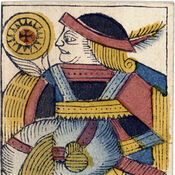
Franco-Spanish | 17 | The early Franco-Spanish pattern goes back to the sixteenth century and had connections with France as well as Spain. Prodigious quantities of playing cards were shipped from Lyon and Thiers into the Spanish peninsular during the 16th, 17th & 18th centuries. Many French manufacturers even emigrated or settled in Spain. Distinguishing features include the cavalier of coins seen from behind; the king of coins holds a small axe; the ace of swords, and often the ace of clubs and one or two other numeral cards, are accompanied by a naked child; the ‘sota’ of cups might display a heraldic lion and the ace of coins features a Spanish heraldic arms. The central coin of the five often shows portraits of the Catholic Monarchs or else a single portrait. The pattern is now extinct. • See also: Aluette • Spanish National pattern► |
| French Catalan Pattern | 4 | ||
| Fribourg pattern | 1 | ||

|
Ganjifa | 8 | This term refers to a family of card games that originated in Persia and spread to India during the Moghul period. The traditional Ganjifa deck consists of 96 cards divided into eight suits. The cards are typically round and hand-painted with intricate designs. The games played with this pack often involve trick-taking mechanics, and the rules can vary significantly depending on the region and specific variant of the game being played. |
| Genoese Pattern | 13 | ||
| Guarro Pattern | 6 | ||
| Guyenne pattern | 1 | ||
| Hanafuda | 7 | ||
| Hokkien | 3 | ||
| Hungarian Seasons Pattern | 10 | ||
| Hwatu | 4 | ||
| Kabu | 1 | ||
| Komaru | 1 | ||
| Kurofuda | 1 | ||
| Languedoc Pattern | 3 | ||
|
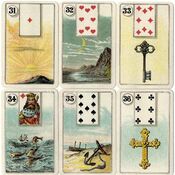
Lenormand | 10 |  Madame Lenormand Cartomancy Cards, also known as the Lenormand Oracle or Petit Lenormand, is a deck of 36 fortune-telling cards created in the early 19th century. They are named after Marie Anne Adelaide Lenormand, a famous French fortune-teller who was known to have read for prominent figures like Napoleon Bonaparte and Empress Josephine. Although there is no historical evidence that Madame Lenormand herself designed or used these specific cards, they have been associated with her due to her reputation and influence in cartomancy. The Lenormand cards differ from traditional Tarot cards in several ways. The Petit Lenormand has fewer cards (36 as opposed to Tarot's 78) and features simpler imagery based on everyday objects and situations, such as a ship, a tree, a heart, or a letter. Each card is numbered and associated with a playing card suit (hearts, diamonds, clubs, or spades), which adds an additional layer of meaning. In recent years, the Lenormand Oracle has gained popularity among modern fortune-tellers and card readers, with many enthusiasts creating their own variations and interpretations of the original deck. |
| Llombart Pattern | 4 | ||
| Lombard Pattern | 1 | ||
| Luditz Pattern | 1 | ||
| Lyon | 7 | The Lyon pattern was initially developed in Lyon, France, during the 16th century. As Lyon was a trading hub, cross-cultural exchange and spread of the designs to Austria, Germany, Italy and Switzerland naturally occurred. The designs spread abroad, undergoing local adaptations, and survived even after they became obsolete in France. | |
| Maciá Pattern | 2 | ||
| Madiao | 1 | ||

|
Mamluk | 5 | Nã'ib, the game of lieutenants... these cards are amongst the earliest Arabic playing cards extant. |
| Mekuri | 3 | ||
| Money-Suited | 6 | ||
|
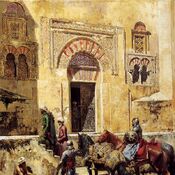
Moorish | 9 | The term 'Moorish' includes Morisco, Mudéjar and other peoples living within al-Ándalus (Iberian peninsula) since the Muslim invasion of 711 and until the expulsions after the Reconquista in the XV & XVI centuries. The Moriscos were descendents of inhabitants of al-Ándalus, who were born and lived in Spain and had converted to Christianity. The Mudéjares remained in Spain during the late medieval period, retaining their Muslim religion and arts. Mozarabic refers to Christians living under Muslim rule and an associated architectural style.
See also: Arabic► |
| Navarra Pattern | 6 | ||
| Neapolitan | 5 | ||
| Nürnberg | 1 | ||
| Pai | 9 | ||
| Paris Pattern | 23 | ||
| Parisian Pattern | 7 | ||
|
Patterns and Suit Types | 66 | Standard patterns are when a certain design becomes established in a certain region and all local manufacturers produce a version of it. It then becomes traditional in that region or in other regions where it is adopted. Some modern patterns are descendants of patterns used three of four hundred years ago. For example, the widely-used standard Anglo-American pattern seen today derives from sixteenth century French designs. |
| Penang | 1 | ||
| Petit Etteilla | 2 | ||
| Piacentine | 1 | ||
| Piedmont | 4 | ||
| Piemontese | 4 | ||
| Portuguese Pattern | 17 | ||
| Provence Pattern | 2 | ||
| Prussian Pattern | 2 | ||
| Raimundo García Pattern | 5 | ||
| Rhineland | 4 | ||
|
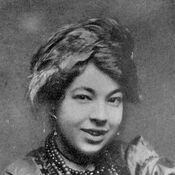
Rider-Waite Tarot | 15 | The Rider Waite Tarot was created at the beginning of the 20th century by Arthur Edward Waite and Pamela Colman Smith. |
| Rouen Pattern | 2 | ||
| Salzburger | 2 | ||
| Saxon Pattern | 1 | ||
| Spanish National Pattern | 19 | ||
| Spanish Suited | 89 | ||
| Standard Pattern | 39 | A card player doesn’t like surprises. During the game s/he needs to recognize his or her cards quickly and easily. Mistakes can lead to loss... thus, players prefer standardized patterns that go unchanged by fashions. These cards are printed by most manufacturers,with only minor variations. They are used for a long period, become traditional and belong to public heritage. All others are “non-standard” or fantasy decks, political, educational, advertising decks, and so on. | |
|
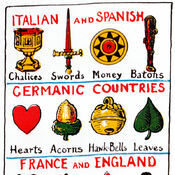
Suits | 38 | Playing cards suits have evolved from the earliest Chinese money-based cards into the suit symbols we find around the world today, including the various European suit-systems (Italian and Spanish, Germanic and Swiss, French and English). There have also been variant, non-standard or experimental suit systems. Articles also include information on different suits used in modern decks, such as those with five suits and variants of traditional designs. The fact that the “French system” prevailed in the long term is likely due to the fact that it represents a more rational production technique: while the individual acorns and bells, swords and coins etc. had to be printed from woodblocks, the single-colour only form in "French suits" required just stencil printing. This printing method saves the card maker much labour on the forty number cards. |
| Swiss | 16 | ||
| Tarot de Besançon | 2 | ||
| Tarot de Marseille | 10 | ||
| Thoth | 4 | ||
| Trappola | 7 | Trappola, or Trappolier cards, are an Austro-Hungarian adaptation of Venetian cards. They are particularly appealing due to their colourfulness. | |
| Triestine | 3 | ||
| Tô Tôm | 2 | ||
| Vienna Pattern | 3 | ||
| Württemberg Pattern | 1 |
