


Nabagunjara Ganjifa
An ancient game from the Puri region of India.
Nabagunjara Ganjifa is one of the many versions of ganjifa, the Indian game with round, hand-painted cards. There are eight suits, each one containing ten pip cards and two court cards, traditionally known as the vizier and the king. In this particular deck, the vizier’s role is filled by the prince Arjuna and the king’s by Krishna (one of the avatars of the god Vishnu) in his form as Nabagunjara, a fantastical creature composed of the parts of nine different animals.
According to one version of the great Hindu epic The Mahabharata, Arjuna was meditating when Krishna appeared as Nabagunjara, made up of: the head of a rooster; the neck of a peacock; the back of a bull; the waist of a lion; the trunk of an elephant; the tail of a serpent; and the legs of an elephant, a tiger, and a deer. The final limb was a human arm holding a lotus. Arjuna, a renowned archer, was about to shoot the beast when he realized it was Krishna. Arjuna then bowed in awe before the god. That’s the pose in which he’s portrayed on these extraordinary cards.


Nabagunjara Ganjifa hand-painted round cards made in India, total = 96 cards.

By Lev Golinkin
United States • Member since May 26, 2026
I'm a US-based author and journalist. I've been collecting playing cards since I was about 8 years old, when I got mesmerized by the various decks that were used in Soviet Ukraine, where I'm from. I collect mainly European decks such as those by Dondorf, Grimaud, and Piatnik. I love courts above all else, and am drawn toward historical and artistic decks.

Activity for Nabagunjara Ganjifa
Sign in to comment or save this article.

Related Articles
Persian Ganjifa
Hand-painted Persian ganjifa cards reflecting a once-popular eight-suited card game.
Early nineteenth-century Transformation cards
Vernacular hand-painted Transformation cards, probably early 19th century.
Heathen Divinities
Handmade playing cards from the British Museum depicting classical Greek and Roman gods and goddesse...
Ganjifa - Playing Cards from India
Indian playing cards, known as Ganjifa, feature intricate designs with twelve suits and are traditio...
Calon Arang • Калон Аранг - Бали
Calon Arang, a figure from 12th-century Javanese and Balinese folklore known as a witch skilled in b...
Handmade Ganjifa Birds Playing Cards
This set of Ganjifa cards is a beautiful example of traditional cards from India.
Sea Myths Playing Cards
Morskie mify (Sea myths) designed by Lev Liberman, Russia, 2005.
Ganjifa™
A colourful pack of round cards with Ganjifa designs by Asha Industries, Mumbai, India, 2002.
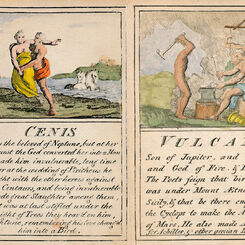
Pantheon or Heathen Mythology
Pantheon or Heathen Mythology cards for instruction of youth, c.1770.
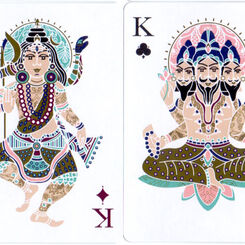
Divine Art
Divine Art Playing Cards by Sunish Chabba & Guru Playing Card Company, 2016.
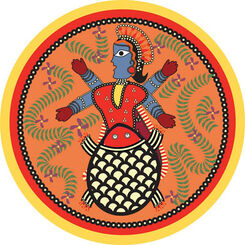
Guru Ganjifa
Sunish Chabba is working on an initiative to revive traditional Ganjifa, the card game most popular ...
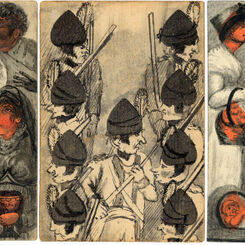
Hand-Painted Transformation, c.1800-20
An early 19th century set of hand-painted transformation playing cards depicting contemporary scenes...
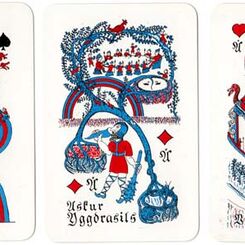
Iceland Mythological Playing Cards
Iceland Mythological Playing Cards designed by Sigurlinna Pétursson, 1958
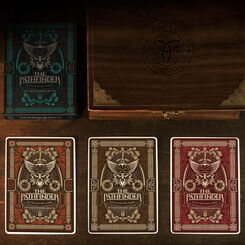
Pathfinder Playing Cards
The Pathfinder deck of cards has been inspired by Odin, the Norse god of wisdom, war and death.
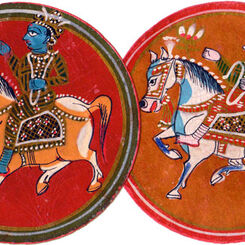
Indian Ganjifa Playing Cards
‘Ganjifa’ playing cards made in Sheopor in the North of Madhya Pradesh province in Central India. Th...
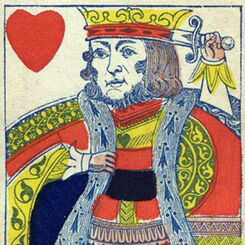
Suicide King
The King of Hearts, holding a sword behind his head, is sometimes nicknamed the “Suicide King”. He c...
Chitrashala Press
Chitrashala Press produced some charming children's pictorial alphabet cards for early learning purp...
Fate Circular Deck
Circular Spanish-suited playing cards for FATE, 2007
Dasavatara Ganjifa from India
Chromo-lithograph Ganjifa cards by the Chitrasala Press, around 1950. Ten suits of twelve cards, eac...
Hunting Depicted on Playing Cards
In the Middle Ages hunting was an integral part of life.
Most Popular
Our top articles from the past 60 days


