


Persian Ganjifa
Hand-painted Persian ganjifa cards reflecting a once-popular eight-suited card game.
Two of the most popular traditional card games in Iran were ganjifa (also spelled ganjafeh or ganjafa) and as (as-nas). Persian ganjifa was played with a 96-card pack divided into eight suits: crowns, silver coins, swords, servants, harps, gold coins, documents and merchandise. Each suit comprised ten numeral cards (1–10) together with two court cards: the king (mir), usually shown enthroned and accompanied by courtiers holding an umbrella, and the minister (wazir), commonly depicted mounted on horseback accompanied by runners.
The incomplete set shown here, preserved in the Bibliothèque nationale de France, illustrates the refined decorative style associated with Persian ganjifa: figures framed by ornate architectural arches and suits represented by symbolic objects. These symbolic objects do not have a clearly documented origin but likely reflect a mixture of courtly, administrative and commercial imagery from the Persianate world. The court cards mirror the structure of royal administration in Safavid Persia. The cards were hand-painted with gouache onto ivory tiles and finished with a thick lacquer. The backs have a floral design within a rectangular decorative frame.


Above: Persian Ganjifa cards from the Bibliothèque nationale de France. 18 cards from a total of 96 : gouache on ivory ; 5.5 × 3.5, 1820.
The eight-suited game was reportedly banned in the 17th century during the reign of Abbas II of Persia (r. 1642–1666), after which knowledge of the game gradually faded in Persia. Nevertheless, the tradition continued in the Indian subcontinent, where Mughal ganjifa cards developed into a flourishing craft with regional variations and distinctive circular cards. The term ganjifa (also spelled ganjafeh or ganjafa) is probably a generic word like na'ib or naipe, used across different languages, rather than a specific game.
The early history of playing cards in Persia is still uncertain and some confusion still persists. A reference in the chronicles of the Mamluk historian Yūsuf ibn Taghrī-Birdī, describing events of 1417–1418, notes that a game called kanjifah was played for high stakes among wealthy and respectable people (i.e. élite Persian society) in Egypt and Syria. Whether these players used Mamluk-style cards or something resembling the 'ganjifa' cards seen here is open to speculation. Whatever their precise origins, such surviving packs offer a glimpse into what may have been a widespread tradition of card play in Persia, the historical region that corresponds broadly to modern Iran.
References and Links
Bibliothèque nationale de France : Jeu de Ganjifa persan ►
Ashmolean Museum : Persian and Indian Playing Cards ►
Mann, Sylvia: All Cards on the Table, Jonas Verlag/Deutsches Spielkarten-Museum, Leinfelden-Echterdingen, 1990
Wikipedia : Ganjifa ►
Wikipedia : Ibn Taghribirdi ►

By Simon Wintle
Spain • Member since February 01, 1996
I am the founder of The World of Playing Cards (est. 1996), a website dedicated to the history, artistry and cultural significance of playing cards and tarot. Over the years I have researched various areas of the subject, acquired and traded collections and contributed as a committee member of the IPCS and graphics editor of The Playing-Card journal. Having lived in Chile, England, Wales, and now Spain, these experiences have shaped my work and passion for playing cards. Amongst my achievements is producing a limited-edition replica of a 17th-century English pack using woodblocks and stencils—a labour of love. Today, the World of Playing Cards is a global collaborative project, with my son Adam serving as the technical driving force behind its development. His innovative efforts have helped shape the site into the thriving hub it is today. You are warmly invited to become a contributor and share your enthusiasm.

Activity for Persian Ganjifa
Sign in to comment or save this article.

Related Articles
La baraja de Almagro
De la chimenea al monumento nacional: la baraja de Almagro y el renacer del corral de comedias.
Ganjifa - Playing Cards from India
Indian playing cards, known as Ganjifa, feature intricate designs with twelve suits and are traditio...
Sevilla 1647 reproduction
Facsimile of Spanish-suited pack produced in Sevilla, Spain, 1647.
Early German playing cards
Some early examples of popular German playing cards from the XV and XVI centuries.
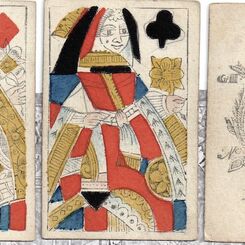
73: Fakes, forgeries and Tax Evasion
When there are official taxes to pay, people will find a way to avoid paying them - often illegally....
Playing Cards: A Secret History
Playing Cards: A Secret History

History of Playing Cards explained in 5 Minutes
Video by Art of Impossible. In this video you will get a short overview of the most important histor...
70: Woodblock and stencil : the spade courts
This is a presentation in a more straight forward fashion of the work done by Paul Bostock and me in...
64: The descendants of the French regional patterns: 2
A continuation oF the development of the off-spring of the Paris patterns and a few examples of how ...
Trentine Pattern
Trentine Pattern
Qajar dynasty playing cards at the British Museum
Two small groups of Qajar-period playing cards from Iran (Persia), photographed in 2017 in the Briti...
Suicide King
The King of Hearts, holding a sword behind his head, is sometimes nicknamed the “Suicide King”. He c...
19: 19th Century Breaks with Tradition - Unusual versions of the Standard English Pattern
The centuries-long tradition of English court cards was subject to misinterpretation and in some cas...
1: Playing Cards and their History: An Introduction and some links to other sites
What was considered the first mention of playing cards in England is in 1463 when Edward I banned th...
History of Blackjack
Over the years the origin of Blackjack, like many other games, has eluded researchers for a long tim...
Paris Pattern
The Paris pattern was established as such around the middle of the seventeenth century (based, perha...
Mamluk Playing Cards
Nã'ib, the game of lieutenants... these cards are amongst the earliest Arabic playing cards ext...
Italian Playing Cards
The first reliable evidence that playing cards were being used in Italy is from 1376, when a game ca...
The History of Playing Cards
Playing cards appear in European records in the late 14th century, but their earlier history lies fu...
History of English Playing Cards & Games
The History of English Playing Cards dates probably from the mid 15th century
Most Popular
Our top articles from the past 60 days


Paola Benzoni
11 July 2026, 21:15SavedSaved this article to Storia delle carte da gioco