


Spanish 19th century Political pack
Satirical playing cards manufactured by Francar y Cía depicting political situation.
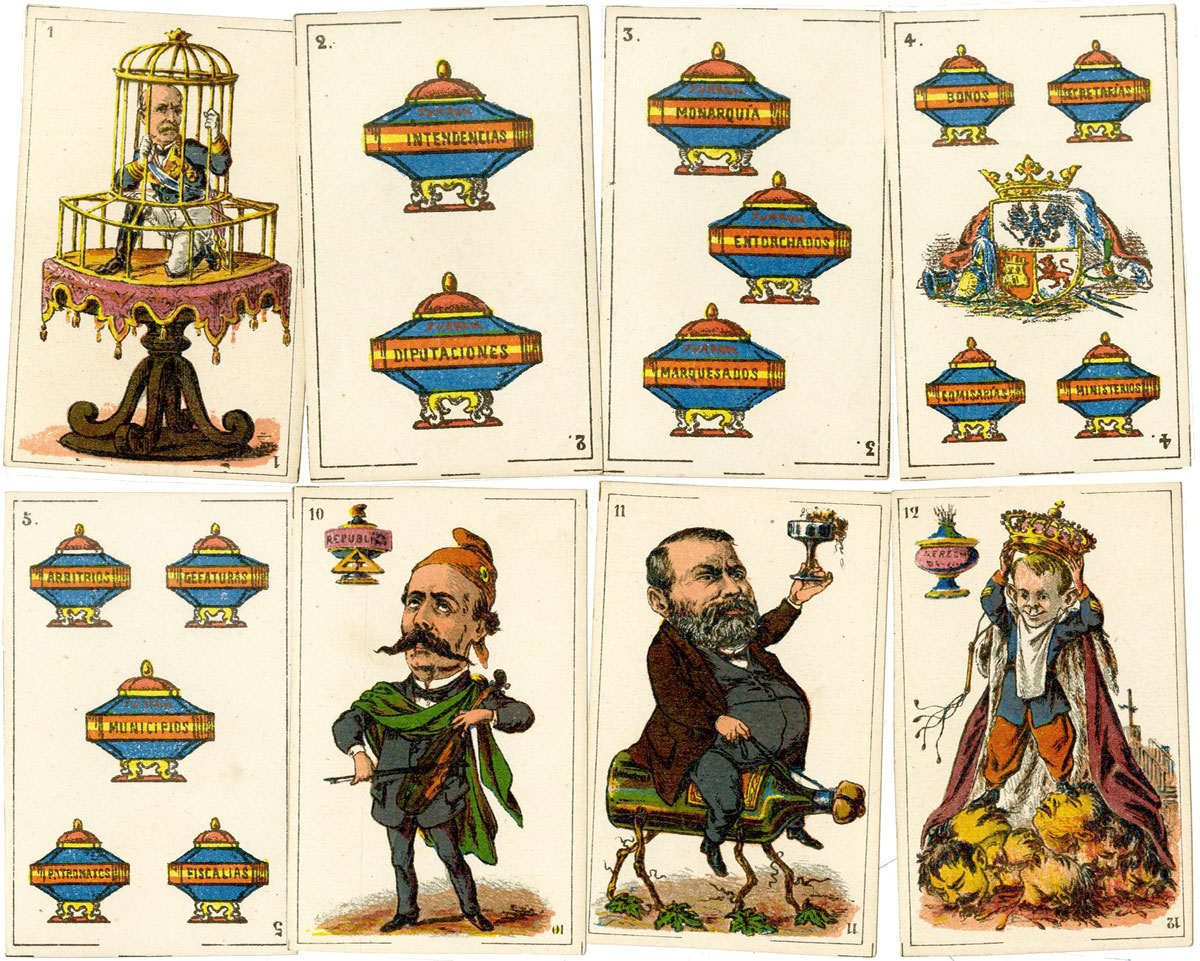
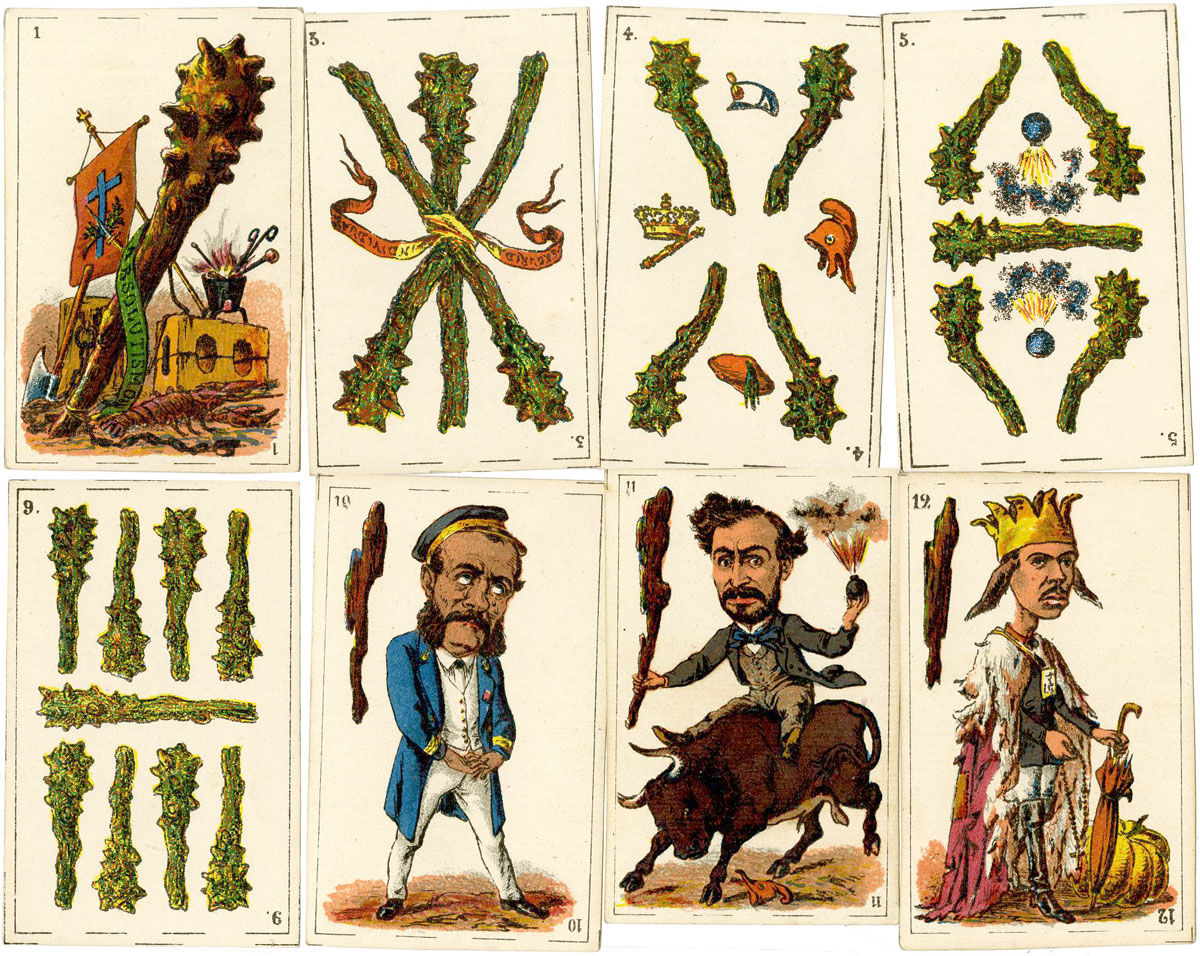
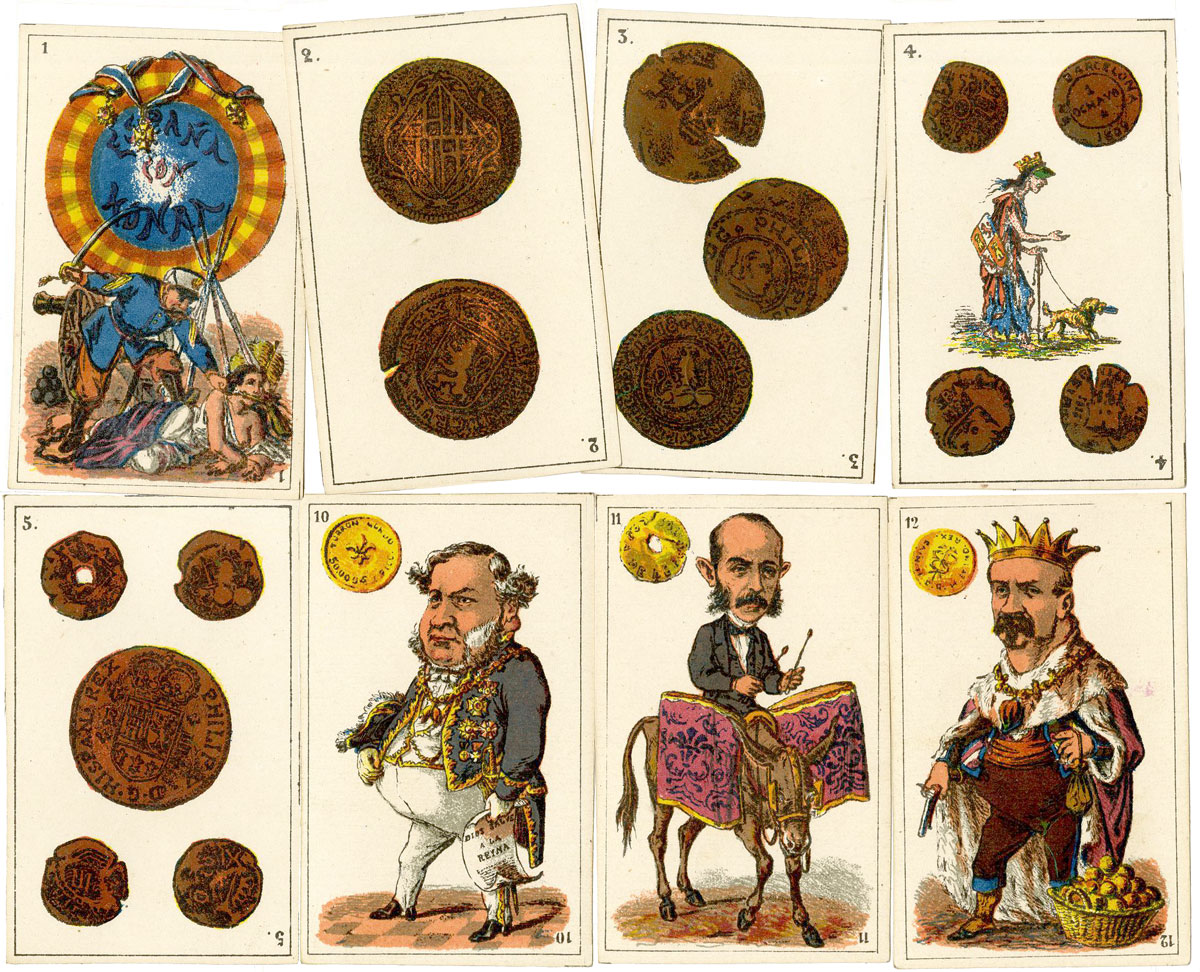
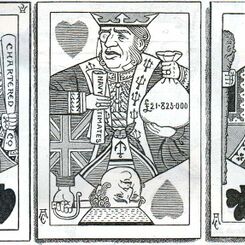
Spanish satirical playing cards reflecting the political situation in Spain following the September 1868 revolution ('La Gloriosa') and the ousting of Isabel II who was exiled to France. The usual suits are fancifully treated: court cards are caricature portraits of contemporary Spanish political characters, the aces have satirical designs, and the coin suit-marks are old Spanish coins.
The ace of cups depicts Francisco Serrano, who became regent in 1870, in a gilded cage. The jack is Emilio Castelar, a visionary republican and eloquent defender of democracy, wearing a Phrygian cap and playing the violin. The cavalier of cups is Nicolás Mª Rivero, who advocated democracy, and the king of cups depicts Prince Alfonso wearing the crown. The four of cups depicts the national coat-of-arms and the remaining numeral cards have political issues inscribed on each cup.
The ace of clubs has a banner with the slogan “Absolutism” and various symbolic motifs in the foreground. The axe and the lobster were associated with critique of Absolutism in 19th century Spain: the axe symbolised violence and repression whilst the lobster symbolised decadence and privilege. The jack of clubs depicts Admiral Juan Baptista Topete with a disappointed look. Although he had played a key role in the revolution he became marginalised as the country descended into deeper political turmoil. The cavalier of clubs is Práxedes Mateo Sagasta, who served as prime minister on several occasions leading the liberal party and was renowned for his rhetorical skills, depicted here riding a bull carrying a bomb. The king of clubs is Don Carlos de Borbon, the pretender.
The ace of coins has a large rosette with the words “España con Honra” (Spain with honour). The image is supposed to represent fallen Spain, freed from the fight with the army, but emphasizing the importance of maintaining Spain's integrity. The jack of coins depicts Salustiano Olózaga holding a sheet of paper bearing the motto “Dios Salve a la Reyna” (God save the Queen) because he famously used this phrase during a parliamentary session in support of the young Queen Isabella II. The cavalier of coins is Estanislao Figueras y Moragas, a prominent figure in the Republican Party, depicted here playing the timbal. The king of coins is the pretender Duke of Montpensier (a member of the French royal family) dressed as a king. The Duke of Montpensier was often caricatured with a pistol and a moneybag due to his perceived association with power, wealth and possibly even corruption or manipulation in political affairs. The coins suit symbols are old Spanish coins.
The ace of swords represents the sword of the law over the state of siege. The jack of swords is Cándido Nocedal, known for his strong defense of Catholic unity and traditional values, holding the national standard. The cavalier of swords shows General Juan Prim y Prats who had been a key figure in the 1868 revolution, but was assassinated in 1870 which left a political vacuum. He is depicted here riding a mangy lion, hiding the crown, as many of his envisioned reforms remained unfulfilled and he was unable to restore Spain's former glory. The king of swords shows the vacant throne. The remaining cards in all suits feature various cartoons of impoverished Spain, and emblems of monarchists, republicans, liberals and carlists, as well as various inscriptions.
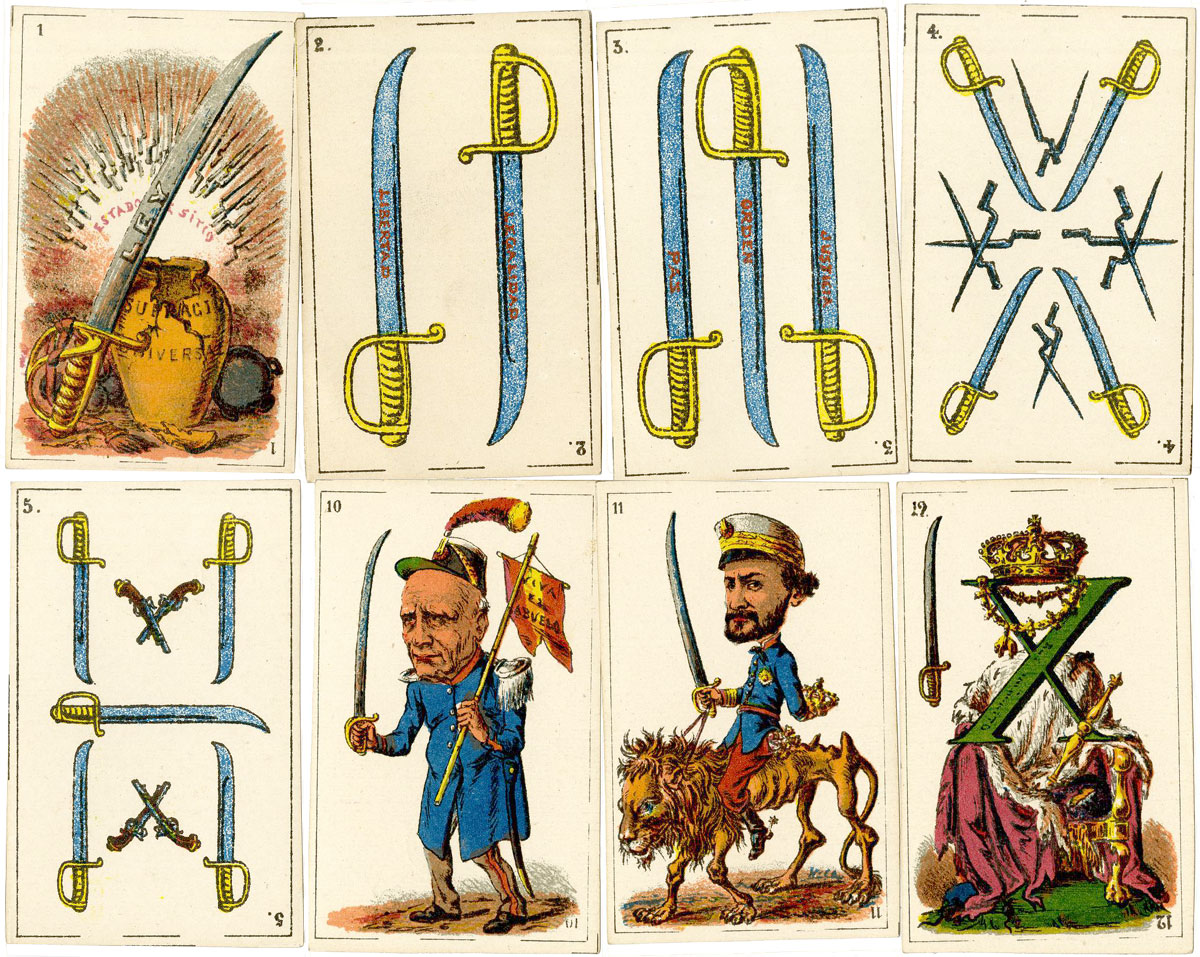
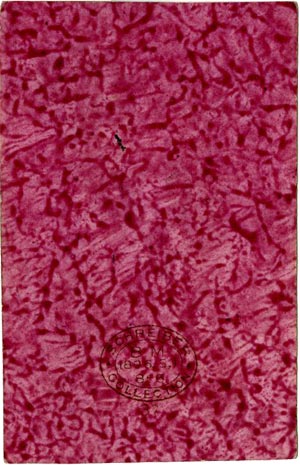
Above: Satirical playing cards manufactured by Francar y Cía, Barbara 12, Barcelona, 1872. © The Trustees of the British Museum • Museum number 1896,0501.866►

By Simon Wintle
Spain • Member since February 01, 1996
I am the founder of The World of Playing Cards (est. 1996), a website dedicated to the history, artistry and cultural significance of playing cards and tarot. Over the years I have researched various areas of the subject, acquired and traded collections and contributed as a committee member of the IPCS and graphics editor of The Playing-Card journal. Having lived in Chile, England, Wales, and now Spain, these experiences have shaped my work and passion for playing cards. Amongst my achievements is producing a limited-edition replica of a 17th-century English pack using woodblocks and stencils—a labour of love. Today, the World of Playing Cards is a global collaborative project, with my son Adam serving as the technical driving force behind its development. His innovative efforts have helped shape the site into the thriving hub it is today. You are warmly invited to become a contributor and share your enthusiasm.

Activity for Spanish 19th century Political pack
Sign in to comment or save this article.

Related Articles
The Five of Hearts
A political hand badly played: Admiral Byng and the satire of failure, c.1756.
La baraja “Alacrán”
Una sátira política con aire caribeño.
Líneas rojas 2016
Semicaricatural images of Spanish politicians by Jordi Minguell, combined with non-standard suits. ...
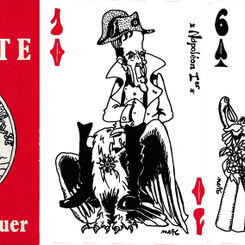
Le Giscarte
Le Giscarte political playing cards designed by Eddy Munerol, France, 1976.
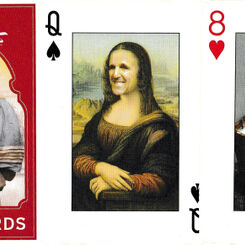
K Deck
“K Deck” political playing cards, USA, c. 2004.
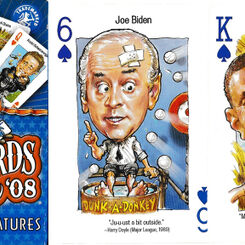
Politicards 2008
Politicards ’08 with caricatures cast as characters from classic movies, USA.
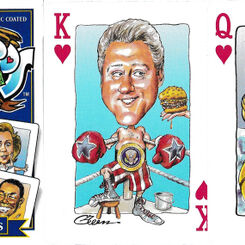
Politicards 1996
Politicards ’96 with satirical caricatures on every card by Peter Green, USA.
Playing Politics ’92: Pack of lies
Playing Politics ’92: Pack of lies with caricatures by Grant Robertson, UK.
B-Deck
“B-Deck” scurrilous playing cards poking fun at a former UK prime minister.
El Jueves playing cards
Caricatures of 52 famous Spaniards for the satirical magazine “El Jueves”.
Baraja Mística
‘Baraja Mística’ satirical playing-cards featuring revelling clergy published by Litografía Fernánde...
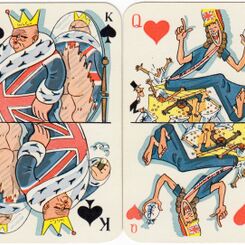
WW2 German Propaganda Playing Cards
showing satirical portraits of Allied leaders and politicians
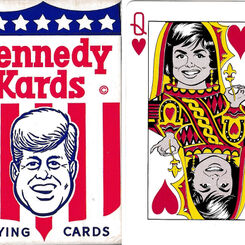
Kennedy Kards
‘Kennedy Kards’ playing cards with satirical portrayals of the Kennedy clan, USA, 1963
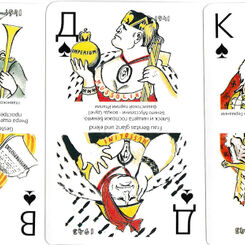
Anti-Fascist cards, 1943
Satirical Anti-Fascist cards designed in 1943 by Ivan Ivanovich Kharkevich.
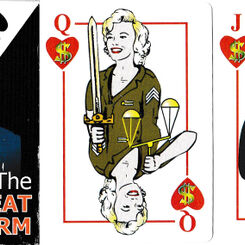
The Great Storm
The Great Storm, Israel, 2003
European Naval Powers
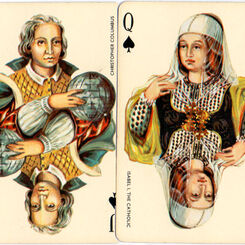
“XVI Century European Naval Powers” deck illustrated by Isabel Ibáñez de Sendadiano and produced by ...
Habemus Boda, 2004
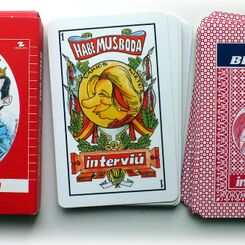
“Habemus Boda” deck celebrating the royal wedding of Prince Felipe and Princess Letizia of Spain wit...
La Baraja Constitucional
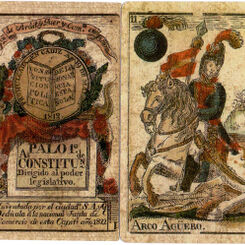
The “Baraja Constitucional” commemorates the declaration in Cádiz of the Constitution of 1812 and wa...
Repoker Político
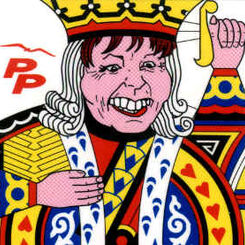
Political caricature playing cards designed by Antonio Olveira, published by the Malaga newspaper “D...
Mr Punch’s Playing Cards
Mr Punch’s Playing Cards, 1896.
Most Popular
Our top articles from the past 60 days


