


Karten-Almanach
Fifth Transformation Card Almanac published by J.G. Cotta’s bookshop, 1810.
Between 1805 and 1811, J.G Cotta, the German publisher famous for printing Goethe and Schiller, released a series of six "Card Almanacs" (Karten Almanach). This is the fifth edition, published as a book, in which each card is accompanied by a humorous poem or description in prose in German. "High" literary culture was being popularized and domesticated into an everyday object like a playing card. See an example
The pip cards
The 40 pip cards depict vignettes of everyday domestic and social life from that era. Officers and soldiers, including send-ups of Napoleon, as well as allegorical or veiled figures, appear in burlesque, satirical contemporary scenes. They provide a window into early 19th century German Romanticism, and a contrast to the mythological grandeur of the court cards. The defining feature is that the suit pips themselves are woven directly into the composition - such as in helmets, faces or lampshades.


The court cards
The 12 court cards are full-length figures which travesty heroes and heroines of ancient mythology in a light-hearted, sometimes ludicrous manner. For example, the valet of diamonds, Paris, is shown as a capering French dancing-master, with cocked hat and fiddle under his arms. The cards are labeled "Valet," "Dame," "Roi" rather than German equivalents, even though this was a German publisher and audience. That's not incidental; it reflects the cultural prestige French language and taste still carried across German courts and educated society in the Napoleonic era, when Württemberg was a French-allied kingdom. However, the overt political commentary in this almanac wasn't on the court cards but on the numbered pip cards shown above.


Karten-Almanach, 52 transformation playing-cards with French suit-marks engraved by Andreas Ludwig Bissel, bound into a book of 102 pages, published by: J G Cotta, Tübingen, 1810. The cards have plain backs.. © The Trustees of the British Museum
References
British Museum number 1876,1014.1513-1564 : A series of 52 transformation playing-cards ►
Willshire, W. H.: A Descriptive Catalogue of Playing and Other Cards in the British Museum (German 156), Trustees of the British Museum, 1876, reprint 1975 (German 279).

By Simon Wintle
Spain • Member since February 01, 1996
I am the founder of The World of Playing Cards (est. 1996), a website dedicated to the history, artistry and cultural significance of playing cards and tarot. Over the years I have researched various areas of the subject, acquired and traded collections and contributed as a committee member of the IPCS and graphics editor of The Playing-Card journal. Having lived in Chile, England, Wales, and now Spain, these experiences have shaped my work and passion for playing cards. Amongst my achievements is producing a limited-edition replica of a 17th-century English pack using woodblocks and stencils—a labour of love. Today, the World of Playing Cards is a global collaborative project, with my son Adam serving as the technical driving force behind its development. His innovative efforts have helped shape the site into the thriving hub it is today. You are warmly invited to become a contributor and share your enthusiasm.

Activity for Karten-Almanach
Sign in to comment or save this article.

Related Articles
Arn de Gothia
A Swedish tale of the Crusades gets the Piatnik treatment.
Allegories and Myths
Semi-transformation playing cards from artist Violeta Monreal.
Odyssey Playing Cards
A Kings Wild Project celebrating Homer’s epic.
Beowulf
Jackson Robinson's Beowulf playing card deck inspired by the Old English pagan poem.
Wedding of Krechinsky • Свадьба Кречинского
A pack of cards depicting characters from the famous play "The Wedding of Krechinsky" by Sukhovo-Kob...
Mythological tarot by Michael Schatzberger
Mythological tarot by Michael Schatzberger, Passau, Bavaria, early 19th century.
Mythological and Allegorical tarot
Mythological and Allegorical tarot produced by Peter Paul Fetscher junior, Munich.
Æsop’s Fables tarot
French-suited Æsop’s fables tarot produced by Leipzig Industrie Comptoir, c.1800-1825.
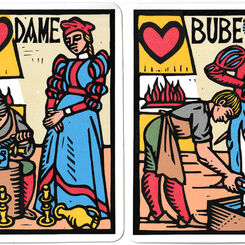
Burgdorf Abschreckhärtetechnik
Promotional pack for a German steel hardening business, with designs by Costante Costantini.
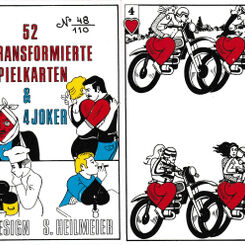
52 Transformierte Spielkarten
Modern transformation pack including some saucy images created by Siegfried Heilmeier.
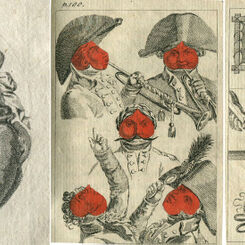
The Kiss, 1808
‘Aphorisms on the Kiss’ published by C. A. Solbrig, Leipzig, 1808.
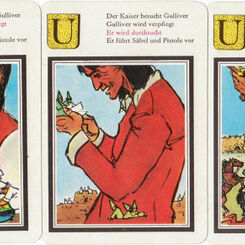
Gulliver im Land der Zwerge
Gulliver in the Land of Dwarfs quartet published by Verlag für Lehrmittel, Pößneck.
On The Cards
A Motley Pack - transformation playing cards & ‘On The Cards’ book facsimile published by Sunish Cha...
Antike Götter
“Antike Götter” - facsimile of antique playing cards originally manufactured by C. A. Müller, Berlin...
Carl Arnold Transformation
Transformation playing cards designed by Carl Johann Arnold (1829-1916), the court artist for King F...
Alice in Wonderland Snap
Alice in Wonderland “Snap” 1 penny game from 1920s or 30s, made in Germany, anonymous manufacturer. ...
Fairy Tales
German Fairy Tales Card Game.
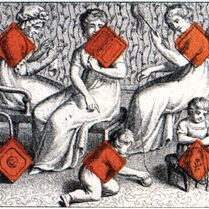
Cotta Transformation playing cards
In 1804, J.G. Cotta, a publisher and bookseller in Tübingen, Germany, produced the first set of tran...
Suicide King
The King of Hearts, holding a sword behind his head, is sometimes nicknamed the “Suicide King”. He c...
South German Engraver
A pack of 52 cards with banner 10s, female 'Sotas', horsemen and kings, the pack was engraved in the...
Most Popular
Our top articles from the past 60 days


