


Hector de Trois
A 1963 facsimile of a seventeenth-century Portrait of Paris pack preserved by the Bibliothèque nationale de France.
Hector de Trois is a 1963 facsimile of one of the oldest known decks of playing cards featuring the “Portrait of Paris” pattern. The original deck was made in the seventeenth century and is preserved in the Bibliothèque nationale de France. This 52-card facsimile was produced for the exhibition 5 siècles de cartes à jouer en France (“Five Centuries of Playing Cards in France”), held from 16 September to 16 October 1963 at the Department of Prints and Photography of the National Library in Paris (Cabinet des estampes). To my knowledge, this is the only facsimile created for this deck, which was later sold as a standard reproduction by Dusserre and Grimaud.
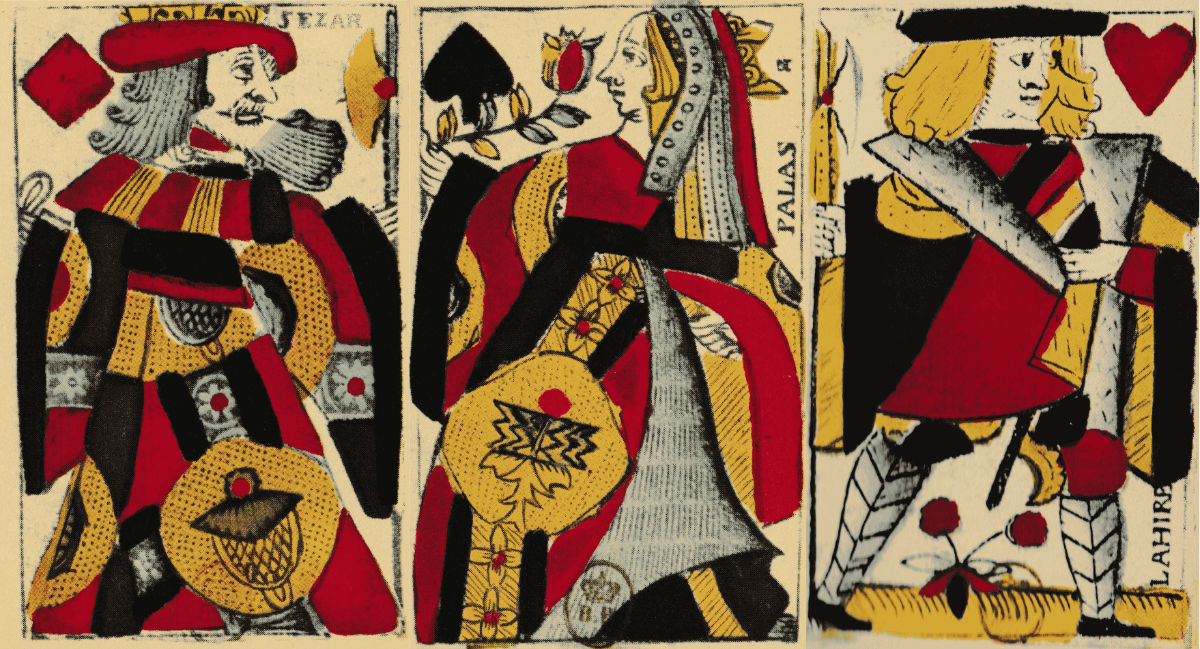
Above: three court cards from the Hector de Trois facsimile, showing the colourful figures of the “Portrait of Paris” pattern.
Three court cards from the Hector de Trois facsimile, arranged side by side to show the colourful figures, intricate linework and red, black and ochre palette of the “Portrait of Paris” pattern.
The proceeds from the exhibition edition benefited the Soutien confraternel des journalistes (“fraternal support of journalists”). It comes from the only known example, produced by an association of leading French card makers of the time: Camoin, B.P. Grimaud and J. M. Simon, Miro Company, Philibert, and Le Triboulet. The edition was available in single or double format. The few sources I have found indicate a limited and numbered edition, but the two copies I own, a single box and a double box, are not numbered. Perhaps this is because they were reserved for the organisers, but the doubt remains. See the presentation cards .
Because the Jack of Diamonds bears the inscription “Hector de Trois,” these cards were long attributed to a card maker from Champagne. However, as early as the eighteenth century, Abbot Jean-Baptiste Bullet knew that it depicted the Homeric hero. The card maker’s name and shop sign should have appeared on the oval shield, or “countermark” (sometimes incorrectly called a “bluteau”), of the Jack of Clubs. But this shield is blank, preventing us from identifying the maker.
These cards are one of the rare pre-1700 examples of the model that specialists call the “Portrait of Paris,” the ancestor of the traditional French deck. The names of the characters that still exist today are recognizable, except, of course, for that of the Jack of Clubs, who bore the name of the card maker. Before 1600, this Jack was called Judas Maccabeus. As recently demonstrated, David, Alexander, Caesar, and Charles (Charlemagne), as well as Hector and Judas Maccabeus, come from the series of the Nine Worthies, conceived in the fourteenth century by the poet Jacques de Longuyon and highly popular until the sixteenth century.
The only known surviving original can be viewed in the Gallica scan. Further research on the deck and the “Portrait of Paris” pattern is available in this BnF note. The catalogue for the 1963 exhibition is also available through Gallica.
The edition was presented in a luxurious leather case, embossed and hot-stamped in gold with a red velvet interior. See the box .
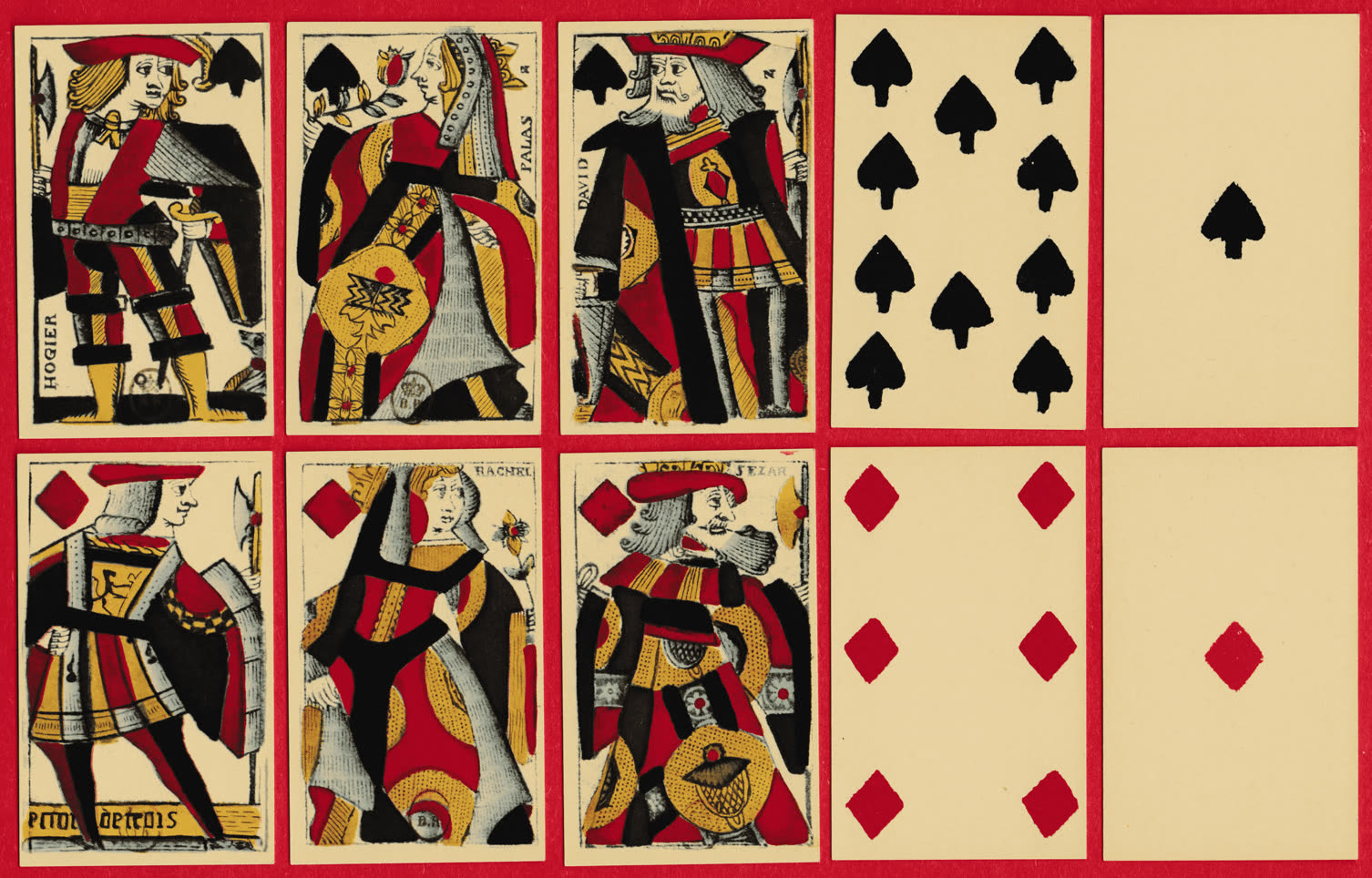
Above: court cards and suit cards from the Hector de Trois facsimile, including Hector, David and Alexander.
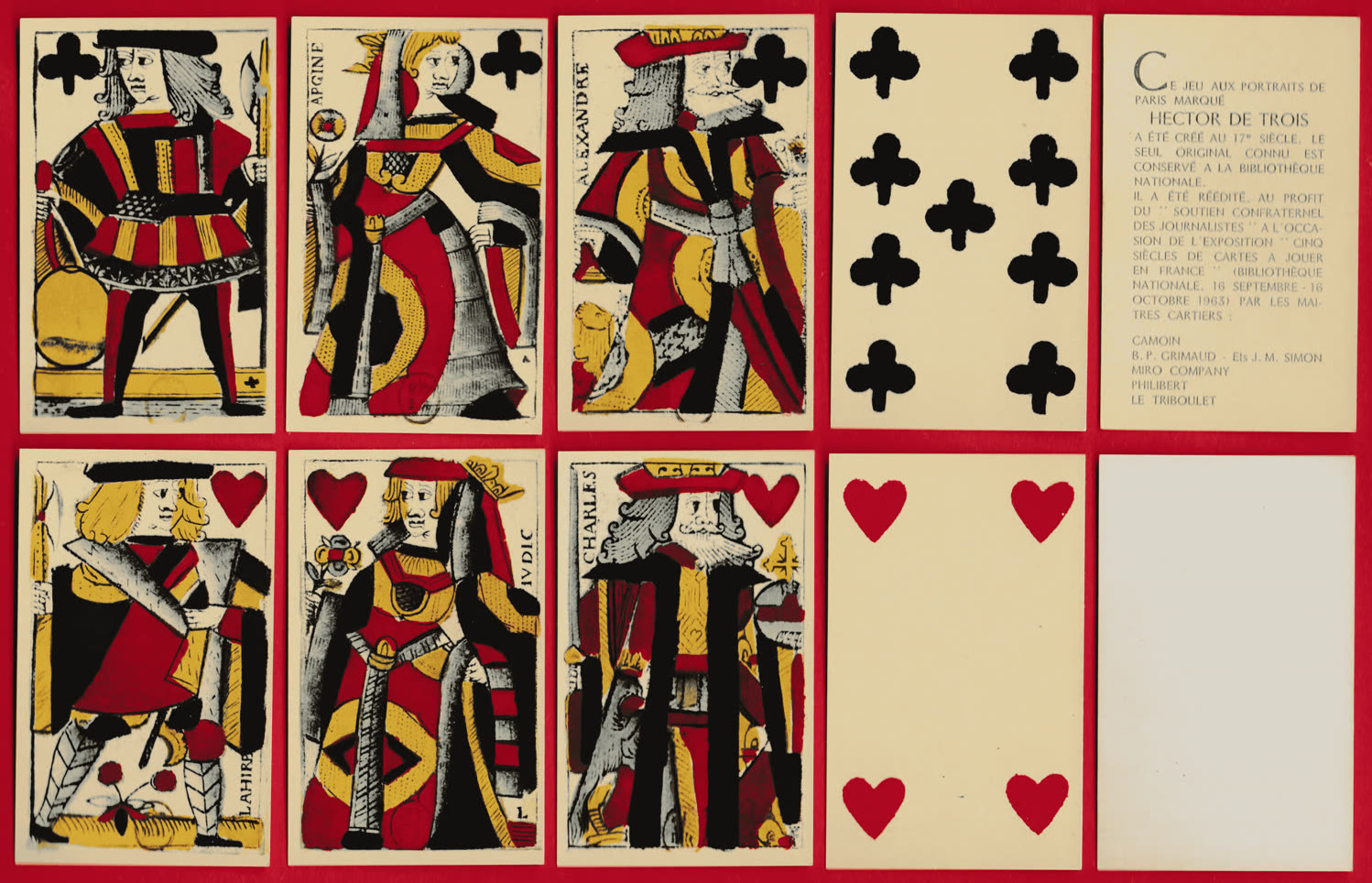
Above: clubs and hearts, with the mirrored court figures rendered in red, black and ochre.

By Vincent Bérail
France • Member since June 22, 2026
Collectionneur français de cartes à jouer de 52 cartes. Principalement des jeux non standarts des années 1950 à 2000

Activity for Hector de Trois
Sign in to comment or save this article.

Related Articles
Les Amoureux de Peynet
An iconic cartoon veers from cute to sexual with no stops in between.
Les Quatre Saisons
A lyrical cycle of the seasons woven into the language of playing cards.
Smith-Corona Marchant
Simplified yet colourful court card designs by Avoine for Smith-Corona Marchant.
Correspondances
‘Correspondances’ depicting the 52 transfer stations of the Paris Métropolitain, France, 1985.
Compagnie Maritime des Chargeurs Réunis
French navigators and explorers on a promotional pack for the C.M.C.R shipping company.
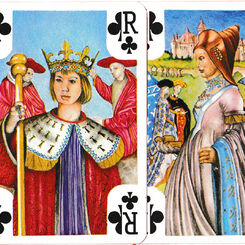
Jeanne d’Arc, “La pucelle d’Orléans”
Joan of Arc and her contemporaries in a colourful pack designed by Patrice Louis.
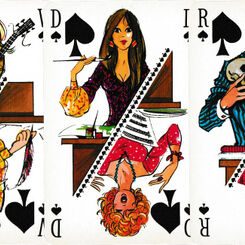
Gibert Jeune
Publicity pack for Gibert Jeune, the famous Parisian bookshop, with designs by James Hodges.
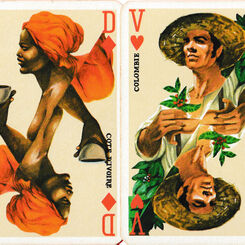
Le Café
Four of the great coffee-producing countries represented in a commemorative pack of playing cards.
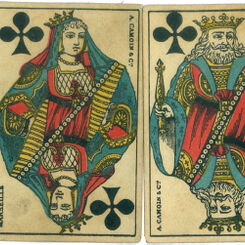
A. Camoin & Cie
This deck was inherited from ancestors, it has has a family history surrounding it. Details of the l...
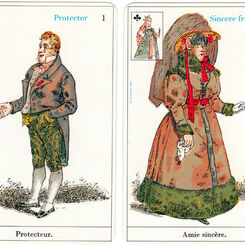
La Sibylle des Salons
La Sibylle des Salons facsimile of 19th century deck published by J M Simon, 1979.
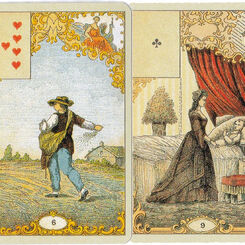
Le Destin Antique
Le Jeu du Destin Antique, originally published by Grimaud in XIX c., republished many times since......
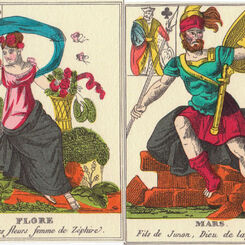
Jeu Mythologique
“Jeu Mythologique” facsimile 18th century pack by J M Simon, 1983.
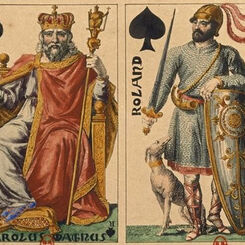
Dames de France
“Dames de France” published by J-M Simon based on originals by Armand Gustave Houbigant, Paris, c.18...
Jeu de l’an 2
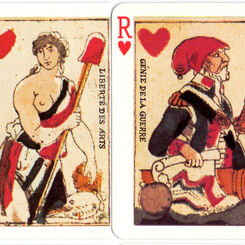
“Jeu de l’an 2” by Grimaud is a facsimile of French Revolutionary cards first published by Veuve Mou...
Jeu Louis XV
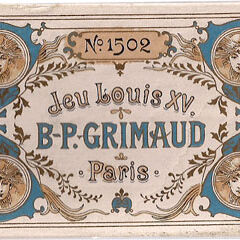
B.P. Grimaud of Paris issued this very ornate costume deck called “Jeu Louis XV No.1502” in c.1895. ...
Masonic Playing Cards
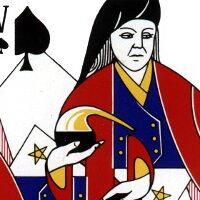
A set of playing cards designed by Julien Lebleu, an original work in the history of Freemasonry. Je...
Livre du Destin
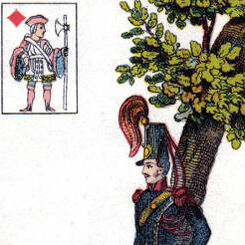
Livre du Destin or Book of Fate, printed by B.P.Grimaud, Paris, c.1900.
French Playing Cards
Some of the oldest cards still in existence come from France. During the 16th and 17th centuries Fra...
Grimaud Spanish pattern
Grimaud Spanish pattern, c.1880
Algeria
Spanish suited playing cards produced by B. P. Grimaud (Paris) for Algeria.
Most Popular
Our top articles from the past 60 days


