


Französisches Bild
North German pattern based on the 'Paris' pattern by Johann Anton Steinberger.
A version of the single-ended Paris pattern was used in Germany from before 1800, often retaining the traditional French names on the court cards. From the late eighteenth century, a number of related double-ended patterns intended for export emerged, loosely derived from the original Paris pattern. One such "International German pattern", or North German pattern, became known locally as the Französisches Bild (French pattern). Johann Anton Steinberger of Frankfurt published a pack of this type, reinforcing its French identity through easily recognised French emblems on the four Aces, lending them a fashionable and cosmopolitan feel.


North German pattern with decorative 'French' aces by Johann Anton Steinberger, backs with dotted circles in blue, 1820. 32 cards. Source gallica.bnf.fr / Bibliothèque nationale de France
The Aces are decorated with French patriotic trophies - tricolour flags, cockades, military emblems and the Gallic rooster - not to commemorate any particular historical event, but simply to emphasise the pack's Französisches Bild identity and to evoke ideas of French style and elegance.
Another version of the same pattern by Steinberger replaces the patriotic devices with engraved Monuments de Paris. Both designs were intended to evoke France in a broad cultural sense rather than make a political statement.
Steinberger's Französisches Bild occupies an interesting position. Rather than merely copying French playing cards, it presents a German interpretation of "France" as an attractive and marketable cultural theme. During the Biedermeier period there was a growing middle-class enthusiasm for travel, urban views and souvenir prints. France - and Paris especially - was regarded as fashionable, sophisticated and romantic by many German consumers. Steinberger appears to have responded to this market, much as he later did with his charming Views of Baden-Baden souvenir cards. The patriotic Aces and the Monuments de Paris Aces can therefore be seen as two variations on the same commercial idea.
Monuments de Paris Aces

Französisches Bild pack with Monuments de Paris scenic Aces by Johann Anton Steinberger. 32 cards, c.1825. Source gallica.bnf.fr / Bibliothèque nationale de France
References and Sources
Peter Endebrock's Playing-card Pages : Single-faced Paris pattern cards from Hannover ►
Bibliothèque nationale de France : Jeu de cartes au portrait allemand à deux têtes ►
Bibliothèque nationale de France : Jeu de cartes allemand au portrait à deux têtes dit "des monuments de Paris" ►
WoPC: North German Pattern ►

By Simon Wintle
Spain • Member since February 01, 1996
I am the founder of The World of Playing Cards (est. 1996), a website dedicated to the history, artistry and cultural significance of playing cards and tarot. Over the years I have researched various areas of the subject, acquired and traded collections and contributed as a committee member of the IPCS and graphics editor of The Playing-Card journal. Having lived in Chile, England, Wales, and now Spain, these experiences have shaped my work and passion for playing cards. Amongst my achievements is producing a limited-edition replica of a 17th-century English pack using woodblocks and stencils—a labour of love. Today, the World of Playing Cards is a global collaborative project, with my son Adam serving as the technical driving force behind its development. His innovative efforts have helped shape the site into the thriving hub it is today. You are warmly invited to become a contributor and share your enthusiasm.

Activity for Französisches Bild
Sign in to comment or save this article.

Related Articles
Views of Baden-Baden
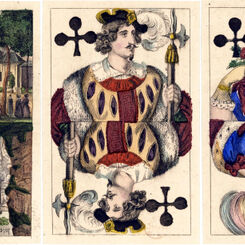
Views of Baden-Baden: a Biedermeier souvenir deck by Johann Anton Steinberger.
The Comedy of Courtship
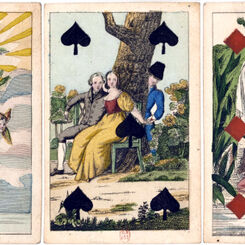
Courtship, class and convention in a Biedermeier satirical card deck from Germany.
Most Popular
Our top articles from the past 60 days


