


Five Suit Bridge
Five Suit Bridge was invented in Vienna in 1937 by Walter W. Marseille and Dr. Paul Stern.
Five Suit Bridge was invented in Vienna in 1937 by Walter W. Marseille and Dr. Paul Stern. At a time when cricket, chess and bridge were popular social games, special 66-card decks went on sale in the UK manufactured by De la Rue and Waddington’s with the fifth suit as crowns (called “Royals”). However, because the game was complex it proved to be unpopular, they were withdrawn in 1939 and have been forgotten. American versions made the fifth suit eagles, coloured green.
De la Rue’s Five-Suit Bridge
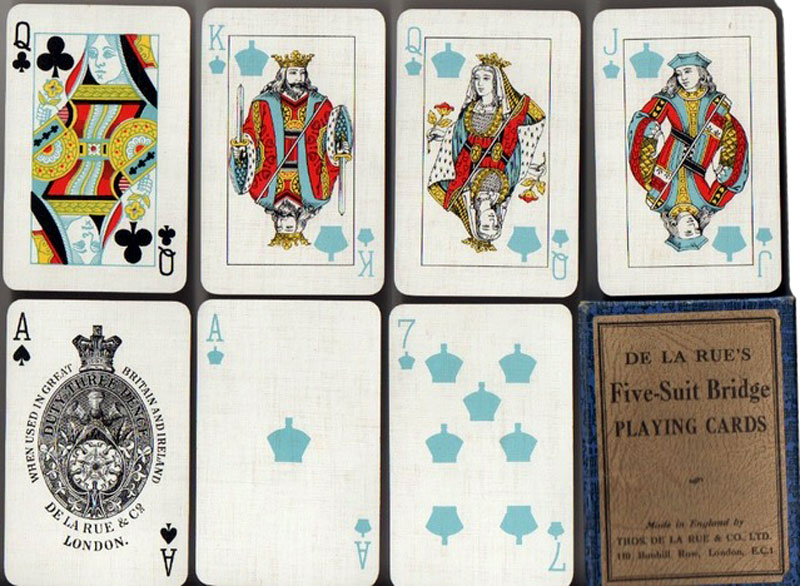
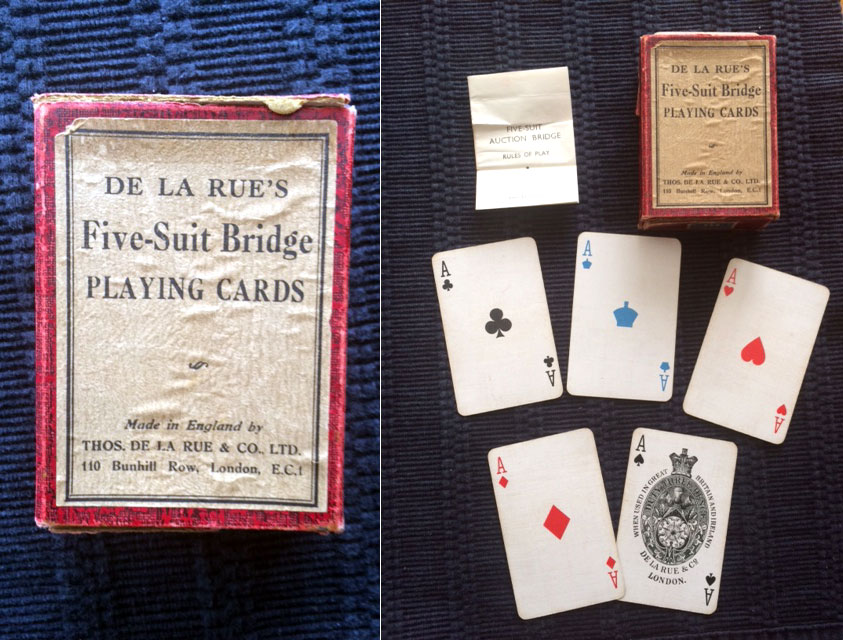
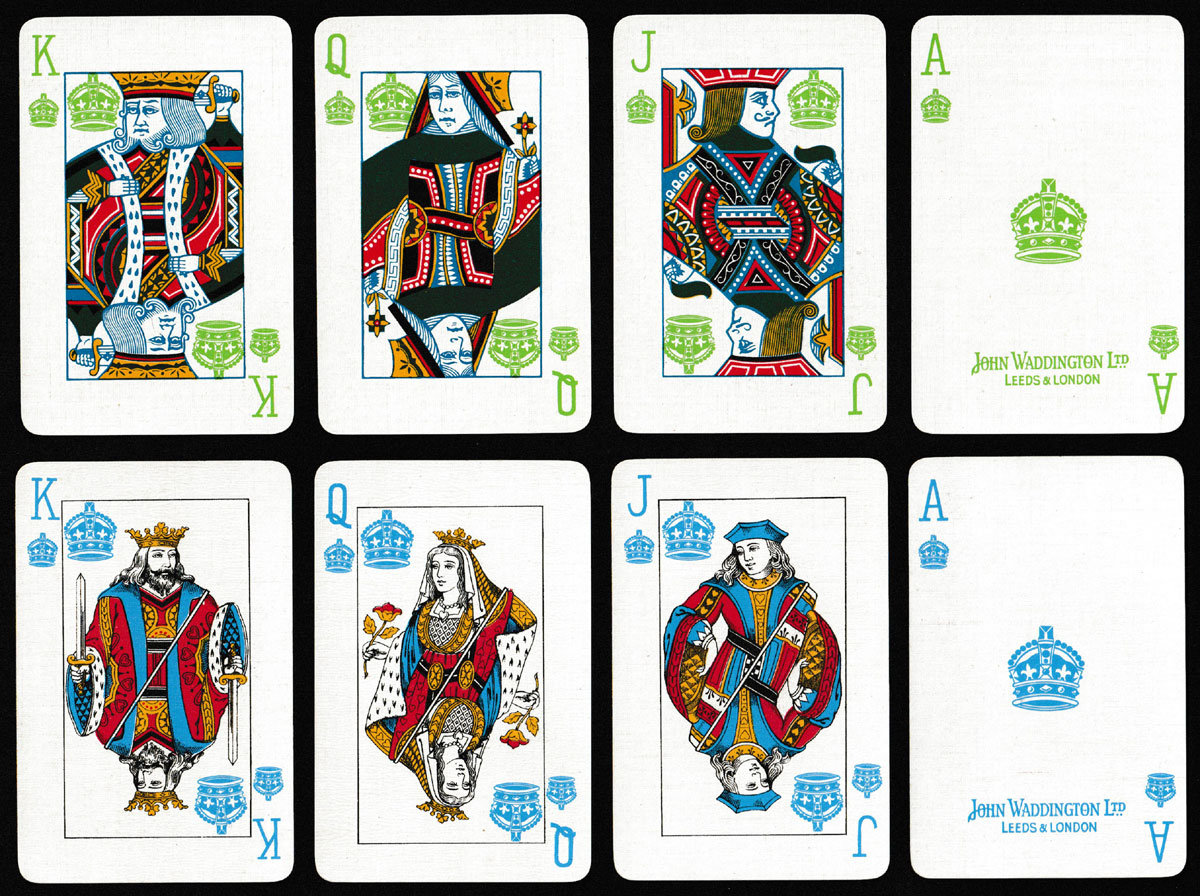
Above: Thomas De la Rue & Co’s Five-Suit Bridge playing cards with the fifth suit of crowns (called Royals) using the Paris pattern’s heart suit designs and the crowns coloured blue, 65 cards + joker, c.1938.
Waddington’s Five Suit Bridge
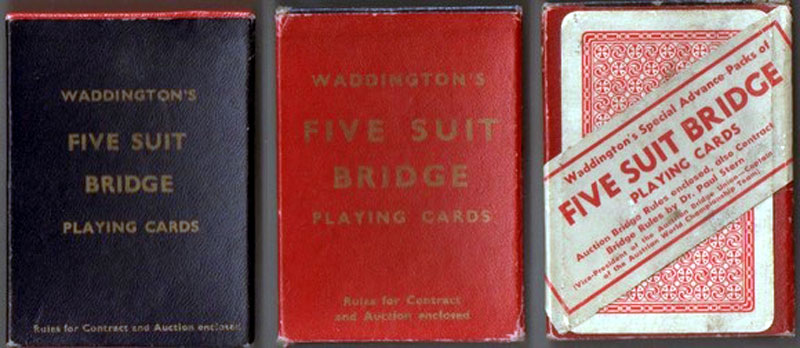
Above: boxes from different editions of Waddington’s Five Suit Bridge playing cards, c.1938. The boxes also contained rules for Five-Suit Auction Bridge and Contract Bridge by Dr. Paul Stern, co-inventor of the five-suited game and vice-president of the Austrian Bridge Union.
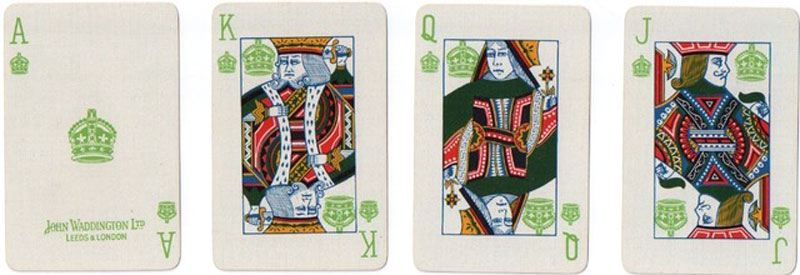
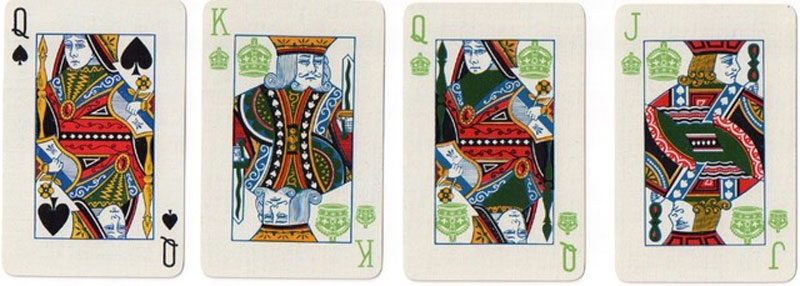
Above: different editions of Waddington’s Five Suit Bridge showing alternative standard designs for the fifth suit of crowns, with indices, suit symbols and parts of the clothing coloured green, c.1938. Examples are also known of sets of Crowns suit cards wrapped separately, presumably as add-ons to a normal pack.
CREDITS & REFERENCES
Images and research courtesy Ken Lodge and Phil Patenaude.
Wikipedia: Five-suit bridge►
Update from Roddy Somerville
First of all, the name. De La Rue seem to have called it "Five-Suit Bridge", while Waddington called theirs "Five Suit Bridge" (without the hyphen). Maybe that was deliberate in order to avoid litigation.
As for the extra suit, there were two Waddington versions, both using crowns. In the first, the crowns are green and the court card designs are taken from the Hearts suit in a standard Waddington English pattern pack. In the second, the crowns are blue and use the same Belgian-Genoese pattern courts as in the De La Rue version (albeit in a deeper shade of blue). I have only seen this second version in double packs. See the box►
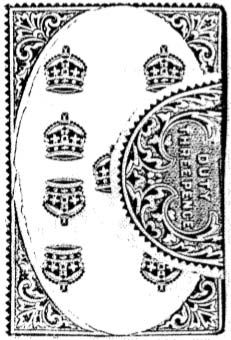
Concerning the tax wrappers, as John Berry states in Part 1 of his catalogue of the Waddington Collection, "It is probable that the reason for the second tax-wrapper enclosing the extra suit is that the provision of the 1862 Act of 25 Vict c.22 was still in force; this Act stipulated that a pack of cards should not have more than 52 cards. It would, of course, have added 3d. to the retail price". However, of the two double packs in my possession, one has two tax wrappers (i.e., one for the first 52 cards and another for the extra 13 cards), while the other merely has one tax wrapper for all 65 cards! How is this possible?! Was there an attempt to avoid paying extra tax or was there a ruling from the authorities that it was unnecessary to wrap the extra cards separately or was it a mistake? Whatever the answer, it is odd that two types of wrapping were used for an item with such a short life (two years at most).
There was clearly some collaboration (or collusion) between De La Rue and Waddington concerning these cards since the names of both companies appear together on the backs of the two leaflets - "Five Suit Contract Bridge Rules of Play" and "Five Suit Auction Bridge Rules of Play" in Waddington's packs. The first of these leaflets appears to have been printed in black to accompany the single packs with green crowns and in red to accompany the double packs with blue crowns. The leaflets with the De La Rue packs differ in look from those with the Waddington packs but also mention both companies on the last page. - R.S
Additional comments from Tony Hall
In the 1920s and 1930s, the game of bridge was undergoing significant changes and could have developed in various ways. Attempts were made to advance it from Auction Bridge, such as introducing 6-handed bridge in the early 20s and 5-handed bridge in the late 1930s. However, it was Contract Bridge that eventually gained popularity and became established. Looking back with hindsight, it might seem like a natural progression from Bridge-whist to Auction to Contract Bridge, but the outcome could have been different based on different circumstances.
During that time, there were influential writers and game designers, such as Walter W. Marseille, Dr. Paul Stern, and R. F. Foster, who could have steered the game in alternative directions. However, Contract Bridge eventually took hold, and once the clubs embraced it as superior to Auction Bridge, there was little room for other approaches. Moreover, the enthusiasm for creating new games that characterized the late 19th and early 20th centuries had subsided by the 1930s, with bridge emerging as the main game people preferred to play. Thus, Contract Bridge emerged as the dominant form of the game.

By Simon Wintle
Spain • Member since February 01, 1996
I am the founder of The World of Playing Cards (est. 1996), a website dedicated to the history, artistry and cultural significance of playing cards and tarot. Over the years I have researched various areas of the subject, acquired and traded collections and contributed as a committee member of the IPCS and graphics editor of The Playing-Card journal. Having lived in Chile, England, Wales, and now Spain, these experiences have shaped my work and passion for playing cards. Amongst my achievements is producing a limited-edition replica of a 17th-century English pack using woodblocks and stencils—a labour of love. Today, the World of Playing Cards is a global collaborative project, with my son Adam serving as the technical driving force behind its development. His innovative efforts have helped shape the site into the thriving hub it is today. You are warmly invited to become a contributor and share your enthusiasm.

Activity for Five Suit Bridge
Sign in to comment or save this article.

Related Articles
Learning to play Cribbage
I learned to pay cribbage when I was very young, aged around six or seven.
Waddington’s faux books
Waddington’s faux book set containing four packs of playing cards and bridge markers.
Lecardo
‘Lecardo’ playing cards, dominos & word building game invented by Stanley Kermode, United Kingdom, c...
Waddingtons Nursery Rhymes
Nursery rhyme playing cards by Waddingtons, Leeds, UK, 1975.
Radio Banker
Radio Banker by John Waddington Ltd for Marconiphone Co Ltd.
Beaver!
The Game of Beaver designed by G E Studdy and published by John Waddington Ltd in 1927.
Lobo
Lobo, the London Underground card game published by Thomas De la Rue & Co Ltd, 1930s.
Pooltella
Pooltella cards by John Waddington Ltd, the cards that simplify football pool forecasts, 1930s.
When three brands merge...
After De la Rue factories were bombed in 1940 their cards were printed by Waddingtons. In 1962 Waddi...
Help Yourself Society
The “Help Yourself” Society was formed in 1927 to run fundraising activities for hospitals.
Iddy Umpty
“Iddy Umpty” card game based around learning to read the Morse Code Alphabet. by Thomas de la Rue & ...
Tempest
Tempest is a family card game designed by W. Heath Robinson and published by Thomas de la Rue & Co. ...
Golliwogg, c.1902
The stories about the Golliwogg and the Dutch dolls were written by Bertha Upton (1849-1912) and ill...
Rūfa
Rūfa is a game designed by Ernest Legh and manufactured by De la Rue. The object is to build a pagod...
Cheers & Tears
Cheers & Tears by John Waddington Ltd, 1963.
Jack Horner Snap
“Little Jack Horner” Snap made by Thomas De la Rue & Co Ltd, c.1890.
14: Back Designs
A few examples of the many interesting back designs.

De La Rue
De La Rue introduced letter-press printing into playing card production and his patent was granted i...
Amalgamated Playing Card Co., Ltd
Agreement had been reached between Waddington's and De La Rue during the second world war for Waddin...
The History of Playing Cards
Playing cards appear in European records in the late 14th century, but their earlier history lies fu...
Most Popular
Our top articles from the past 60 days


