


Hardy
The Hardy family of playing card manufacturers began with Henry Hardy (1784-89) and continued through to Hardy & Sons who finally closed down in c.1840.
Hardy and Sons, (1784-c.1840)
The Hardy family of playing card manufacturers began with Henry Hardy (1784-89) and continued through to Hardy & Sons who finally closed down in c.1840.
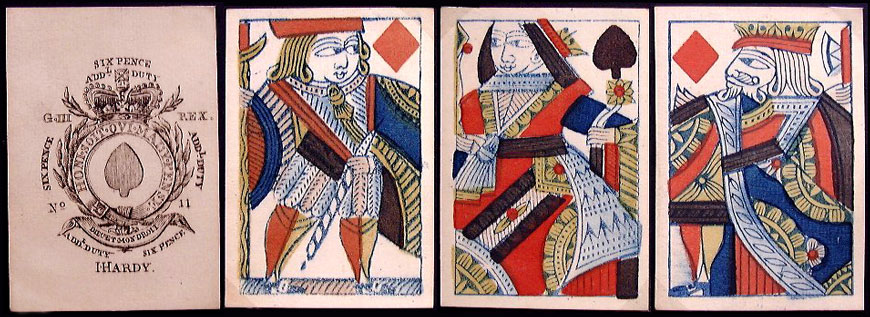
Above: Standard single-ended English pattern deck with 'Garter' Ace of Spades made by I. Hardy, c.1817. The Ace has "Addl. Duty Sixpence" inscribed three times. The cards show the typical deterioration of the quality of design in English cards at the end of the 18th and early part of the 19th century. The designs tend to take up more space on the cards, losing their profiles, and the figures become more stylised or grotesque.
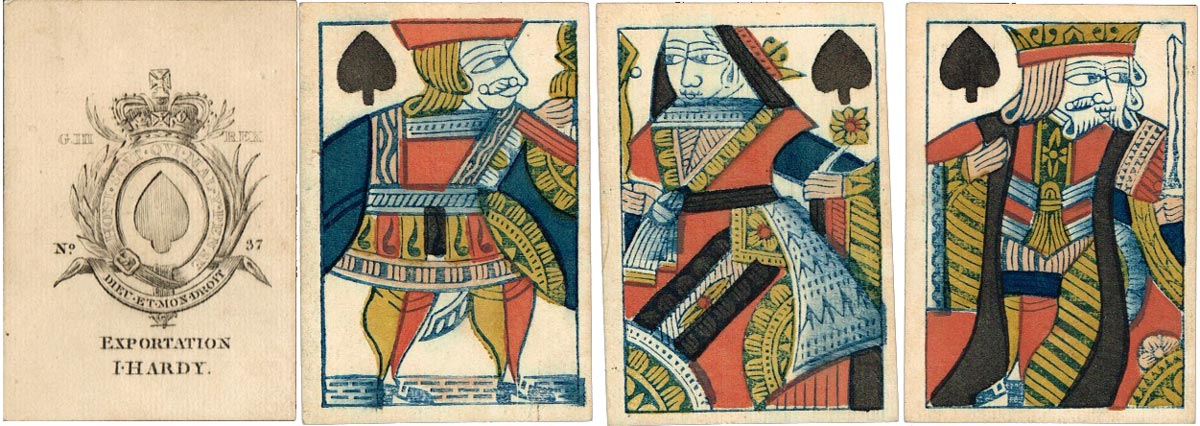
Above: Hardy exportation playing cards with George III Garter duty ace, c.1818. These cards were made for exportation to the colonies, USA, Europe or the Far East, and thus bear no duty. Image courtesy John Sings.
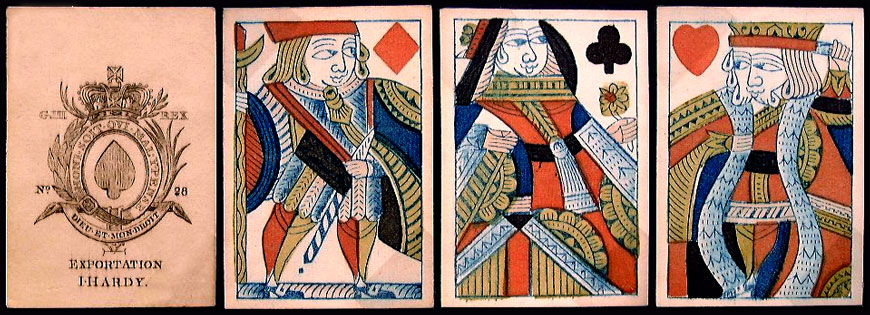
Above: Standard single-ended English pattern deck with 'Exportation' Ace of Spades made by I. Hardy, c.1820. It is not known precisely which country (-ies) these packs were destined for, but quite likely U.S.A. was one destination.
Facsimile editions
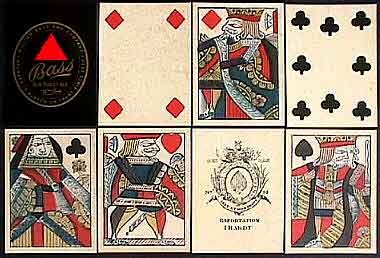
Right: modern facsimile edition of above deck promoting Bass beer, c.1977.
There has been more than one facsimile or replica edition of the Hardy 'Exportation' deck as the deck has been in more or less constant production in various facsimile wrappers. Some copies were known as early as 1973, another facsimile edition was produced in c.1982 for the Williamsburg Museum, in Virginia, USA, which included a facsimile of the wrapper. In another edition from the 1990s the original tax wrapper is also reproduced and these have been known to mislead the unwary collector into believing it to be a genuine original. From time to time these copies have been seen for sale on eBay see more►
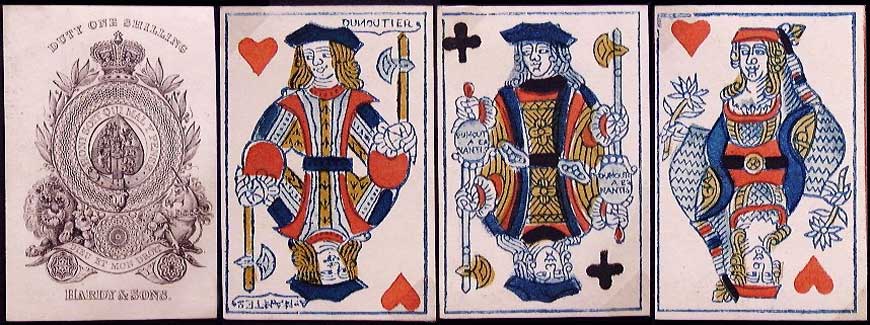
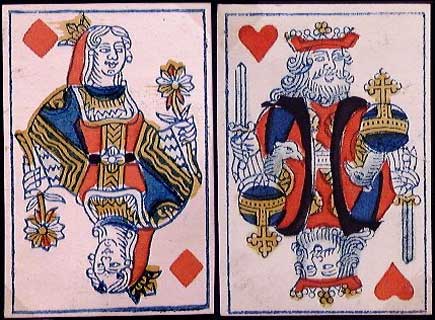
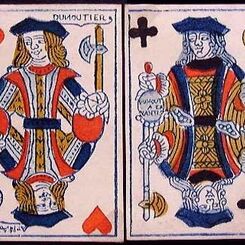
Above: interesting double-ended French-style deck with 'Old Frizzle' Ace of Spades manufactured by Hardy & Sons, c.1840. The court cards have the inscription "Dumoutiers a Nantes" so they may have been foreign cards sold in the UK by Hardy & Sons under their own name.
Addendum - courtesy Linda Green
James Hardy was the oldest son of Henry and Sarah Hardy, born in 1773, and his brother Henry was born in 1775. James was admitted to the Worshipful Company of Makers of Playing Cards in 1794, according to their minute books, after he completed his apprenticeship and became free of the Goldsmiths' company. He married in 1796 and moved to the Minories, where he set up business. Henry Hardy senior died in 1789, his will specifying that his wife Sarah should take over the supervision of their sons' apprenticeships. So any mention of Henry after 1789 is likely to be Henry junior, Sarah's son. The earliest record I have of Henry Hardy senior making playing cards is February 1773, when he and James Rowley dissolved their partnership, with Henry taking over the card making and James Rowley sorting out the bills. Henry was recorded as a printer when he joined the Goldsmith's company in 1766, though whether or not he was printing playing cards is not known. As well as to the USA they also advertised as exporting to South America and Spain. James Hardy died in 1837. The last Hardy cardmakers, Henry and Edmund, [sons of James] died in 1854 and 1859 respectively, although I don't know how they continued to make cards. They both described themselves as card-makers on the 1851 Census and still appeared in a street directory in business premises in 1853. - Linda Green [descendant of Hardys].

By Simon Wintle
Spain • Member since February 01, 1996
I am the founder of The World of Playing Cards (est. 1996), a website dedicated to the history, artistry and cultural significance of playing cards and tarot. Over the years I have researched various areas of the subject, acquired and traded collections and contributed as a committee member of the IPCS and graphics editor of The Playing-Card journal. Having lived in Chile, England, Wales, and now Spain, these experiences have shaped my work and passion for playing cards. Amongst my achievements is producing a limited-edition replica of a 17th-century English pack using woodblocks and stencils—a labour of love. Today, the World of Playing Cards is a global collaborative project, with my son Adam serving as the technical driving force behind its development. His innovative efforts have helped shape the site into the thriving hub it is today. You are warmly invited to become a contributor and share your enthusiasm.

Activity for Hardy
Sign in to comment or save this article.

Related Articles
Why our playing-cards look the way they do
Analysis of early playing card designs: origins, suit differences, standardization, technological ad...
Great Mogul Playing Cards
The origins of the 'Great Mogul' brand playing cards.
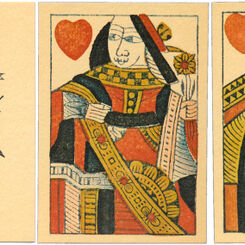
I. Hardy facsimile
Facsimile edition of 19th century I. Hardy Exportation deck complete with reproduction tax wrapper, ...
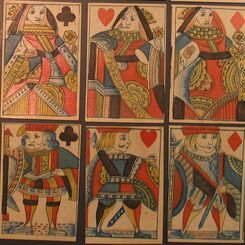
46: Henry Hardy, Henry French & Christopher Groser
A brief look at some makers of whom we know little.
32: The Not-So-Minor Cardmakers of the 19th Century - Part 3
A survey of the cards made by Creswick and Hardy, with a brief mention of De La Rue, Goodall and Rey...
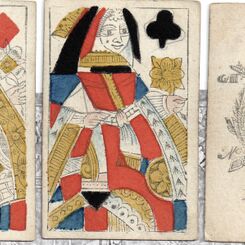
24: The Fournier Museum Catalogue: Comments and Corrections
The Fournier catalogue is a very useful reference book, full of pictures of cards from all over the ...
Most Popular
Our top articles from the past 60 days


