


24: The Fournier Museum Catalogue: Comments and Corrections
The Fournier catalogue is a very useful reference book, full of pictures of cards from all over the world, especially Europe. Unfortunately, there are quite a few mistakes and unlikely assumptions in it.
The Fournier catalogue is a very useful reference book, full of pictures of cards from all over the world, but especially Europe. Unfortunately, there are quite a few mistakes and unlikely assumptions in it, which renders it less reliable than it should be. I'm sure the information regarding Spanish and Portuguese cards is excellent, and I'm in no position to judge, but in 1970 Fournier bought the De La Rue collection, which had been housed in the British Museum for several years, and some of the accompanying descriptions and information may have contained these errors, only to be reproduced in the catalogue. There is a list of errata in Volume II, but this also contains errors, for example: "Page 215 No. 14. Where its [sic] says: Hervson, this should read Huson." Actually, it should read Hewson. So it might be useful to take a few examples and comment on them one at a time. I'll give the country and reference number and put an illustration (of an equivalent) of some of the items.
France 1/England 46: These cards are from England and date to c.1800; the AS is a fake.
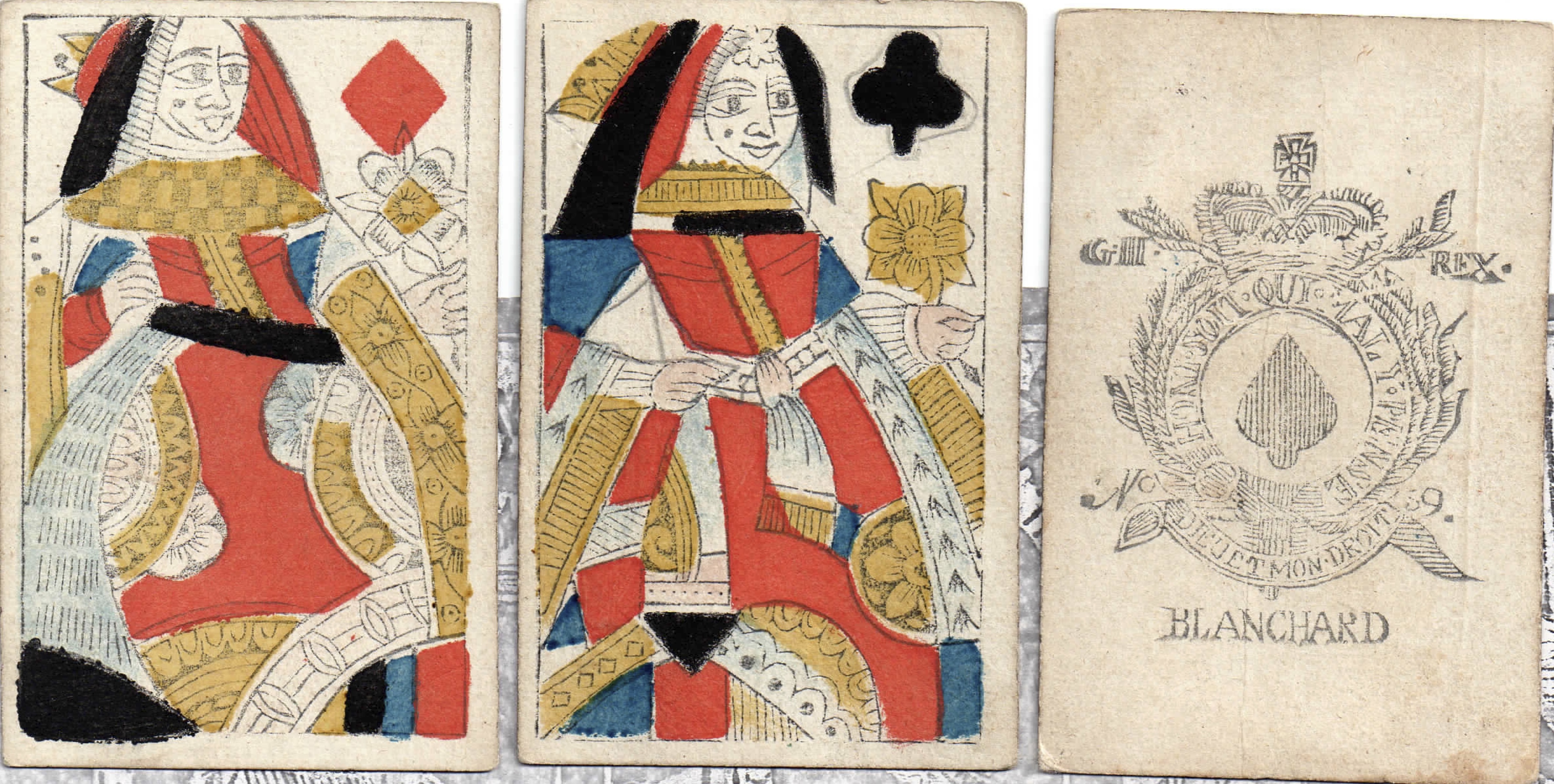
England 42: Could well be later than 1712.
England 43: Three intriguing courts; likely to be nearer 1780 than 1720.
England 55: Confusion with the earlier Henry Hardy; these are c.1810-20.
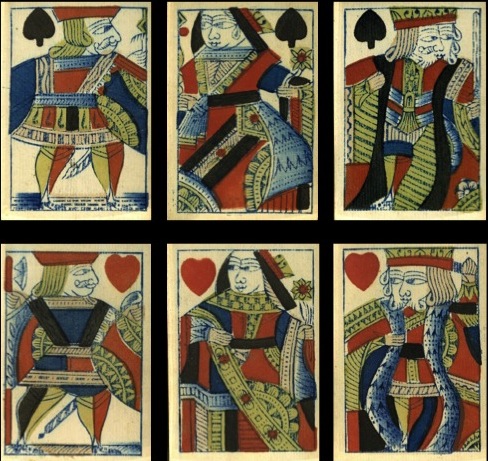
England 76: Intriguing: these look like Hall courts (Type II), would need to see the AS & wrapper.
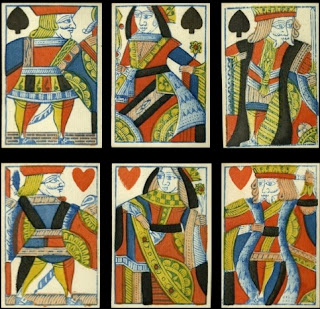
England 81: Probably later, would need to see it.
England 85: Must be after 1803.
England 150: Hall & BANCKS!!
England 162: Should be Hunt & Sons by this date.
England 165: Likely to be later, at least 1840s. Whittaker's early cards used the wood-block Type I.
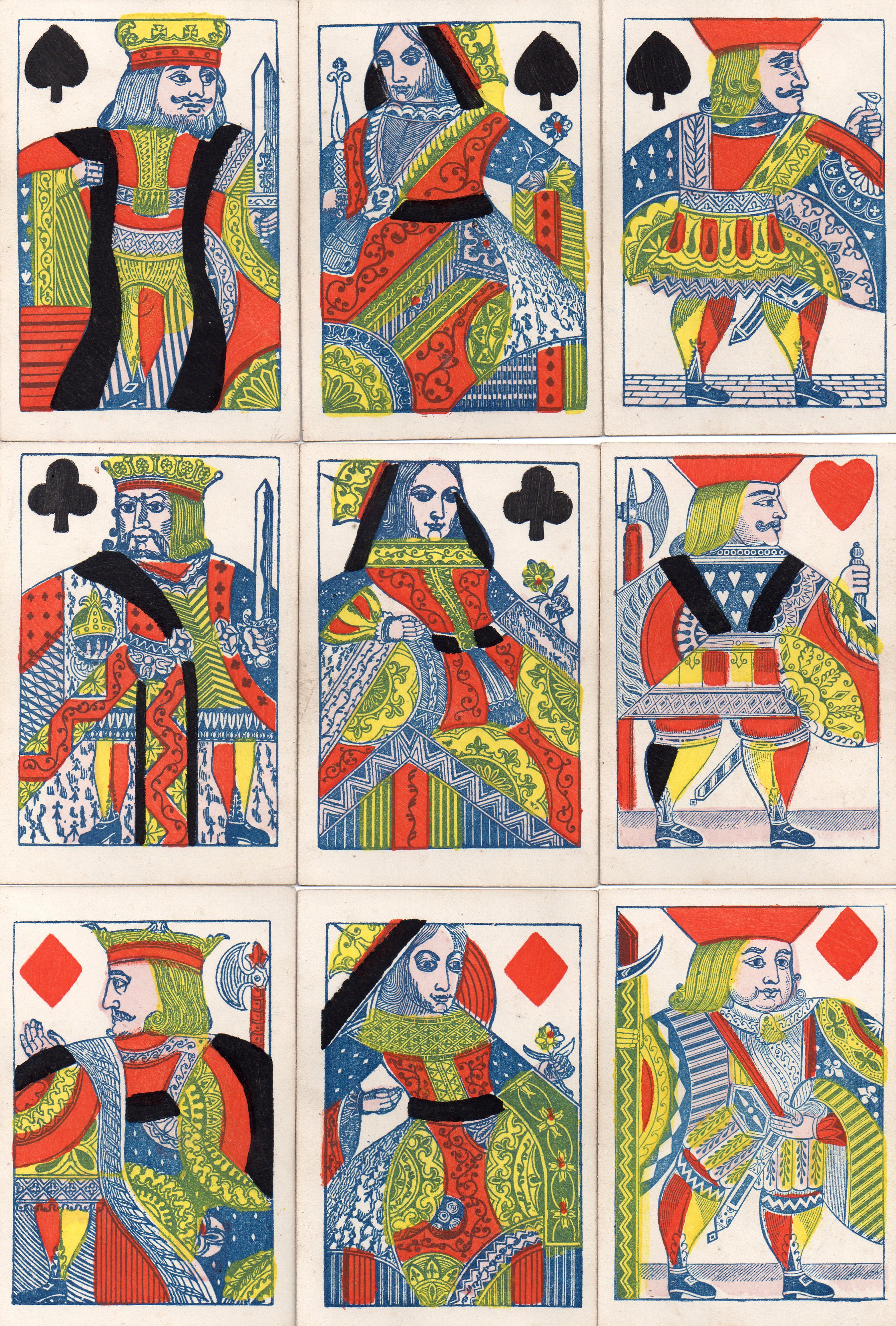
England 197: This is by Van Genechten, made in Turnhout, Belgium. The inscription is certainly unusual; it's normally "Dieu pour tous". It's likely to be from c.1870, but would need to see the courts.
England 206: There were no double-ended packs made in England as early as 1841. This was a popular back design and was used for many years. The first reference to double-ended cards is at the Great Exhibition of 1851, so this pack is likely to date from the 1850s. This is a good example of jumping to conclusions about date based on just one piece of evidence. A date on the reverse of a card indicates the earliest it could be, but packs were issued for many years and other evidence in this case contradicts the early one.
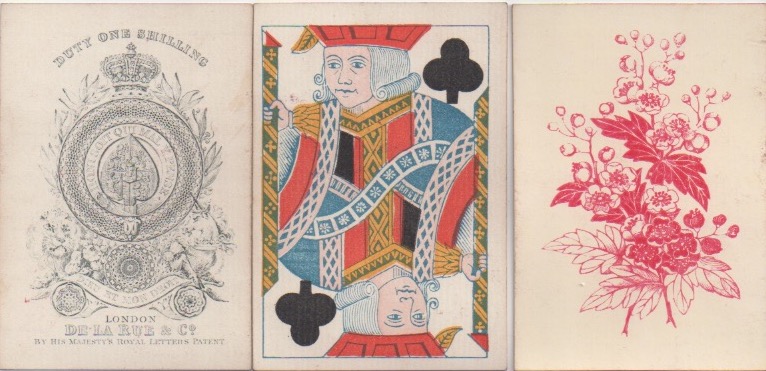
On eBay I saw a Waddington pack given as 1911. This was the one produced as one of a pair for George V's Jubilee in 1935, with a picture of his coronation. It was difficult to persuade the seller that Waddington's were not making cards before 1922: the date on the cards was a will-o'-the-wisp.
England 207: Since this is the later version of their redrawn, single-figure courts, the pack is likely to date from no earlier than 1850.
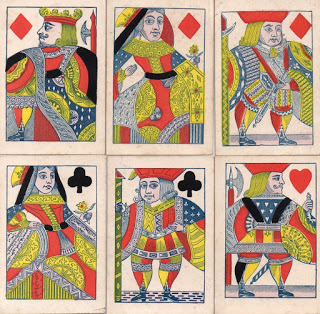
England 211: According to the AS this is by Reynolds & Co (not Sons), so must be from the 1880s. It would be useful to see the courts, but they are probably Reynolds' own (R1).
France 225/England 223: Hardy finished trading in the 1840s; these cards are more likely to be from the 1830s.
England 225: Intriguing, but no picture. These could be the first version of their Optik cards to help people with poor sight, on show at the Great Exhibition of 1851.
England 226: No picture, but unlikely to be like a Hunt pack (162).
England 254: Unlikely to be 1868: the courts are redrawn and turned (D6), probably c.1875.
England 289: James English's cards are not like those of Goodall (246).
England 310: Closer to 1870 than 1890.
England 311: No picture, but these sound like the cards made for Scandinavia in the 1930s.
England 327: What on earth are "allusive designs"?
England 441: Edward VIII!!
Belgium 117: Not Belgian, these cards are by Obchodni Tiskarny Karty, Prague, imported into England as Casino.
Germanic 93: Must be 1960, not 1860.
[Incidentally, Germanic means belonging to the large ethnic group of the Germanic tribes and/or their languages, which include English, Icelandic and the Scandinavian languages; it does not mean 'German-speaking'.]
There are several more errors, many of which may be editorial in origin, in the supplement volume as well; in places the English is somewhat odd.

By Ken Lodge
United Kingdom • Member since May 14, 2012
I'm Ken Lodge and have been collecting playing cards since I was about eighteen months old (1945). I am also a trained academic, so I can observe and analyze reasonably well. I've applied these analytical techniques over a long period of time to the study of playing cards and have managed to assemble a large amount of information about them, especially those of the standard English pattern. About Ken Lodge →

Activity for 24: The Fournier Museum Catalogue: Comments and Corrections
Sign in to comment or save this article.

Related Articles
Why our playing-cards look the way they do
Analysis of early playing card designs: origins, suit differences, standardization, technological ad...
Naipes de Personajes Granadinos
Forty famous men and women with links to Granada, on a pack designed by Rubén Garrido.
Souvenir Playing Cards of Egypt
55 different photographic views of Egypt in full colour.
El Desnudo en el Arte
The Nude in Art / El Desnudo en el Arte, Spain, 1977 (reprint 1990)

Baraja Fiesta Taurina
‘Baraja Fiesta Taurina’ bullfight playing cards published by Heraclio Fournier, Spain, 1975.
Naipes Heraclio Fournier 130th Anniversary
Baraja conmemorativa del 130 aniversario de naipes Heraclio Fournier (1868-1998) Spain, 1998.
Multicard
A Spanish-suited pack with multiple uses including roulette and dice.
Rasta playing cards
Rasta playing cards celebrating the Rastafari religion.
Liban Historique et Touristique
“Liban historique et touristique” souvenir of Lebanon playing cards manufactured by Heraclio Fournie...
Parejas del Mundo
“Parejas del Mundo” matching pairs card game by Naipes H. Fournier, 1972.
Venezuela Baraja Turística
Venezuela Souvenir deck by Heraclio Fournier, c.1980s.
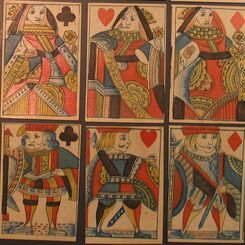
46: Henry Hardy, Henry French & Christopher Groser
A brief look at some makers of whom we know little.
Canary Islands Souvenir
Canary Islands Souvenir by Heraclio Fournier, c.1970.
Philishave
Spanish-suited advertising deck for Philishave electric razors.
Monumentos de España
"Monumentos de España" souvenir playing cards manufactured by Heraclio Fournier, S.A., Vitoria (Spai...
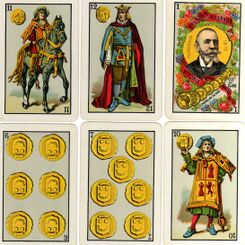
Fournier “El Fundador”
The cards shown here were originally printed in 12-colour lithography and published by Heraclio Four...
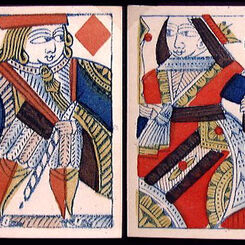
Hardy
The Hardy family of playing card manufacturers began with Henry Hardy (1784-89) and continued throug...
Heraclio Fournier S.A.
Founded in 1868, today it is part of Cartamundi.
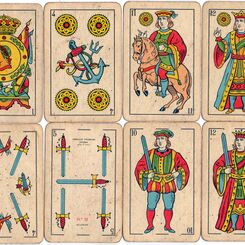
Fournier No.35 Spanish-suited playing cards
Fournier No.35 Spanish-suited playing cards imported into Argentina by Fagoaga y Compañía ...
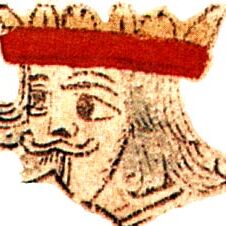
Blanchard, c.1770
The style of these cards is descended from the earlier seventeenth century cards of makers such as H...
Most Popular
Our top articles from the past 60 days


