




Arnold Schönberg
In around 1909 he created three sets of playing cards. His inventiveness was driven by a passion for rules, order and numbers.
Playing Cards created by Arnold Schönberg
"Self-expression is the thing! Direct self-expression! But not expressing one's taste, one's education or one's intellect, one's knowledge or one's skills. None of these acquired qualities. Rather the innate, instinctive qualities. And the quest for form - the conscious quest - is bound to involve some kind of mathematics, or geometry, the golden section and so on..." - Extract from a letter from Schönberg to Kandinsky, 24.1.1911.
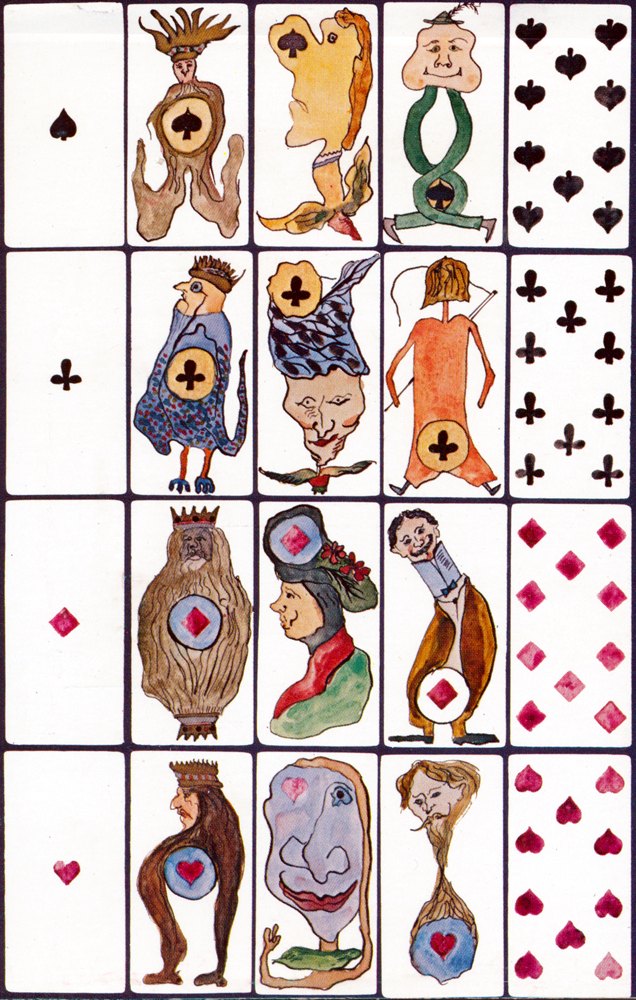
Arnold Schönberg's (1874-1951) creativity was not limited to music. He practised several extra-musical pursuits, producing at least 250 paintings, toys, games, chess sets and playing cards for his own use. He even did his own bookbinding. In around 1909 he created three sets of playing cards. One set used grotesque imagery and visual puns from his caricatures and doodles, with the suit symbols integrated into the designs (see image→). Another set (shown below) is more severe and geometric, almost digital. His inventiveness was driven by a passion for rules, order and numbers, and his cards also reveal his capacity for highly personal expression. The elongated cards are divided into four suits (based upon clubs, hearts, spades and diamonds) each comprising both numeral and double-ended court cards. The designs don't contain many curves and are more technical than fluid. The influence of Jugendstil is recognisable. The third set is probably for children.
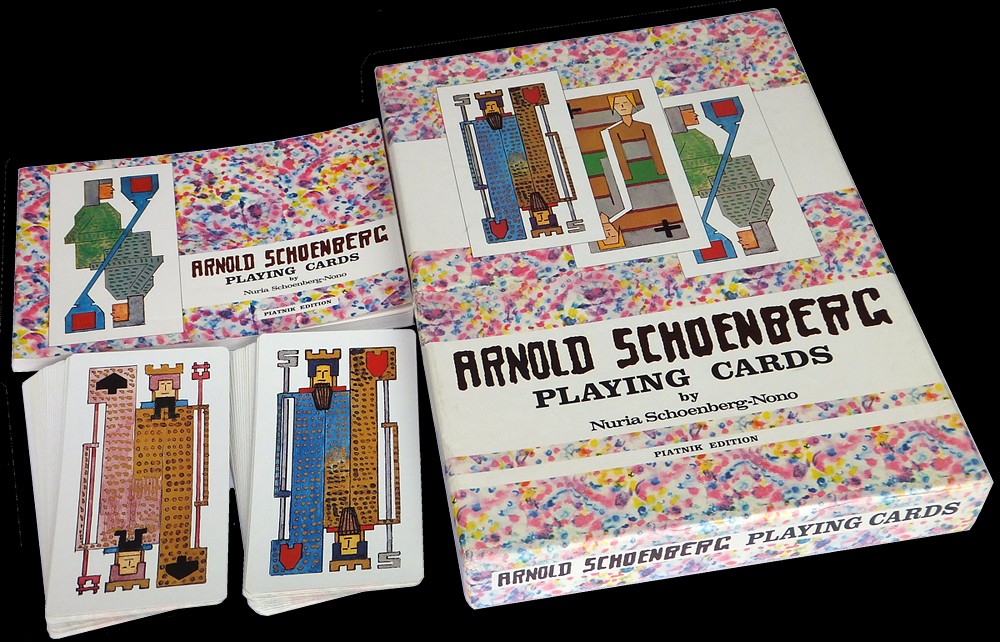
Above: this facsimile edition of playing cards painted by the composer Arnold Schönberg in c.1910 was published by Belmont Music Publishers in 1981 and produced by Ferd Piatnik (Vienna), with a preface by the composer's daughter, Nuria Schoenberg-Nono. The original cards were made in watercolours and gouache on cardboard with gold and silver, size: 10.5 by 5.5 cm. No reverse has been found for the cards so a coloured pattern painted in one of his diaries was used. (Click above image to see more). Thanks to Eike Fess for additional information; see Arnold Schönberg Centre website►
Note: it is always fascinating to discover that even the greatest geniuses can be flawed. There is one small error on these cards which the great composer made but never corrected. Look carefully at the King of Hearts and you will see that he has forgotten to turn the suit-sign at the far end of the card. The Queen and Jack of Hearts are fine. Schönberg was human after all! - Roddy Somerville.

By Barney Townshend
United Kingdom • Member since October 06, 2015
Retired Airline Pilot, interested in: Transformation Playing Cards, Karl Gerich and Elaine Lewis. Secretary of the EPCS. Treasurer of the IPCS.

Activity for Arnold Schönberg
Sign in to comment or save this article.
Related Articles
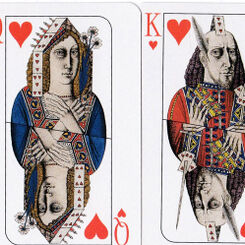
Cosmopolitan № 2121 playing cards
“Cosmopolitan” № 2121 playing cards designed by Russian artist Valeri Mishin, 1996
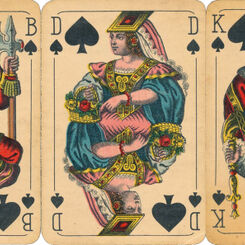
Vienna (ex-Lyon) pattern
‘Vienna pattern’ derived from archaic Lyon pattern by Ferd Piatnik & Söhne A.G., c.1926-1934.
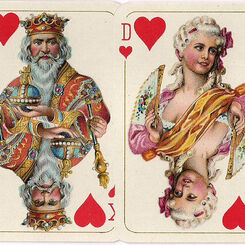
Baroque No.2118
“Baroque” by Ferd Piatnik & Sons, Vienna, reflecting a bygone era of fashion.
48: Ferdinand Piatnik & Sons
Ferd. Piatnik produced a very large range of cards with many different standard and non-standard pat...
Popular No.257
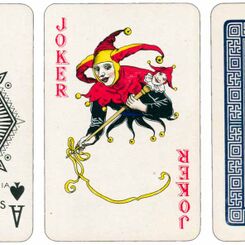
Piatnik’s “Popular Playing Cards” No.257
Salzburger Pattern
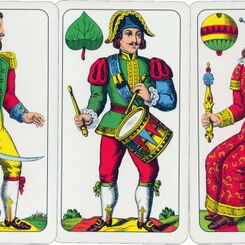
Salzburger pattern by Ferd. Piatnik & Söhne, Vienna
Rococo No.2130
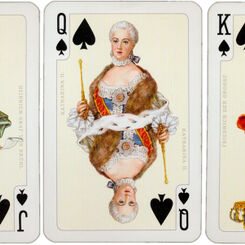
Piatnik: Rococo No.2130 playing cards designed by Prof. Kuno Hock, c.1975
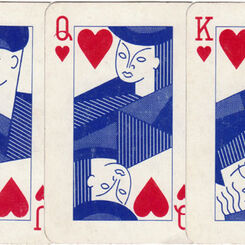
Blue Playing Cards
“Blue Playing Cards” by Piatnik, 1960s, inspired by the Cubism art movement in which objects are ana...
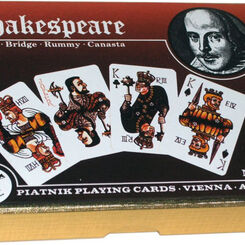
Shakespeare by Piatnik
‘Shakespeare’ playing cards by Piatnik designed by the British actor Donald Burton.
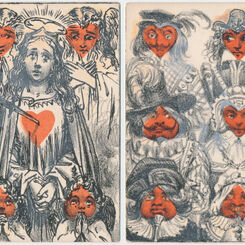
Carl Arnold Transformation
Transformation playing cards designed by Carl Johann Arnold (1829-1916), the court artist for King F...
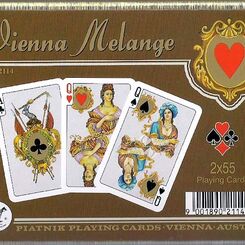
Vienna Melange
“Vienna Melange” Playing Cards by Piatnik with a historical feel representing the four races that ma...

Cocktail
Aluminium playing cards manufactured by Häusermann United Chemical and Metal Engraving Co., Vienna, ...
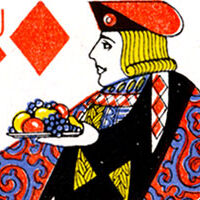
Ritter & Cie, 1933
A colourful re-working of the standard Anglo-American pattern in Art Deco style.
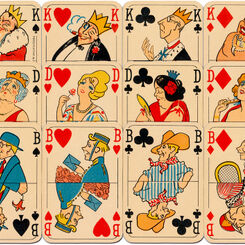
Rummy No.210
Period cartoon images from the 1930s. The Kings are in fancy dress ready to party, the Queens appear...
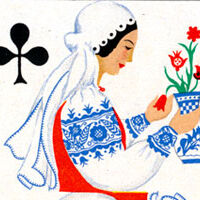
Matyó-Bridge No.50
The court cards in this delightful Art Deco pack represent persons in various colourfully embroidere...
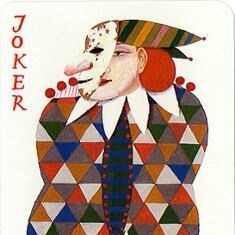
Karl Korab (Ed. Hilger)
Karl Korab was born in 1937 in Falkenstein (Lower Austria), the son of a forester. As a child he exp...
Waisenfond
Intended to attract donations on behalf of the Imperial Royal Austrian Military Widows’ and Orphans’...
Cashmere
Bernhard Altmann is from the “The House of Cashmere” and these playing cards honour their best known...
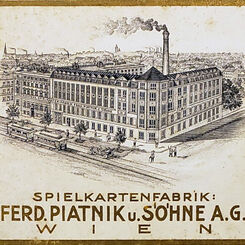
Ferd. Piatnik & Söhne
Ferdinand Piatnik was born in Ofen on October 14, 1819.
The History of Playing Cards
Playing cards appear in European records in the late 14th century, but their earlier history lies fu...
Most Popular
Our top articles from the past 60 days


Peter Burnett
19 November 2025, 09:47SavedSaved this article to Peter's Collection
Ваня Козлов (Vanya Kozlov)
19 November 2025, 09:47SavedSaved this article to Ваня Козлов's Collection
jan merc
19 May 2026, 23:56SavedSaved this article to MOST WANTED