


Jean Picart le Doux
Jean Picart le Doux playing cards, issued in 1957 to celebrate the company's 125th anniversary, featuring designs carried out in richly toned colourings typical of tapestries.
Jean Picart le Doux
Thomas De La Rue and Company
Issued in 1957 on the occasion of the First International Playing Card Week, hosted by De la Rue in London to celebrate the company's 125th anniversary. Artists from several countries had been invited to submit designs for new court cards. Those submitted by Jean Picart le Doux, the famous French tapestry designer, were chosen as the most attractive and outstanding. The set features designs carried out in richly toned colourings typical of the tapestries which Picart le Doux designed for Aubusson & Gobelins. The box (detail shown left) bears a version of the Ace of Hearts which takes the form of a Love Bird. The court cards of the Spades Suit are inspired by maritime ideas and have a recurring theme of the trident. Star fish decorate their clothes. The Ace of Spades is formed by two dolphins supporting the trident with their tails.
One of the striking features of the pack is the interesting treatment of the index figures showing the value of the cards and the carefully conceived layout of the suit symbols. Picart le Doux playing cards were first offered for sale through retail stores at 25 shillings per double pack from 8th October 1957.

Above: Playing cards specially designed by Jean Picart le Doux for Thomas De La Rue and Company's 125th anniversary, 1957. The card faces are printed in fourteen different colours; the backs in four colours. The carefully conceived layout of the suit symbols gives the cards an appearance of supreme elegance and charm. The Diamonds suit cards are inspired by the troubadours and other characters of mediaeval romance: the masked knave is shown playing a lute. For the court cards of the Club suit Picart le Doux has sought his inspiration in scenes of the countryside. The King is shown bearing a scythe and flowers; leaves and butterflies are used as decoration on all the court cards. The court cards in the Heart Suit, notable for their grace and flowing lines, are based on portraits of mediaeval fowls. The bird theme which occurs on the Ace of Hearts in the form of a Love Bird bearing an ardent heart on its back is repeated on the King and Knave. The Knave is depicted as holding a cage from which the Love Bird has escaped but which still holds a captive heart.

Above: the Joker, extra card, back designs and the control slip giving De La Rue's address as De La Rue House, 84-86 Regent Street, London W.1. This was De La Rue's office in London; the cards actually would have been printed by Waddington's at 40 Wakefield Road, Leeds 10.

By Simon Wintle
Spain • Member since February 01, 1996
I am the founder of The World of Playing Cards (est. 1996), a website dedicated to the history, artistry and cultural significance of playing cards and tarot. Over the years I have researched various areas of the subject, acquired and traded collections and contributed as a committee member of the IPCS and graphics editor of The Playing-Card journal. Having lived in Chile, England, Wales, and now Spain, these experiences have shaped my work and passion for playing cards. Amongst my achievements is producing a limited-edition replica of a 17th-century English pack using woodblocks and stencils—a labour of love. Today, the World of Playing Cards is a global collaborative project, with my son Adam serving as the technical driving force behind its development. His innovative efforts have helped shape the site into the thriving hub it is today. You are warmly invited to become a contributor and share your enthusiasm.

Activity for Jean Picart le Doux
Sign in to comment or save this article.

Related Articles

SCAC Jean Picart le Doux
A Jean Picart le Doux pack with a sea theme.
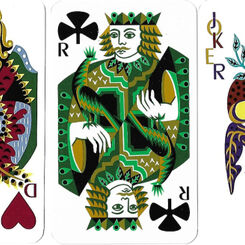
Les Quatre Saisons
A lyrical cycle of the seasons woven into the language of playing cards.
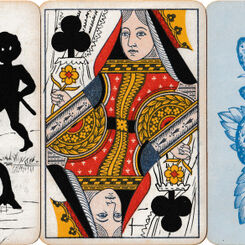
Hand-drawn transformation cards, c1875
A complete set of hand-drawn transformation cards from c1875, using a standard De La Rue pack.
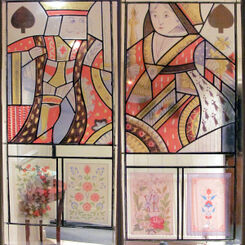
68: Playing cards in glass
My wife and I have recently commissioned a unique pair of stained glass windows for our home.
59: Owen Jones (1809-74) and De La Rue
A selection of examples of Owen Jones's artwork printed by De La Rue.
Pneumatic c.1960-1965
De la Rue were producing Pneumatic cards with the “special graining for ease of handling” as late as...
Rufford Playing Cards
Rufford playing cards is one of several brand names used by Boots for their stationery department, a...
De la Rue for export
Non-standard playing cards produced by De la Rue & Co. (London), c.1930s
Draughts League Medals
Arthur Charles Prince worked for De la Rue as a playing card cutter and later was promoted to superv...
![28: How to Analyze and Differentiate Playing Card Plates (De La Rue, Waddington and the Berlin pattern [Französisches Bild])](/core/cache-wopc-thumbs/var/www/wopc/production/www/images/contributors/kenlodge/4889-analyzing-playing-card-plates/JS_D1-D2-D3.b26b0503.jpg "28: How to Analyze and Differentiate Playing Card Plates (De La Rue, Waddington and the Berlin pattern [Französisches Bild])")
28: How to Analyze and Differentiate Playing Card Plates (De La Rue, Waddington and the Berlin pattern [Französisches Bild])
My interest in postage stamp variants led me to apply the same principles to playing cards.
14: Back Designs
A few examples of the many interesting back designs.
5: De La Rue
In December 1831 Thomas de la Rue was granted his patent for printing playing cards by letterpress.
Cheery Families, c.1893
Cheery Families card game designed by Richard Doyle and printed by De La Rue & Co., Ltd, c.1893

De La Rue Continental
During the latter part of the nineteenth century De La Rue produced two special packs of cards for t...
De La Rue
De La Rue introduced letter-press printing into playing card production and his patent was granted i...
Owen Jones (1809-1874)
Owen Jones (1809-1874) was a Welsh architect and interior designer who designed the backs of playing...
The History of Playing Cards
Playing cards appear in European records in the late 14th century, but their earlier history lies fu...
Most Popular
Our top articles from the past 60 days


