

Quaterne
A Victorian quartet-style children’s card game by Goodall & Son.
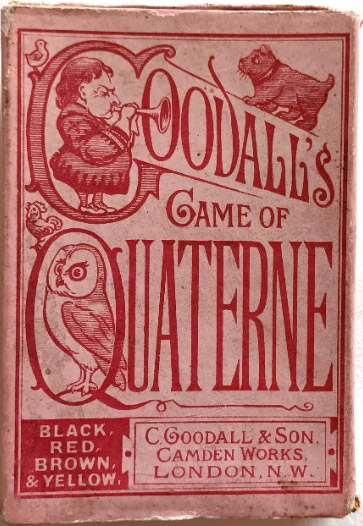
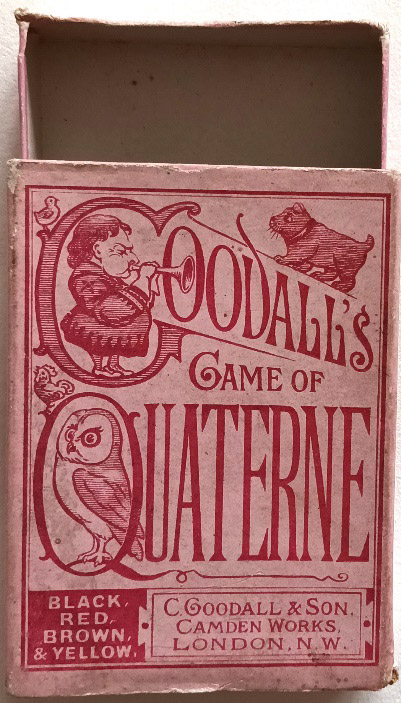
Goodall and Son are best known for their playing cards and wide variety of card sets and game paraphernalia. But they also produced a number of children’s games, although not on the same scale as De La Rue. One of these games was Quaterne which, according to Mike Goodall, was first published in 1873¹. Each pack of 48 cards comprises 12 sets of 4 cards in woodcut-style line illustrations, in different colours, as it says on the box – black, red, brown and yellow. Each of the sets in my copy of the game is shown below. There are 4 Kings, 4 Queens, 4 knaves etc.
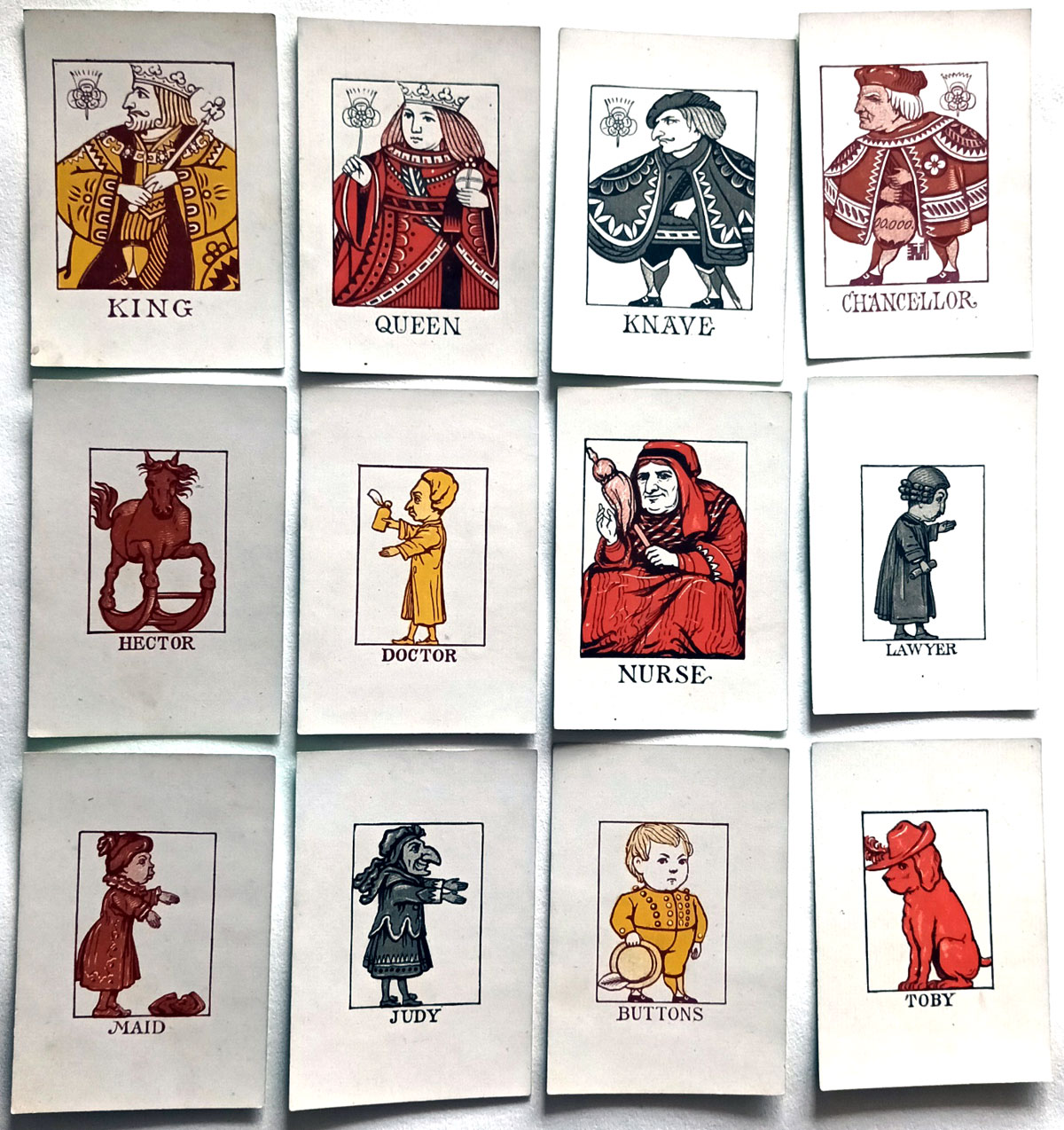
Above: Quaterne: a children’s card game published by Goodall & Son, 1873. The backs are plain light green.
Close inspection of the particular sets of cards in this box suggests something is not quite right. There seems to be no logical link or theme between some of the sets and others. Members of the royal family and various occupations seem straightforward, but the others appear less so. Judy and Toby are presumably from Punch and Judy, Buttons is traditionally part of the Cinderella story but Hector, in the form of a rocking horse, is less easy to place. Perhaps this meant something more to children playing the game in the 1870s. It looks as if it was designed more for fun than for education, and for quite young children too.
Quaterne was originally produced in six different sets: Dogs, Cats and Rabbits; London Mixture; Monkeys, Owls and Snails; Punch and Judy, Royal Court and Zoological. It is now easy to see that my pack is made up from several of these separate games. Yet, all of the cards are clearly of the same vintage, wear and backing colour, and, frankly, feel like a pack of cards that have been together for a long time.
I’d like to speculate that my set was jumbled together by a young owner who owned more than one of this series of games, who played with all the cards together but was less than careful about which cards went into which box at the end of play!
To make it even more intriguing the side of my box is labelled “DOGS, CATS & RABBITS” which in no way represents the cards which it now contains– apart from Toby!
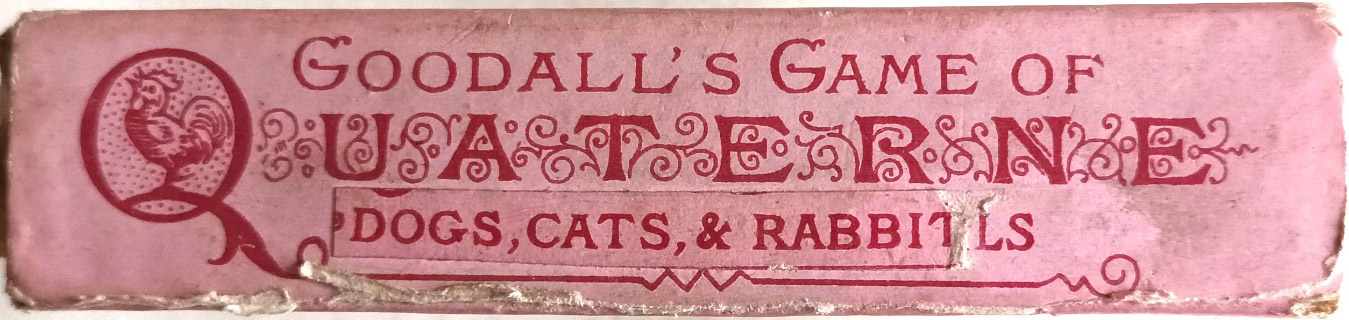
To complicate matters still further, one can see that this label has been pasted over an alternative list which ended in “LS”. This additional labelling appears, from the colour and materials used, to have been done by the manufacturer, or retailer, back in the 1870s. Speculating further, it seems likely that the box was originally printed to contain the only other set ending in “LS”, namely “MONKEYS, OWLS & SNAILS”. My set is clearly a mishmash with a complicated history!
However, what do we know? Quaterne was one of a series of games with this title first published by Goodall & Sons in 1873. My box contains a mixture of cards from at least three different versions of this game. The games were mass produced for children, and the quality of the cards was poor by comparison with other Goodall products. The Quaterne box, unlike playing card containers, opens like a match box .
Sadly my pack contains no playing instructions which would undoubtedly have been included when sold. It is obvious that 12 sets of four cards could be used in a wide variety of children’s games current at that time, from Snap to Pelmanism. The name "Quaterne" is derived from the Latin quaterni (meaning “four each”), emphasizing that the object of the game is to collect sets of four related cards.
Reference
- M. H. Goodall, The Family and the Firm, 1820-1922, 2000

By Tony Hall
United Kingdom • Member since January 30, 2015
I started my interest in card games about 70 years ago, playing cribbage with my grandfather. Collecting card game materials started 50 years or so later, when time permitted. One cribbage board was a memory; two became the start of a collection currently exceeding 150!
Once interest in the social history of card games was sparked, I bought a wooden whist marker from the 1880s which was ingenious in design and unbelievably tactile. One lead to two and there was no stopping.
What happened thereafter is reflected in my articles and downloads on this site, for which I will be eternally grateful.

Activity for Quaterne
Sign in to comment or save this article.

Related Articles
Learning to play Cribbage
I learned to pay cribbage when I was very young, aged around six or seven.
Scientific Whist
“Scientific Whist” : standard cards with instructions for play on the faces by Chas Goodall & Son, 1...
Heartsette by Herbert Fitch & Co, 1893
A glimpse into a busy print and design office in late Victorian London.
Pastime Playing Cards for the Blind
The “Pastime” Playing Cards for the Blind manufactured by Goodall & Son Limd., c.1910.
So-Lah – A Game of Music
An early 20th century domino-type musical card game by Goodall.
Bridge Markers and bridge scoring methods
Bridge Markers and bridge scoring methods 1900-1930
French for Fun
French for Fun instructive card game published by John Jaques & Son Ltd., c.1930s
Khanhoo
Khanhoo by Charles Goodall & Son, 1895.
Have A Go
Have A Go card game published by Photo-Briton Ltd featuring photographs of waxwork figures from Mada...
Hindooly
Hindooly published by Chas Goodall & Son Ltd with four newly designed suits, c.1904.
Derby Day
Derby Day race game published by Parker Games’ English subsidiary at Ivy Lane, London, from 1908 to ...
Toby’s Family Playing Cards
“Toby’s Family Playing Cards” published by G. Heath Robinson & J. Birch Ltd, London, 1920s.
John Bull
“John Bull”, the Capital English Game published by W. Cremer, c.1865.
Funny Families
“Funny Families” card game manufactured by Woolley & Co, 1890s.
Strip Tease
‘Strip Tease’ card game featuring characters involved in the performance and subsequent prosecution ...
Our Ship
The “New Game of Our Ship”, published by Chas Goodall & Son, London, 1896.
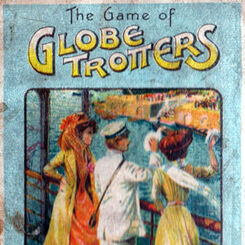
Globe Trotters
Globe Trotters follows the journey of a group of travellers who depart from Genoa by ocean liner and...
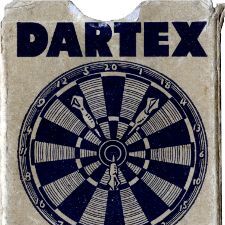
Dartex
Dartex, the Thrilling New Card Game of Skill (1938) based on the traditional pub game where darts ar...
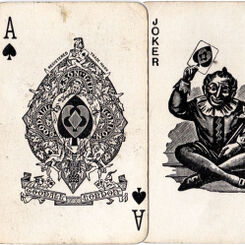
The Virtue of Princes
The Virtue of Princes, 1938.
Most Popular
Our top articles from the past 60 days