


Vandenborre Tarot
Belgian Tarot published by François-Jean Vandenborre, Brussels (1762-1803)
Vandenborre Tarot, Brussels, c.1780
The Flemish or Belgian Tarot, with Italian suit signs, became a standard design in Belgium during the 18th century. It is a sort of hybrid tarot, and with its cousins the Tarot de Marseille and Tarot de Besançon derives from Italian designs. For some reason the legend “Cartes de Suisses” appears on the ace of Coins.
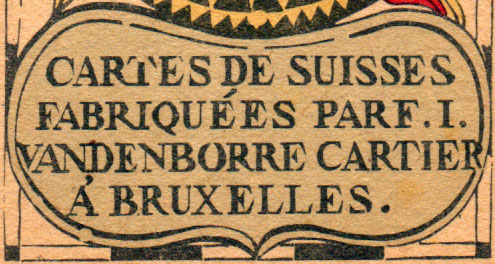
Above: detail from the ace of coins.
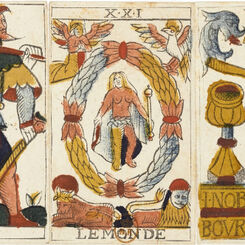
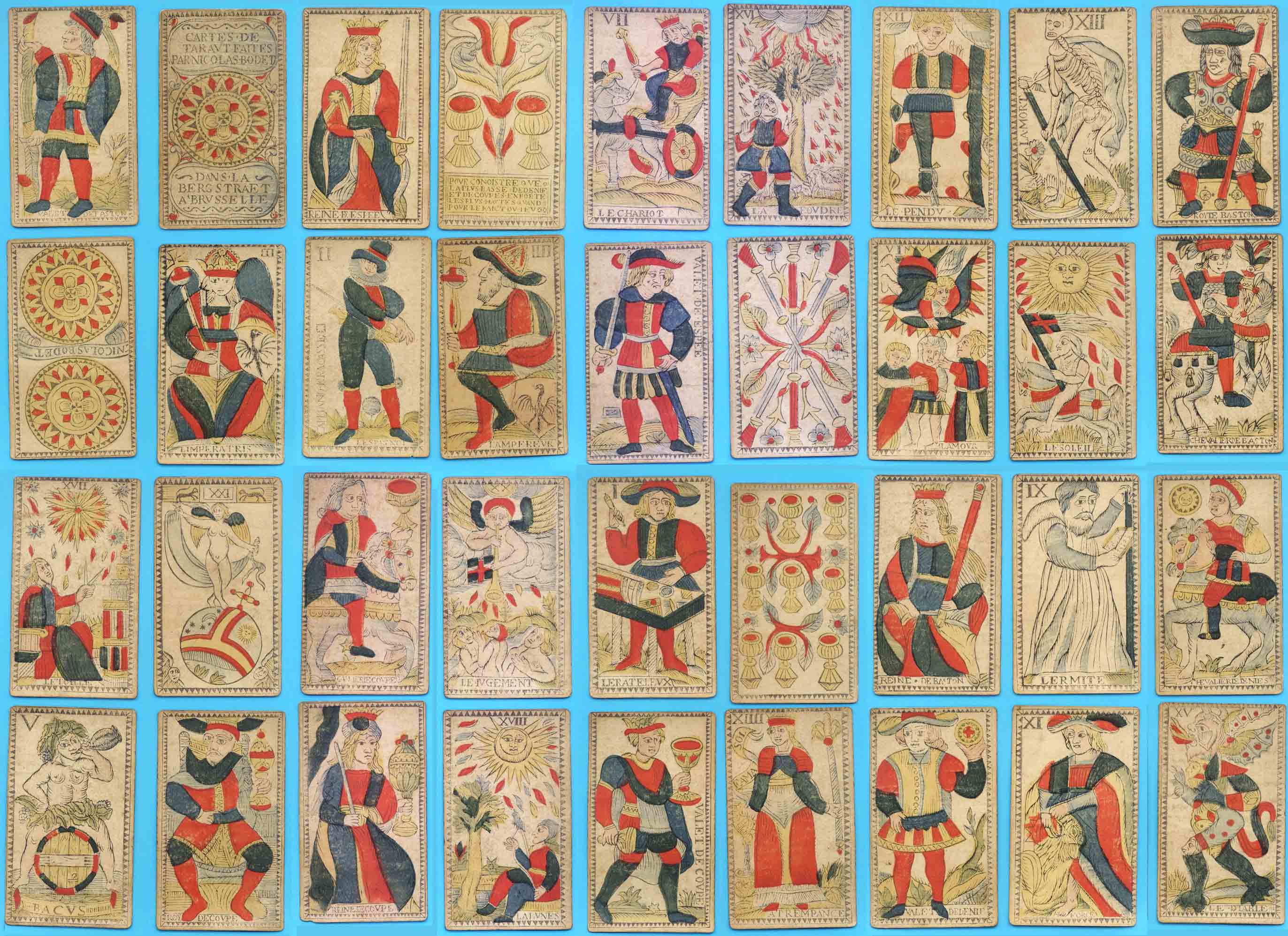
The deck is executed in a vigorous and energetic style with a chequered frame around each card. The trump cards have Roman numerals and are inscribed with French titles. The complete deck contains 78 cards.
• See also: Tarot cards by Nicolas Bodet (1743-1751).
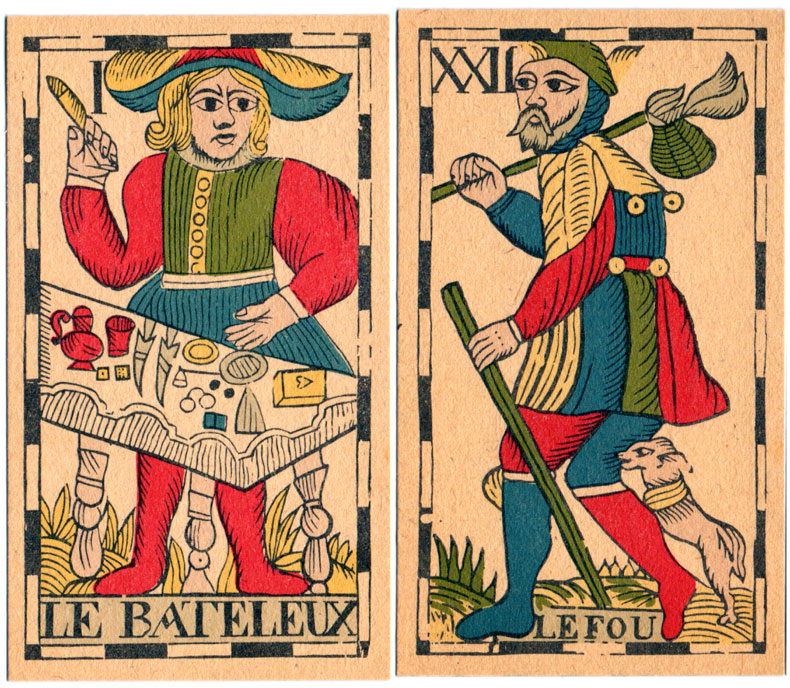
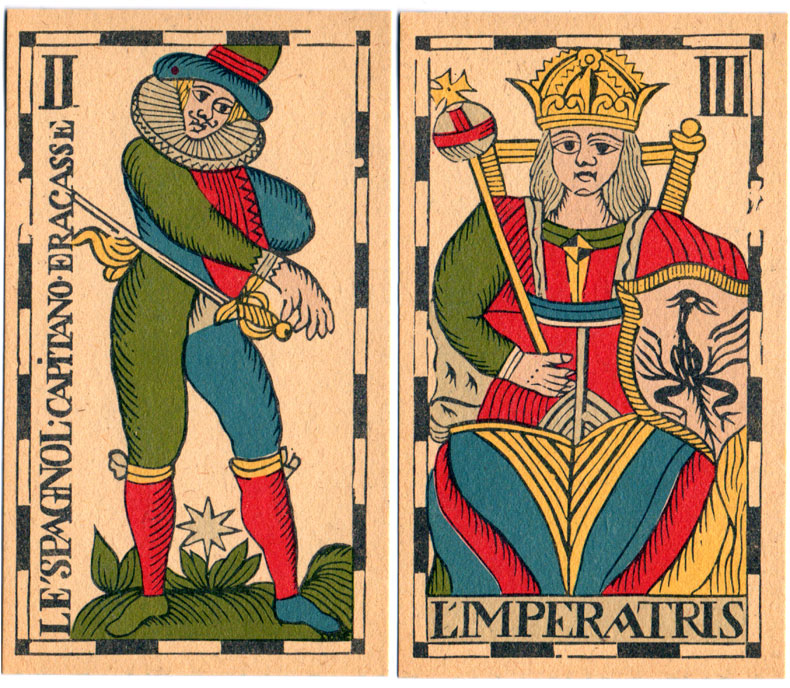
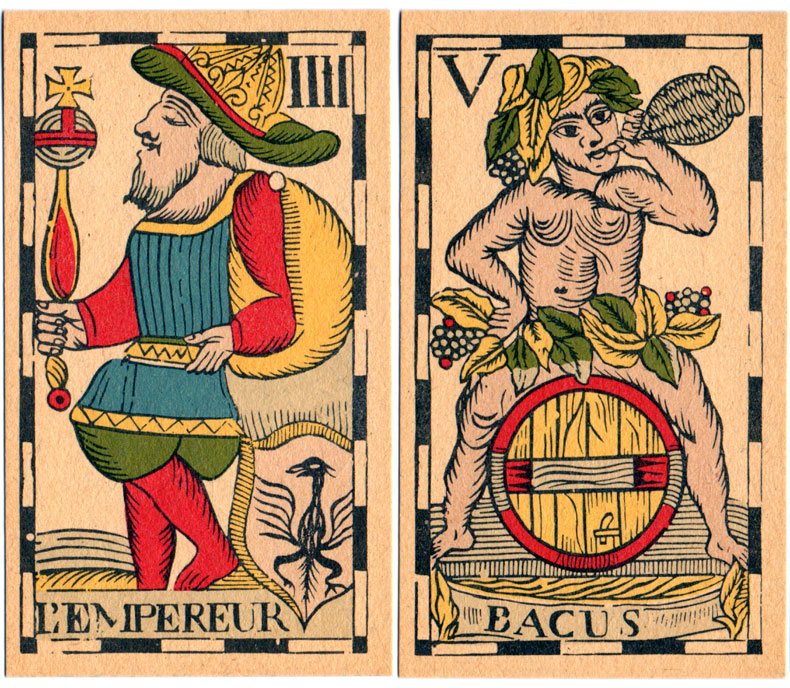
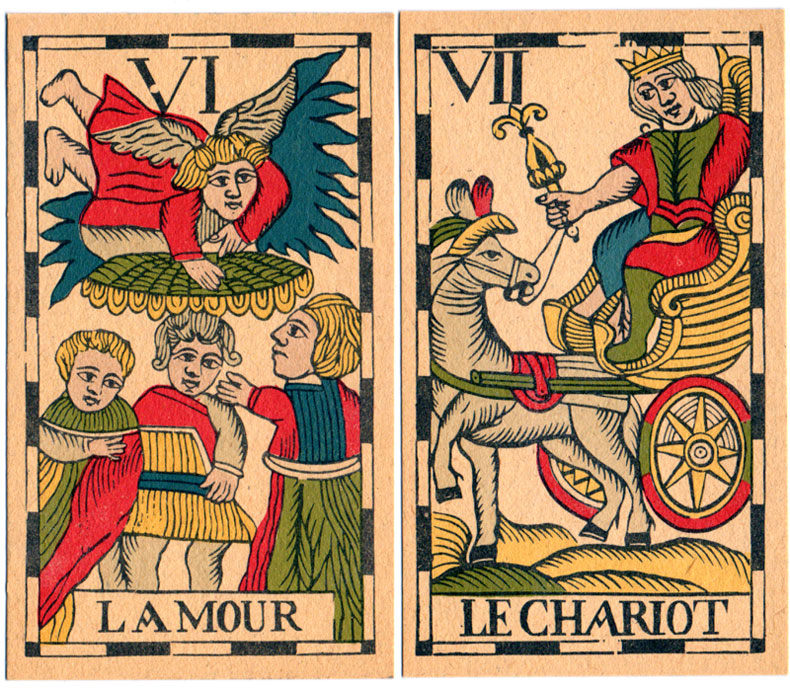
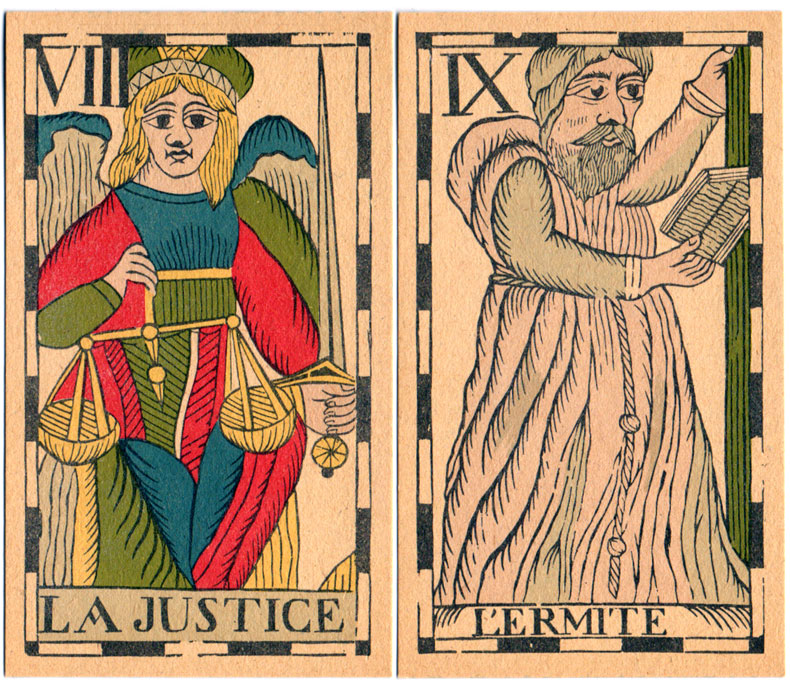
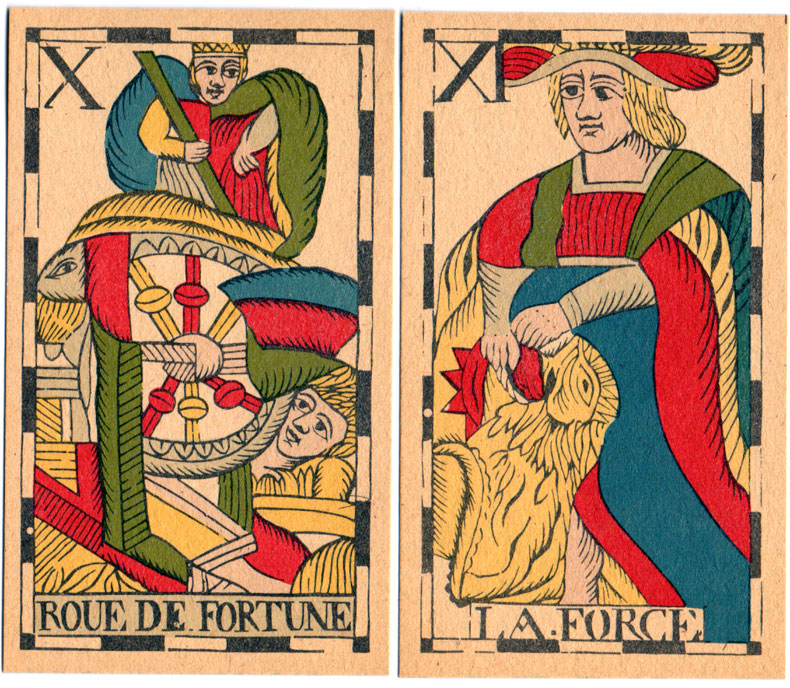
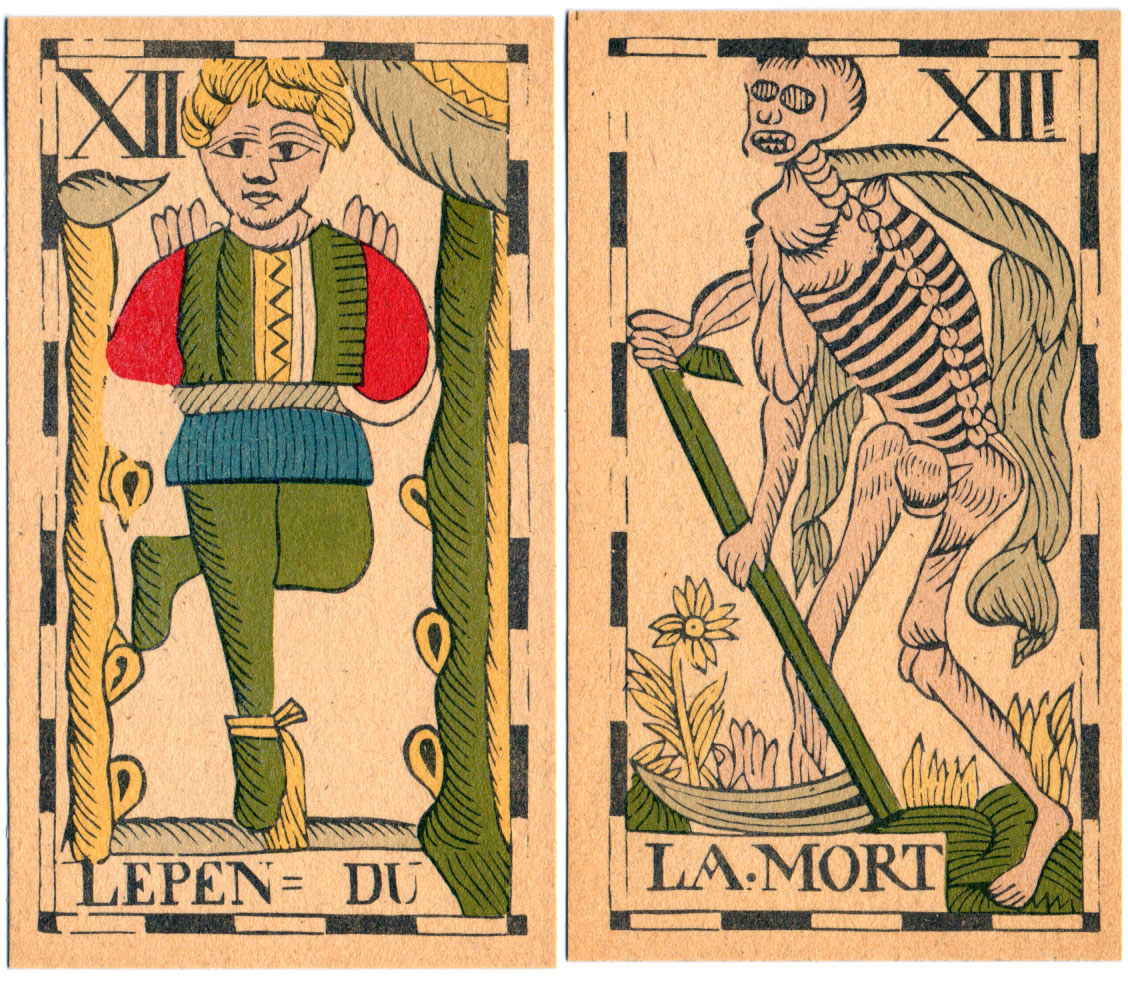
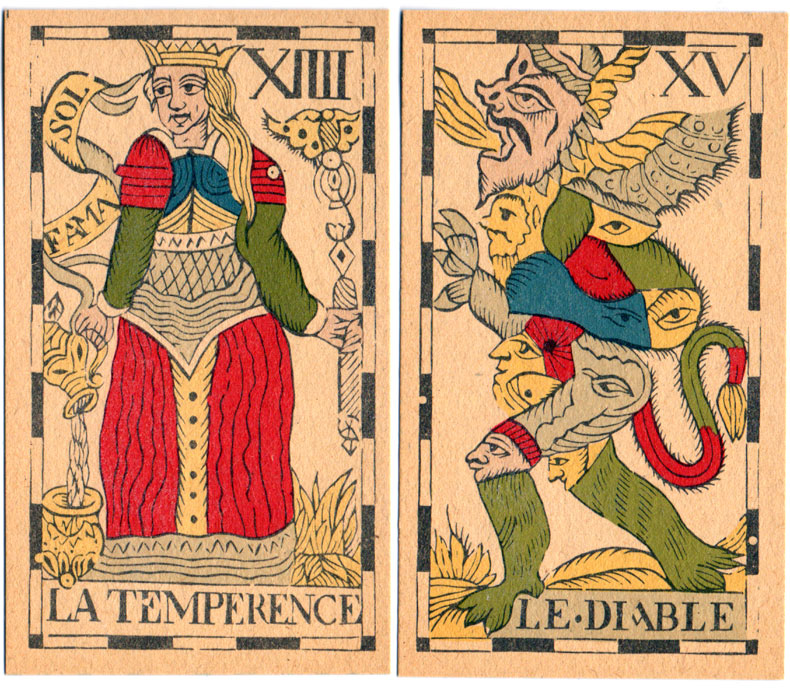
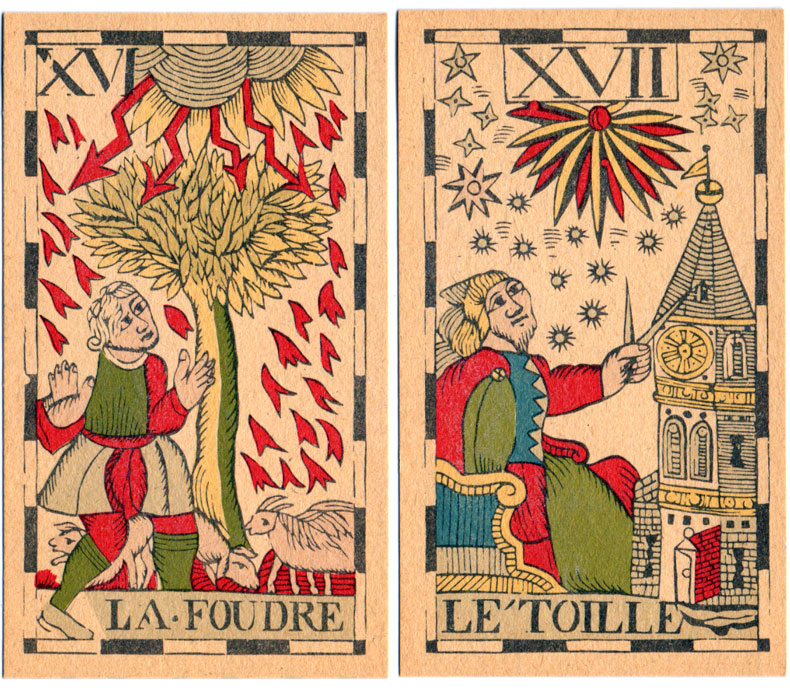
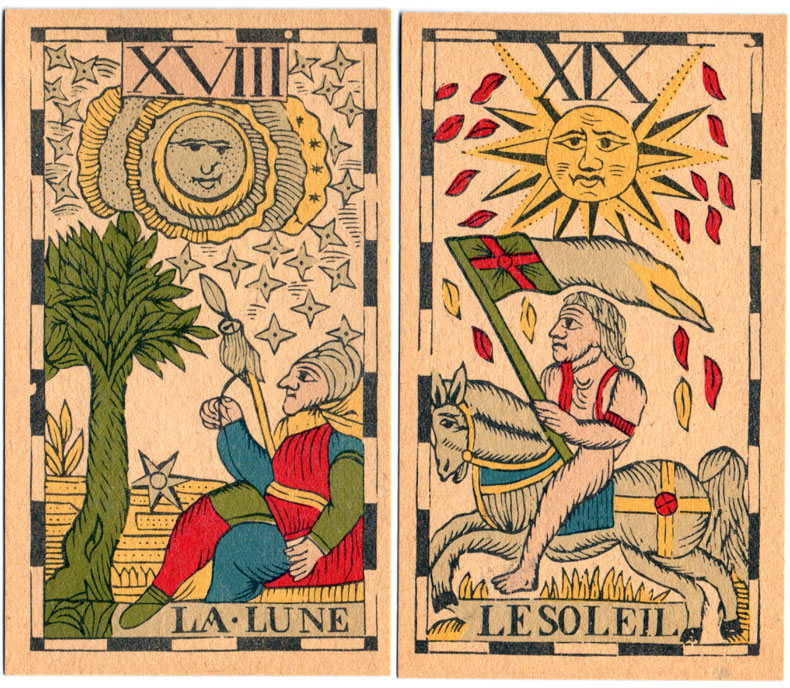
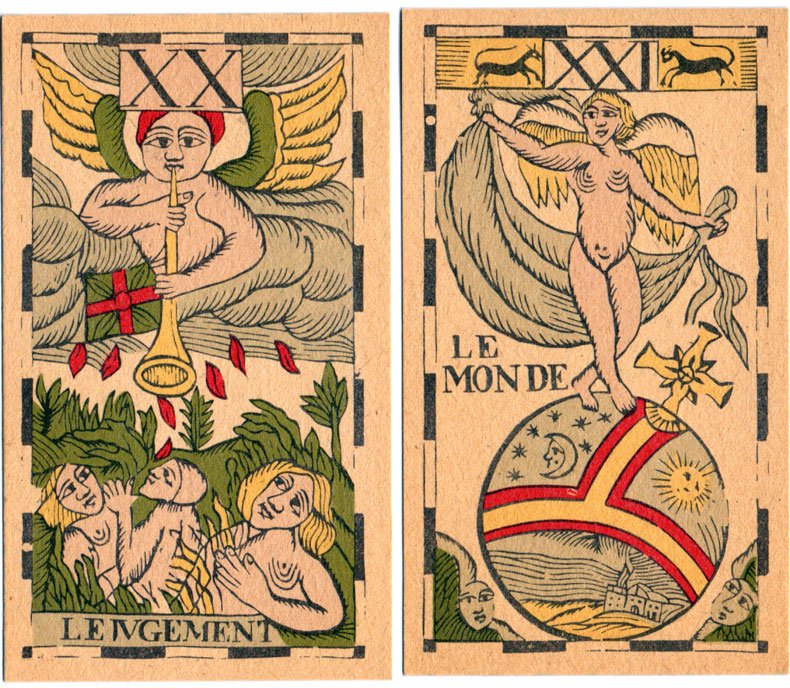
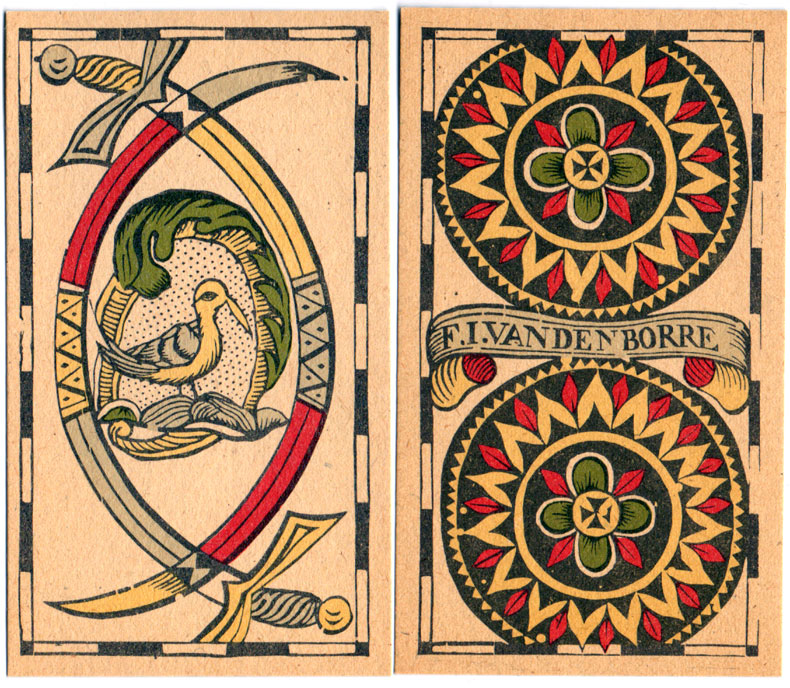
Above: facsimile edition of Belgian Tarot published by François-Jean Vandenborre, Brussels (1762-1803).
Several trumps deviate from the tradition: trump II (normally the High Priestess) is depicted as “Le’spagnol · Capitano Eracasse”, a cocky figure from the Commedia dell’arte, and trump V (otherwise the Pope) is “Bacus”, the Roman god of euphoria. Other idiosyncrasies in the deck can be traced back to Italian prototypes. The Fool is number XXII.
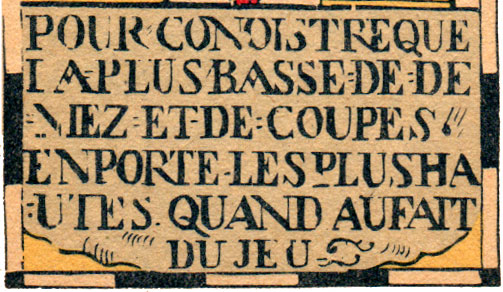
Left: inscription from 2 of Cups “POUR CONOISTRE QUE LA PLUS BASSE DE DENIEZ ET DE COUPES ENPORTE LES PLUS HAUTES QUAND AU FAIT DU JEU” reminds players that in Coins and Cups the lower-numbered cards beat the higher ones, suggesting that the deck was intended for playing games rather than divination.
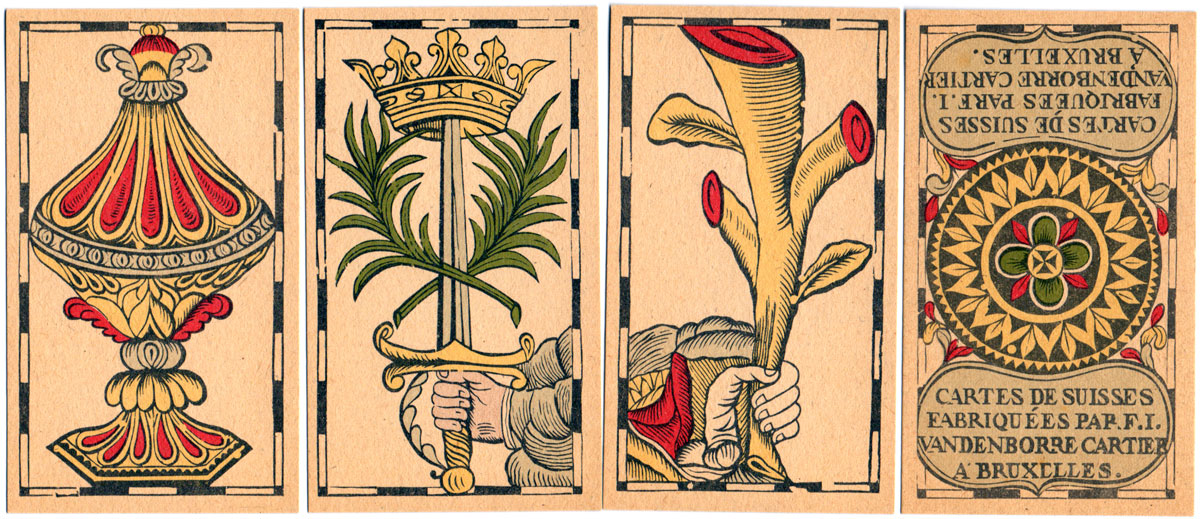
Above: the four aces, Vandenborre Tarot, Brussels, c.1780.
The Court Cards
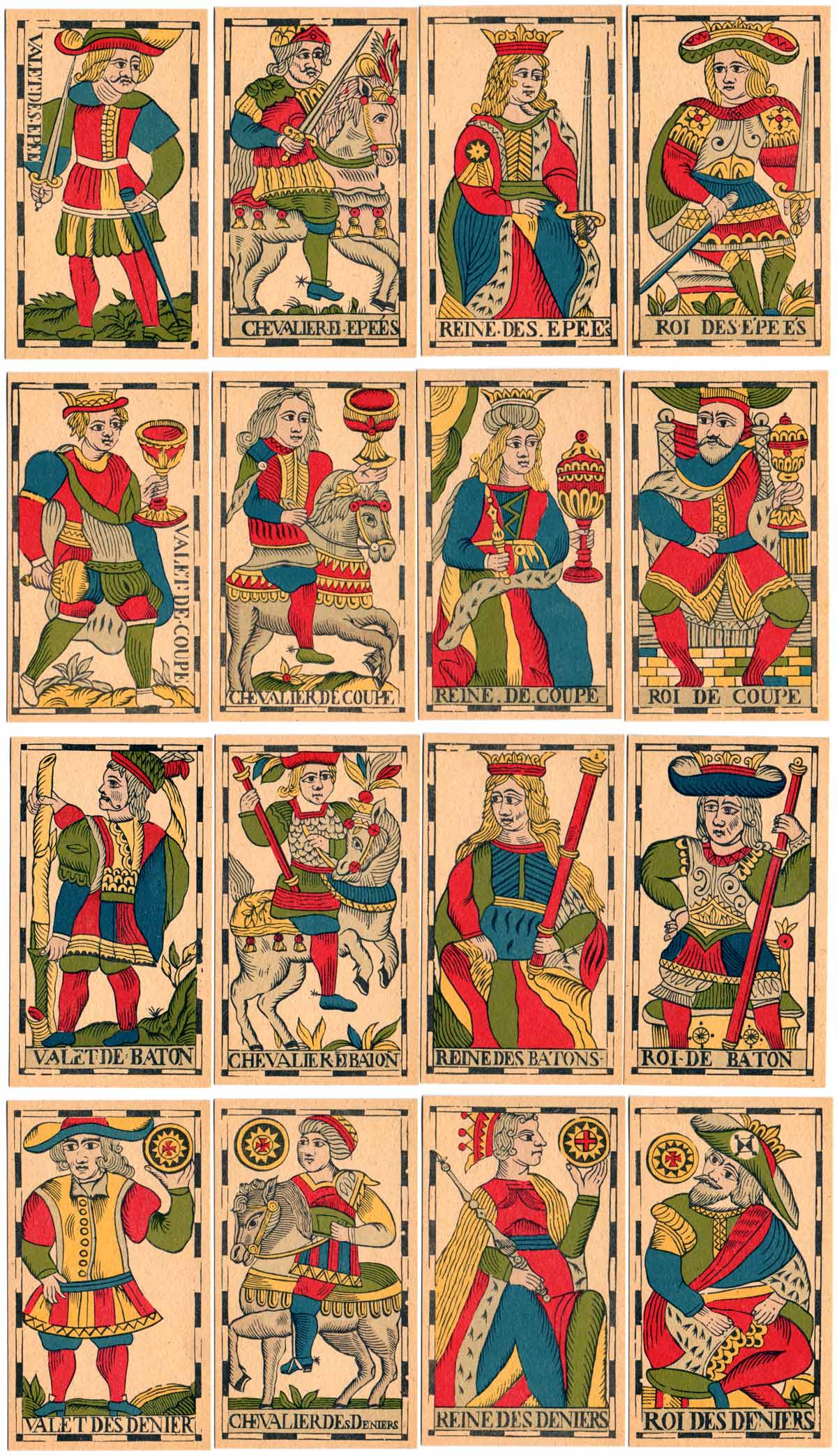
Above: the 16 court cards, Vandenborre Tarot, Brussels, c.1780.

By Simon Wintle
Spain • Member since February 01, 1996
I am the founder of The World of Playing Cards (est. 1996), a website dedicated to the history, artistry and cultural significance of playing cards and tarot. Over the years I have researched various areas of the subject, acquired and traded collections and contributed as a committee member of the IPCS and graphics editor of The Playing-Card journal. Having lived in Chile, England, Wales, and now Spain, these experiences have shaped my work and passion for playing cards. Amongst my achievements is producing a limited-edition replica of a 17th-century English pack using woodblocks and stencils—a labour of love. Today, the World of Playing Cards is a global collaborative project, with my son Adam serving as the technical driving force behind its development. His innovative efforts have helped shape the site into the thriving hub it is today. You are warmly invited to become a contributor and share your enthusiasm.

Activity for Vandenborre Tarot
Sign in to comment or save this article.

Related Articles
The Sola-Busca Tarot
Humanist Iconography, Alchemical Metaphor, and the Origins of the Illustrated Minor Arcana.
Tarot Beirut
A beautiful Arabic Tarot : a mystical tool for positive guidance and well-being.
Mademoiselle Lenormand
XIX century ‘Mlle Lenormand’ cartomancy deck by Daveluy, Bruges.
Le Monde Primitif Tarot
Facsimile edition produced by Morena Poltronieri & Ernesto Fazioli of Museo Internazionale dei Taroc...
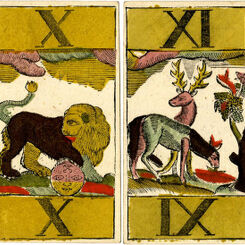
Animal Tarot by J. B Dubois
French-suited Bavarian Animal Tarot by J B Dubois, Liège, Belgium, late 18th C.
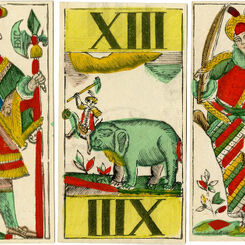
Animal Tarot by J. T Dubois
Early 19th century Animal Tarot pack produced by J T Dubois, Liège, Belgium.
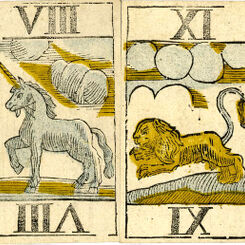
Animal Tarot by G. Larmoyer
Flemish Animal Tarot deck by G. Larmoyer, Liège, 1753.
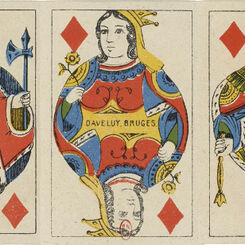
Cartes Marbrées
A provincial variant of the French ‘Paris’ pattern produced by Daveluy c.1850-1895.
Jean Noblet Tarot de Marseille
Jean Noblet: the oldest known ‘Tarot de Marseille’ deck, Paris, c.1650.
Tarocchini Bolognesi by Carlo Zanardi
Tarocchini Bolognesi by Carlo Zanardi, c.1850
Cartes de Luxe (1877) facsimile
‘Cartes de Luxe’ first published by Biermans in 1877 was reproduced in facsimile by Amstel Beer in c...
Anon Spanish Cards c.1875
Spanish-suited playing cards made in Belgium by Mesmaekers Frères, c.1875.
Brepols Genoese pattern
“Cartes Françaises” and Genoese pattern by Brepols.
Serravalle-Sesia Tarot
Serravalle-Sesia Tarot published by Fratelli Avondo, c.1880.
Mitelli Tarocchini
The title refers to “a new form of Tarocchini”. Mitelli's designs are to a high standard of artistic...
Spanish Cards c.1920
Spanish-suited Playing Cards manufactured by Van Genechten, c.1920.
Portuguese Type Playing Cards c.1860
10 cards from a pack of later Portuguese ‘Dragon’ type cards from c.1860, with the Maid of batons ab...
Kart do Tarota
78-card Polish tarot pack designed by Edyta Gdek.
XV Century Italian Playing Cards
Cards from a pack of an early form of north Italian playing cards, with the swords back-to-back and ...
Jason Ennis Tarot Cards
Jason Ennis was a self trained artist interested in man's nature, his powers and abilities.
Most Popular
Our top articles from the past 60 days


Stefan Lauwers
17 January 2023, 18:02The "Cartes de Suisses' were first re-produced in a very limited serie of only 500 decks, in 1974 --in a box-- by Aurelia Books, Brussels, a publishing company that was ran by Jan Bauwens who has several reproductions on his name. Jan Bauwens was very close tot E. Van Autenboer, the former director of the Turnhout National Playing Card Museum. These cards were re-issued a second time in 1984 as 'Vlaamse Tarok', this time distrubuted by Cartamundi and US Games System, (Yellow and Blue box, and with a box in several languages. The origine of the name 'Cartes de Suisses'is known, even if they are basically 'Tarot de Marseille' ... When (by the year 1765 or so), some people also started to use tarot-cards for "fortune telling", the card-makers ran into trouble with the Catholic Church in the South of France. Persecution hit in the South of France, and a lot of them re-located, first to the 'Doubs'/'Jura'/'Franche Comté' region (Besançon), and later further on to Switserland. And of course, they were taking their skills with them. Once in Switserland, the cards received Italian influences and became like a sub-type of their own ... Later, these decks became known as 'Cartes de Suisses' (like in 'cards made by Swiss people'), and Vandenborre, who was a Brussels-based card-manufacturer, also took over this type of cards, by 1780. Others, in Ghent and Bruges would soon follow. These cards became popular in the north of the Belgian country, in Flanders region, by opposition to the south, the Liège region, where 'Animal'-tarot was popular. So, in the end these cards became also known as 'Flemish Tarot'.
Maria Nick
05 March 2026, 06:40SavedSaved this article to Maria Nick's Collection