


L. P. Holmblad, c.1845
Holmblad ordered his earlier designs to be re-drawn and updated. Comparison of packs from this era show instances where one figure is replaced by another more imposing version.
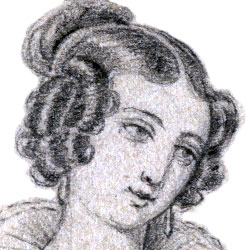
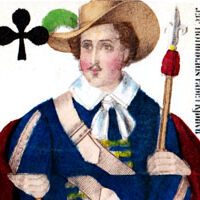
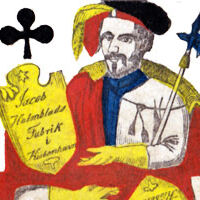
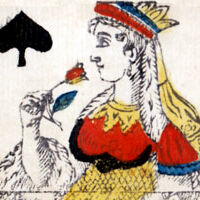
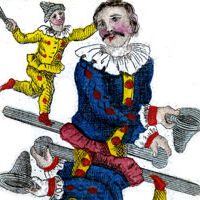
Lauritz P. Holmblad (1815-1890) ordered his earlier designs to be re-drawn and updated. Comparison of packs from this era show instances where one figure is replaced by another more imposing version. The artwork shown here provides a fascinating insight into the creative processes at work between pencil drawings on paper, with delicate rendering of local colour, light, shade and texture and the etched, printed and stencil-coloured playing cards. The artists' and models' identities are not known.
Fortune Buchholtz comments: "Several of these faces seem quite familiar to me - they are highly reminiscent of various royal portraits in the Danish Rosenborg Castle. This opened to the public in 1838, so by the 1845 these portraits would have been well-known to the educated in Denmark."
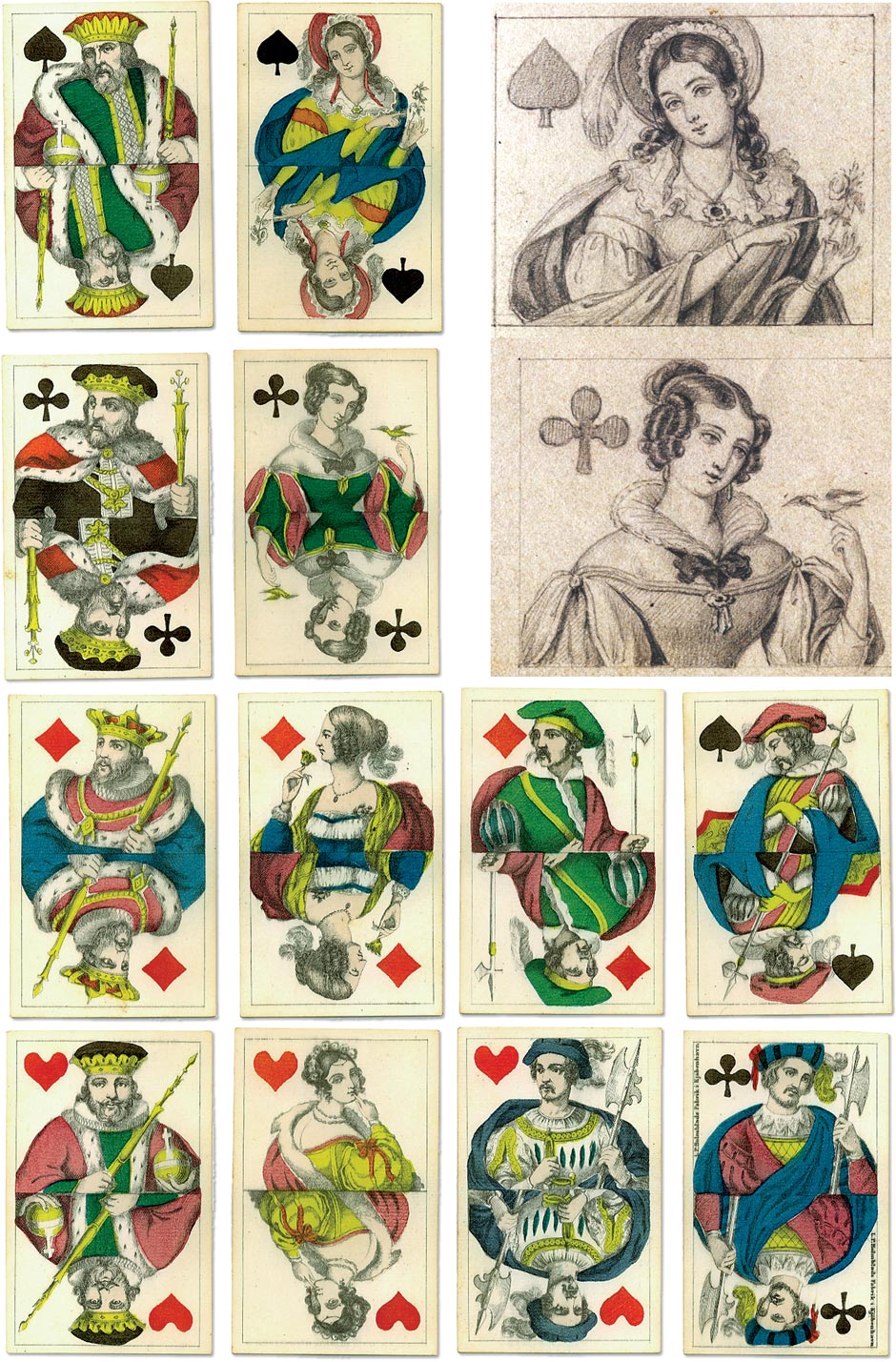
Above: an early L. P. Holmblad deck, c.1845 and some of the original drawings. The royal licence had been transferred to him in 1841 so by making his new playing card designs highly reminiscent of royal portraits perhaps he was seeking to establish a reputation with the best clientèle. All images courtesy Hans J. Hinrup.
REFERENCES
Hinrup, Hans J.: The Holmblad Playing Card Patterns, in "The Playing-Card" vol.33 no.4, IPCS London, Apr-June 2005.

By Simon Wintle
Spain • Member since February 01, 1996
I am the founder of The World of Playing Cards (est. 1996), a website dedicated to the history, artistry and cultural significance of playing cards and tarot. Over the years I have researched various areas of the subject, acquired and traded collections and contributed as a committee member of the IPCS and graphics editor of The Playing-Card journal. Having lived in Chile, England, Wales, and now Spain, these experiences have shaped my work and passion for playing cards. Amongst my achievements is producing a limited-edition replica of a 17th-century English pack using woodblocks and stencils—a labour of love. Today, the World of Playing Cards is a global collaborative project, with my son Adam serving as the technical driving force behind its development. His innovative efforts have helped shape the site into the thriving hub it is today. You are warmly invited to become a contributor and share your enthusiasm.

Activity for L. P. Holmblad, c.1845
Sign in to comment or save this article.

Related Articles
Balearic Souvenir Cards
Mediterranean Souvenir deck by Rioba Studio, Pollença, Mallorca.
Damn! Fools by Moon
Damn! Fools playing cards designed by Leo Scherfig, 2022.
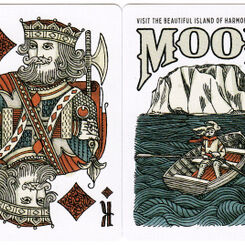
Old School Playing cards from Moon
Designed and published by Leo Scherfig
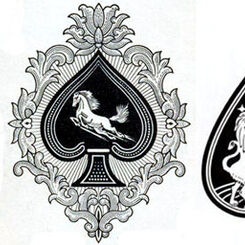
Modern Aces of Spades
Many modern aces of spades are anonymous so that, in the absence of any other information, the colle...
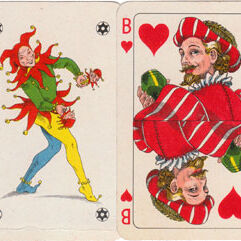
Warburg’s Danske
Warburg’s Danske playing cards published by Aktieselskabet Emil Jensen, København, 1944.
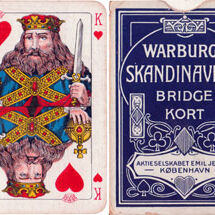
Warburg’s Skandinaviske Bridge Kort
“Warburg’s Skandinaviske Bridge Kort” published by Aktieselskabet Emil Jensen, København, c.1935.
Standard Handa Pattern
Standard Danish playing cards made by Handa, Copenhagen.
Four Centuries
“Four Centuries” playing cards by Esselte Öbergs with court cards depicted as caricatures from diffe...
Anonymous Dutch deck, 1940s
Anonymous Dutch deck, 1940s
De la Rue for export
Non-standard playing cards produced by De la Rue & Co. (London), c.1930s
Jacob Holmblad c.1830
An amazing difference can be seen between the early and the later Jacob Holmblad packs, covering a t...
Jacob Holmblad, 1820s
The Q♥ has a butterfly net in which she has caught four hearts. Many of Holmblad's designs were repl...
Jacob Holmblad c.1820
Standard woodblock and stencil deck produced by Jacob Holmblad with double-ended court cards in the ...
Holmblad Animal Tarot
Instead of the old emblematic designs, the trump cards show illustrations of animals, which could po...
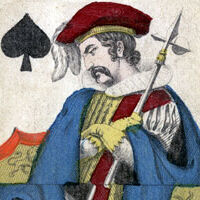
L. P. Holmblad c.1840
L. P. Holmblad's house pattern used from c.1840. The K♠ carries a harp as in the traditional French-...
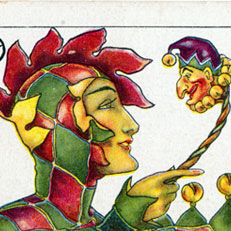
Warburg Luxus Bridgekort
“Luxus Bridgekort” was specially designed by Barbara MacDonald in a vibrant Art Deco style for Warbu...
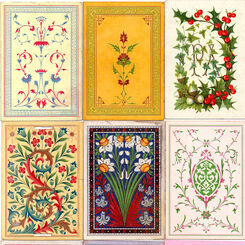
14: Back Designs
A few examples of the many interesting back designs.
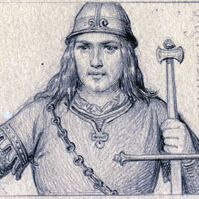
L. P. Holmblad - Denmark
Cards from c.1850 by L. P. Holmblad showing fantasy historical Danish Kings and Queens.
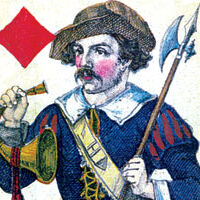
Danish Tarok Cards - Holmblad, c.1850
The traditional animal images on tarok decks are here substituted by images of buildings from Copenh...
The History of Playing Cards
Playing cards appear in European records in the late 14th century, but their earlier history lies fu...
Most Popular
Our top articles from the past 60 days


Maria Nick
21 February 2026, 10:32SavedSaved this article to Maria Nick's Collection