


Richard Bouvier
The assorted antique playing cards shown below are examples of the French 'Paris' pattern from the seventeenth century. The Jack of Clubs has the name Richard Bouvier.
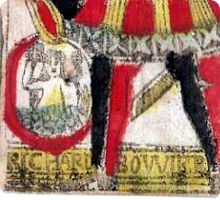
Seventeenth century French playing cards
Richard Bouvier
The assorted antique, single-ended playing cards shown below are examples of the French 'Paris' pattern from the seventeenth century. The Jack of Clubs has a mermaid in a small medallion, and the name Richard Bouvier who was a seventeenth century manufacturer working in Rouen and/or Abbeville. The colour scheme including purple is also present on the Jack of Spades (third card, top row) who has a small dog by his leg. The other cards have a different colour palette and may be by a different maker; also the differences in the shape of the suit symbols suggests different makers and dates. As was the custom in France at this time, the cards are named from characters in epic narratives or heroes of antiquity.
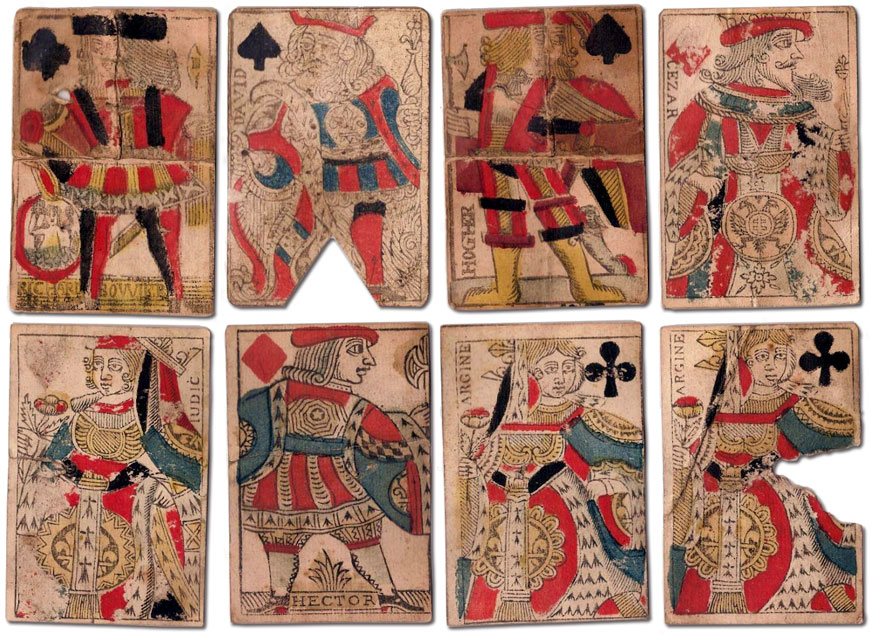
Above: assorted seventeenth century French playing-cards, one of which has the manufacturer's name Richard Bouvier (Jack of Clubs). Woodblock and stencil printing. The cards appear to have been used for various secondary purposes (see below).
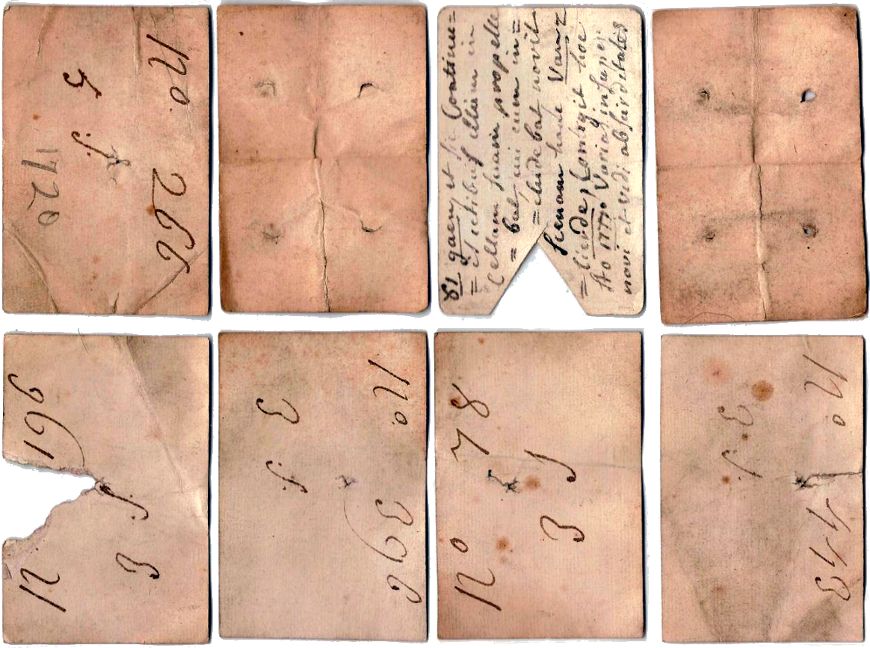
Above: the reverse of the cards reveals several different secondary uses, which are not obvious to explain. Some cards have been folded and pierced, maybe used as stiffening, whilst others have been used for writing various pieces of information.

By Simon Wintle
Spain • Member since February 01, 1996
I am the founder of The World of Playing Cards (est. 1996), a website dedicated to the history, artistry and cultural significance of playing cards and tarot. Over the years I have researched various areas of the subject, acquired and traded collections and contributed as a committee member of the IPCS and graphics editor of The Playing-Card journal. Having lived in Chile, England, Wales, and now Spain, these experiences have shaped my work and passion for playing cards. Amongst my achievements is producing a limited-edition replica of a 17th-century English pack using woodblocks and stencils—a labour of love. Today, the World of Playing Cards is a global collaborative project, with my son Adam serving as the technical driving force behind its development. His innovative efforts have helped shape the site into the thriving hub it is today. You are warmly invited to become a contributor and share your enthusiasm.

Activity for Richard Bouvier
Sign in to comment or save this article.

Related Articles
Most Popular
Our top articles from the past 60 days


