


French Revolutionary cards by Pinaut
Seven cards from a French Revolutionary pack by Pinaut featuring characters from classical antiquity.
These few cards hold much historical interest, having been produced in Paris in 1794 at the height of the French Revolution. Prior to this during the Revolution, Paris and provincial pattern packs had been corrected (“corrigés”) by the removal of crowns and other attributes linked to the Ancien Régime. The new “modèle” represented here was authorised in February 1794 but only makers in Paris are known to have produced it. Pinaut, although from Paris, is not one of the Parisian makers listed in the Gazette nationale as being authorised to produce these cards so he presumably copied someone else’s designs.
This new pattern is sometimes called the “portrait de Paris révolutionnaire” or SVB III (from the first letters of the names on the court cards). It is characterised by a series of figures from classical antiquity plus Rousseau. These represent “Sages” (K), “Vertus” (Q) and “Braves” (J). Adding to the interest is the fact that these cards have turned suit-signs in the bottom right-hand corner together with indices using Roman numerals: I = roi; II = dame; III = valet. This is one of the first times – if not, the very first time – that such double-ended indices appear on playing cards.
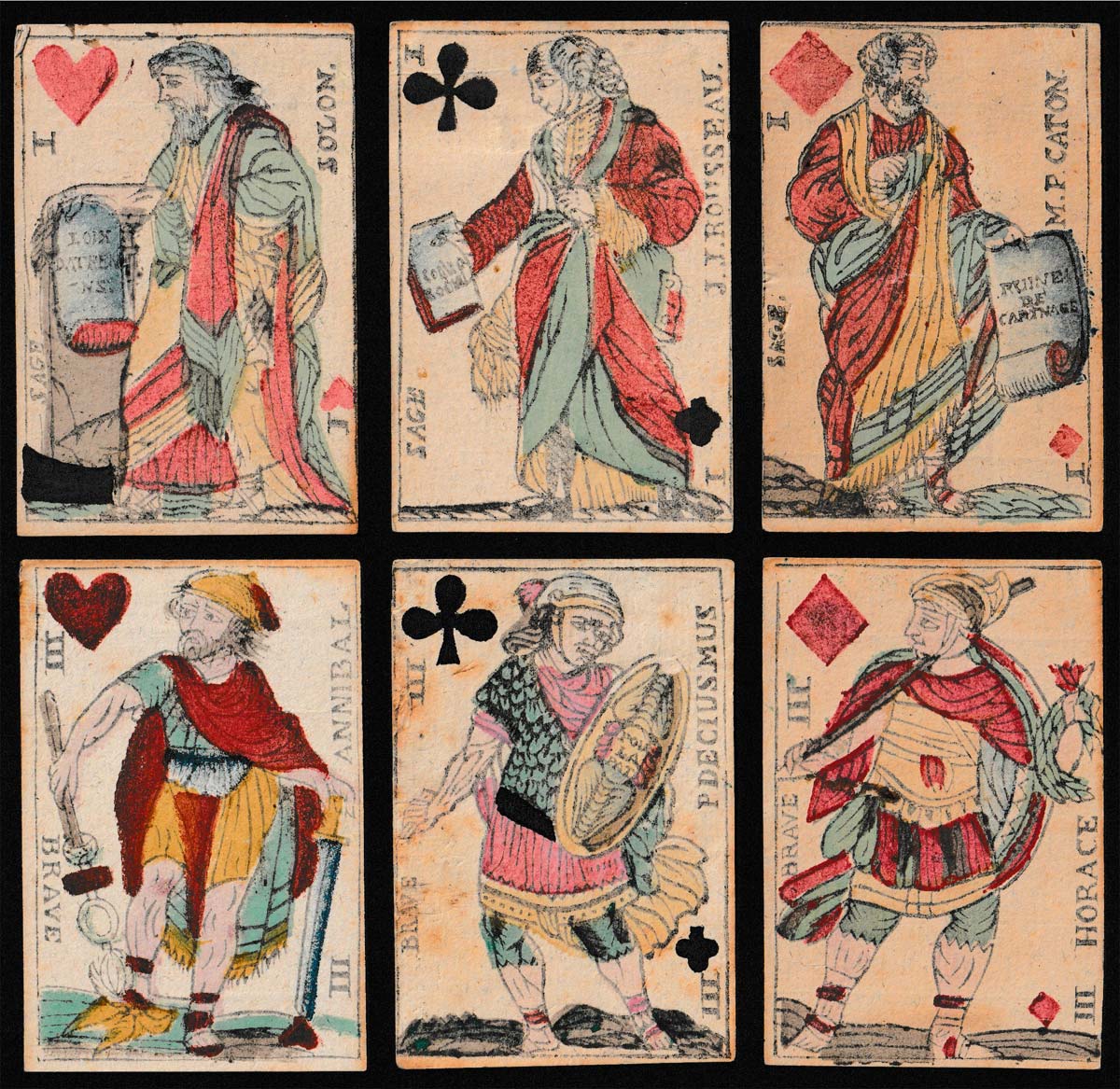
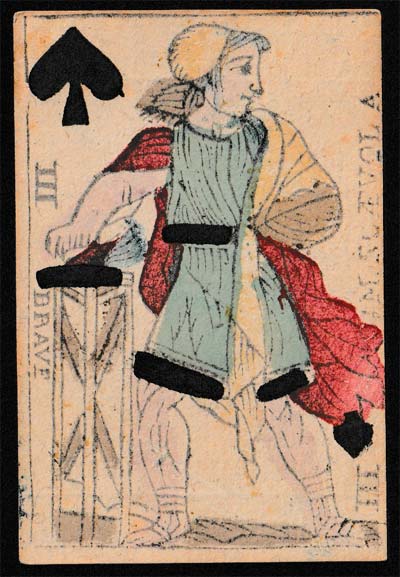
Above: seven French Revolutionary playing cards made by Pinaut, Paris, France, 1794. 7/32 cards. Size: 55 x 83 mm.
The colours, too, are remarkable. At least five colours are present on these cards: black, red, blue, green and yellow.
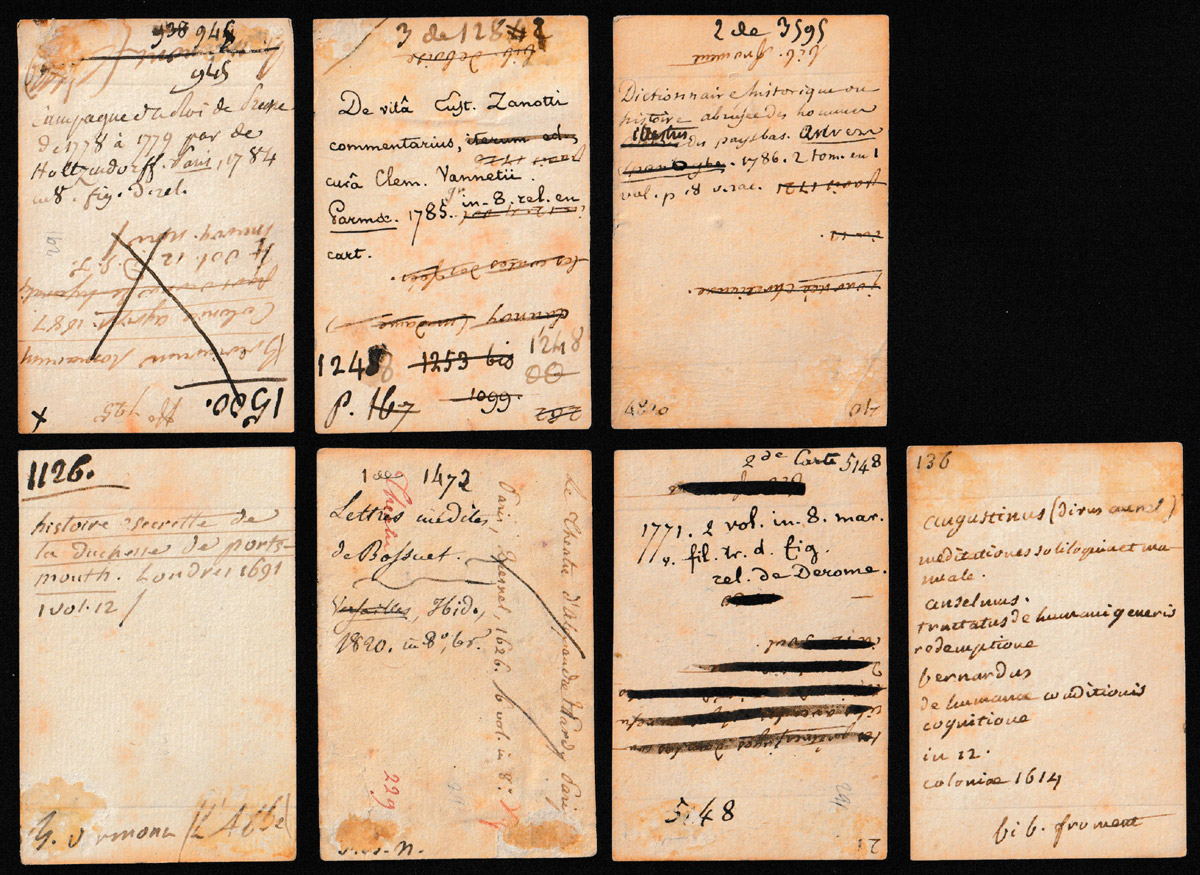
As is often found on cards of this period, the plain backs have been used for a secondary purpose, in this case to record the titles and dates of a collection of books.
For comparison, please see french-playing-cards►. The subjects there are the same but they have been treated differently: no green colour used and an entirely different form of indexing.
Reference
Depaulis, Thierry. Les Cartes de la Révolution. Issy-les-Moulineaux, France: Musée français de la Carte à jouer; 1989. p. 34, cat. no. 43.

By Roddy Somerville
France • Member since May 31, 2022
Roddy started collecting stamps on his 8th birthday. In 1977 he joined the newly formed playing-card department at Stanley Gibbons in London before setting up his own business in Edinburgh four years later. His collecting interests include playing cards, postcards, stamps (especially playing cards on stamps) and sugar wrappers. He is a Past President of the Scottish Philatelic Society, a former Chairman of the IPCS, a Past Master of the Worshipful Company of Makers of Playing Cards and Curator of the WCMPC’s collection of playing cards. He lives near Toulouse in France.

Activity for French Revolutionary cards by Pinaut
Sign in to comment or save this article.

Related Articles
Portrait de Paris corrigé de Minot
Early French Revolutionary cards with certain elements removed from the old Paris pattern.
Assassin’s Creed Unity
Characters from the 2014 video game set during the French Revolution, published by Ubisoft.
Jeu Révolutionnaire
Court cards and aces from a French Revolutionary pack by Pinaut, Paris, c.1794.
English Pattern by B.P. Grimaud
Standard English pattern published by B.P. Grimaud with engraving by F. Simon, c.1880.
The Parisian Tarot
The “Parisian Tarot”, early 1600s, with imagery and design synthesizing several influences.
Pierre Roiné Aluette
Archaic form of Aluette published by Pierre Roiné, Nantes, c.1785.
Antoine de Logiriera
Archaic Spanish-suited playing cards published in Toulouse by Antoine de Logiriera (1495-1518).
A. Camoin & Cie
This deck was inherited from ancestors, it has has a family history surrounding it. Details of the l...
64: The descendants of the French regional patterns: 2
A continuation oF the development of the off-spring of the Paris patterns and a few examples of how ...
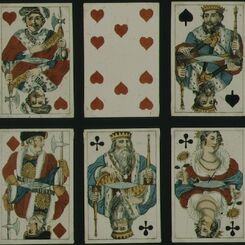
63: The descendants of the French regional patterns: 1
A great many regional patterns were exported from France and subsequently copied elsewhere. Some of ...
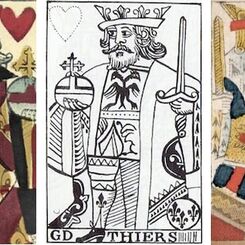
61: French regional patterns: the kings
On page 11 I illustrated several examples of the regional French patterns from Sylvia Mann's collect...
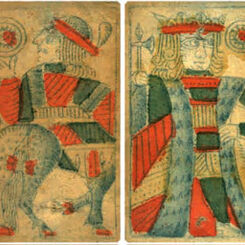
Pedro Varangot, 1786
Archaic Navarra pattern produced for the Pamplona General Hospital Monopoly by Pedro Varangot in 178...
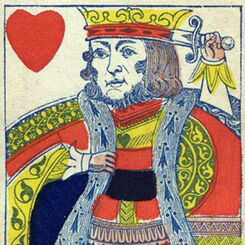
Suicide King
The King of Hearts, holding a sword behind his head, is sometimes nicknamed the “Suicide King”. He c...
Pierre Marechal
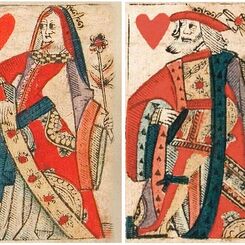
Rouen became an important centre for card-making whose influence extended far afield. Cards from Rou...

Benoist Laius
Spanish playing cards such as these were used in those parts of France where certain games were enjo...
Lyon Pattern type iii
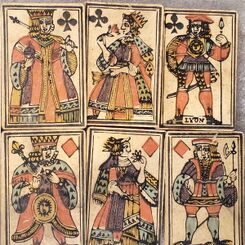
This pattern was used in various parts of eastern France but was ultimately replaced by the official...
Paris Pattern
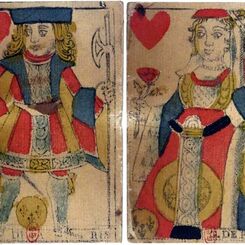
The Paris pattern was established as such around the middle of the seventeenth century (based, perha...
Mamluk Playing Cards
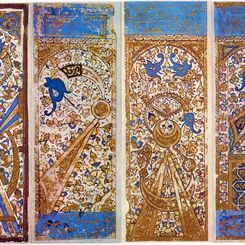
Nã'ib, the game of lieutenants... these cards are amongst the earliest Arabic playing cards ext...
The History of Playing Cards
Playing cards appear in European records in the late 14th century, but their earlier history lies fu...
History of Court Cards
The court cards in English packs of playing cards derive from models produced by Pierre Marechal in ...
Most Popular
Our top articles from the past 60 days


