


The Molassine Company and its link to Whist and Bridge
A savvy marketing strategy blending Victorian decorative design with Edwardian practicality.
I know I go on endlessly about how great the Victorians were in inventiveness, design and manufacturing. This article refers to a company based on a Victorian invention, but which reached its heyday in the Edwardian period and far beyond. I refer to the Molassine company founded in Greenwich, London, in 1900 and which continued trading until 1979 when it was absorbed into its parent company, Tate and Lyle¹. This Greenwich-based company produced various forms of animal feed using beet and cane molasses and sold its various feeds all over the world. Their main product was a molasses-based feed for horses comprising a mixture of sphagnum moss and molasses with some chemical additions. In the First World War this feed was considered antiseptic and soldiers used it as a plaster for wounds². In later years the company heavily promoted its dog biscuits called Vims and dog food called Stimo.
Now I wouldn’t be writing about this company at all if it had no connection to card games. A large part of the success of Molassine was its widespread promotion on both sides of the Atlantic which gave the company huge success over many years. One of the reasons for this success was its very effective marketing which included distributing a huge variety of “give-away artefacts” and other promotions carrying the Molassine name and logo. Their marketing department clearly exploited every means available to this generation of entrepreneurs to get the name and dramatic Molassine logo widely known. These included posters, tins and boxes, postcards, celluloid and metal vesta cases to store matches, collectable card sets and even a silver pocket watch carrying the Molassine name. Relevant to the present context were these two items made from thin, cream celluloid (itself a relatively new invention) and carrying the name, logo and explanation of its purpose
Their first venture into the popular card-playing arena was a simple celluloid whist marker with integrated wheels to record the trump suit, the number of tricks won, and the number of games played. Each pair would need a marker of their own.
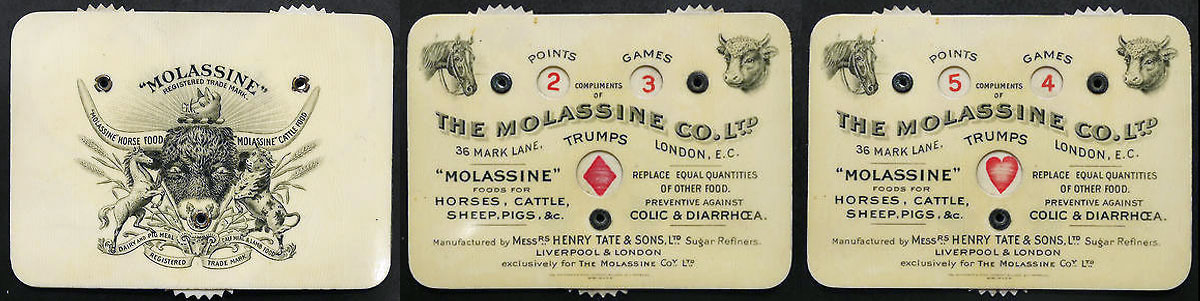
Above: celluloid whist marker, with three serrated wheels and intricate imagery promoting horse and cattle feed, made by Whitehead and Hoag Co., US, for Henry Tate and Sons of London, exclusively for the Molassine Co., c.1910. 3 1/16" x 2 3/16".
Within this early period, however, a new variation of the whist game was being widely played and the Molassine wizz-kids quickly added a “bridge marker” to their give-away promotional repertoire. It comprises a foldable whist and bridge marker contained in a folded case which slides inside a sheath as shown below.
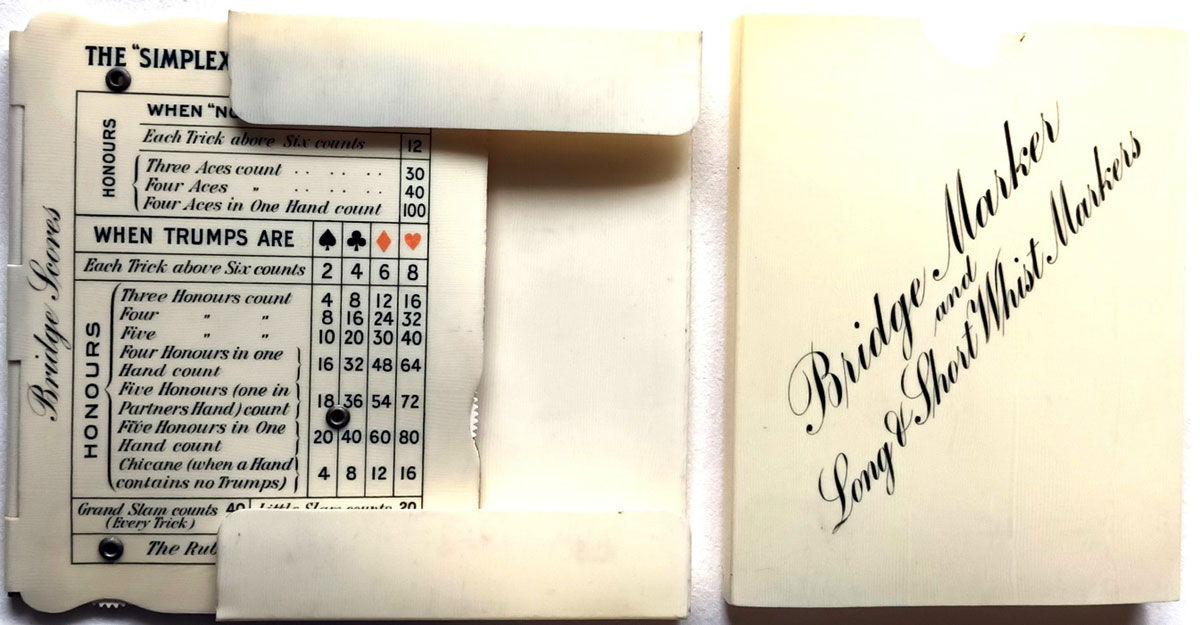
The folded marker is cleverly designed to cater for whist and bridge players alike. Indeed, it accommodates not only the by now fairly universal form of short whist, but also the somewhat outdated form of long whist which plays to ten points per game rather than five.
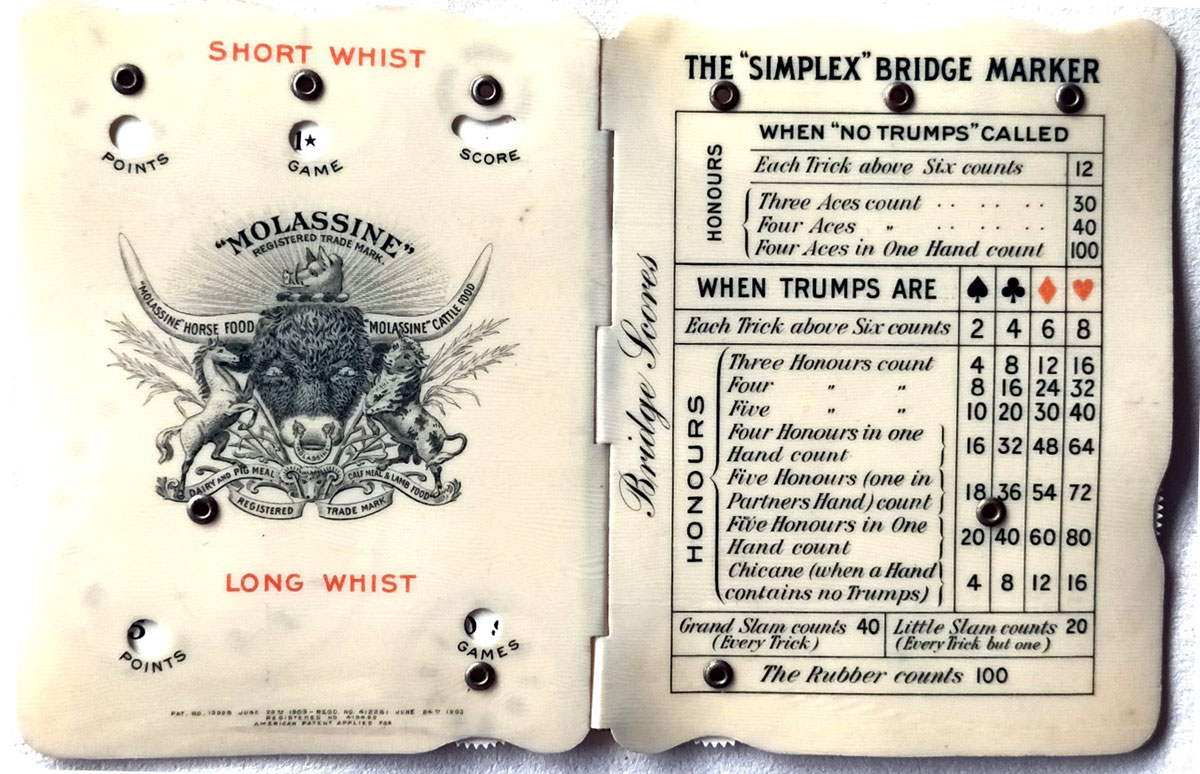
The bridge scoring system is that developed for “bridge-whist” – the first attempt to introduce bidding into the game of whist - which was played between around 1897 and 1910. This confirms the product as being one of the earliest after the company was formed. By 1910 most serious bridge players had moved to the rather more sensible scoring system of auction bridge which improved the scoring rating of the spades suit and took better account of the value of slams. I can find no evidence of Molassine updating this particular product to accommodate changes in the game after 1910.
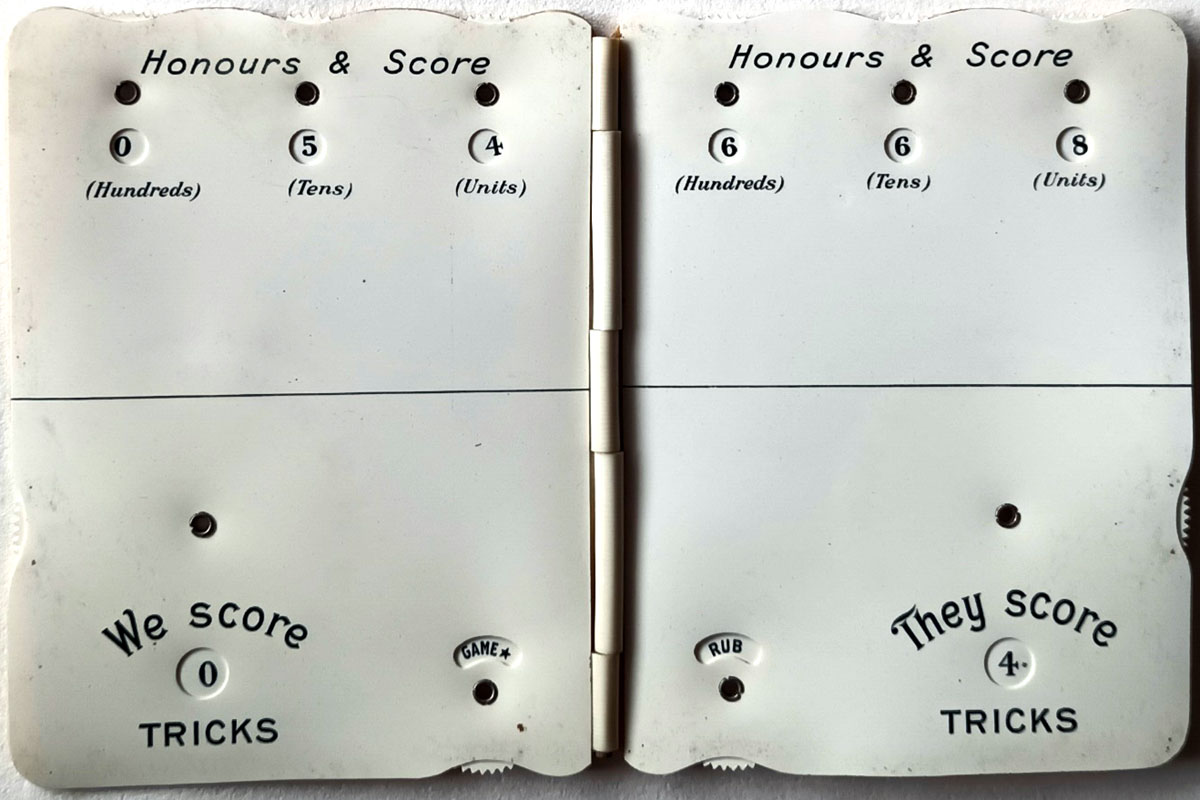
On the reverse side (or inside) of the folded marker are wheels which are used to record the accumulated scores of both pairs of players. However, as you can see, this device only recorded a total points scored, and did not differentiate between game points and those “above the line” i.e. honours, bonuses and game scores. As a result, it was of limited use and, like so many other attempts to score bridge games with the use of a physical marker³, it was soon abandoned in favour of a simple paper and pencil.
I have a number of other celluloid whist and bridge markers from this period and later, but nothing as dramatic or stylish as those produced by Molassine. Business success produced by advertising is clearly not just a modern phenomenon.
Tony Hall, 21 June 2025
References
- The feed part of the business was finally closed down in 1981.
- Greenwich Industrial History : Molassine, November 2019►
- Tony Hall : Bridge Markers and Bridge Scoring Methods►


By Tony Hall
United Kingdom • Member since January 30, 2015
I started my interest in card games about 70 years ago, playing cribbage with my grandfather. Collecting card game materials started 50 years or so later, when time permitted. One cribbage board was a memory; two became the start of a collection currently exceeding 150!
Once interest in the social history of card games was sparked, I bought a wooden whist marker from the 1880s which was ingenious in design and unbelievably tactile. One lead to two and there was no stopping.
What happened thereafter is reflected in my articles and downloads on this site, for which I will be eternally grateful.

Activity for The Molassine Company and its link to Whist and Bridge
Sign in to comment or save this article.

Related Articles
Two consecutive 7 No Trumps contracts!
What are the odds?
Pictures of Early Whist writers and their stories
The Invisible Experts: Tracking the Elusive Faces of Whist History.
Victorian grocer’s scale plate
Large flat plate decorated with highly coloured English cards and royal arms.
Will’s Cigarettes and Auction Bridge
In 1926 Will’s issued a set of 25 cigarette cards on Auction Bridge, presenting a range of hands ill...
A New Look at the Evolution of Whist Markers and Gaming Counters
This article aims to illustrate the evolution of whist and gaming counters from the 18th century to ...
Whist writers and their pseudonyms
Why did so many early writers about whist and other card games feel the need to write under a pseudo...
Whist marker boxes
The Camden Whist marker was being advertised by Goodall and son in 1872 as a new product.
Bridge Markers and bridge scoring methods
Bridge Markers and bridge scoring methods 1900-1930
The Personalities and Books which shaped the game of Whist, 1860-1900
All the books described here are from Tony Hall's own collection, put together over years because of...
The Jovial Cards
Publicity items for a group of entertainers, Southend-on-Sea, Essex, UK, 1911.
Leather Card Case Patent Application
In 1932, a patent was granted to Colin Hart and George Franklin for a leather case in the form of a ...
67: Adverts and related material after 1900
The final page of material relating to playing cards from British periodicals.
47: Welch’s postcards and De La Rue’s redrawing
There are a number of court card designs that have never actually been produced as cards. It's a sha...
The Odd Trick
The Odd Trick - a bit of Edwardian naughtiness.
Music Manuscripts
Artwork featuring playing cards in Music Manuscripts
Draughts League Medals
Arthur Charles Prince worked for De la Rue as a playing card cutter and later was promoted to superv...
Pope Joan Trays
Some traditional Pope Joan boards comprise a circular tray, others are square, divided into sections...
Games Leaflets
Thos De la Rue & Co. & Gibson's Games Leaflets.
Lottery Scratch Playing Card
Move your mouse over the scratch area...
History and Evolution of Spades
History and Evolution of Spades
Most Popular
Our top articles from the past 60 days


