


Waddington’s faux books
Waddington’s faux book set containing four packs of playing cards and bridge markers.
I recently came across a complete boxed set of faux books containing four packs of playing cards and four “bridge markers” (pictured below). I have acquired various elements of these sets before but never a complete set, as sold.
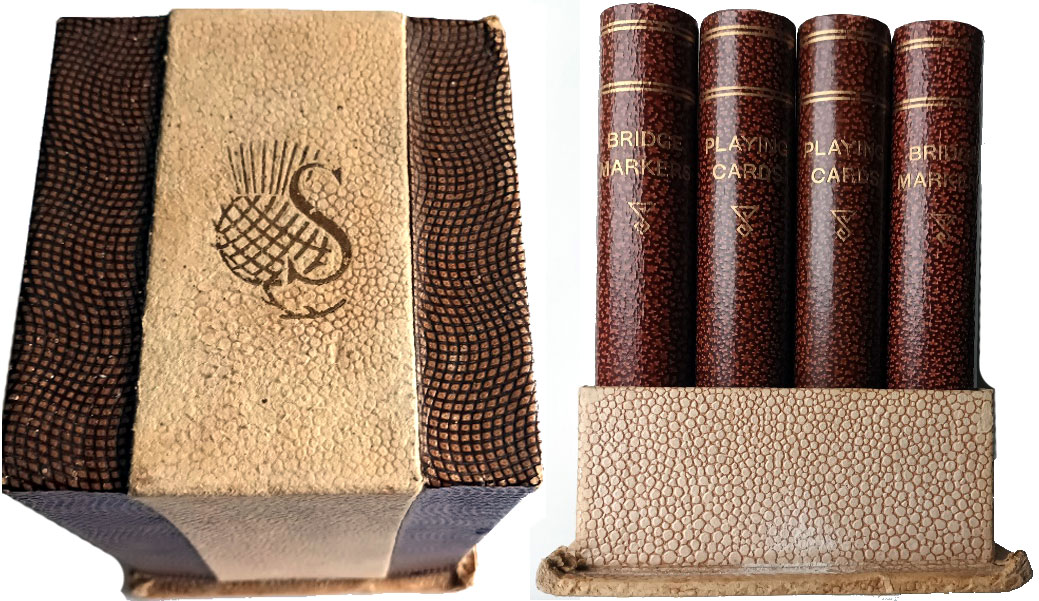
Each faux book contains either two packs of cards or two scoring pads described as “markers”. This complete set contains two of each. Each book contains a gold-coloured case which, with its various contents, slides inside. The box, each of the faux books and the packs of cards all carry the thistle logo with a prominent S.
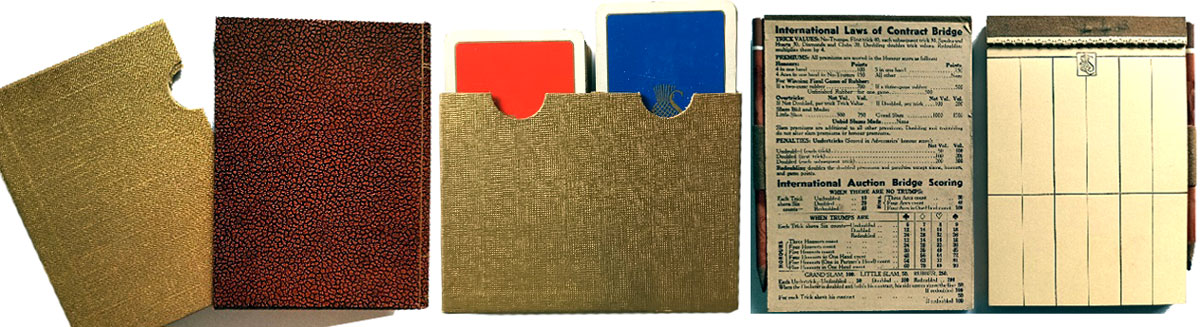
The cards are made by Waddingtons, are original to the box and are consistent with the style produced in the early 1930s.
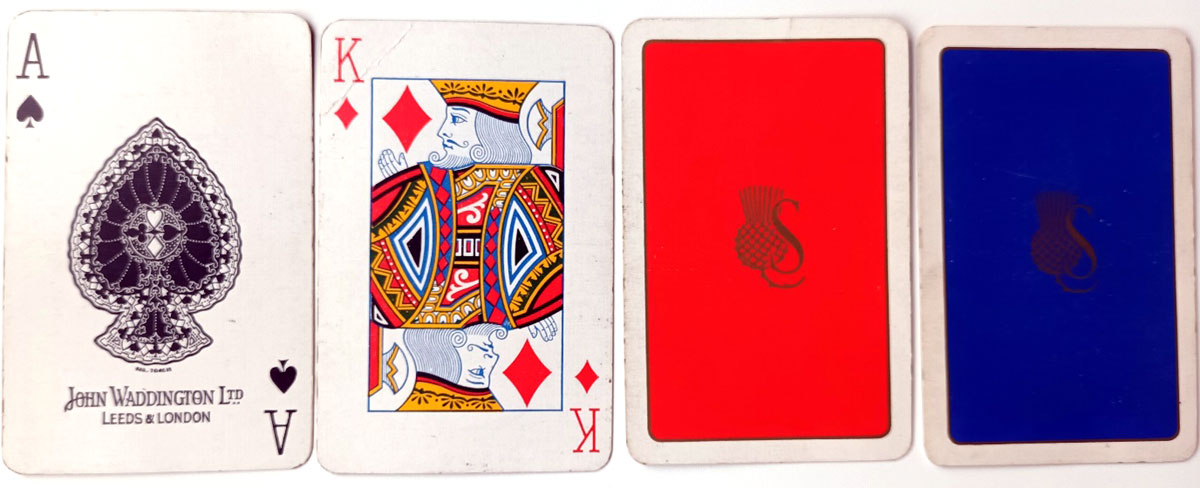
Interestingly, nowhere does the name Waddingtons appear on the box or the individual book holders, but the name on the Ace of Spades makes the origin of the cards at least clear. But what of the boxes?
I couldn’t help noticing, being an avid reader of other people’s wopc articles, that this set shows a remarkable similarity to the Lexicon card set described by Simon Wintle in 2015, and reproduced below. This set is clearly marked “Waddingtons”.
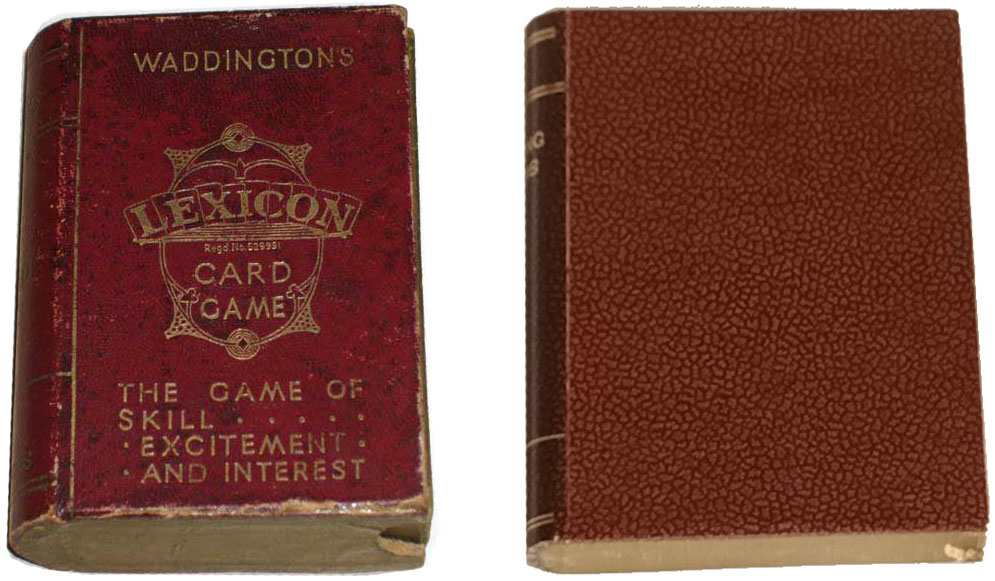
The faux Lexicon book also contains a gold-coloured case which slides into the covers of the book. This too has semi-circular cut-outs for ease of access. Simon dates this set to October 1933, based on the date printed on the rule book.
My set of faux books contain no such indicator of manufacturer or date of production, but it seems very likely that the faux bridge sets were also produced by Waddingtons and that they were initially produced at around the same time as the Lexicon set, namely the early to mid-1930s.
I conclude this based not only on the similarity of design of the two sets, but the details on the so-called bridge markers. As you can see, the scoring systems printed on the back includes both Auction and Contract. The early 1930s was a crucial period of evolution from auction to contract bridge, when both versions are being played and scoring systems refined. If we look closely at the scoring system proposed for contract bridge, we can see that the first trick in a no trumps contract is worth 40 points; subsequent tricks 30 each. This system, familiar today, was only finally settled upon in 1935 and thus the scoring pad can be dated as 1935 or soon thereafter.
It is also interesting to note, as I have before, the use of the term “marker” rather than “score pad”. This echoes earlier times when physical markers were used to score the game of whist. Early attempts to provide the same style of physical marker for bridge were doomed to failure and paper and pencil proved to be a far better scoring method, but the name “marker” stuck for a period in the 1930s . Indeed, Agatha Christie was still using the term marker for a score pad in her play, Spider’s Web, produced in 1954.
Finally, there remains the mystery of the thistle logo on the box, “books” and backs of the cards. We know that this does not refer to Waddingtons who never used a logo of this design. We can only conclude that the owner of the logo commissioned Waddingtons to produce this set – the box, the faux books and the cards - with their insignia, presumably for promotional purposes. Sadly, extensive research has not yet revealed who or what this sponsor was! Given the nature of the commission it must have been a significant organisation at the time, but a lot has happened since the mid-1930s and so far the owner of the logo has been lost without trace! Any help on this would be much appreciated.
Acknowledgement & Reference
I would like to acknowledge the help and advice received from Ken Lodge in researching this item. See
• WoPC : Lexicon►
Tony Hall, 10 June 2025

By Tony Hall
United Kingdom • Member since January 30, 2015
I started my interest in card games about 70 years ago, playing cribbage with my grandfather. Collecting card game materials started 50 years or so later, when time permitted. One cribbage board was a memory; two became the start of a collection currently exceeding 150!
Once interest in the social history of card games was sparked, I bought a wooden whist marker from the 1880s which was ingenious in design and unbelievably tactile. One lead to two and there was no stopping.
What happened thereafter is reflected in my articles and downloads on this site, for which I will be eternally grateful.

Activity for Waddington’s faux books
Sign in to comment or save this article.

Related Articles
Two consecutive 7 No Trumps contracts!
What are the odds?
The Molassine Company and its link to Whist and Bridge
A savvy marketing strategy blending Victorian decorative design with Edwardian practicality.
Double Dummy Bridge
In the early 20th century several firms began to promote whist or bridge as a game for two.
Tangle Foot Ale
Badger Brewery Tangle Foot strong ale advertising pack.
Agatha Christie and Playing Cards revisited
Agatha Christie uses card-play as a primary focus of a story, and as a way of creating plots and mot...
Hollywood Greats playing cards
18 stars in black and white from the Golden Age of Hollywood.
Waddington’s 1940 Trade Brochure
Waddington’s 1940 Trade Brochure.
Cribbage Board Collection part 4
A collection of antique and vintage Cribbage Boards by Tony Hall, part 4.
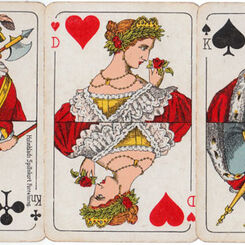
S. Salomon & Co Nr.154
Nr.154 Holmblads made by John Waddington Ltd specially for S. Salomon & Co., Copenhagen

John Waddington Ltd, early type
John Waddington Ltd, early type Ace of Spades and court cards, 1922-30.
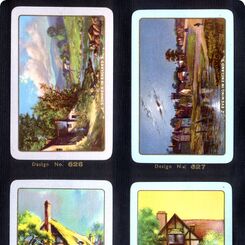
Waddington’s “Rural England” Series, 1933
Waddington’s "Rural England" Series, 1933.
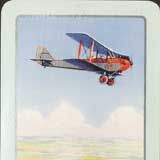
Waddington’s “Flying” Series, 1933
Waddington’s “Flying” Series, 1933.
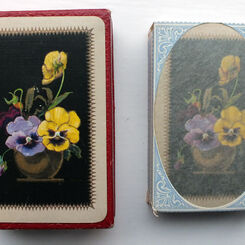
Waddington’s “Envoy“ Series
Waddington’s “Envoy“ Series.
Waddington’s Varsity Series
Waddington’s Varsity Series.
Waddington’s Old Master Series, 1933
Waddington’s Old Master Series, 1933
Waddington’s Dog Series
Waddington’s Dog Series, 1933

Waddington’s Classic and Wildlife Series, 1933
Waddington’s Classic and Wildlife Series, 1933.
Waddington’s Clan Tartan Series
Waddington’s Clan Tartan Series, 1933.

Waddington’s 1933 Trade Brochure
Waddington’s 1933 Trade Brochure.
Waddington’s Playing Cards
John Waddington Limited was a leading producer of playing cards and card games in the UK during the ...
Most Popular
Our top articles from the past 60 days


