


Quadruple Bézique sets
Quadruple Bézique sets with self-scoring markers published by Willis & Co, London.
Willis & Company was formed in 1869, having been preceded by Charles Steer at the same address (80 Long Acre, London). They promptly entered the Bezique market and their early lists include their own design of Patent Self-Scoring Bezique Markers. These are described in Willis' promotional material as superior and durable, “undeviatingly correct”, presented as their own patented design. No surviving patent documentation has yet been identified.

This Quadruple set contains 4 "Patent Self-scoring" markers which are also mentioned on the label inside the box top. Each deck has 32 cards, with double-ended court cards but single-ended number cards. The faces are uncoloured. We estimate the date to be sometime during 1870s.
The backs have two different colours.The set includes a rules booklet and a card promoting the Patent Self-Scoring Bézique Marker as undeniably the best of its kind plus prices of different boxed sets, zoom the extra card►
Records show that Charles Steer’s firm did not advertise self-scoring markers before Willis took over. It is therefore quite possible that Willis built on pre-existing scoring devices rather than being the absolute originator. Reynolds, Goodall, and De La Rue were already producing Bezique scoring devices, making it unlikely that Willis invented the idea; more probably, they patented their own variant or improvement on an already-existing concept.
It is also puzzling that references to the Patent Self-Scoring Markers, as well as mentions of 'Entered at Stationers Hall', are not consistent on all the box labels, making it harder to date these sets more accurately.


Above: quadruple boxed set with violet & white label inside the box lid with mention of Patent Self-Scoring Markers, c.1870s. Images courtesy Fabio De Paolis.

Above: quadruple boxed set and rules booklet with large red label inside the box lid, no mention of Patent Self-Scoring Bézique Marker on the label. or of entry at Stationer's Hall, c.1870s.

Above: quadruple boxed set with brown & white label inside the box lid with mention of Entry at Stationer's Hall, c.1870s.

By Simon Wintle
Spain • Member since February 01, 1996
I am the founder of The World of Playing Cards (est. 1996), a website dedicated to the history, artistry and cultural significance of playing cards and tarot. Over the years I have researched various areas of the subject, acquired and traded collections and contributed as a committee member of the IPCS and graphics editor of The Playing-Card journal. Having lived in Chile, England, Wales, and now Spain, these experiences have shaped my work and passion for playing cards. Amongst my achievements is producing a limited-edition replica of a 17th-century English pack using woodblocks and stencils—a labour of love. Today, the World of Playing Cards is a global collaborative project, with my son Adam serving as the technical driving force behind its development. His innovative efforts have helped shape the site into the thriving hub it is today. You are warmly invited to become a contributor and share your enthusiasm.

Activity for Quadruple Bézique sets
Sign in to comment or save this article.

Related Articles
Mystery Objects
I have finally identified the purpose of this puzzling piece of card-playing kit.
New interest in old games
Games once fashionable are now eclipsed by quicker gratifications.
T. Drayton & Son
Bezique and Whist boxed sets by T. Drayton & Son, London, c.1875.
The Evolution of Bezique boxed sets, 1869 to 1990
The first company to register Bezique materials with Stationers’ Hall was Josh Reynolds & Son in Sep...
The making of a Bridge or Bézique marker
This post-mortem was carried out on a Bezique marker which was already falling apart.
Goodall 1915-1916 Sample Book
Complete contents of a sample book by Goodall & Sons
De La Rue Pocket Guides
The 19th Century saw the production, by all of the major companies, of pocket guides or “mini-books”...
What can we learn from mini-booklet advertisements?
Over the years I have collected a large number of mini-booklets and pocket guides offering rules and...
Bezique Markers, 1860-1960
Bezique is a two-player melding and trick-taking game. Dr. Pole introduced Bezique to England in 186...
C.L. Wüst English pattern comparison
A review of the Ace of spades, court card, backs and joker of English pattern playing cards by Wüst ...
Dondorf related ephemera
A few items used for advertising or displaying Dondorf playing card products.
Why do we Collect? My 20 Favourite Items
I suppose people collect for different reasons, rarity, quality, ingenuity of design, sentimental va...
Deakin’s 3rd edition
Deakin’s Political Playing Cards 3rd edition, c.1888.
Wills Scheme
The W.D & H.O. Wills Playing Card promotion of the early 1930s
37: Late 19th Century Card-Makers and Problem Cases
After the Old Frizzle period and the tax was reduced to 3d per pack, from 1862 onwards, a number of ...
27: Cards at Strangers’ Hall, Norwich
There is a very interesting collection of playing cards held at the Strangers' Hall Museum in Norwic...
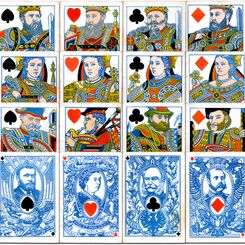
International Playing Cards
Designed by Reuben Townroe (1835-1911), the artist who designed the ornamented terra cotta work on t...
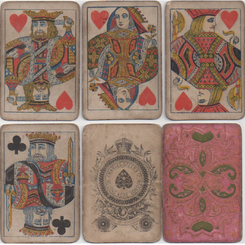
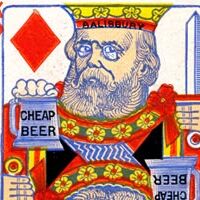
Deakin’s 1st edition
Deakin & Co., 45 Eastcheap, London EC published a political pack in 1886 with caricatures of politic...
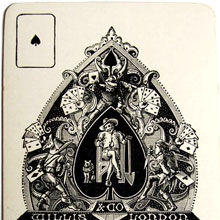
W. H. Willis & Co
Willis & Company was formed in 1869, having been preceded by Charles Steer at the same address (80 L...
Most Popular
Our top articles from the past 60 days


