


W. H. Willis & Co
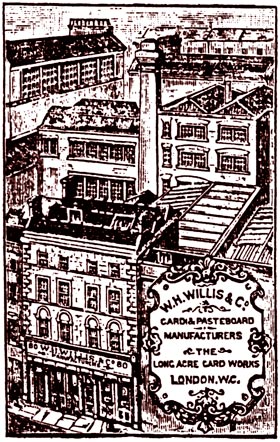
Willis & Company was formed in 1869, having been preceded by Charles Steer at the same address (80 Long Acre, London), who also manufactured playing cards during the 1850s and 60s.
W. H. Willis & Co
c.1869 - 1892
a brief history...
Willis & Company was formed in 1869, having been preceded by Charles Steer at the same address (80 Long Acre, London), who also manufactured playing cards during the 1850s and 60s. Sample books and price lists first appear in 1870 offering a wide range of cards of different qualities, prices, designs and style, including Improved Ivory cards, rules booklets and Self-Scoring Cribbage and Bézique Markers.
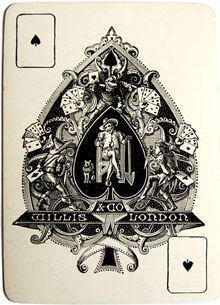
Willis playing cards were all of the double-ended courts variety, although early packs had one-way numeral cards. The court cards are in a decorative style. Willis & Co. also followed the trend in round corners and indices once these became preferred by card players. The designer/engraver Harrison Weir produced back designs for Willis & Co. The quaint Ace of Spades shows many similarities with the newly-designed Goodall Ace and may have been by the same artist (Cruikshank). There are no known Willis Jokers.
Standard Playing Cards
W. H. Willis & Co's range of standard playing cards included various qualities, such as: Court Moguls, Moguls, Oriental Moguls, Double Moguls, etc. at the top end, down to Harrys, Gold Harrys, Third Harrys, Highlanders, Best Highlanders at the bottom end. These quality designations, along with distinctive back design names, are the precursors to early brand names, such as "Jockey Club" or "Alpine Series".
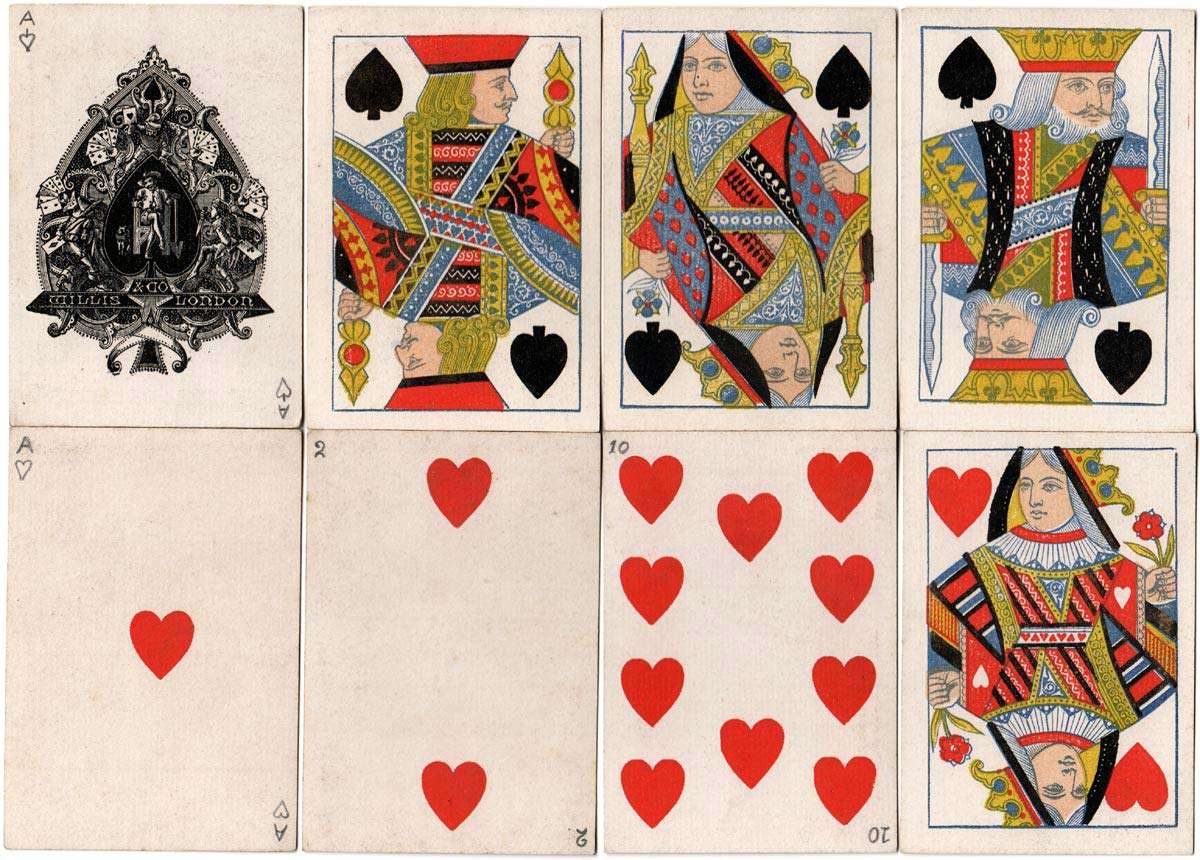
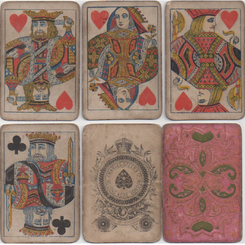
Above: cards by Willis & Co., c.1875, square corners, no indices. Small 'Eureka' indices have been neatly pencilled in, documentary evidence of the time when corner indices were still in their infancy. Although the court cards are double-ended, the numeral cards are still single-ended.
See: Quadruple Bézique sets→
Triplicates
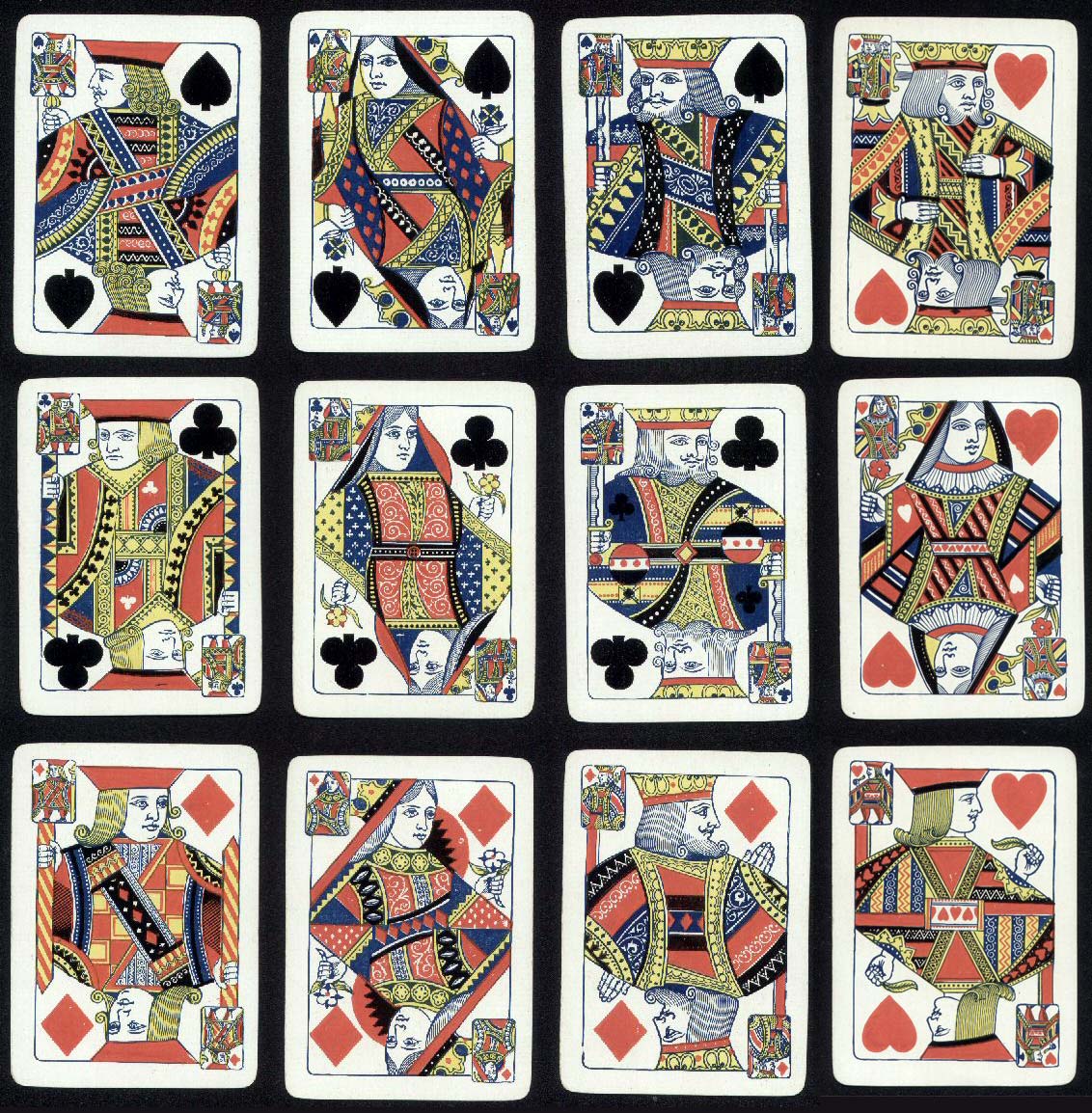
Above: following the lead of American manufacturers such as Dougherty and New York Consolidated Card Company, Willis & Co. introduced novel types of miniature corner indices to facilitate fanning or 'squeezing' the cards during the mid-1880s. The miniature 'triplicate' cards in the corners were apparently registered, and are ¾ or full-length figures. Interestingly the mini court indices are full length courts but Willis appeared never to manufacture full length court cards.
W. H. Willis & Co back designs
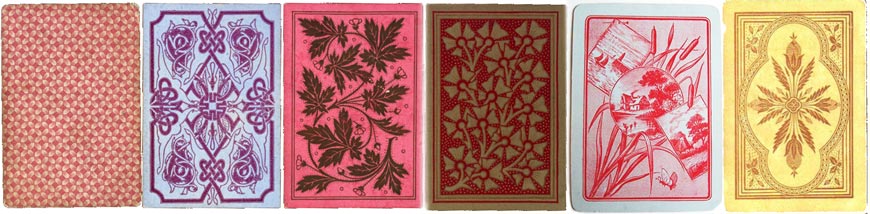
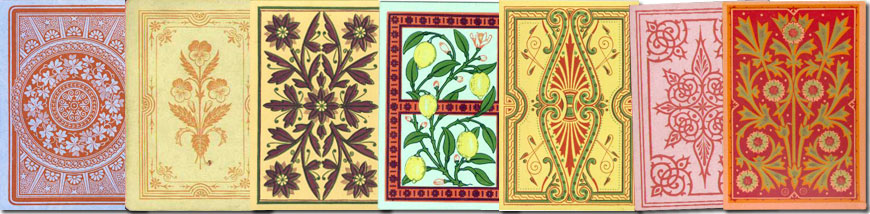
Above: back designs by Willis & Co. These are described in specimen books as "Calico pattern", "Ornamental", "Ornamental Gold", etc. During the 1870s W. H. Willis & Co also produced a series of packs titled "Jockey Club" having on their backs the best known horse owner's colours, and also the boating colours of Oxford and Cambridge. During the 1880s Willis' price lists included various floral and ornamental back designs, and an "Alpine" series with ornamental designs, Swiss views, round corners and highly enamelled faces and backs.
The business continued to expand during the 1870s and early 1880s and won prize medals at International Exhibitions. Then the playing card interests were wound down and sold off in 1887. Subsequent efforts to re-start the firm's playing card production appear to have been in vain, although Willis & Co continued to operate as cardboard makers until around 1893. Willis & Co printed the delightful Political Pack shown below in 1886.
Deakin’s Political Playing Cards
The wholesale stationers Deakin & Company, of 45 Eastcheap, London EC saw the opportunity to publish a political pack with caricatures of political figures relating to the Irish Home Rule movement which was a contentious issue of the day. The packs were printed in three editions by Willis and Co., and the first edition in 1886 sold 60,000 packs in three months. In subsequent editions details on some cards were modified.
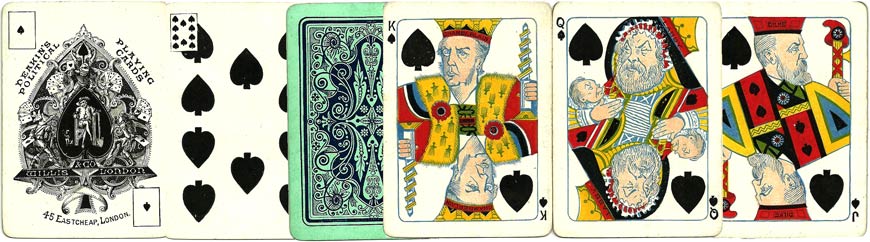
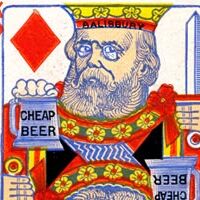
Above: first edition of Deakin's Political Playing Cards (1886) with the standard Willis & Co. Ace of Spades overprinted with the title of the pack and Deakin's address. The numeral cards Ace-10 are in Triplicate format, but the court cards have normal corner indices. The cards are named as follows: Jack of Hearts Hartington, King of Spades Parnell, Queen of Clubs Biggar, Jack of Clubs Healy, Queen of Diamonds Iddesleigh, Jack of Diamonds Churchill, King of Spades Chamberlain and the Jack of Spades Dilke. See more →
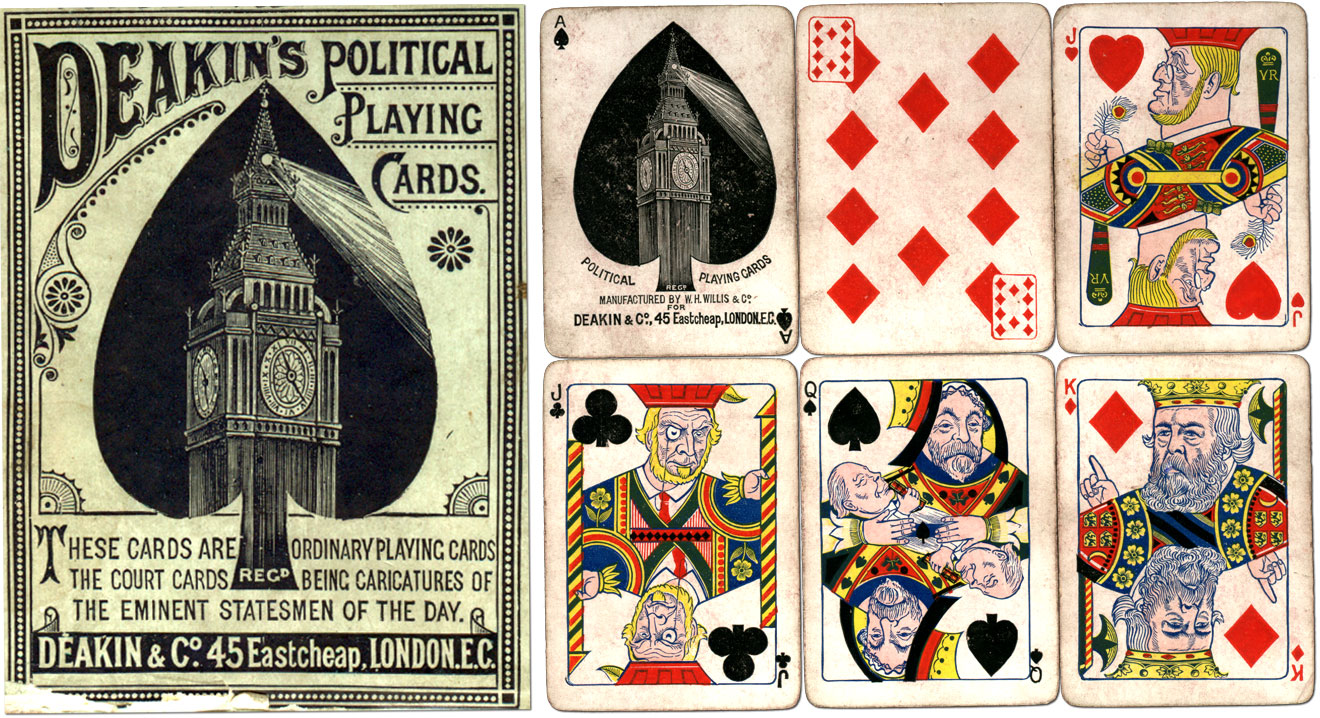
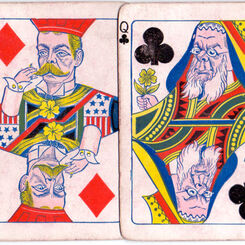
Above: Box and six cards from the 3rd edition (1888) of Deakin's Political Playing Cards, with caricatures of eminent statesmen of the day, which now has a special Ace of Spades featuring the same design as the box (note the "triplicate" indices).
REFERENCES
Goodall, Michael H., "Minor British Playing Card Makers of the Nineteenth Century Volume 1: W H Willis & Company," Woking, 1996.

By Simon Wintle
Spain • Member since February 01, 1996
I am the founder of The World of Playing Cards (est. 1996), a website dedicated to the history, artistry and cultural significance of playing cards and tarot. Over the years I have researched various areas of the subject, acquired and traded collections and contributed as a committee member of the IPCS and graphics editor of The Playing-Card journal. Having lived in Chile, England, Wales, and now Spain, these experiences have shaped my work and passion for playing cards. Amongst my achievements is producing a limited-edition replica of a 17th-century English pack using woodblocks and stencils—a labour of love. Today, the World of Playing Cards is a global collaborative project, with my son Adam serving as the technical driving force behind its development. His innovative efforts have helped shape the site into the thriving hub it is today. You are warmly invited to become a contributor and share your enthusiasm.

Activity for W. H. Willis & Co
Sign in to comment or save this article.

Related Articles
Mystery Objects
I have finally identified the purpose of this puzzling piece of card-playing kit.
Quadruple Bézique sets
Quadruple Bézique sets with self-scoring markers published by Willis & Co, London.
New interest in old games
Games once fashionable are now eclipsed by quicker gratifications.
T. Drayton & Son
Bezique and Whist boxed sets by T. Drayton & Son, London, c.1875.
The Evolution of Bezique boxed sets, 1869 to 1990
The first company to register Bezique materials with Stationers’ Hall was Josh Reynolds & Son in Sep...
Goodall 1879-1880 Sample Book
Complete contents of a sample book by Goodall & Sons
De La Rue Pocket Guides
The 19th Century saw the production, by all of the major companies, of pocket guides or “mini-books”...
Karl Gerich No. 25: “Great Mogul”
'Great Mogul' branded playing cards designed and produced by Karl Gerich.
Hall & Son
Hall & Son
Why do we Collect? My 20 Favourite Items
I suppose people collect for different reasons, rarity, quality, ingenuity of design, sentimental va...
60: Some less common Goodall packs, 1875-95
There are some interesting packs from Goodall in the last quarter of the 19th century.
I. Hardy facsimile
Facsimile edition of 19th century I. Hardy Exportation deck complete with reproduction tax wrapper, ...
Deakin’s 3rd edition
Deakin’s Political Playing Cards 3rd edition, c.1888.
International Playing Cards
Designed by Reuben Townroe (1835-1911), the artist who designed the ornamented terra cotta work on t...
Karl Gerich No.16: “Patience Indien”
Karl Gerich's “Patience Indien No.16”, published in 1991, is adapted from Grimaud's “Whist Indienne”...
Gibson, Hunt & Son
Gibson originally took over the business of Blanchard in 1769. Gibson & Hunt operated briefly and we...
Deakin’s 1st edition
Deakin & Co., 45 Eastcheap, London EC published a political pack in 1886 with caricatures of politic...
John Llewellyn, playing card manufacturer, London, 1778-1785
John Llewellyn, playing card manufacturer, London, 1778-1785
Reynolds c.1809-1885
Joseph Reynolds had been producing playing cards in the traditional method since c.1809.
Most Popular
Our top articles from the past 60 days


