


Circular Coon Cards
Circular playing cards in a round tin titled: Sutherland's Circular Coon Cards published by Hartley Bros Pty Ltd, Australia, late 19th century.
Sutherland’s Circular Coon Cards
These unusual circular playing cards, along with an early example of ‘The Joker’, depict persons of foreign heritage in an uncomplimentary manner : a racist caricature. Possibly made during a time of segregation, the set was presumably seen as humorous and socially acceptable in those days. The lettering is ornate and curvilinear, wrapping around the Joker and ace of spades. The imagery of watermelons and flamboyant dress provides documentary evidence of popular culture, social history, stereotypes, ethnicity and national identity from that time and also illustrates how attitudes have changed.

Above: Sutherland's Circular Coon Cards, c.1880. 53 circular cardboard playing cards, full deck and a joker, printed on one side in cream and navy or red with picture of African American man in stylized period costume. Contained in circular gold enamelled metal tin, with cover showing African American child eating watermelon within a spade motif. The lid of the tin reads "Circular Playing Cards / Sutherland Circular Coon Cards / As Black as the Ace of Spades / New York / Copyright / Sole Proprietors / Hartley Bros Pty ltd / 148 Swanston St. Melbourne". Images courtesy Linda Johnson.
Laughter and ridicule prevailed in the post-Civil War period and the first half of the twentieth century. These attitudes became embedded in the media artifacts of the time. In the early part of the twentieth century the desire to make insulting fun of black people was expressed by the so-called “coon card” craze.
See also: Master PW Circular Playing Cards • Pekka-Peli • Cir-q-lar Playing Cards • Hoechst Festal • Pharaoh Palmier Poker • El Negrito Pedro


Note from Roddy Somerville
I recently acquired an example of this pack in a tin but find that it varies slightly from the ones shown above. There is no reference to Australia on my tin, which leads me to think that it was more likely printed and published (primarily) in the USA.
I have seen dates for the pack varying from 1880 or 1885 to 1925!! 1925 is the date given in Hochman. Apart from the tin lid, the Ace of Spades in my pack is slightly different from the one you illustrate and also from the one in Hochman: mine has only 7 index markings round the edge instead of the more usual 8. - R.S

These antique playing cards come from a period when “coon songs” and minstrel imagery were mainstream entertainment. The circular cards and tin were unusual and a selling point as a clever example of late 19th-century packaging design. The very name “Coon Cards” was intended to be catchy, humorous, and marketable within a culture steeped in racial caricature.

By Simon Wintle
Spain • Member since February 01, 1996
I am the founder of The World of Playing Cards (est. 1996), a website dedicated to the history, artistry and cultural significance of playing cards and tarot. Over the years I have researched various areas of the subject, acquired and traded collections and contributed as a committee member of the IPCS and graphics editor of The Playing-Card journal. Having lived in Chile, England, Wales, and now Spain, these experiences have shaped my work and passion for playing cards. Amongst my achievements is producing a limited-edition replica of a 17th-century English pack using woodblocks and stencils—a labour of love. Today, the World of Playing Cards is a global collaborative project, with my son Adam serving as the technical driving force behind its development. His innovative efforts have helped shape the site into the thriving hub it is today. You are warmly invited to become a contributor and share your enthusiasm.

Activity for Circular Coon Cards
Sign in to comment or save this article.

Related Articles
Ubo cards
Traditional Ubo cards from the Philippines made from tree bark.

Motherpeace Round Tarot
An original and imaginative feminist tarot invoking matriarchal Goddess energy.
Le jeu des 7 Familles ’Utuafare
Colourful Happy Families game from Tahiti depicting costumes from different archipelagoes.
Race Card
‘Race Card’ playing cards published by the Concept Card Co., New Orleans, Louisiana, USA.
Drum playing cards
Drum playing cards depicting demographically diverse Africans of different ethnicities.
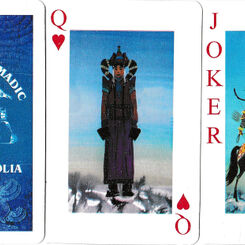
Traditional Nomadic Life of Mongolia
Playing cards depicting paintings of Traditional Nomadic Life of Mongolia.
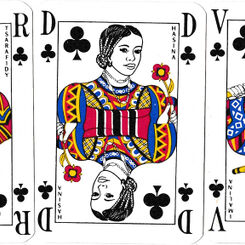
Tanisa cartes à jouer
“Tanisa cartes à jouer” published by Colormad, Madagascar.
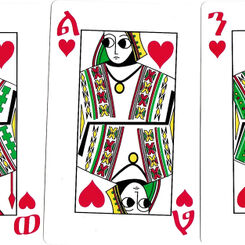
Habesha playing cards
Habesha playing cards published by “Ethiopian Reflection”
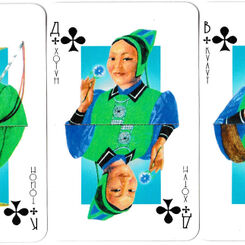
Hotel Lena
Hotel Lena playing cards published by Bichik in Yakutsk in 2001.
Happy Playing Cards
Cheerful, colourful designs on handmade paper from Nepal.
Ganjifa™
A colourful pack of round cards with Ganjifa designs by Asha Industries, Mumbai, India, 2002.
Tonalamatl
Baraja Tonalamatl Mexican Aztec playing cards based on the prehispanic Codex Borgia manuscript.
Naipes Cardón
Naipes Cardón designed by Mario Luis Rivero depicting traditional Argentine culture and identity, 20...
Native American Warriors
Native American Warriors from the Wild West Series published by SPCC, 2018.
Banana Leaf Cards
English Standard pack hand drawn & coloured on banana leaf, c.1820.
Iceland Mythological Playing Cards
Iceland Mythological Playing Cards designed by Sigurlinna Pétursson, 1958
Pelaco
‘Pelaco’ playing cards with Aboriginal characters by Sands & McDougall, Australia, c.1930.
Maori
Maori themed playing cards from New Zealand depicting Maori Kings, Queens and Chiefs
Fate Circular Deck
Circular Spanish-suited playing cards for FATE, 2007
Mongolian Playing Cards
Mongolian Playing Cards.
Most Popular
Our top articles from the past 60 days


