


Peter Flötner, c.1545
Seven cards from a satirical pack produced by Peter Flötner of Nuremberg, c.1545. The suit symbols are acorns, leaves, bells and hearts. The block-cutter and publisher was Franz Christoph Zell.
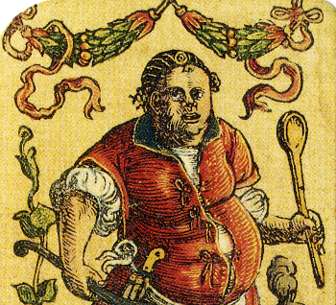
Satirical Playing Cards by Peter Flötner, Nuremberg, c.1545
Behind the superficial representation to which one's attention is initially drawn, there is a second one in which Flötner sets irony and parody against the past, against the classical and bourgeois way of life...
Although Nuremberg had no university, towards the end of the 15th century the city became a major centre of humanism in Germany, as well as a centre of trade and skilled craftsmanship. The influence of classical forms and humanism was also mirrored by anti-classical tendencies, so that these playing cards can be seen as a parody or burlesque. The vulgar everyday activities of common folk (e.g. toilet humour and irreverence) is juxtaposed to bourgeois pretentiousness. The art of printing made it possible for art, knowledge and information - including political or social comment - to be made accessible to the common people… in this case thanks to a good block maker.
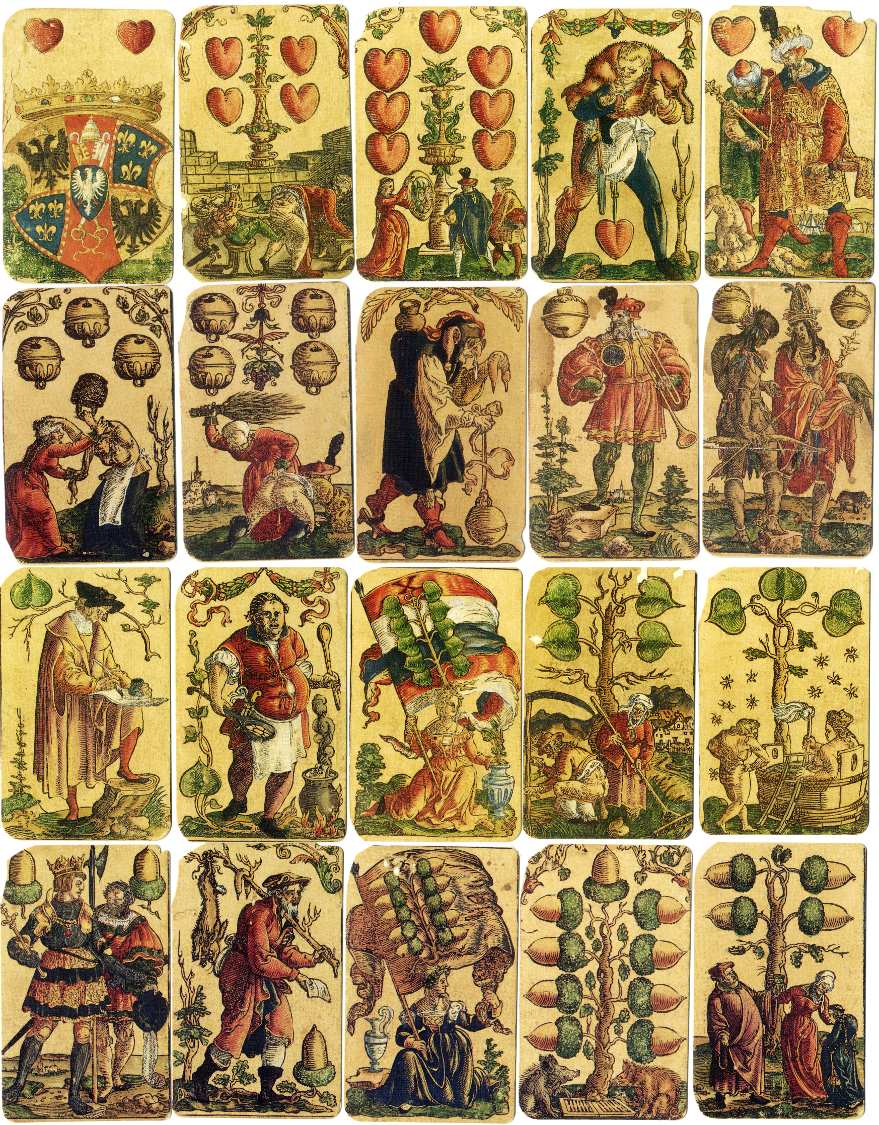
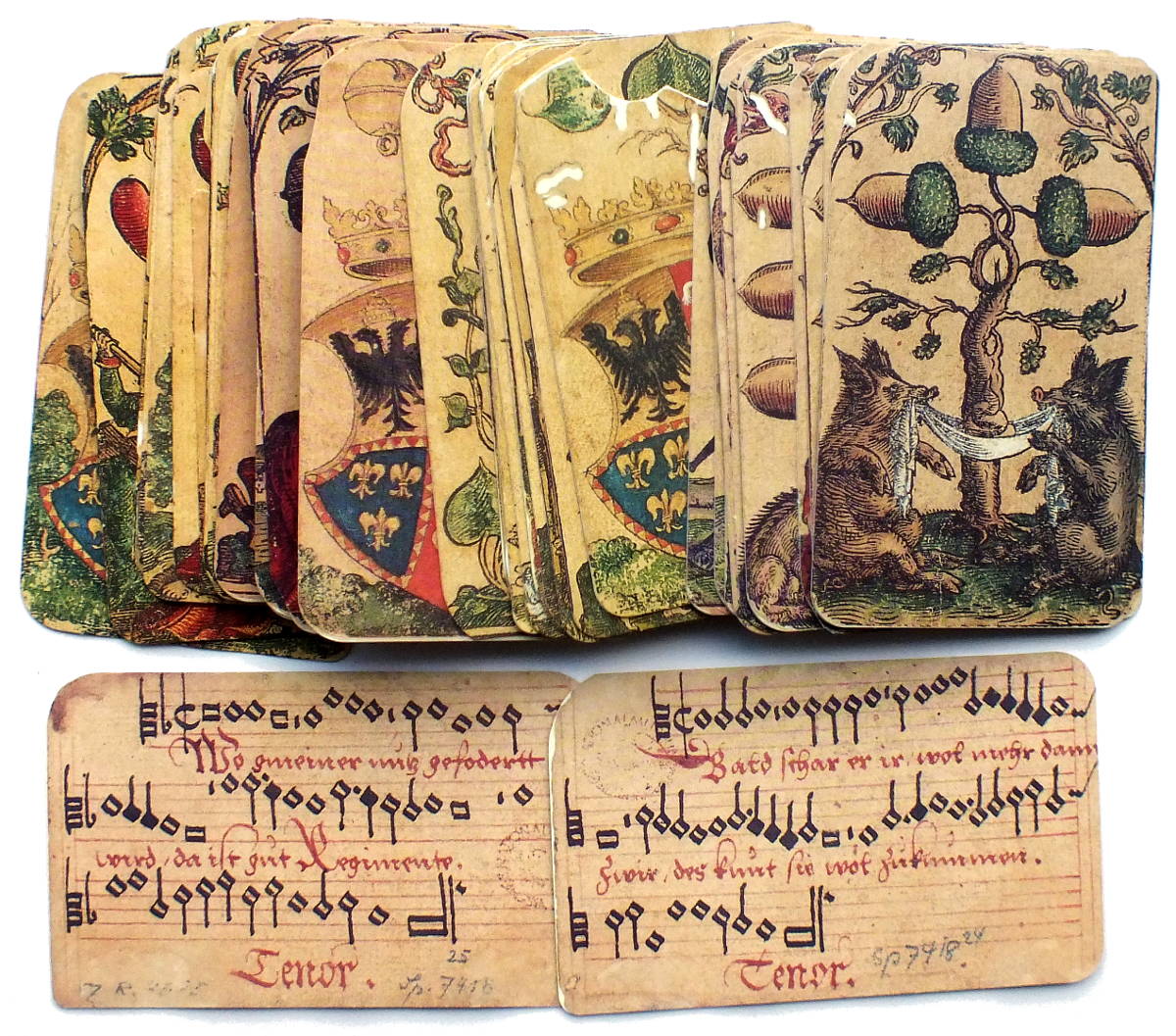
Above: cards from a satirical woodblock printed and water coloured pack designed by Peter Flöttner of Nuremberg, c.1545. The block-cutter and publisher was Franz Christoph Zell. Gold highlights have been added. The suit symbols are acorns, leaves, bells and hearts and the card values run from deuce, 3,4,5,6,7,8,9,10, Unter, Ober, Künig. The 10s are represented by banners. In the numeral cards the suit symbols have been moved to the upper half of the cards so that the bottom of each card is free for illustration, in what must be one of the most splendid woodblock packs from the first half of the sixteenth century. The backs of the cards contain the vocal scores for German songs. Cards from the facsimile edition published by Ferd Piatnik & Söhne, Vienna, 1993.
Peter Flötner (c.1490-1546) was a German designer, sculptor, and printmaker. He was an important figure in the introduction of Italianate Renaissance design to sculpture and the decorative arts in Germany. Read Wikipedia article →

By Simon Wintle
Spain • Member since February 01, 1996
I am the founder of The World of Playing Cards (est. 1996), a website dedicated to the history, artistry and cultural significance of playing cards and tarot. Over the years I have researched various areas of the subject, acquired and traded collections and contributed as a committee member of the IPCS and graphics editor of The Playing-Card journal. Having lived in Chile, England, Wales, and now Spain, these experiences have shaped my work and passion for playing cards. Amongst my achievements is producing a limited-edition replica of a 17th-century English pack using woodblocks and stencils—a labour of love. Today, the World of Playing Cards is a global collaborative project, with my son Adam serving as the technical driving force behind its development. His innovative efforts have helped shape the site into the thriving hub it is today. You are warmly invited to become a contributor and share your enthusiasm.

Activity for Peter Flötner, c.1545
Sign in to comment or save this article.

Related Articles
History of Tarot and Playing Cards: Timeline & Origins
An alternative history of tarot and playing cards – from Mamluk Egypt to the invention of tarot in R...
Sevilla 1647 reproduction
Facsimile of Spanish-suited pack produced in Sevilla, Spain, 1647.
Early German playing cards
Some early examples of popular German playing cards from the XV and XVI centuries.
History of Playing Cards explained in 5 Minutes
Video by Art of Impossible. In this video you will get a short overview of the most important histor...
“Deck with French suits”
A facsimile of an early 19th century French-suited deck from the collection of F.X. Schmid.
Tell Wilmoś
Facsimile of ‘Wilhelm Tell’ Hungarian deck by Salamon Antal, Keczkemét, 1860.
Tyrolean Playing Cards
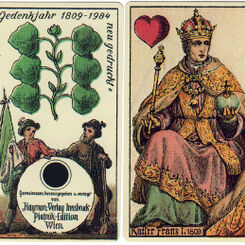
Facsimile of patriotic 1878 Tyrolean playing cards published by Piatnik in 1992.
Notgeld - Emergen¢y Money
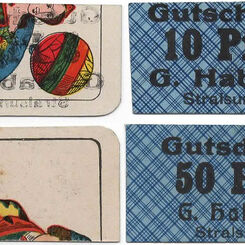
Notgeld - Emergency Money - was in rare cases issued on playing cards.
Johannes Müller c.1840
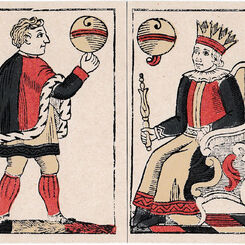
Facsimile edition of Swiss suited deck first published by Johannes Müller in c.1840.
Delightful Cards, c.1723
Delightful Cards, containing variety of entertainment for young Ladies and Gentlemen c.1723.
Joseph Losch
French-suited pack with full-length courts by Joseph Losch, c.1800.
Hans Sebald Beham
Playing cards designed by Hans Sebald Beham (1500–1550).
Austrian Cartomancy Cards
During the 19th century a system of fortune telling arose in Europe using unnumbered, pictorial card...
Bohemian Pattern
The Bohemian Pattern, sometimes called the Prager Pattern, has roots in the 16th century.
Suicide King
The King of Hearts, holding a sword behind his head, is sometimes nicknamed the “Suicide King”. He c...
Löschenkohl’s Musical Playing Cards
Johann Hieronymus Löschenkohl (1753-1807) produced a copper engraved deck of playing cards titled “D...
Soldaten Tarock
Piatnik was known for their magnificent quality of chromo-lithographic printing, and this facsimile,...
Mamluk Playing Cards
Nã'ib, the game of lieutenants... these cards are amongst the earliest Arabic playing cards ext...
The History of Playing Cards
Playing cards appear in European records in the late 14th century, but their earlier history lies fu...
Hofamterspiel, c.1460
Hofamterspiel, c.1460
Most Popular
Our top articles from the past 60 days


Stephen Scharber
07 March 2026, 04:17SavedSaved this article to Stephen Scharber's Collection