


Notgeld - Emergen¢y Money
Notgeld - Emergency Money - was in rare cases issued on playing cards.
The secondary use of playing cards turns them into a valuable source of social documentation. Many examples of repurposed playing cards are known from as far back as the 16th century. In rare instances emergency money (notgeld) was issued on playing cards. During and after the First World War, money, especially small change, was in short supply. In Austria the towns of Reichental and Steyregg issued what we know as spielkarten notgeld and in Germany spielkarten notgeld was issued between 1914 & 1923. See some of them in the scans below.
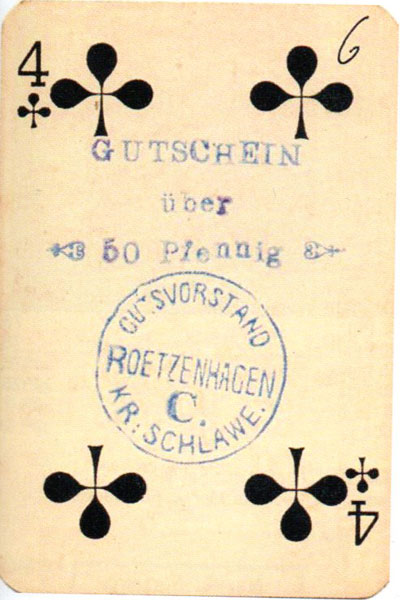
Germany
in Germany, spielkarten notgeld issued between 1914 & 1923 include the towns of Bretleben, Leipzig, Lopischewo, Marienwerder, Roetzenhagen and Stralsund.
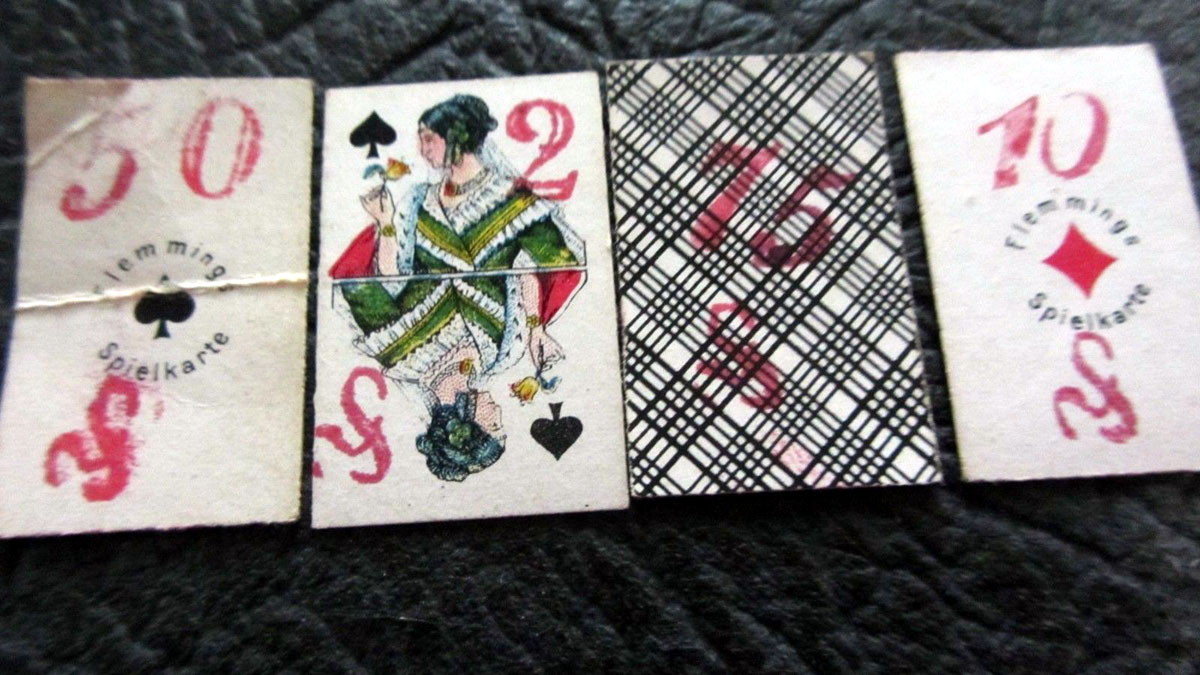
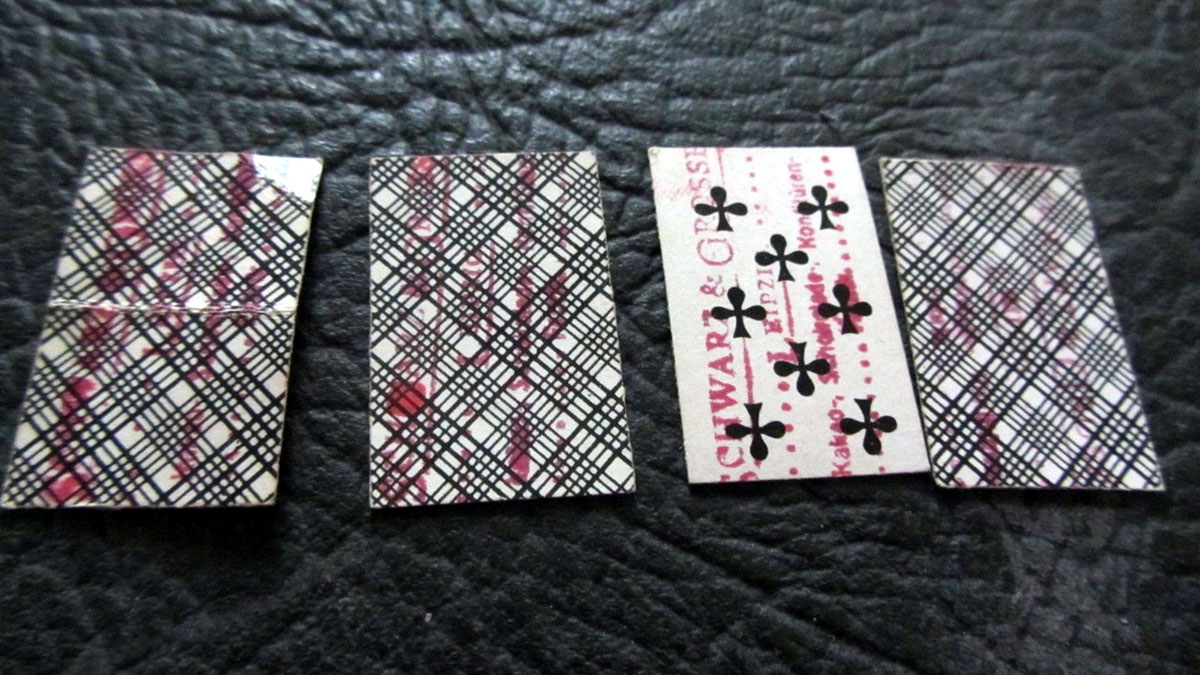
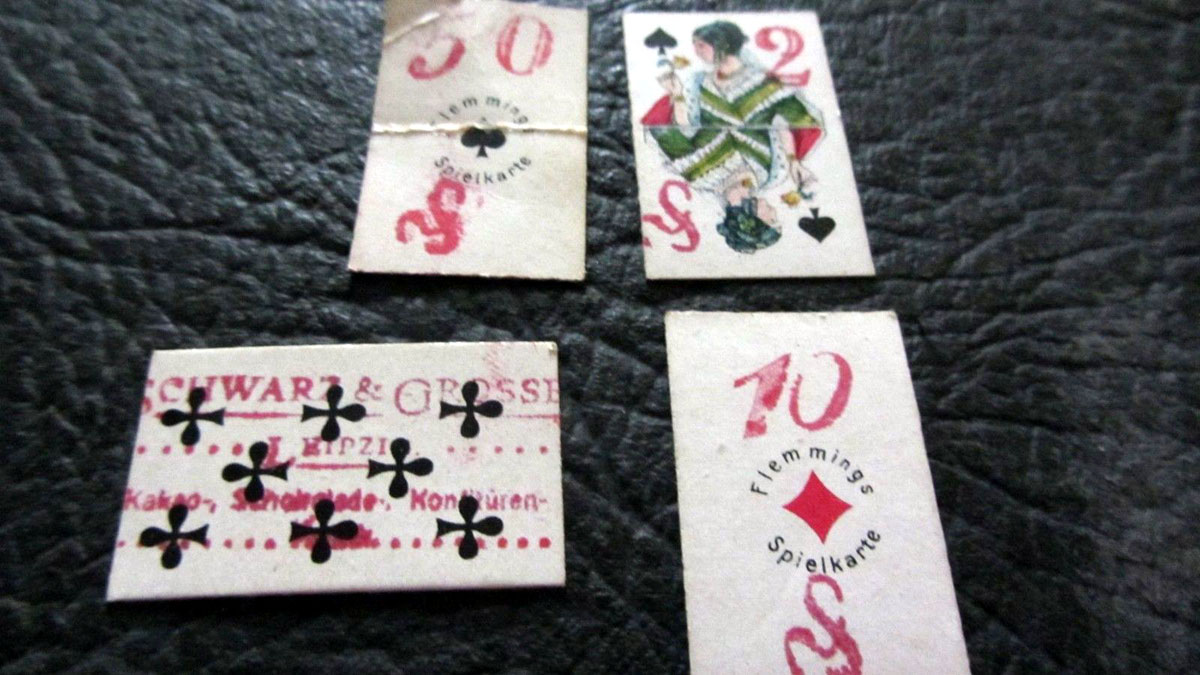
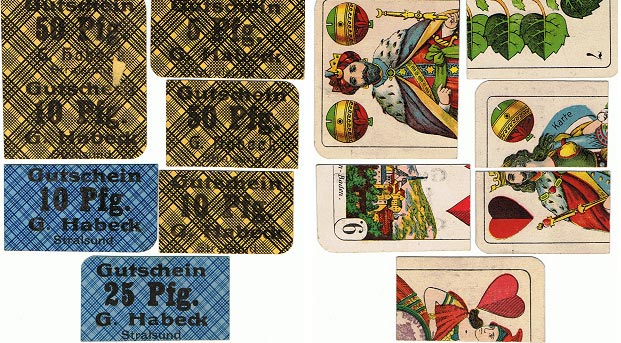
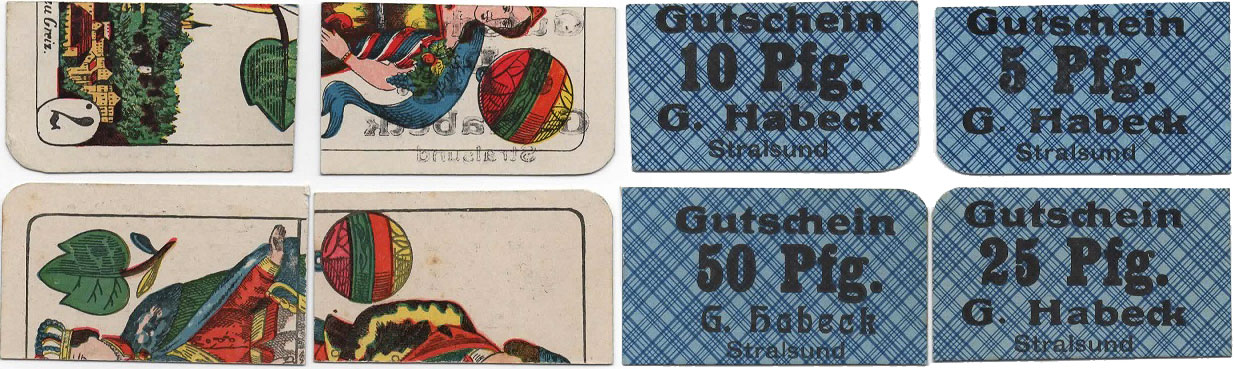
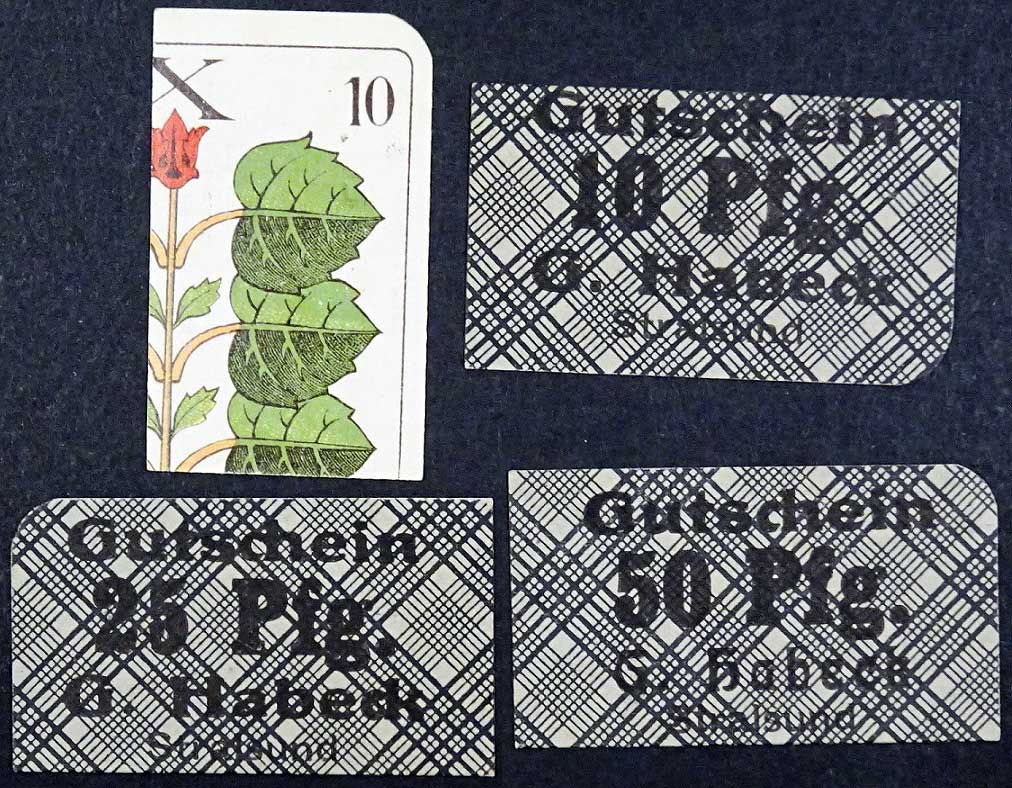
Above: these scarce serienscheine pieces were issued by Gustav Habeck from Stralsund, printed on the backs of playing cards, c.1921. They must have set up the printing plate, printed the money onto the playing cards and then cut them into seperate pieces. The pieces are different sizes, so the cutting was probably performed manually, possibly using a guillotine.
Austria
In Austria the towns of Steyregg and Reichental issued spielkarten notgeld made of playing cards in around 1920-1921. Others may also exist. Steyregg pieces had face values of either 10, 20, 30, 40, 50, 60, 80 or 90 heller. They were issued in several different colours with attractive woodcut illustrations.
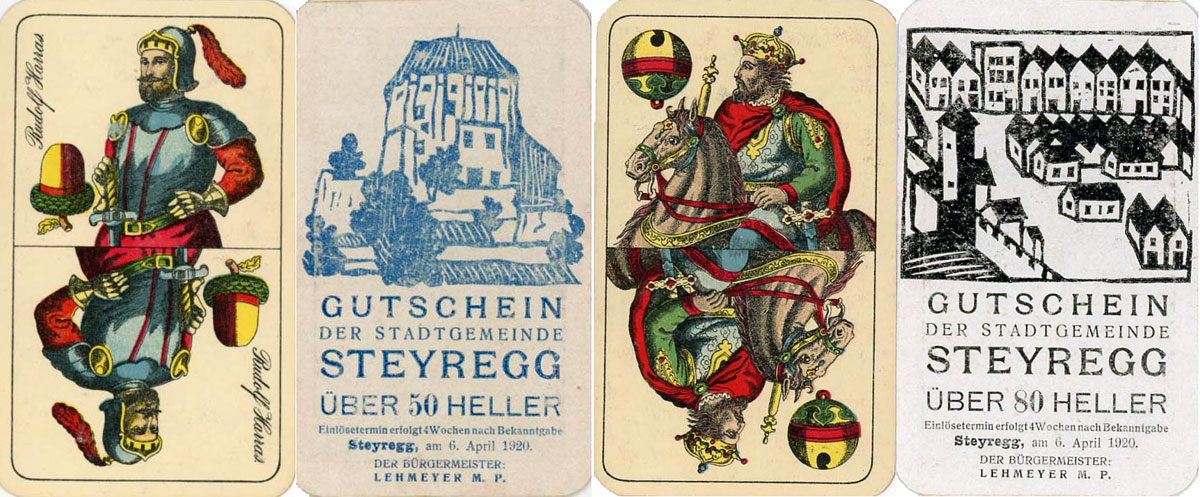
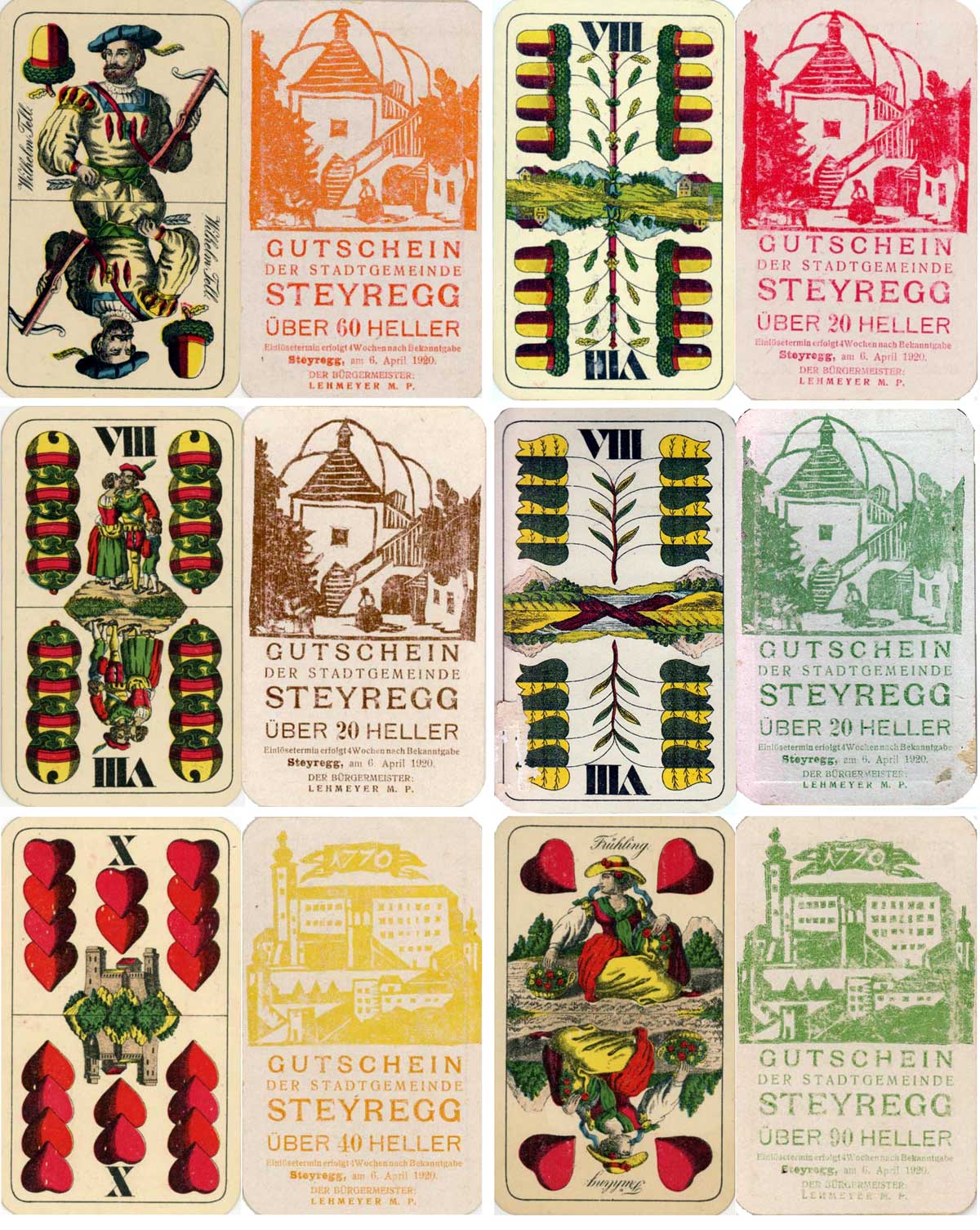
Above: spielkarten notgeld from Steyregg, c.1920-21.
The notgeld playing card pieces of Reichental were a little different. They had a stampmark on them and an 'auflage' (issue number). Face values were for either 10, 20, 30 or 50 heller. All card suits were represented, with hearts being stamped with the 50 heller value, diamonds with 30, spades with 20 and clubs with the 10 heller value.
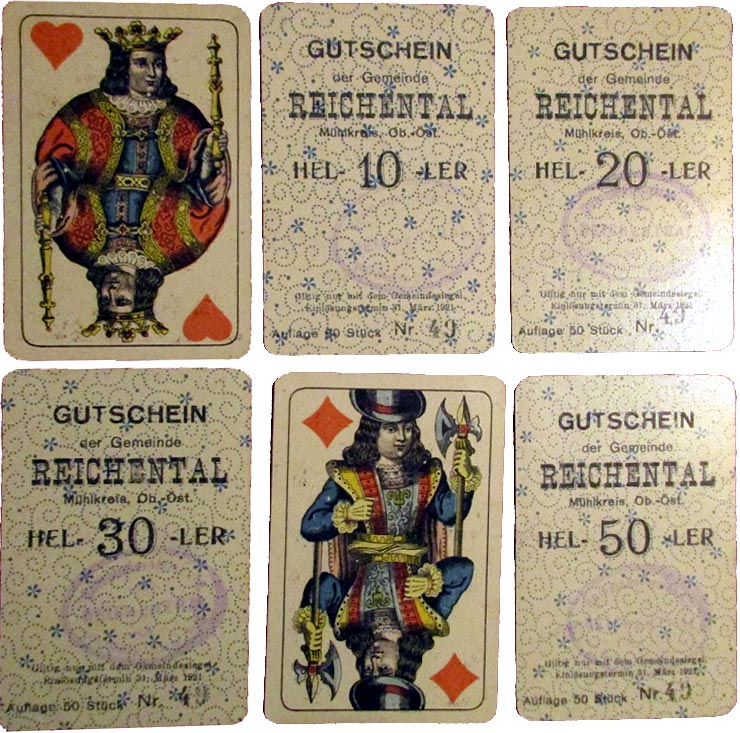
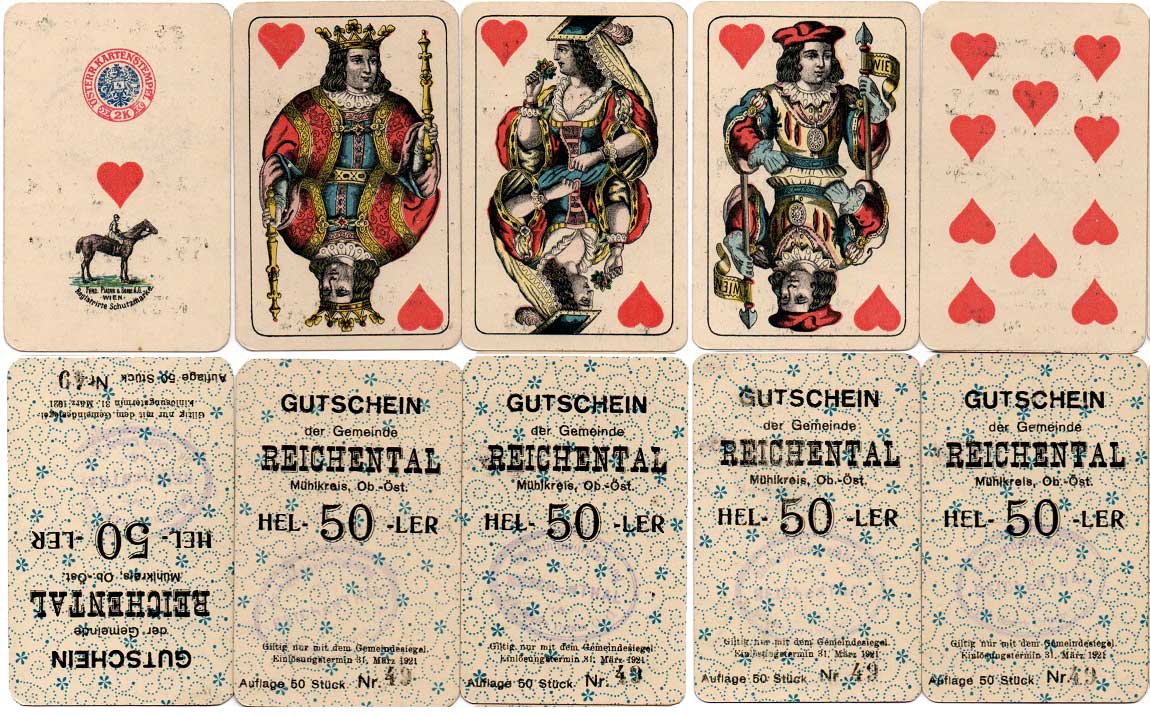
Above: Austrian spielkarten notgeld dating from 1920/21 issued in Reichental, printed onto cards made by Ferd Piatnik & Son. Instead of the face values being in German marks or pfennigs, the Austrian pieces have face values in heller or krone. The Reichental spielkarten pieces had an issue (auflage) of just 50 and these pieces come from set no.49.
Poland
The notgeld issues of 1914 tend to be plainer looking than those issued after WWI. In 1914 there was a real 'necessity' for small change money. The later issues also met a need in the collecting market!
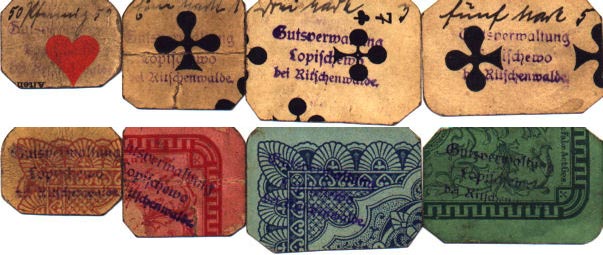
Above: ‘Gutsverwaltung’ notes were issued in Lopischewo (Polish - Lopiszewo) with no written date, although the date is known to be 8th August 1914. These ‘spielkarten’ pieces (made from playing cards) are extremely rare due to the very small numbers that were actually issued. They made 162 (81 marks worth) of the 50pf piece, 327 of the 1m piece, 164 (492 marks worth) of the 3m piece and only 99 (495 marks worth) of the 5m piece! The 50pf pieces are brown, the 1m pieces red, the 3m pieces blue and the 5m pieces green. They were all printed on either 'Hearts', 'Diamonds', 'Spades' or 'Clubs' ('Herz', 'Kreuz', 'Pik', 'Karo') - so there are 16 different pieces in total to collect. It is not known how many exist today.
CREDITS & REFERENCES
Thanks to Tony Gibbs-Murray for providing the inspiration for this page.
For further info about these pieces please visit notgeld.com►
General Secretariat of the National Bank of Belgium • Playing with money►

By Simon Wintle
Spain • Member since February 01, 1996
I am the founder of The World of Playing Cards (est. 1996), a website dedicated to the history, artistry and cultural significance of playing cards and tarot. Over the years I have researched various areas of the subject, acquired and traded collections and contributed as a committee member of the IPCS and graphics editor of The Playing-Card journal. Having lived in Chile, England, Wales, and now Spain, these experiences have shaped my work and passion for playing cards. Amongst my achievements is producing a limited-edition replica of a 17th-century English pack using woodblocks and stencils—a labour of love. Today, the World of Playing Cards is a global collaborative project, with my son Adam serving as the technical driving force behind its development. His innovative efforts have helped shape the site into the thriving hub it is today. You are warmly invited to become a contributor and share your enthusiasm.

Activity for Notgeld - Emergen¢y Money
Sign in to comment or save this article.

Related Articles
Luxury No. 2167
A Piatnik classic that lives up to its title.
Art pack I
Art pack featuring Old Masters, including Bruegel, Vermeer, Titian, Raphael, Caravaggio, Canaletto, ...
Rika playing cards
Playing cards depicting famous Austrian skiers of the 1970s.
Piatnik No.97
Non-standard French-suited cards published by Ferd Piatnik & Sõhne, Vienna, c.1940s.
Vienna (ex-Lyon) pattern
‘Vienna pattern’ derived from archaic Lyon pattern by Ferd Piatnik & Söhne A.G., c.1926-1934.
48: Ferdinand Piatnik & Sons
Ferd. Piatnik produced a very large range of cards with many different standard and non-standard pat...
Popular No.257
Piatnik’s “Popular Playing Cards” No.257
Salzburger Pattern
Salzburger pattern by Ferd. Piatnik & Söhne, Vienna
Die Neue ÖVP
Promotional deck for the Austrian People’s Party (ÖVP) printed by Piatnik, 1996.
Vienna Melange
“Vienna Melange” Playing Cards by Piatnik with a historical feel representing the four races that ma...
Austrian Cartomancy Cards
During the 19th century a system of fortune telling arose in Europe using unnumbered, pictorial card...
Suicide King
The King of Hearts, holding a sword behind his head, is sometimes nicknamed the “Suicide King”. He c...
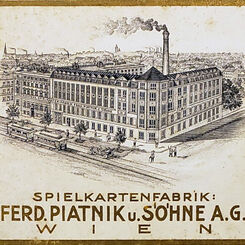
Ferd. Piatnik & Söhne
Ferdinand Piatnik was born in Ofen on October 14, 1819.
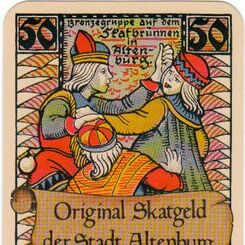
Original Skatgeld der Stadt Altenburg
“Original Skatgeld der Stadt Altenburg” featuring the emergency money of 1921 designed by Otto Pech ...
Rhineland Pattern
This pack was probably the culmination of a mixture of designs from 19th century Germany which emerg...
Secondary Uses of Playing Cards
The unprinted backs of playing cards have led people to use them for secondary purposes such as memo...
Mamluk Playing Cards
Nã'ib, the game of lieutenants... these cards are amongst the earliest Arabic playing cards ext...
Peter Flötner, c.1545
Seven cards from a satirical pack produced by Peter Flötner of Nuremberg, c.1545. The suit symbols a...
The History of Playing Cards
Playing cards appear in European records in the late 14th century, but their earlier history lies fu...
Hofamterspiel, c.1460
Hofamterspiel, c.1460
Most Popular
Our top articles from the past 60 days


